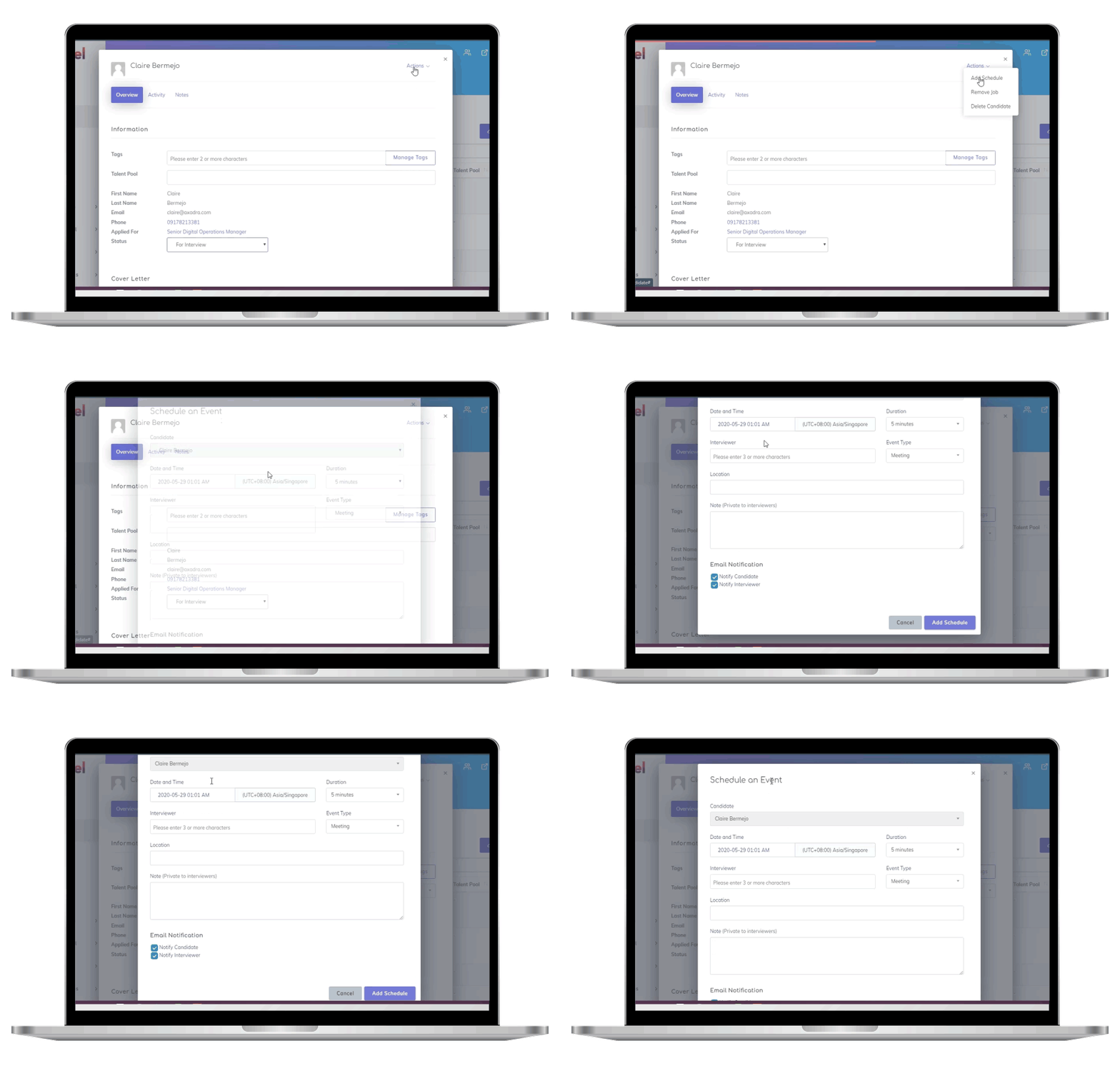

Recruitment analytics is transforming hiring by using data to make smarter, faster decisions. Here’s why it matters:
- Better Hiring Decisions: Companies using analytics report doubling hiring efficiency and cutting costs per hire by threefold.
- Improved Metrics: Focus on key indicators like retention rates, time-to-productivity, and manager satisfaction to measure long-term employee value.
- Predictive Power: Analytics helps identify top candidates by analyzing historical data and forecasting success.
- Real-Time Adjustments: Dashboards highlight bottlenecks, ensuring smoother and faster hiring processes.
Key Recruitment Analytics Statistics and Impact on Quality of Hire
What Quality of Hire Means and How to Measure It
Defining Quality of Hire
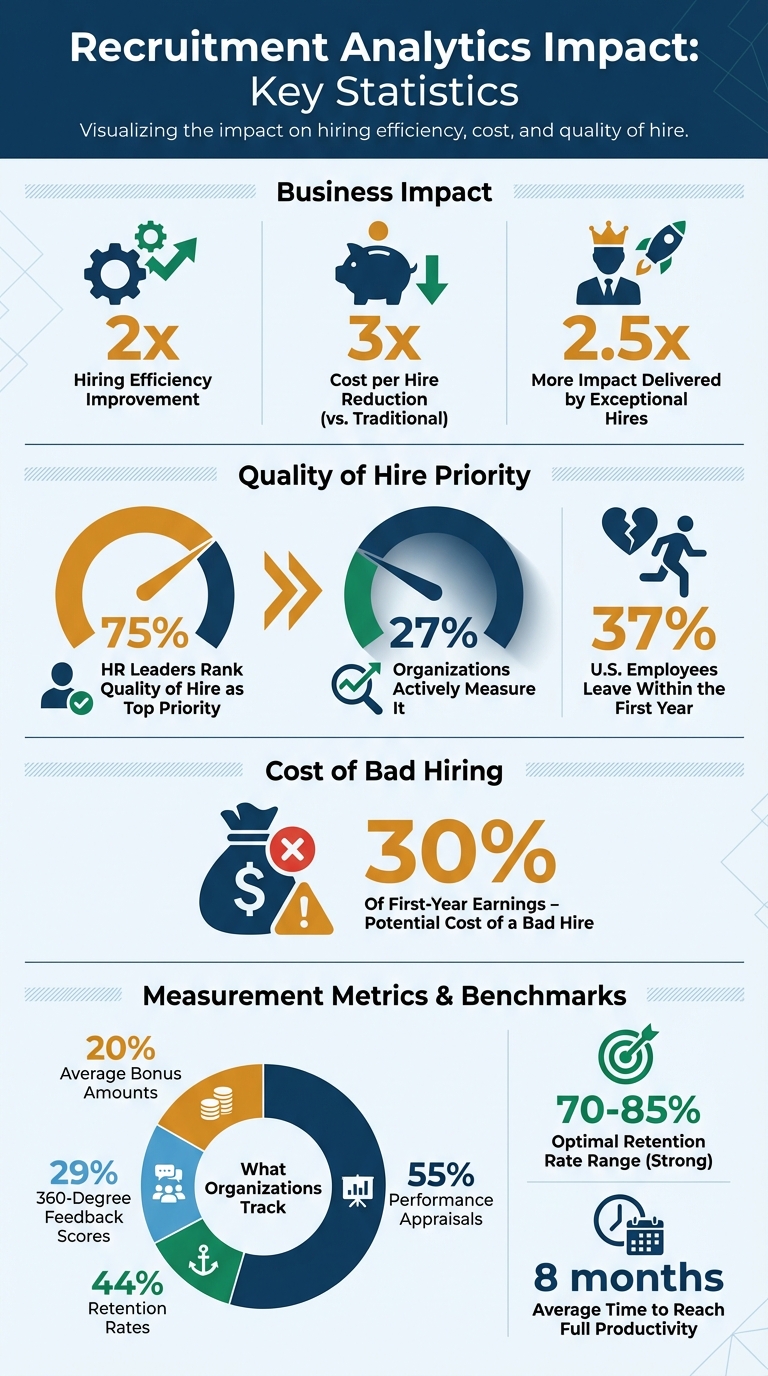
Quality of hire gauges the long-term value a new employee brings to your organization, focusing on their impact rather than just the speed or cost of hiring. A quality hire not only performs well but also stays with the company, aligns with its culture, and contributes to achieving business goals. Despite its importance – 75% of HR leaders rank it as their top priority – only 27% of organizations actively measure it.
"Quality of Hire isn’t just another HR metric – it’s the linchpin for aligning talent strategies with business success." – Kyle Lagunas, Head of Strategy and Principal Analyst, Aptitude Research
The stakes are high. Exceptional hires can deliver up to 2.5× more impact, while a bad hire might cost up to 30% of their first-year earnings. With 37% of U.S. employees leaving their jobs within the first year, tracking quality of hire has become essential.
Metrics That Measure Quality of Hire
Measuring quality of hire often involves combining multiple performance indicators into a composite score. Instead of relying on a single metric, organizations that see success in this area use a mix of data points. A common method weights retention at 12 months (40%), time-to-productivity (30%), and manager ratings at 90 days (30%).
Performance appraisals are the most frequently tracked metric, used by 55% of organizations that measure quality of hire. These standardized reviews, often conducted around the 90-day mark, provide clear data on whether new hires are meeting role-specific goals. Retention rates, tracked by 44% of organizations, measure whether employees stay beyond the critical 6- to 12-month period. A retention rate between 70-85% is typically seen as strong.
Time-to-productivity measures how quickly new employees become fully effective. On average, it takes 8 months for someone to reach full productivity, though this timeline varies by role. For example, a salesperson might be evaluated on the time it takes to close their first deal, while a developer might be assessed based on when they independently deliver their first feature.
Hiring manager satisfaction provides another layer of insight through structured feedback surveys conducted at 30, 60, and 90 days. These surveys capture qualitative data on cultural fit and team integration – factors that numbers alone can’t fully capture. Some organizations also include 360-degree feedback scores (29%) and average bonus amounts (20%) as additional indicators.
Consistency is key. Standardizing evaluation methods ensures accurate comparisons over time. To close the loop, connect post-hire performance data back to the original hiring process. Which sourcing channels, interview scores, or assessment results were most predictive of success? This feedback enables more precise, data-driven recruitment decisions.
When used effectively, these metrics can help refine hiring strategies and improve overall outcomes for your organization.
sbb-itb-e5b9d13
How to measure and improve quality of hire
How Recruitment Analytics Improves Hiring Decisions
Understanding how to measure the quality of a hire is only the beginning. The real game-changer lies in using recruitment analytics to move from guesswork to informed, data-driven decisions. Analytics transforms hiring into a structured process, helping organizations pinpoint effective strategies and identify top candidates.
"Moving from intuition to evidence-based decision-making removes guesswork and creates a culture of continuous improvement." – Recruitics Logic
Organizations that adopt data-driven recruitment strategies report hiring efficiency doubling and costs per hire dropping by threefold compared to traditional methods. This is achieved through three main capabilities: analyzing historical data, predicting candidate success, and tracking metrics in real-time.
Analyzing Historical Data to Find Patterns
Historical hiring data is a treasure trove of insights. It connects candidate traits – like resume details, assessment scores, and interview feedback – with long-term outcomes such as retention and performance ratings over a year.
One major advantage is sourcing optimization. By analyzing past data, you can identify which recruitment channels – job boards, referrals, or social media – consistently deliver high-quality hires. Instead of spreading your budget across all platforms, you can focus on the ones with the best return on investment.
Analytics also uncovers bottlenecks in your hiring process. For example, tracking "time-in-stage" data can reveal where candidates drop off, such as delays in scheduling interviews or slow feedback from hiring managers. Fixing these issues ensures you keep qualified candidates engaged.
| Metric Type | Data Points Collected | Actionable Insight |
|---|---|---|
| Historical | Source of hire, past performance, tenure | Highlights effective recruitment channels and success profiles. |
| Predictive | Assessment scores, keywords, stage speed | Forecasts candidate fit and likelihood of offer acceptance. |
| Real-Time | Pipeline volume, time-in-stage, response times | Identifies bottlenecks and enables immediate adjustments. |
To make the most of historical data, ensure consistent data collection across your organization. Use combined retention and performance metrics to create a composite score for quick evaluations.
Using Predictive Analytics for Candidate Screening
Building on historical insights, predictive analytics takes things a step further by forecasting which candidates are likely to succeed. This method uses candidate data – like skills, experience, and assessment results – to generate a "candidate fit score" that guides recruiters toward high-potential applicants.
"Predictive analytics for recruitment uses historical and real-time talent data to forecast hiring outcomes – such as candidate fit, time-to-fill, pipeline coverage, and retention risk – so teams prioritize the right candidates and actions." – Ameya Deshmukh, Director of Recruiting
For example, if successful employees in your company often hold specific certifications or have prior experience in a certain field, predictive models will flag candidates with similar profiles. Many organizations use this approach to tier candidates into A/B/C categories, focusing most of their efforts on the top tier, which holds the highest potential for success.
Predictive analytics also helps identify retention risks early. By analyzing patterns from employees who left within their first year, the system can flag candidates with similar traits – like frequent job changes – so recruiters can address these concerns during interviews.
To start, focus on one role or team to test the effectiveness of predictive screening. Provide hiring managers with clear explanations, like "85% skill match based on required certifications", to build trust in the system. Standardized rubrics and job-related criteria also help reduce unconscious bias in the early stages of screening.
Monitoring Metrics with Real-Time Dashboards
Real-time dashboards add a layer of immediacy to your recruitment strategy, offering instant visibility into your hiring pipeline. These tools highlight bottlenecks as they occur. For instance, if a high-potential candidate has been waiting too long for an interview, the system can alert the recruiter to act before the candidate loses interest.
Another key feature is pipeline coverage monitoring. Dashboards compare your current candidate volume at each stage with historical conversion rates. If you’re falling short – say, you need 40 phone screens to yield 10 final interviews but only have 25 scheduled – you can launch targeted sourcing efforts to fill the gap.
Platforms like Skillfuel streamline this process with centralized dashboards that sync with calendars and use Kanban workflows to track candidate progress. These tools ensure no candidate gets overlooked and help maintain hiring momentum.
To get the most out of real-time dashboards, set automated reminders for critical actions, like scheduling interviews for top-tier candidates within 48 hours. Keep an eye on candidate engagement – signs like missed emails or declined interview slots can indicate disengagement. Accurate data entry is also crucial to maintaining the reliability of your metrics.
Improving Recruitment Processes with Data
Enhancing recruitment isn’t just about making better hiring decisions; it’s about refining every step of the process. Once you grasp how analytics can transform hiring, the next step is using that data to improve how you find, evaluate, and engage with candidates. The objective? Spend less time on ineffective methods and double down on what works best.
Finding Better Sourcing Channels
Data can pinpoint which sourcing channels – job boards, social media, or employee referrals – consistently bring in candidates who perform well and stick around longer. By tracking the source of hire alongside metrics like retention and performance, you can identify the platforms that deliver top talent.
For instance, you might find that employee referrals lead to hires with better retention rates compared to candidates from job boards. A great example of data-driven sourcing is Chipotle‘s AI assistant, launched in February 2026, which helped streamline the hiring process for 20,000 seasonal workers. By leveraging analytics, they cut the average time to hire from 12 days to just 4 days.
Tools like Skillfuel simplify this process by centralizing data on social media recruitment and referral tracking. With all insights in one place, teams can quickly identify underperforming campaigns and shift focus to channels that consistently deliver high-quality candidates. This kind of optimization ensures your resources are directed where they make the biggest impact.
Once sourcing channels are optimized, the next step is improving how candidates are assessed.
Refining Screening Methods
Analytics can also transform how candidates are evaluated, helping you focus on traits that align with strong job performance. By analyzing historical data, you can refine your screening criteria to prioritize what truly matters.
Start by standardizing your evaluation process. Using structured interview rubrics, unified rating systems, and consistent assessments across all candidates ensures clean, comparable data. For example, you might notice that candidates who complete work-sample tests perform better in early reviews than those evaluated through unstructured interviews.
A candidate fit score – combining factors like skills, relevant experience, and assessment results into a 0–100 scale – can help recruiters quickly identify high-potential applicants. This allows your team to focus their efforts on candidates most likely to succeed, rather than manually sifting through every resume.
To build confidence in these systems, pair scores with clear explanations, such as "80% match on required skills." This helps hiring managers understand the reasoning behind recommendations. Regularly auditing screening data can also ensure fairness and reduce the risk of bias creeping into the process.
With a refined evaluation process in place, automation can take your recruitment workflow to the next level.
Using Automation to Improve Workflows
Recruiters often lose valuable time on repetitive tasks like resume parsing, interview scheduling, and follow-up emails. Automation can handle these tasks, freeing up your team to focus on engaging with top candidates.
Organizations that adopt data-driven recruitment strategies often see their hiring efficiency double and their cost per hire drop significantly. Much of this improvement comes from automating low-value activities. For example, automated scheduling eliminates the back-and-forth of setting up interviews, while resume parsing tools instantly match candidate skills to job requirements.
Automation also keeps the process moving. Automated reminders can nudge hiring managers to provide feedback within 48 hours, reducing the chances of losing strong candidates to competitors. Real-time analytics can even flag issues like pipeline shortages, prompting immediate action to fill gaps.
Skillfuel supports these efforts with features like automated candidate communication, real-time calendar syncing, and Kanban-style workflow management. By integrating these tools, you can minimize manual coordination and ensure no candidate slips through the cracks. The result? A smoother hiring experience for everyone involved and measurable improvements in hiring quality.
Monitoring and Adjusting for Long-Term Results
Improving the quality of hire isn’t a one-and-done task – it’s an ongoing process. The recruitment world is always evolving, which means strategies that work today might not deliver the same results tomorrow. Companies that treat analytics as a continuous cycle are the ones that see the most sustained success in hiring.
"Quality of hire needs to be the North Star metric for your recruiting team. When your quality of hire numbers are strong, you can expect other metrics to improve as well." – Mark Ko, Crosschq
The key here is creating systems that gather feedback at multiple stages and using that data to make informed adjustments. Take Amazon, for instance. In early 2026, they used advanced analytics to monitor both hiring speed and quality. By keeping an eye on these metrics over time, they fine-tuned their hiring criteria and stayed ahead of their pipeline needs. This kind of continuous monitoring connects short-term hiring decisions with long-term recruitment success.
Creating Feedback Systems
Building effective feedback systems is an essential step in refining your hiring process. Gathering input from different sources – like hiring managers and new hires – can highlight challenges, whether they’re related to ramp-up time or onboarding.
Candidate experience is another critical area to monitor. Tools like Net Promoter Score (NPS) surveys can provide insights into process pain points. For example, if candidates mention slow response times, that’s a red flag – especially since top talent often stays on the market for only about 10 days.
Another useful tactic is implementing standardized reason codes in your applicant tracking system. This ensures recruiters document why candidates are advanced or rejected, making it easier to spot trends and adjust for the future.
Responding to Changing Workforce Requirements
As business needs shift, your recruitment strategy has to follow suit. Real-time dashboards can help you identify changes quickly, allowing you to adjust sourcing channels or strategies as needed. If you see a dip in candidate quality from a particular source, reallocating resources to better-performing channels can help maintain strong results.
"Data-driven hiring isn’t another reporting exercise; it’s an operating model that marries metrics, instrumentation, and AI-powered execution." – Austin Braham, Everworker
Over 60% of talent professionals rank quality of hire as the most important recruitment metric. Companies that embrace data-driven strategies double their hiring efficiency and cut costs per hire by three times. But achieving and maintaining this level of quality requires constant fine-tuning based on fresh data.
Regular quarterly audits can help you uncover bottlenecks or issues caused by shifting priorities. To keep things moving smoothly, establish service-level agreements (SLAs) that require hiring manager feedback within 24–72 hours. This keeps your recruitment process both agile and competitive.
Conclusion
Recruitment analytics is reshaping how organizations find and secure top talent. By measuring the factors that drive success in specific roles and connecting candidate data to long-term outcomes, companies can predict which applicants are most likely to excel – making hiring decisions based on data rather than instinct.
"Recruitment analytics involves collecting real-time data to measure efficiency and uncover talent acquisition strategy alternatives… moving from intuition to evidence-based decision-making removes guesswork." – Recruitics
The numbers back this up. Organizations using recruitment analytics report doubling their hiring efficiency while reducing the cost per hire by threefold. These improvements lead to real business benefits, like cutting vacancy costs, boosting retention rates, and speeding up time-to-productivity for new hires.
At its core, analytics creates a system that gets smarter over time. By integrating real-time dashboards, standardizing data collection, and linking hiring outcomes to performance metrics, companies create a feedback loop that drives continuous improvement. This allows recruiters to focus their energy on the top 20% of candidates most likely to succeed, rather than spreading resources across every applicant.
The recruitment world will keep changing, but businesses that embrace data-driven approaches – like predictive modeling and real-time monitoring – are better equipped to adapt and maintain high hiring standards. The key lies in systems that evolve alongside new data, ensuring ongoing success.
For those ready to tap into these advantages, Skillfuel offers an analytics-driven recruitment management solution designed to streamline every step of the hiring process. With tools like these, organizations can unlock the full potential of data-driven hiring.
FAQs
What data do we need to start measuring quality of hire?
To gauge the quality of hire, focus on tracking how new employees contribute to your company’s success over time. Look at key metrics like retention rates, employee performance, and their overall impact on team or business results. By analyzing these factors, you can better evaluate and refine your hiring strategies.
How do we build a quality-of-hire score without bias?
Creating a fair and unbiased quality-of-hire (QoH) score starts with relying on objective, data-driven metrics. To evaluate performance, retention, and contributions effectively, it’s important to focus on measurable outcomes and consistent data collection.
Here are a few strategies to minimize bias:
- Use structured assessments and pre-hire evaluations: These tools help establish clear benchmarks for candidates, ensuring everyone is measured against the same standards.
- Standardize interviews: By asking the same set of questions to all candidates, you reduce the chances of unconscious bias creeping into the hiring process.
- Leverage advanced recruitment analytics tools: These tools analyze hiring patterns and provide insights into what defines a high-quality hire, all while maintaining fairness and transparency.
By combining these methods, you can ensure your QoH evaluation process is both fair and rooted in objective data.
Which hiring dashboard metrics matter most week to week?
Tracking the right hiring dashboard metrics every week is essential to understand how well your recruitment process is performing. Key metrics to focus on include:
- Time-to-fill: This reveals how quickly you’re filling open positions, helping you gauge the efficiency of your hiring process.
- Quality of hire: A critical measure of how well new hires meet performance expectations and contribute to your organization.
- Candidate experience: This metric highlights how candidates perceive their journey through your hiring process, which can impact your employer brand.
- Offer acceptance rate: A reflection of how competitive and appealing your job offers are to candidates.
By keeping an eye on these metrics, you can pinpoint areas that need attention and fine-tune your approach to achieve better hiring results.