
Real-time analytics is transforming recruitment by delivering instant insights into hiring processes. Instead of relying on static reports or subjective decisions, recruitment teams can now monitor live data to make faster, data-driven choices. Here’s what you need to know:
- Key Metrics: Track time-to-hire, cost-per-hire, and diversity ratios to identify bottlenecks and optimize hiring efficiency.
- Cost Savings: Real-time tracking can cut recruiting expenses by 20–30% by reallocating resources to effective channels like referrals.
- Diversity Tracking: Monitor demographic data at each hiring stage to address disparities and improve workforce representation.
- Improved Collaboration: Shared dashboards keep teams aligned, reducing delays and ensuring smoother processes.
- Automation: Tools like Skillfuel’s ATS streamline workflows, track metrics, and enhance candidate experiences.
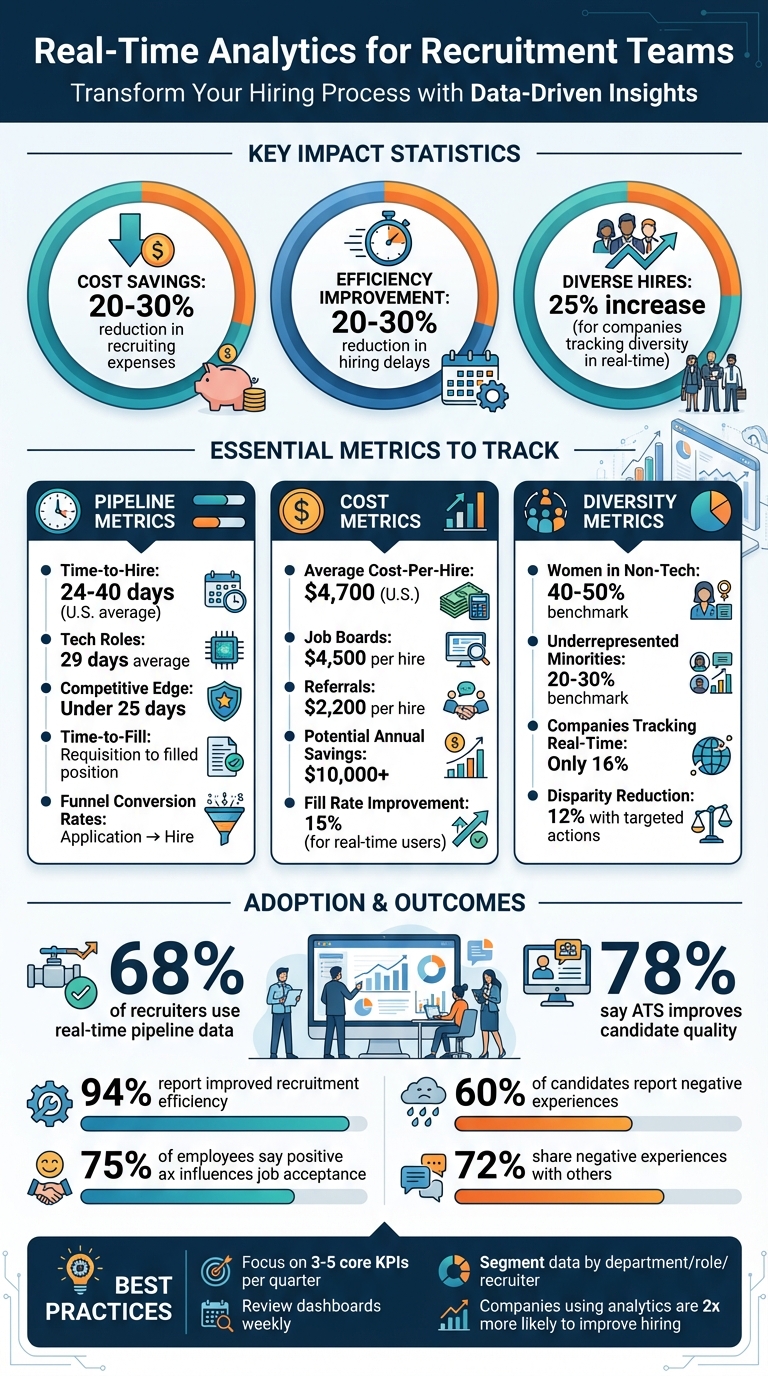
Real-Time Recruitment Analytics: Key Metrics and Impact Statistics
Key Metrics to Track with Real-Time Analytics
Pipeline Metrics
Real-time data provides a clear window into how efficiently your hiring process is operating. Key metrics like time-to-hire, time-to-fill, and candidate funnel conversion rates are crucial for keeping recruitment efforts on track. For example, time-to-hire measures the number of days from when a candidate applies or is sourced to when they accept an offer. In the U.S., this typically ranges from 24–40 days for most roles, with tech positions averaging around 29 days. Teams that manage to keep this metric under 25 days gain a competitive edge, especially in tight labor markets.
On the other hand, time-to-fill measures the duration from when a job requisition is approved to when the position is filled. This helps identify how long roles remain vacant. Meanwhile, candidate funnel conversion rates track the percentage of candidates moving through each stage – from application to interview, offer, and hire. These rates can highlight bottlenecks, such as lengthy interview processes. By using real-time tracking, teams often cut delays by 20–30%, improving both the candidate experience and overall hiring speed.
Next, let’s look at how real-time analytics can optimize recruitment costs.
Cost Metrics
Metrics like cost-per-hire and sourcing channel performance reveal where your recruitment budget is working best. For instance, cost-per-hire is calculated by dividing total recruiting expenses – such as ads, agency fees, and recruiter salaries – by the number of hires. On average, U.S. companies spend about $4,700 per hire. However, real-time analytics can trim this figure by 20–30% by reallocating resources to more effective channels.
Imagine your dashboard shows that hiring through job boards costs $4,500 per hire, while referrals only cost $2,200. With that insight, you can immediately shift budget toward referrals to maximize efficiency. Real-time tracking also highlights seasonal cost spikes, enabling mid-campaign adjustments that can save over $10,000 annually. Interestingly, only 68% of recruiters currently use real-time pipeline data, but those who do report a 15% improvement in fill rates.
Beyond operational and financial gains, real-time analytics also plays a critical role in promoting fairness in hiring.
Diversity and Inclusion Metrics
Metrics such as demographic representation, pipeline diversity ratios, and inclusion scores help ensure your hiring practices are equitable. For example, tracking the percentage of applicants, interviewees, and hires by gender, ethnicity, age, and disability at each stage can reveal disparities. If real-time data shows a 25% drop in underrepresented groups at the interview stage, you can immediately adjust strategies to address the issue.
Benchmarks in the U.S. suggest that 40–50% of hires in non-tech roles are women, while underrepresented minorities make up 20–30% of overall hires. Despite the importance of these metrics, only 16% of companies track diversity data in real time. Those that do, however, report a 25% increase in diverse hires. When your dashboard flags imbalances, actions like targeting diverse job boards or implementing bias training can reduce disparities by 12%. This not only helps exceed EEOC compliance standards but also builds a more inclusive workforce.
sbb-itb-e5b9d13
Benefits of Real-Time Analytics for Recruitment Teams
Making Decisions Based on Current Data
Real-time analytics gives recruitment teams the ability to pivot strategies right when challenges arise. Harsha Ghosh from Testlify highlights this shift:
Real-time analytics has revolutionized the HR field, offering a wealth of data-driven insights that enable HR professionals to make faster and more precise hiring decisions.
Unlike traditional batch analytics, live data empowers recruiters to act quickly – an essential advantage in competitive markets where timing can make or break hiring success. This ability to respond instantly also fosters smoother collaboration within teams.
Better Team Collaboration
Fast decision-making is only part of the equation. Real-time dashboards bring teams together by providing a single, shared view of candidate progress. From HR professionals to hiring managers, everyone stays on the same page. For example, Sussex Staffing Solutions introduced real-time collaboration tools and a 48-hour feedback rule for interview evaluations in February 2026. These changes, tracked with live data, cut stage drop-off rates from 28% to 14% and turned three declined offers into three accepted ones.
By giving all team members access to the same up-to-date data, real-time systems eliminate information silos. This unified approach makes it easier to implement Service Level Agreements (SLAs), like 24-hour CV reviews or 48-hour feedback deadlines, and track compliance effectively.
Spotting and Fixing Delays Quickly
Real-time analytics also ensures that delays in the recruitment process are identified and addressed immediately. Jeff Erickson from Oracle explains:
Real-time analytics allows businesses to detect operational or market issues in the moment and accurately anticipate the next events.
For example, if dashboards reveal bottlenecks in scheduling interviews or a sudden dip in application completion rates, teams can act quickly to resolve these issues. This is critical because 75% of employees report that a positive candidate experience heavily influences their decision to accept a job offer. Automated alerts further enhance efficiency by flagging key performance indicator (KPI) deviations, like an increase in time-to-hire for important roles. These tools ensure recruitment teams stay on track and maintain strong performance throughout the hiring process.
How to Set Up Real-Time Analytics in Skillfuel
Setting Up Centralized Dashboards
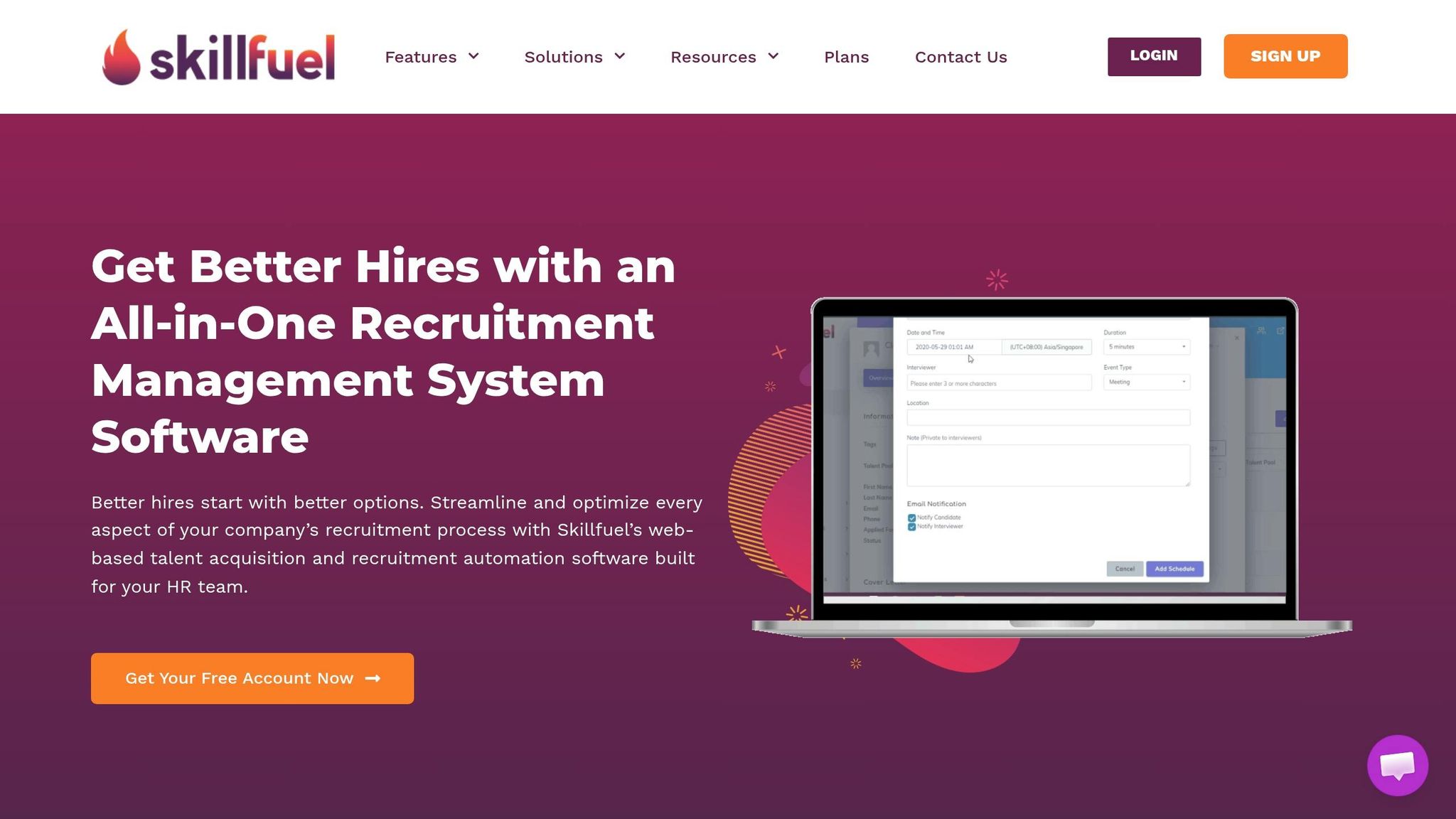
Skillfuel’s centralized dashboard eliminates the need for spreadsheets by offering an Applicant Tracking System (ATS) that auto-ranks and tracks candidates. Start by syncing all your candidate sources – such as employee referral programs – into the platform for complete visibility. You can also configure dashboards tailored to your recruitment goals, like workforce representation dashboards to monitor diversity and inclusion metrics. With its Kanban-style visual workflow, the platform allows you to oversee candidate progress through each hiring stage in real-time. This setup makes it easy to identify bottlenecks and address them as they happen. By enabling real-time workflow monitoring, you can track every step of the process, from application submission to offer acceptance.
Enabling Automated Metrics Tracking
Skillfuel takes metrics tracking to the next level by automating key recruitment data. You can create custom workflows and fields, while tools like the Interview Scheduler automatically capture feedback and track scheduling efficiency. The Employee Referral Tracking module monitors the progress of recommendations and manages rewards. Integrations with social media and job boards provide insights into interaction metrics and sourcing efficiency, giving you a clear picture of where your top candidates originate. Instead of overwhelming yourself with data, focus on 5–7 key metrics, such as time-to-hire and cost-per-hire. The interactive reporting dashboard generates real-time performance reports, which is vital considering that 78% of recruiters say an ATS improves candidate quality, and 94% report improved recruitment efficiency.
Using Career Page Customizations
Skillfuel’s customizable career pages are designed to capture real-time candidate interactions, complementing your internal tracking efforts. These pages can be tailored to monitor visitor behavior, application completions, and conversion rates, helping you attract more candidates. This is especially important since about 60% of candidates report negative recruitment experiences, and 72% of them share those experiences with others. By analyzing data from your career page, you can pinpoint where candidates drop off during the application process and make immediate adjustments. All applicant information is stored in a centralized repository, feeding real-time data into your dashboards. Additionally, automated candidate communication tools help maintain engagement while tracking response rates and time-to-response metrics, which are critical for securing top talent.
These features work together to simplify and optimize your recruitment process within the Skillfuel platform.
Best Practices for Using Recruitment Analytics
Setting KPI Targets
To make your recruitment efforts more effective, your KPIs should follow the SMART framework – Specific, Measurable, Achievable, Relevant, and Timely. These metrics should align with your organization’s larger objectives, whether that’s reducing costs, attracting top-tier talent, or boosting employee retention. It’s also essential to ensure your team agrees on how metrics are defined to avoid inconsistent reporting.
Focus on tracking just 3–5 core KPIs each quarter. Why? Data-driven recruitment processes have been shown to double hiring efficiency while reducing cost-per-hire by up to threefold. Use dynamic dashboards with features like color-coded progress bars and real-time widgets to track these metrics. Automated alerts can notify you when metrics exceed predefined thresholds, allowing you to address potential problems early.
Review KPI dashboards on a weekly basis, and assign specific fixes to workflows that are underperforming. Avoid relying on blended averages; instead, segment your data by department, role complexity, recruiter, or hiring manager. This approach helps you pinpoint where delays or inefficiencies are happening. For example, if your offer acceptance rate is low, take the time to interview candidates who declined offers to understand the root causes – whether it’s compensation, speed of the process, or perceptions of your company.
Once your KPIs are in place, refine your understanding by drilling down into the data.
Filtering Data for Specific Analysis
Segmenting your data is key to uncovering actionable insights. Once you’ve established your KPIs, filter the data to understand the story behind each metric. Break it down by recruiter, date range, pipeline stage, or source channel. For instance, analyzing the time candidates spend at each stage of the hiring pipeline can highlight bottlenecks, such as delays in interview scheduling or feedback loops.
Keep an eye on your submit-to-interview ratio. Ideally, this should be close to 1:1. A higher ratio may indicate inefficiencies in your screening process. While the average time to fill a position across industries is 41 days, 55% of candidates expect a job offer within just two weeks of their first interview. Use filters to identify which recruiters or departments are meeting this timeline and which are falling short.
Using Predictive Analytics
Predictive analytics can help you anticipate hiring needs and trends based on historical data. As Derry Holt, CEO & co-founder of OneUp Sales, puts it:
Predictive analytics is like using clues from past data to make smart guesses about the future.
By analyzing performance data from previous hires – such as their tenure and feedback – you can identify traits like teamwork or problem-solving that correlate with long-term success. These insights allow you to develop predictive fit scores, which estimate how well a candidate matches a role based on historical patterns. This method helps prioritize the most effective recruitment channels and set realistic timelines for filling specific roles.
Before introducing predictive tools, conduct a thorough data audit to ensure your information is accurate, consistent, and error-free. Regularly monitor and tweak your strategies if the outcomes deviate from predictions. Companies that use recruitment analytics are twice as likely to improve their hiring results compared to those relying on traditional methods.
Modern Recruiting Metrics | Ashby One
Conclusion
Real-time analytics is reshaping recruitment, making it a data-driven process that can improve hiring efficiency and reduce costs by as much as threefold. These advancements give your organization a stronger edge in attracting top-tier talent.
The move from outdated batch reporting to dynamic, live dashboards lets you address problems before they grow – whether that means fixing delays in interview scheduling or fine-tuning your overall hiring process. This approach not only solves immediate challenges but also lays the groundwork for long-term success in recruitment.
Industry experts echo this sentiment. Harsha Ghosh from Testlify explains:
The primary keyword ‘hiring decision’ should no longer be a source of concern but rather a beacon guiding your HR team toward better, faster, and more informed choices.
This highlights the true potential of real-time analytics: replacing uncertainty with clear, actionable insights.
To get started, focus on 3–5 essential KPIs, consolidate your data, and set up automated alerts to tackle issues as they arise. Break down metrics by recruiter, department, or sourcing channel to identify what’s driving results. Research shows that companies leveraging recruitment analytics are twice as likely to improve their hiring outcomes, offering a clear competitive edge.
Real-time analytics isn’t just about speeding things up – it’s about working smarter. Whether it’s tracking diversity metrics throughout your hiring funnel, reallocating budgets to the most effective channels, or using historical data to predict future hiring needs, you’re doing more than filling vacancies. You’re building a strategic advantage that grows stronger with every decision.
FAQs
Which 3–5 recruitment KPIs should we track first?
Tracking the right recruitment KPIs is crucial. Start with these key metrics: Time-to-Fill, Quality of Hire, Source of Hire, Candidate Satisfaction, and Offer Acceptance Rate.
These indicators give you insight into hiring efficiency, sourcing performance, and the overall candidate experience. For example, Time-to-Fill can reveal delays in your process, while Quality of Hire helps assess how well new hires perform over time. Together, they lay the groundwork for refining and improving your recruitment strategy.
How do we set up real-time dashboards without messy data?
To build effective, real-time dashboards, start by centralizing and automating your data collection processes. This minimizes manual errors and ensures consistency. Clearly define metrics that matter – such as time-to-hire or candidate pipeline status – so your team knows exactly what to track. Opt for tools that allow you to create configurable reports tailored to your needs.
It’s equally important to regularly validate and clean your data inputs to prevent clutter and inaccuracies. By following these steps, your dashboards will stay organized, precise, and actionable, enabling your recruitment team to make informed decisions on the fly.
How can we track diversity in real time while staying compliant?
Tracking diversity in real time requires tools designed to monitor inclusivity metrics while ensuring compliance with legal and ethical standards. AI-powered Diversity Dashboards can help by spotting bias trends in hiring and tracking progress toward inclusivity goals. Staying compliant means prioritizing transparency, protecting data privacy, and following regulations like EEOC guidelines. Regular audits of your data are also key to maintaining fair and ethical practices.