
Recruitment automation tools can transform hiring processes by saving time, reducing costs, and improving hire quality. Here’s what you need to know:
- ROI Formula:
(Value of Hires – Total Costs) / Total Costs × 100 - Key Benefits: 31% faster hiring, 50% better hire quality, and up to 340% ROI in 18 months.
- Automation Impact: Cuts manual tasks by 73%, reduces cost-per-hire by 20–40%, and shortens time-to-hire by 30–50%.
- Examples: A UK agency earned $104,000 in 30 days after adopting automation, while Hilton Hotels slashed time-to-fill by 90%.
Recruitment automation doesn’t just save money – it accelerates hiring cycles and boosts productivity. For HR teams, it’s a game-changer in achieving measurable results.
AI in Hiring: Recruitment Automation & ROI at Checkers & Rally’s Drive-In Restaurants
sbb-itb-e5b9d13
Key Metrics for Measuring Recruitment ROI
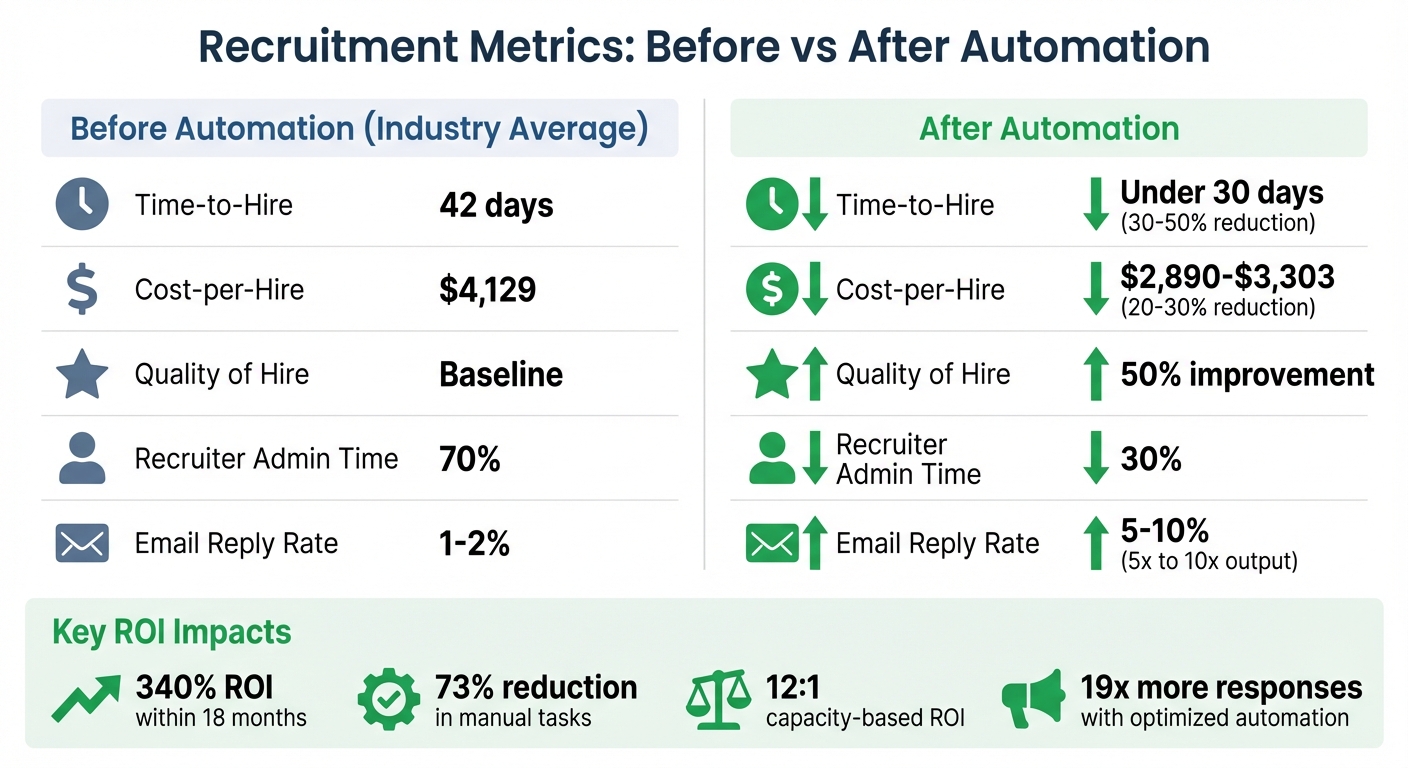
Recruitment Automation ROI: Before vs After Metrics Comparison
Core Metrics and Industry Benchmarks
Tracking recruitment ROI begins with five essential metrics. Let’s start with cost-per-hire, which averages $4,129 according to SHRM. This figure includes everything from recruiter salaries to software expenses. Another key metric, time-to-hire, averages 42 days across industries but can vary depending on the complexity of the role. Then there’s quality-of-hire, often assessed through retention rates at 90 or 180 days and performance indicators like ramp-up time.
Cost-of-vacancy is another critical measure. It calculates the daily financial loss when a position remains unfilled. The formula is simple: divide the role’s annual fully loaded value by 260 workdays, then multiply by the number of days saved and the number of hires impacted. For example, if an Account Executive generates $600,000 annually, each vacant day costs about $2,308 in lost productivity. Lastly, response rates on candidate outreach typically range from 1% to 2% for manual efforts, but targeted campaigns can improve this to 5%-10%.
These benchmarks provide a foundation for understanding how automation reshapes these metrics.
How Automation Changes Hiring Metrics
Automation significantly reduces manual workload – by as much as 73%. A great example comes from February 2026, when Loup Staffing, a boutique NYC design firm, sent 1,090 highly targeted emails to UI/UX designers at funded SaaS companies. The campaign achieved an impressive 22.7% reply rate, leading to a $10,000+ retained search deal within just 14 days. That’s more than 10 times the efficiency of manual outreach.
The financial impact of automation is equally striking. HYRD, a one-person construction recruitment agency in the UK, earned $104,000 in placement fees in just 30 days after introducing an automated pipeline system in early 2026. Hilton Hotels saw their average time-to-fill drop by 90% thanks to AI-powered screening tools. Across the board, organizations using AI-driven tools report 31% faster hiring times and a 50% boost in quality-of-hire metrics.
"The cost of doing nothing is not zero. It is $30K per week in recoverable capacity and a 95-99% waste rate on manual outreach." – Niklas Huetzen, CEO, Automindz
These improvements collectively lead to transformative outcomes, as shown in the comparison below.
Metrics Comparison: Before and After Automation
Here’s a side-by-side look at how automation affects key recruitment metrics:
| Metric | Industry Average | Post-Automation Target | ROI Impact |
|---|---|---|---|
| Time-to-Hire | 42 days | Under 30 days (high-volume) | 30-50% reduction |
| Cost-per-Hire | $4,129 | $2,890-$3,303 | 20-30% reduction |
| Quality of Hire | Baseline | 50% improvement | Lower early attrition |
| Recruiter Effort | 70% admin time | 30% admin time | 12:1 ROI (capacity-based) |
| Reply Rate | 1-2% (manual) | 5-10% (targeted/automated) | 5x to 10x output |
The real power of automation lies in optimizing multiple variables simultaneously. For instance, improving inbox placement rates (from 50% to 95%) and reply rates (from 1% to 10%) can result in 19 times more responses from the same email volume. This demonstrates just how dramatically automation can enhance recruitment ROI.
Research Findings on Recruitment Automation ROI
ROI Statistics from Industry Studies
Studies consistently show that recruitment automation can deliver impressive returns. On average, businesses see a 340% ROI within 18 months and 3–10x ROI within the first 90 days after implementation.
For companies using an applicant tracking system, the first year typically brings a 100–200% ROI, with median annual savings of $89,000, a payback period of 5.1 months, and a 2.4x Year 1 ROI across 41 companies studied. Larger enterprises see even bigger savings, averaging $2.3 million annually by leveraging AI-driven recruitment tools.
ROI outcomes often depend on the size of the company and how automation is implemented. Companies achieving 4x or higher ROI usually dedicate 4–6 weeks to testing automation before a full rollout. These businesses achieve 91% accuracy before launch, compared to only 76% accuracy for firms that test for just two weeks.
While the financial metrics are impressive, automation also delivers game-changing operational efficiencies.
Financial and Operational Benefits
The financial returns are only part of the story – automation transforms how recruitment teams operate. One of the biggest advantages is capacity recovery, shifting the workload balance from 70% administrative tasks to 70% revenue-generating activities. This change frees up 15 hours per recruiter per week for more strategic efforts.
Automation also significantly reduces time spent on hiring processes. For example:
- Recruiters save up to 23 hours per hire by eliminating manual resume screening.
- Automated scheduling tools cut coordination time by 80%.
- Currently, 73% of hiring team tasks could be automated, and 89% of HR professionals using AI report substantial time savings.
Beyond efficiency, automation enhances fairness in hiring. AI-driven screening reduces unconscious bias by 25–50%, promoting more equitable candidate evaluations. Additionally, 85% of employers using automation report increased overall efficiency, and staffing firms using these tools are 2.4 times more likely to experience revenue growth compared to those that don’t.
"Process automation ROI is real, but it compounds over time. The first year delivers 30-40% efficiency gains; by year three, you’re seeing 70-80% improvement." – Dr. Maria Santos, Director of Automation Research, MIT
Cost-saving strategies also play a key role in maximizing ROI. High-performing companies often use "model tiering", which involves applying high-cost AI models like GPT-4 only for complex decisions while relying on less expensive models for simpler tasks. This approach reduces API costs by 43%. For mid-sized firms (51–150 employees), the median implementation cost is $24,000, with annual API costs of $3,600.
These findings highlight how recruitment automation delivers measurable financial gains while driving operational improvements, making it a smart investment for organizations of all sizes.
Skillfuel‘s Role in Maximizing Recruitment ROI
Skillfuel takes industry insights and turns them into actionable tools that help recruitment teams achieve a better return on investment (ROI) by automating key processes.
Features That Drive ROI
Skillfuel streamlines some of the most time-consuming recruitment tasks, freeing up recruiters to focus on what really matters. For example, the applicant tracking system consolidates candidate information into one centralized location, eliminating the need for hours of manual data entry. Similarly, automated interview scheduling with real-time calendar sync removes the hassle of back-and-forth scheduling emails.
Another standout feature is employee referral tracking, which focuses on high-quality candidates while reducing administrative burdens. Since referrals tend to convert at higher rates, automating this process lets recruiters spend more time closing deals instead of handling paperwork. Additionally, social media recruitment integration enables recruiters to post job openings across multiple platforms without the need for manual updates, saving even more time for strategic initiatives.
By combining these tools, Skillfuel helps recruiters shift their focus from repetitive tasks to high-impact activities like interviewing top candidates and engaging with clients. This shift directly supports key metrics like reducing cost-per-hire and speeding up time-to-fill. For example, in a team of 10 recruiters, recovering just 15 hours per week per recruiter – at a $200 hourly billable rate – could generate approximately $129,000 in monthly value. These features don’t just improve efficiency; they also set the stage for measurable ROI improvements, clearly reflected in the platform’s pricing options.
Skillfuel Pricing and ROI Value
Skillfuel’s pricing model is designed to deliver value at every stage, offering scalable options that grow with your business. There are three pricing tiers to choose from, each catering to different organizational needs:
- The Free Plan includes essential tools like applicant tracking, interview scheduling, and job portal development. It’s a great starting point for small teams exploring automation.
- The Premium Plan builds on the Free Plan by adding advanced analytics and team collaboration tools, perfect for businesses looking to track and improve recruitment performance.
- The Enterprise Plan adds dedicated support and custom integrations, making it ideal for large organizations with high-volume hiring needs.
| Plan | Monthly Cost | Features Driving ROI | Best For |
|---|---|---|---|
| Free Plan | $0/month | Applicant tracking, interview scheduling, job portal development | Small teams establishing baseline metrics |
| Premium Plan | Custom pricing | All Free Plan features plus advanced analytics and team collaboration tools | Growing businesses tracking performance improvements |
| Enterprise Plan | Custom pricing | All Premium Plan features plus dedicated support and custom integrations | Large organizations with complex hiring workflows |
This structured approach helps organizations see tangible results. For instance, starting with the Free Plan allows teams to establish baseline metrics – like hours spent on admin tasks, monthly placements, or average fees – before upgrading to more advanced plans as they start to see measurable improvements. The pricing model is designed to deliver immediate value, aligning with research-backed strategies for achieving rapid recruitment gains.
How to Implement Recruitment Automation
Components of ROI Calculation
Breaking ROI into three key areas – time savings, cost avoidance, and revenue gains – lays the groundwork for a compelling case for recruitment automation. Each of these requires its own method of measurement.
Time savings can be directly tied to increased recruiter productivity. To measure this, calculate the hours saved on repetitive tasks like screening and scheduling. Multiply those hours by your recruiters’ hourly pay to determine the benefit in dollar terms.
Cost avoidance focuses on expenses you no longer need to cover. This includes lower agency fees – SHRM estimates the average cost-per-hire at $4,129 – reduced job board spending, and fewer bad hires. Since a bad hire can cost around 30% of the first-year salary, even a modest 25% reduction in mis-hires could save a small company approximately $12,375 annually. Additionally, revenue gains can be quantified by calculating the savings from shorter vacancy periods.
Revenue gains are often measured through "cost of vacancy" calculations. For example, if a role contributes $600,000 annually, reducing the vacancy period by 8 days across 20 hires could recover an estimated $369,280 in productivity. To ensure accuracy, spread one-time costs like implementation and training over 12 months and compare them to the annual benefits.
Proof-of-Value Approaches
With ROI components outlined, a targeted pilot program is the next step to confirm these gains. A 90-day "Test vs. Control" pilot – using comparable roles with similar levels, departments, and salaries – can provide reliable insights into the automation tool’s effectiveness.
Establishing a pre-automation baseline is essential. Use a 6–12 month period to gather historical data on KPIs such as time-to-fill, cost-per-hire, and agency spending. This helps smooth out any seasonal variations and creates a strong "before" benchmark.
Instead of automating every process at once, focus the pilot on one impactful workflow, like sourcing or screening. For example, Cast UK, a Manchester-based agency with over 15 consultants, used this phased approach in early 2026. In just 3.5 months, CEO Wayne Brophy reported $130,000 in invoiced revenue directly linked to their automated pipeline. Reflecting on the results, he shared:
"JFDI – just do it. It is the best thing we have done"
To evaluate the pilot’s success, track both quantitative metrics (e.g., hours saved, requisitions closed) and qualitative ones (e.g., hiring manager satisfaction, 90-day retention rates). This combined approach not only provides hard numbers for decision-makers but also demonstrates how automation enhances both the speed and quality of hiring outcomes.
Conclusion
Recruitment automation is reshaping how organizations allocate their resources. Companies using AI-driven tools for hiring report 31% faster hiring times, a 50% improvement in quality-of-hire, and an average 340% ROI within 18 months – with some seeing returns of 3-10x in just 90 days.
These numbers highlight more than just efficiency; they signal a fundamental shift in operations. Instead of spending 70% of their time on administrative tasks, recruitment teams can now focus that energy on strategic activities like building relationships and engaging top talent. This transformation is significant, especially when staffing firms using automation are 2.4 times more likely to experience revenue growth compared to those sticking with manual methods. The competitive edge is clear.
Skillfuel simplifies critical recruitment tasks such as applicant tracking, interview scheduling, and candidate communication. By centralizing workflows and syncing calendars in real-time, it removes bottlenecks and frees HR teams to focus on what matters most: connecting with candidates and closing hires. Its customizable career pages further enhance the process, making it easier to attract and engage talent.
The results speak for themselves. Take HYRD, for instance, which generated $104,000 in placement fees within 30 days of adopting automation. This isn’t just theory – it’s tangible proof. On the flip side, manual processes come with hidden costs, including prolonged vacancy periods, higher agency fees, and missed opportunities to secure top talent.
The real question isn’t whether automation boosts ROI – it’s whether your organization can afford to wait while others race ahead.
FAQs
What costs should I include in recruitment automation ROI?
When figuring out the return on investment (ROI) for recruitment automation, make sure to account for all relevant costs. These typically include software licenses, setup fees, enablement expenses, and change management costs. Including these factors ensures you get a clear and accurate picture of the value your investment brings.
Which hiring metrics change the most after automation?
Automation has a noticeable impact on hiring metrics, especially time-to-hire and cost-per-hire. By automating parts of the recruitment process, companies can fill roles faster while receiving a higher volume of qualified candidates. This not only speeds up hiring but also makes the entire process more efficient and effective.
How do I run a 90-day pilot to prove ROI?
To kick off a 90-day pilot, start by establishing a baseline. Spend 4–6 weeks tracking key metrics like time-to-fill, cost-per-hire, and recruiter workload. These baseline numbers will serve as your reference point.
During the pilot, measure how these metrics change. For instance, look for improvements like shorter time-to-fill or lower hiring costs. Then, compare those gains against the total expenses of the tool, including software and setup costs.
Make sure your test is controlled, your tracking methods are consistent, and your baseline data is solid. This approach ensures that any improvements can be clearly tied to the automation tool, helping you confidently validate its ROI.