
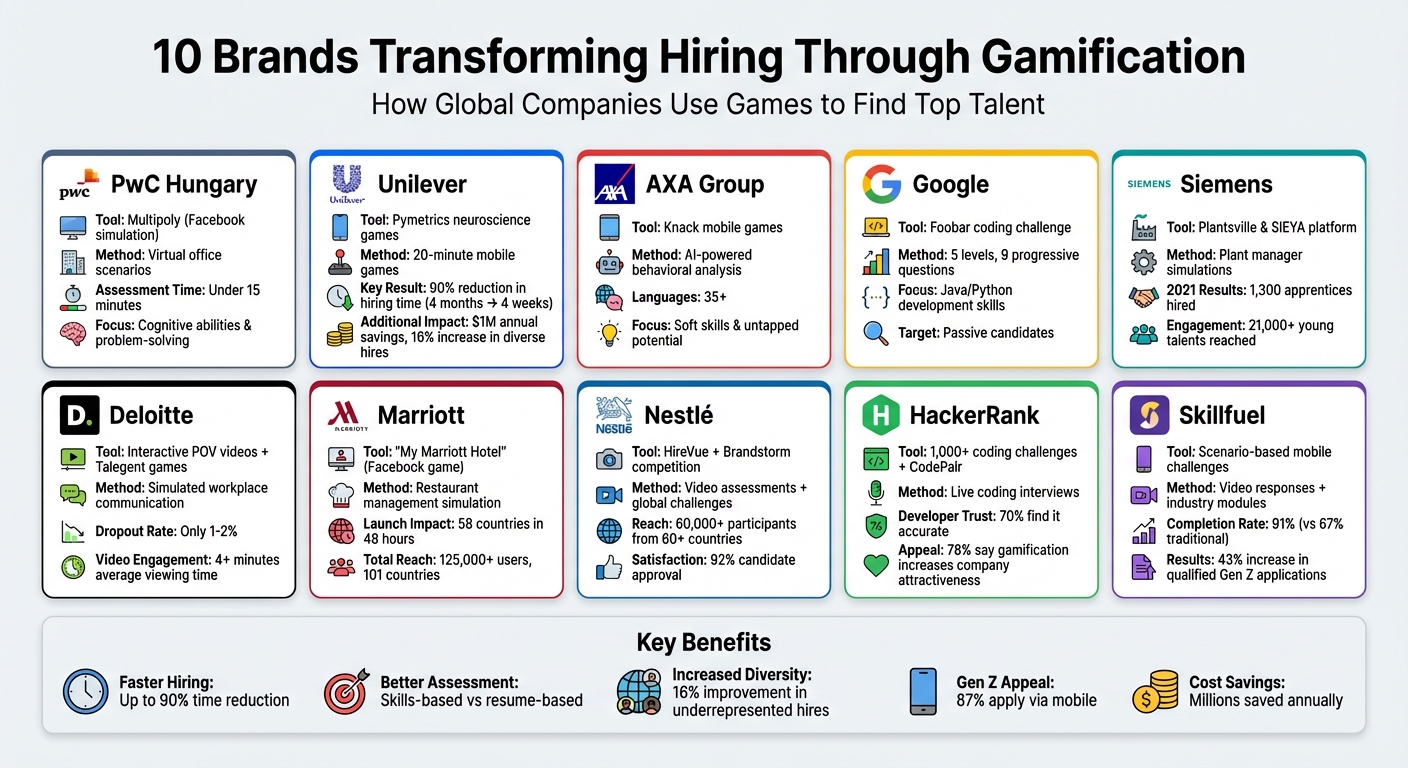
Gamification is transforming hiring by blending job applications with fun, interactive experiences. Companies now use games, simulations, and challenges to evaluate candidates’ skills, reduce bias, and improve engagement. This approach appeals especially to Gen Z, who prefer mobile-first, interactive content. Here’s how 10 major brands are doing it:
- PwC Hungary: Uses "Multipoly", a virtual office simulation on Facebook, to assess cognitive and problem-solving skills in under 15 minutes.
- Unilever: Employs neuroscience-based Pymetrics games to evaluate traits like focus and memory, cutting hiring time by 90%.
- AXA Group: Partners with Knack for mobile games that uncover soft skills, broadening their talent pool.
- Google: Features coding challenges like "Foobar" and puzzle-based hiring campaigns to identify top developers.
- Siemens: Introduces simulations like "Plantsville" to showcase plant manager roles and assess candidates.
- Deloitte: Offers interactive videos and logic-based challenges to test learning agility and workplace communication.
- Marriott: Launched "My Marriott Hotel", a Facebook game to attract hospitality talent globally.
- Nestlé: Combines automated video assessments with competitions like "Brandstorm" to evaluate technical expertise.
- HackerRank: Provides coding challenges and live coding interviews for developer hiring.
- Skillfuel: Engages Gen Z with scenario-based challenges and mobile-friendly job applications.
Gamification isn’t just making hiring more engaging – it’s delivering measurable results like shorter hiring times, better skill assessments, and increased diversity. These brands show how games can help companies find the right talent faster and more efficiently.
10 Major Brands Using Gamification in Recruitment: Methods and Results
1. PwC Hungary’s Multipoly
A New Take on Recruitment
PwC Hungary has reimagined how it recruits graduates with Multipoly, a virtual office simulation designed to immerse candidates in the role of a digital intern. Hosted on Facebook, this simulation allows participants to step into realistic workplace scenarios, including interviews, negotiations, and problem-solving challenges. By navigating these tasks in a stress-free environment, candidates can showcase their skills while gaining insight into professional life at PwC.
Assessing Skills That Matter
Multipoly focuses on evaluating two key competency areas: Cognitive Abilities (such as mental agility, reasoning, and numerical skills) and Working with Information (problem-solving and adaptability). PwC CEE explains:
"These were designed based on traditional psychometric (IQ) tests, and measure several different skills and abilities in an interactive and stimulating way".
The assessment is broken into a series of 3-minute games, all rooted in psychometric principles, which collectively take less than 15 minutes to complete. Afterward, candidates receive a personalized feedback report highlighting their working style and how their strengths align with PwC’s culture. This detailed evaluation helps streamline the transition to the interview stage.
Enhancing Candidate Experience
Multipoly doesn’t just assess – it engages. Acting as a pre-selection tool, it allows candidates to explore their compatibility with PwC before committing to formal interviews. This means they enter interviews better informed and prepared. PwC CEE noted:
"In order to enhance the graduate candidates experience, we have exchanged traditional online tests with a modern, user-friendly game-based assessment".
sbb-itb-e5b9d13
2. Unilever‘s Pymetrics Assessments
Innovation in Gamified Approach
Unilever has reshaped graduate recruitment by integrating neuroscience-based mobile games from Pymetrics into its process. Since 2016, the company has handled 1.8 million applications annually through a streamlined, four-stage digital funnel. This process includes an online application, 20 minutes of gaming, video interviews, and a final virtual discovery center.
The games, which take 15–30 minutes to complete, evaluate over 50 cognitive and behavioral traits like attention, risk-taking, focus, and memory. Machine learning compares candidates’ results against profiles of successful Unilever employees. Designed with a mobile-first approach, this method is especially effective in areas where mobile usage dominates. Beyond assessing abilities, this system simplifies and accelerates the screening process.
Skill Assessment and Relevance to Job Roles
Unilever uses data from these games to predict how well candidates align with specific roles. Mechell Chetty, VP of Human Resources Africa at Unilever, highlighted the value of this approach:
"Applicants’ gameplay provides insights into their potential and alignment with our company’s goals".
By anonymizing applications and focusing on objective trait measurement, the system reduces unconscious bias. Candidates who progress further experience a "day in the life" virtual collaboration exercise, ensuring their traits and skills match both the job’s demands and Unilever’s work culture.
Impact on Recruitment Outcomes
The results of this approach have been transformative. Unilever slashed its time-to-hire by 90%, reducing it from four months to just four weeks. This efficiency saved the company $1 million annually and eliminated 50,000 hours of recruiter time by reducing the need for manual candidate reviews by 90%. Additionally, hiring of underrepresented and neuro-atypical candidates increased by 16%, while candidate engagement rose by 20%. Studies also revealed that employees hired through this gamified process performed as well as – or better than – those selected through traditional methods.
3. AXA Group‘s Knack Games
A Gamified Shift in Talent Discovery
In July 2016, AXA Group teamed up with Knack to rethink how it identifies and assesses talent. The Knack platform blends game theory, brain science, and artificial intelligence to evaluate candidates through mobile games instead of traditional resumes. By analyzing micro-behaviors during gameplay, it uncovers cognitive abilities and soft skills. With availability in over 35 languages, the platform ensures a seamless experience for candidates across the globe. This approach moves away from relying solely on conventional qualifications, focusing instead on uncovering untapped potential. It reflects a growing trend of using technology to look beyond resumes for talent.
Matching Skills to Business Needs
AXA uses this gamified system alongside advanced data analytics to align candidates’ skills with the company’s dynamic requirements. As their Group Chief HR Officer put it:
"We’re able to de-emphasize academic background and job experience, and emphasize the individual’s true talents and potential. We want to be a successful company tomorrow. This is all about tomorrow."
By diving into gameplay data, AXA pinpoints candidates whose abilities fit specific roles. This method also addresses a major challenge in the insurance industry, where up to 70% of entry-level employees leave within their first year.
Broadening the Talent Pool
AXA’s approach has significantly widened its reach for talent. CEO Henri de Castries noted:
"the potential pool of talent was a lot larger than AXA was fishing in with traditional recruitment techniques"
This strategy has also improved diversity at entry-level positions by reducing unconscious biases linked to factors like gender, race, disability, and socioeconomic status. By tapping into overlooked talent pools, AXA has been able to discover high-potential candidates who might not have traditional qualifications.
4. Google’s Hiring Challenges
Innovation in Gamified Approach
Google is known for turning recruitment into a creative and engaging process. One standout example is the Google Foobar challenge, an exclusive coding game that pops up when developers search for specific programming terms like "headless chrome", "list comprehension", or "mutex lock." This challenge greets participants with a UNIX-style command-line interface, giving them a taste of what real-world development work feels like. The game spans 5 levels and includes 9 progressively harder questions, starting with basic Java or Python concepts in Level 1 and advancing to intricate permutations by Level 5. The varying deadlines add an extra layer of complexity, pushing candidates to demonstrate not just technical skills but also time management.
Back in July 2004, Google also launched an intriguing recruitment campaign with a billboard on Highway 101 in Silicon Valley. The billboard presented a mathematical puzzle: "{first 10-digit prime found in consecutive digits of e}.com". Solving this puzzle led to another equation, which eventually directed problem-solvers to a Google Research and Development hiring page. The page greeted candidates with this message:
"One thing we learned while building Google is that it’s easier to find what you’re looking for if it comes looking for you. What we’re looking for are the best engineers in the world. And here you are".
These creative simulations not only test candidates’ problem-solving abilities but also integrate seamlessly into Google’s formal interview process.
Skill Assessment and Relevance to Job Roles
The Foobar challenge mirrors the actual technical environment at Google, focusing on the skills the company values most in its developers. Participants are required to solve problems using Java or Python, which aligns with Google’s core technology stack. Each level of the challenge is designed to evaluate specific areas of expertise, ranging from foundational programming skills to advanced mathematical concepts. Once candidates successfully complete Level 3, they are prompted to share their contact information, which triggers the next step: direct communication with Google recruiters.
Impact on Recruitment Outcomes
This approach has proven to be an effective recruitment tool, delivering measurable results. By gamifying the hiring process, Google has created a precise way to filter through a vast pool of applicants. Dmitry Nazarevich, CTO at Innowise, highlighted the unique value of this strategy:
"Not only did it attract high-caliber candidates, but it also did what no job board ever could: it pre-qualified applicants based on how they think, not just what they claim".
These challenges are particularly effective at engaging passive candidates – those who aren’t actively job hunting but have the curiosity and skills Google seeks. As the 2004 recruitment page explained:
"As you can imagine, we get many, many resumes every day, so we developed this little process to increase the signal-to-noise ratio".
5. Siemens‘ Simulated Assessments
Gamified Recruitment in Action
Siemens introduced Plantsville, a simulation game where players step into the role of plant managers, handling facility operations. This game provides a risk-free way to showcase what industrial roles entail. Tom Warney, Siemens’ Head of Marketing and Communications, explained the purpose behind this initiative:
"Plantsville… will generate interest in manufacturing careers among young people. The company can show prospective employees what the role of plant manager entails and, in some sense, prepare someone to do the job outside the virtual realm."
Plantsville was just the beginning. Siemens expanded its digital recruitment efforts with SIEYA (Siemens Your Adventure), a gamified portal designed to engage and evaluate candidates. In September 2021, Siemens AG launched its new training year using SIEYA’s virtual tradeshow portal, which included an online assessment tool enriched with gamification. Spearheaded by Barbara Ofstad, Head of Siemens Professional Education in Germany, this initiative successfully brought on 1,300 apprentices and work-study students across 20 locations in 2021. Of these, 800 joined Siemens AG, 200 joined Siemens Mobility, and 110 joined Siemens Healthineers.
Improving Engagement and Candidate Experience
These gamified assessments do more than just evaluate skills – they ease test anxiety and give candidates a real sense of what the job involves. By targeting digitally savvy individuals who may not have previously considered manufacturing careers, Siemens is making these roles more approachable and appealing.
Barbara Ofstad emphasized the educational value of these tools:
"We’re providing our students with the digital tools to survive in our modern corporate culture in times of digital transformation, and embrace the imperative of lifelong learning."
Results That Speak Volumes
Siemens’ gamified approach has delivered impressive outcomes. Over 21,000 young talents have interacted with the SIEYA webapp for career exploration. During the 2021 training year alone, Siemens onboarded about 1,300 apprentices and university students into work-study programs, with 87% of the training focused on technical and IT professions.
The company’s commitment to training is reflected in its financial investments. In fiscal 2020, Siemens allocated more than $173 million (€159 million) toward youth training. By fiscal 2024, this figure had grown to approximately $482 million (€442 million) globally for training and professional development [15, 21]. These numbers highlight how gamification is not just a novel idea but a practical way to boost engagement and recruitment efficiency.
6. Deloitte‘s Gamified Processes
Innovation in Gamified Approach
Deloitte shook up the traditional recruitment process by swapping standard psychometric tests for interactive, game-based experiences. Back in 2014, Deloitte New Zealand teamed up with Little Sister Films and Rapt Media to launch "Will You Fit Into Deloitte", an interactive point-of-view video that offers candidates a glimpse into the daily life of a Deloitte employee. Director Logan McMillan highlighted the importance of a mobile-first approach, saying:
"It’s a sleek, mobile-first experience, but the fact that it works natively on mobile was the deal maker for us".
They didn’t stop there. Deloitte also collaborated with Talegent to develop a game-based assessment tool that mimics workplace communication. This tool uses simulated emails and instant messages to present logic challenges inspired by real projects. Impressively, the entire solution was rolled out in just three months. This shift toward gamified tools allows for a more practical and engaging evaluation of candidates’ abilities.
Skill Assessment and Relevance to Job Roles
Deloitte’s gamified assessments go beyond traditional testing, focusing on critical skills like learning agility. These tools not only evaluate logic-based cognitive competencies but also measure how quickly candidates can learn and adapt through hands-on experimentation. Gemma Hudson, National Graduate Talent Acquisition Manager, explained:
"We designed the test to assess certain logic-based cognitive competencies. But it actually assesses more than that – assessing not only logic but also learning agility, as candidates experiment and learn through real-time challenges".
Additionally, the simulated work scenarios give candidates a realistic preview of the tasks they might face on the job, such as handling emails and instant messages that outline real-world challenges.
Impact on Recruitment Outcomes
The impact has been striking. The dropout rate for candidates was a mere 1–2%, while the "Will You Fit Into Deloitte" video achieved an average viewing time of over 4 minutes – far surpassing the performance of traditional, linear recruitment videos. Hudson shared:
"We’ve received consistent positive feedback from the grad candidates who took the assessment".
She also noted:
"From anecdotal evidence we’ve gotten back from managers, the gamified assessment is delivering high quality talent".
On top of that, Deloitte’s gamified Leadership Academy saw a 47% boost in users returning to the platform weekly. These results highlight how gamification not only enhances the candidate experience but also delivers better outcomes for the organization.
7. Marriott‘s Virtual Tasks
Gamified Recruitment with "My Marriott Hotel"
Marriott International took a bold step in hospitality recruitment by introducing "My Marriott Hotel" on Facebook back in June 2011. This virtual game, developed alongside Evviva Brands over a span of 10 months, invited players to step into the shoes of a hotel restaurant manager. The tasks? Budgeting for equipment and ingredients, hiring and training virtual staff, and ensuring guests were served efficiently – all while earning points and avoiding penalties. With this launch, Marriott became the first in the hospitality sector to leverage gaming for recruitment and employer branding.
The game was designed to appeal to millennials and emerging job markets, particularly in regions like China and the Middle East. To ensure global accessibility, it was offered in five languages: English, Spanish, French, Arabic, and Mandarin. Susan Strayer, Marriott’s Senior Director of Global Employer Brand and Marketing, highlighted the importance of tailoring the approach to regional trends:
"We wanted to uncover some patterns. For example, we found that in the Middle East, Facebook is the No. 1 activity outside of work. That was great fodder for us".
This innovative approach quickly gained attention, setting the stage for broader adoption across the globe.
Results and Recruitment Success
The game’s impact was immediate. Within just 48 hours of its launch, players from 58 countries had joined in. By week three, participation had jumped to 99 countries, and eventually, the game reached players in 101 countries. During its first year, over 125,000 users registered, contributing to Marriott’s ambitious goal of filling 50,000 jobs worldwide by the end of 2011.
Although not a formal evaluation tool, the game provided a realistic glimpse into the challenges and rewards of working in hospitality. This aligns with the broader trend of using gamified methods to offer authentic job previews. Plus, the game made it simple for interested players to transition directly to Marriott’s career site, blending engagement with effective talent pipeline building.
8. Nestlé’s Interactive Recruitment
A Gamified Twist on Hiring
Nestlé has taken a forward-thinking approach to recruitment by blending automated video assessments with a global virtual competition. Back in 2012, the company adopted HireVue (formerly Modern Hire) to replace traditional phone interviews with interactive technical questions. This move supported their broader sustainability goals, like achieving 100% recyclable or biodegradable packaging by 2025. Fast forward to 2019 and 2020, Nestlé introduced "Brandstorm" through The Talent Games platform – a global competition that drew over 60,000 participants from more than 60 countries. To keep the process personal, HR representatives kicked off each assessment with introductory videos.
Jonathan Fearn, Talent Acquisition Partner at Nestlé, explained the benefits of this approach:
"We use Modern Hire (now part of HireVue) to ask really technical questions which allow us to very quickly qualify that experience. It cuts out our talent team having 30-minute phone interviews in which they couldn’t accurately assess technical knowledge".
This combination of automation and engagement has not only streamlined early-stage hiring but also allowed for more precise skill evaluation.
Matching Skills to Roles
Nestlé’s interactive platform has proven especially effective in identifying candidates with the technical expertise needed for specialized roles, such as positions on the Audit team. Video-based assessments allowed multiple team members to review candidates at their convenience, reducing the chances of missing out on strong talent. Reflecting on this, Jonathan Fearn noted:
"If we invited ten candidates for a phone interview based on CV review only, there would be a high probability of missing some relevant profiles, but with Modern Hire… we can put as many applicants through… you’re always hiring from Modern Hire".
This approach ensures that recruitment decisions are based on skills and knowledge rather than just resumes, making the process more reliable and inclusive.
Results That Speak Volumes
The impact of these assessments has been striking. Among candidates, 92% expressed satisfaction with the process, 98% found the software easy to use, 93% were open to future video assessments, and 95% appreciated the multi-assessor format. Operational teams typically aimed to hire 2 to 3 candidates out of every 7 invited to a final Assessment Centre, showcasing the efficiency of their screening process. By integrating automated tools with interactive elements, Nestlé has not only boosted candidate engagement but also refined their talent selection process, keeping pace with hiring innovations seen in other top companies.
9. HackerRank for Developer Hiring
Gamified Recruitment in Action
HackerRank takes the hiring process to the next level by gamifying how developers are assessed. With over 1,000 carefully designed coding challenges, the platform covers a range of topics like algorithms, data structures, SQL, and even AI-related tasks. These challenges let candidates showcase their practical coding skills in a competitive, interactive environment, moving beyond the limitations of traditional resume screening. Adding to this, HackerRank’s CodePair feature allows for live coding interviews, offering real-time collaboration and built-in proctoring. It’s a hands-on way to evaluate technical expertise in real-world scenarios.
Practical Skill Testing for the Right Fit
HackerRank’s strength lies in its ability to focus on job-specific, objective skill evaluations. Instead of relying on subjective resume reviews, the platform emphasizes practical coding tests. According to research, 70% of developers believe these challenges offer an accurate measure of their technical abilities. Certified assessments, combined with automated scoring and detailed performance insights, provide instant feedback, boosting recruiter confidence. Plus, AI-powered tools streamline the process by automating shortlisting and integrating with popular Applicant Tracking Systems, making it easier to handle high-volume hiring.
Positive Impact on Hiring Efficiency
The gamified approach doesn’t just make assessments more engaging – it delivers results. For example, 78% of job seekers say gamification makes a company more appealing. By prioritizing coding skills over resumes, recruiters can discover high-potential candidates who might not fit traditional hiring molds. Automated testing also speeds up the hiring process by delivering fast and reliable results, cutting down on time-to-hire.
10. Skillfuel‘s Gamified Hiring Features
Engagement and Candidate Experience
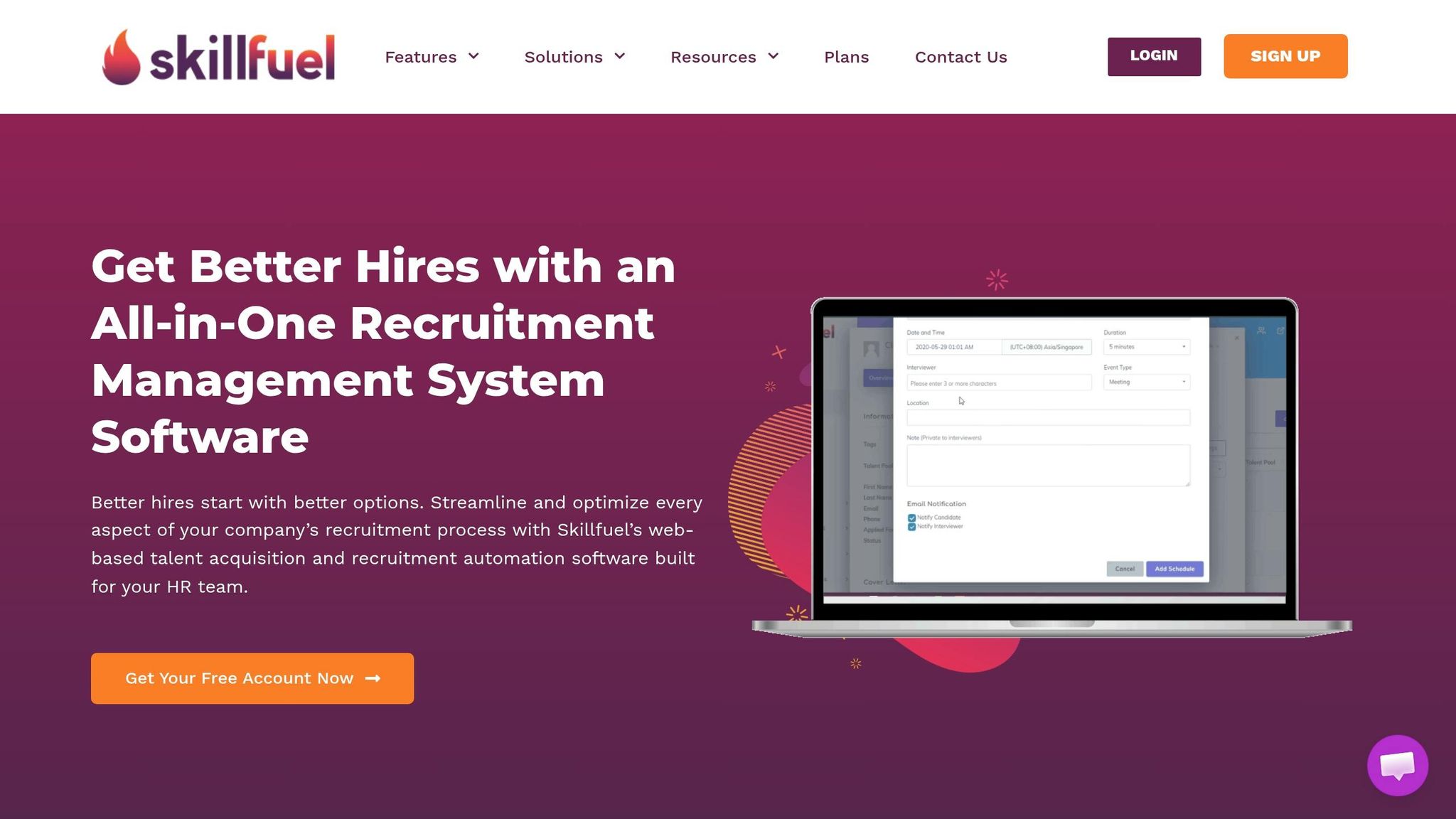
Skillfuel is shaking things up in recruitment by using gamification to make the process more interactive and engaging. Instead of relying on the usual long-winded forms, it offers candidates fun, interactive challenges. This approach is especially appealing to Gen Z, a group known for its preference for mobile-first experiences – 87% of them apply for jobs using their phones. What makes Skillfuel stand out is its ability to keep candidates engaged, with completion rates soaring to 91%, compared to just 67% for traditional forms.
Skill Assessment and Relevance to Job Roles
Skillfuel takes a hands-on approach to assessing candidates by using scenario-based challenges that focus on real-world problem-solving. These challenges, often completed through video responses, integrate seamlessly with the platform’s applicant tracking and interview scheduling tools. On top of that, Skillfuel offers industry-specific educational modules. For example, Heineken’s "Beer Academy" introduces applicants to the company’s history, values, and environmental initiatives, helping them decide if they align with the organization before moving forward. This self-qualification process not only saves time but also ensures that candidates who advance are more likely to thrive in the role and stay longer.
Impact on Recruitment Outcomes
The results speak for themselves: companies using Skillfuel have seen a 43% jump in qualified Gen Z applications and a 31% boost in recruitment performance metrics. By replacing outdated forms with engaging, gamified challenges, Skillfuel attracts candidates who might otherwise skip the traditional application process. Its combination of mobile-friendly design, interactive assessments, and self-qualification tools helps recruiters quickly identify top talent while providing a better experience for job seekers. This streamlined approach benefits both sides, making the hiring process faster and more effective.
11 examples of gamification for recruitment
Conclusion
Brands like PwC, Unilever, and HackerRank have shown that gamification in recruitment is more than just a passing trend – it’s reshaping how companies find and hire talent. By replacing traditional, static hiring methods with dynamic, interactive experiences, gamification benefits everyone involved. Employers enjoy shorter hiring timelines, better ways to assess skills, and access to a broader, more diverse talent pool. Meanwhile, candidates experience a less stressful, more engaging, and transparent process.
Take Magyar Telekom as an example: candidates reached 95% of high-performer KPI levels within just three months of being hired through gamified methods. This demonstrates how gamification can dramatically improve how companies identify and onboard top talent.
But it’s not just about speed and efficiency. Gamification also promotes fairer, skills-based hiring practices. Unlike traditional resumes, which rely on self-reported claims, gamified challenges showcase real-world abilities – like problem-solving, adaptability, and decision-making under pressure. By focusing on observable behaviors rather than demographic factors, this approach naturally reduces biases and helps companies build diverse teams. As David Szilagyi, Founder and CEO of benchmark.games, put it:
"Telekom noticed that some people who had been rejected because of their resumes were hired a year after because they scored really high in our games. And now they’re high performers".
Gamification also aligns with how younger generations engage with technology. With 87% of Gen Z applying for jobs using mobile devices, gamified, mobile-friendly assessments meet candidates where they are. This interactive approach not only appeals to modern job seekers but also allows candidates to self-select. Those who engage with the challenges show genuine interest, while others can opt out early, saving time for both parties.
As the gamification industry grows – from $4.91 billion in 2016 to nearly $12 billion by 2020 – companies that adopt these tools gain a competitive edge. The examples featured here prove that when recruitment becomes more interactive, transparent, and skills-focused, both employers and candidates come out ahead.
FAQs
Do gamified hiring tests reduce bias?
Gamified hiring tests offer a fresh way to evaluate candidates by prioritizing soft skills and personality traits through interactive, game-based simulations. Unlike traditional methods, these tests focus on measurable performance, reducing the influence of subjective judgment and helping to minimize bias in the hiring process.
What skills do these hiring games measure?
These hiring games evaluate a mix of soft skills – such as empathy, flexibility, and handling challenges under pressure – and hard skills, like technical knowledge and practical application. They offer a thorough look at how candidates perform in real-world situations.
How should I prepare for a gamified job assessment?
Gamified job assessments are designed to evaluate candidates through interactive tasks like simulations, puzzles, or game-like challenges. These tests aim to measure a mix of your soft and hard skills in a dynamic way.
How to prepare:
- Sharpen your problem-solving and critical thinking skills by practicing puzzles or logic-based games.
- Approach each task with a calm and focused mindset, ensuring you stay engaged and complete them carefully.
- Set up a quiet workspace with a stable internet connection to minimize distractions and technical issues during the assessment.
These steps can help you feel more confident and perform at your best.