
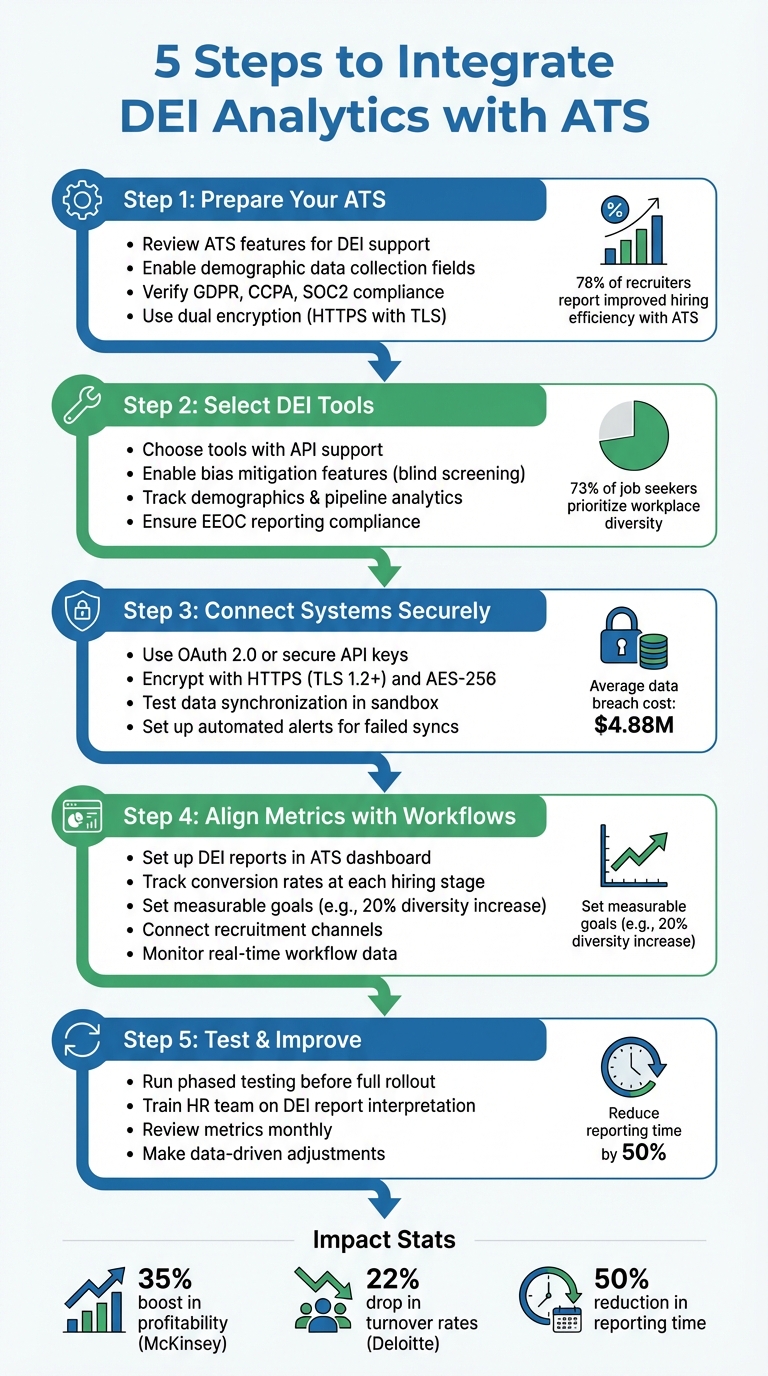
Struggling with diversity in hiring? Here’s how to fix it. Many companies invest heavily in DEI (Diversity, Equity, and Inclusion) programs but fail to see measurable results. Integrating DEI analytics with your ATS (Applicant Tracking System) can improve hiring transparency, reduce biases, and track diversity metrics at every recruitment stage.
Key Steps:
- Prepare Your ATS: Ensure it supports demographic data collection, secure handling, and customization.
- Select DEI Tools: Choose tools with API support for real-time data sync and bias mitigation features.
- Connect Systems Securely: Use secure authentication protocols and test data synchronization.
- Align Metrics with Workflows: Map DEI data to hiring stages and set measurable goals.
- Test and Improve: Train your team, monitor metrics monthly, and refine strategies based on data.
Why It Matters: Companies that prioritize DEI see better hiring outcomes, higher profitability, and reduced turnover. By following these steps, you can create a fairer hiring process while meeting compliance requirements.
5 Steps to Integrate DEI Analytics with ATS
AI in DEI: How Technology is Revolutionizing Diversity & Inclusion #aiinhr
sbb-itb-e5b9d13
Step 1: Prepare Your ATS for Integration
Before diving into DEI (Diversity, Equity, and Inclusion) integration, make sure your ATS (Applicant Tracking System) is ready. This involves ensuring it can handle demographic data collection, supports customization, and meets strict security standards for managing sensitive candidate information.
Review Your ATS Features
Start by assessing whether your ATS is equipped with the necessary tools for DEI integration. For example, Skillfuel provides customizable data fields to track diversity metrics alongside traditional recruitment data. Look for features like centralized dashboards that offer real-time insights into DEI trends, such as candidate drop-off points. Another essential capability is support for standardized evaluation tools, like role-specific rubrics and competency benchmarks. These tools help reduce bias by ensuring all candidates are evaluated using consistent criteria. Don’t forget to use the sandbox environment to test workflows and integrations. Once the core features are verified, activate DEI-specific data fields to enable more detailed tracking.
Enable DEI Data Collection Fields
Activate fields in your ATS that allow candidates to self-report details such as gender, ethnicity, and veteran status. These fields should always be optional and kept separate from the application review process to ensure compliance with privacy regulations. Test these fields in a sandbox environment to confirm secure data handling and smooth workflows. According to Knit, 78% of recruiters using an ATS report improved hiring efficiency. Properly configuring these fields is key to achieving those benefits while safeguarding candidate privacy.
Verify Compliance and Data Security
Handling DEI data comes with significant responsibility, so your ATS must meet regulations like GDPR, CCPA, and SOC2. For instance, Skillfuel employs dual encryption to safeguard data both at rest and during transit using HTTPS with TLS. Check that your ATS uses secure authentication methods, such as OAuth or API keys, and that role-based permissions restrict access to sensitive demographic data. Knit emphasizes, "Security is paramount when handling sensitive candidate data. Mistakes can lead to data breaches, compliance issues, and reputational harm". To stay ahead of potential issues, set up continuous logging and monitoring for every data sync event, ensuring you can quickly identify and address misconfigurations or security concerns.
Step 2: Select and Set Up DEI Analytics Tools
Choose DEI analytics tools that work seamlessly with Skillfuel. The right tools can automate diversity metric tracking, minimize unconscious bias, and deliver real-time insights into your hiring process – all without adding extra manual work for your team.
Choose Tools with API Support
API support is a must for accurate, real-time DEI data tracking. Tools with strong API functionality sync candidate data automatically, cutting down on manual errors. Look for tools offering webhook support, which ensures instant data updates as candidates progress through the pipeline. As Unified.to highlights:
"For recruiting products – where timing matters – scheduled syncs are fundamentally limiting".
Check the API documentation to confirm it includes OAuth/API key support and customizable DEI fields.
Beyond API features, focus on tools designed to promote fair hiring practices. Bias mitigation tools, such as blind screening, can anonymize details like names, gender, and educational background during early screenings, so evaluations center on skills instead of personal identifiers. Tools that track demographics and offer pipeline analytics provide real-time visibility into candidate data, from sourcing to final offers. Compliance features should include built-in support for EEOC reporting and GDPR-compliant data handling. Inclusive language tools are another key feature, helping to flag biased language in job descriptions and suggesting gender-neutral alternatives. These features are crucial, as 73% of job seekers say workplace diversity is a critical factor when considering job applications.
Configure Tool Settings
Once you’ve chosen your tools, configure them to align with Skillfuel’s workflows and reporting needs. Start by defining the specific metrics and goals you want to track. For example, you might focus on EEO-1 reporting (covering representation of women, minorities, and individuals with disabilities), candidate pipeline data (like source-to-interview or interview-to-offer ratios), or even turnover rates. Set clear objectives, such as increasing leadership diversity by a set percentage within a year.
Next, integrate the tool with Skillfuel’s dashboard to enable real-time DEI data tracking. This integration allows for better hiring decisions and improved candidate sourcing throughout the recruitment process. Keep your metrics manageable by focusing on a few impactful data points rather than trying to monitor everything. Combining quantitative data (like demographic breakdowns) with qualitative feedback (via surveys or focus groups) can provide a more complete picture of your recruitment efforts.
Finally, establish a regular review schedule. Dedicate one day each month to updating and analyzing your DEI metrics. This ensures your data stays accurate and your hiring strategies remain informed and effective.
With your tools selected and configured, the next step is ensuring they integrate smoothly with your existing systems.
Step 3: Connect Systems Securely
Once your ATS and DEI tools are ready, the next step is to securely integrate them with Skillfuel. Considering that the average cost of a data breach is around $4.88 million, even small errors can lead to major compliance issues or security risks. With security as a top priority, start by establishing strong authentication protocols.
Set Up Secure Authentication
For secure connections, use OAuth 2.0 (client credentials flow) to enable token-based, expiring authentication. If your requirements are simpler, secure API keys can also work. Regardless of the method, enforce least-privilege access by limiting permissions to only what’s necessary.
Make sure all data transfers are encrypted using HTTPS (TLS 1.2 or higher) and that data at rest is protected with AES-256 encryption. To reduce risk, use a zero-storage integration layer that passes data without storing it locally.
"Recruiting data often includes sensitive information such as resumes and interview notes. [Integration] architecture should be designed to minimize risk".
Once authentication is in place, the next step is to ensure data flows seamlessly between systems.
Test Data Synchronization
Run tests in a sandbox environment using realistic but non-sensitive data. This helps confirm that candidate information – such as application stages, rejection statuses, and EEOC demographics – syncs properly between Skillfuel and your DEI analytics tool. Real-time synchronization is essential for recruiting systems, so opt for webhooks over batch processing whenever possible.
To maintain reliability, set up detailed logging and automated retry mechanisms with backoff logic to handle API rate limits or network disruptions. Regularly monitor the connection’s status (e.g., "healthy", "unhealthy", or "needs_reconnect") and configure automated alerts for any failed syncs.
Finally, test the system’s ability to handle high-volume data flows. This ensures it can manage Skillfuel’s API rate limits without losing data. Standardize field mappings – such as linking "candidate_id" to "cand_id" – to keep data consistent across platforms. This level of preparation ensures your integration is both secure and efficient.
Step 4: Align DEI Metrics with ATS Workflows
Once your systems are securely transmitting data, the next step is turning those raw metrics into actionable recruitment insights. By aligning DEI metrics with your ATS workflows, you can transform data into decisions that drive equitable hiring. This involves mapping specific DEI metrics to Skillfuel’s recruitment processes, allowing you to track critical points – such as where diverse candidates enter your pipeline, where they drop off, and which sourcing channels yield the best results. This approach not only keeps you compliant but also strengthens your ability to attract top talent.
Set Up DEI Reports
Start by configuring Skillfuel’s analytics dashboard to monitor candidate demographics and conversion rates at each stage of the recruitment process.
"By tracking these metrics, you can identify areas where your process may be biased and take steps to correct it." – FastHire.io
Using these reports, set measurable goals. For instance, you could aim to boost team diversity by 20% over the next 12 months. With Skillfuel’s real-time workflow monitoring, you can spot potential biases as they happen, rather than waiting for annual reviews. This allows for immediate adjustments – like tweaking job descriptions or broadening sourcing strategies – if the data indicates that certain demographics are underrepresented in your pipeline. Once your reports are up and running, focus on improving the channels you use to source candidates.
Connect Recruitment Channels
Let the insights from your DEI reports guide your recruitment strategy. Use Skillfuel’s social media recruitment tools and employee referral tracking to access a broader range of talent. Pinpoint which channels, such as LinkedIn, niche job boards, or referral programs, bring in the most diverse applicants, and adjust your resources accordingly. This ensures you’re allocating efforts where they matter most.
Pay close attention to referral programs. While these can be effective, they also carry the risk of perpetuating "like-me" bias. By syncing Skillfuel’s referral tracking with your DEI dashboard, you can ensure that these programs enhance, rather than limit, workforce diversity. For example, if your data shows that women are underrepresented in traditionally male-dominated roles, consider revising job descriptions to appeal to a wider audience. The goal is to rely on real-time data to make informed hiring decisions, rather than leaning solely on instinct.
Step 5: Test, Monitor, and Improve
Once your system is set up and securely connected, the next step is to ensure it operates smoothly through testing, training, and continuous refinement. This step transforms your integration from a static project into a dynamic, evolving solution that aligns with your recruitment goals.
Run Phased Testing
Before rolling out your integration across the entire organization, start with a phased testing approach. Use a sandbox environment to simulate real recruitment scenarios – like processing applications from diverse candidate pools or tracking conversion rates at various hiring stages. This method helps pinpoint issues like data flow interruptions, workflow inefficiencies, or configuration mistakes early on. Validate the accuracy and integrity of candidate data before moving to full deployment. As Skillfuel emphasizes:
"The success of an ATS heavily relies on the quality of the data entered into the system".
Regular system checks are essential to catch errors or biases that may arise. Once testing confirms smooth data flow, shift your focus to preparing your HR team for the system’s full potential.
Train Your HR Team
A successful integration hinges on a well-prepared HR team. Provide training that enables them to interpret DEI reports, identify trends in candidate pipelines, and present insights in a way that’s easy for stakeholders to understand. Keep in mind:
"ATS implementation can only be successful if everyone on your team is onboard".
When your team is equipped to analyze and act on the data, they can address issues proactively. Continuous training and regular reviews ensure the team remains confident and capable as the system evolves.
Make Ongoing Adjustments
Set a schedule to review key DEI metrics monthly, and use both quantitative data and qualitative feedback to refine your recruitment strategies. Focus on indicators like interview-to-offer ratios across demographics, time-to-hire metrics for different groups, and turnover rates among underrepresented employees. As FastHire.io points out:
"If you don’t regularly review and update your DEI metrics, you’ll never know if your initiatives are making a real impact".
When disparities appear in the data, dig deeper to uncover the root causes instead of settling for surface-level explanations. This deeper analysis is where meaningful progress begins. Regularly revisiting your metrics and strategies ensures your recruitment system remains effective and aligned with your organization’s goals.
Conclusion
Bringing DEI analytics into your ATS completely reshapes how you approach equitable hiring. By setting up your ATS, configuring analytics tools, establishing secure data connections, aligning key metrics, and committing to regular testing, you lay the groundwork for a strategy that goes beyond data collection. Each step moves you closer to actionable insights that can drive meaningful change in your hiring process.
Skillfuel offers a centralized dashboard, secure API connections, and automated workflows to simplify integration and ensure compliance. The platform enables real-time tracking aligned with EEOC and OFCCP standards, eliminating the need for manual intervention. Its secure data connections safeguard candidate information while maintaining the transparency needed for fair decision-making. With these tools, you can identify candidate drop-off points and fine-tune sourcing channels to tackle bias systematically.
The impact extends far beyond meeting compliance standards. Research highlights the tangible advantages of integrated DEI analytics: McKinsey reports that companies with strong diversity tracking see a 35% boost in profitability, while Deloitte notes a 22% drop in turnover rates. On top of that, Skillfuel’s automated workflows can reduce reporting time by 50%, allowing your HR team to focus on strategic goals instead of administrative tasks.
However, successful integration isn’t a one-and-done effort. It requires ongoing commitment, including regular reviews of metrics, continuous team training, and system updates to stay aligned with your equity objectives. With the right tools and a dedication to improvement, you’re not just tracking diversity – you’re creating a hiring process that actively promotes it.
FAQs
What DEI data should we collect in our ATS?
Collecting demographic data – such as race, ethnicity, gender, and other identities – plays a key role in supporting diversity, equity, and inclusion (DEI) efforts. By tracking this information, organizations can evaluate the effectiveness of DEI initiatives and identify areas for improvement.
However, there are challenges to consider. For instance, participation in demographic surveys is typically voluntary, which may result in incomplete data. Additionally, using standardized questions is crucial to ensure consistency and comparability across responses.
Another important step is integrating DEI metrics with other analytics, like sourcing, pipeline, and hiring data. This approach can help uncover bottlenecks and pinpoint areas where bias might be influencing recruitment processes. By addressing these issues, companies can work toward creating a more equitable hiring environment.
How do we keep demographic data private and compliant?
When handling demographic data for Diversity, Equity, and Inclusion (DEI) efforts, safeguarding privacy and adhering to ethical standards is non-negotiable. Here’s how to approach it effectively:
- Limit Access: Ensure that only authorized personnel can access sensitive information. This minimizes the risk of misuse or accidental exposure.
- Anonymize Data: Whenever possible, anonymize or de-identify data. Removing direct identifiers like names or contact details helps protect individuals’ privacy.
- Clear Policies: Establish clear guidelines for data usage and retention. Define how long data will be stored and the specific purposes it will serve.
- Protect Sensitive Information: Pay special attention to details like race, gender identity, and disability status. Implement strong privacy measures to secure this data.
By prioritizing these practices, you not only comply with regulations but also build trust, encouraging more people to participate in DEI initiatives.
Which DEI metrics best reveal bias in our hiring funnel?
Tracking the right DEI metrics can help uncover bias in your hiring process. Start by examining the diversity of your candidate pipeline, hire rates, and employee turnover. By analyzing demographic representation at each stage – sourcing, screening, interview offers, and hiring decisions – you can pinpoint where disparities may exist. Beyond recruitment, keeping an eye on the progression and retention of diverse employees sheds light on biases that might impact inclusion over time. These insights are crucial for building a fair and equitable workplace.