
AI is reshaping hiring by making pre-employment assessments faster, more accurate, and fairer. Traditional hiring methods often rely on manual resume reviews and subjective decisions, leading to inefficiencies and bias. AI tackles these challenges by automating repetitive tasks, standardizing evaluations, and focusing on skills over credentials. Key benefits include:
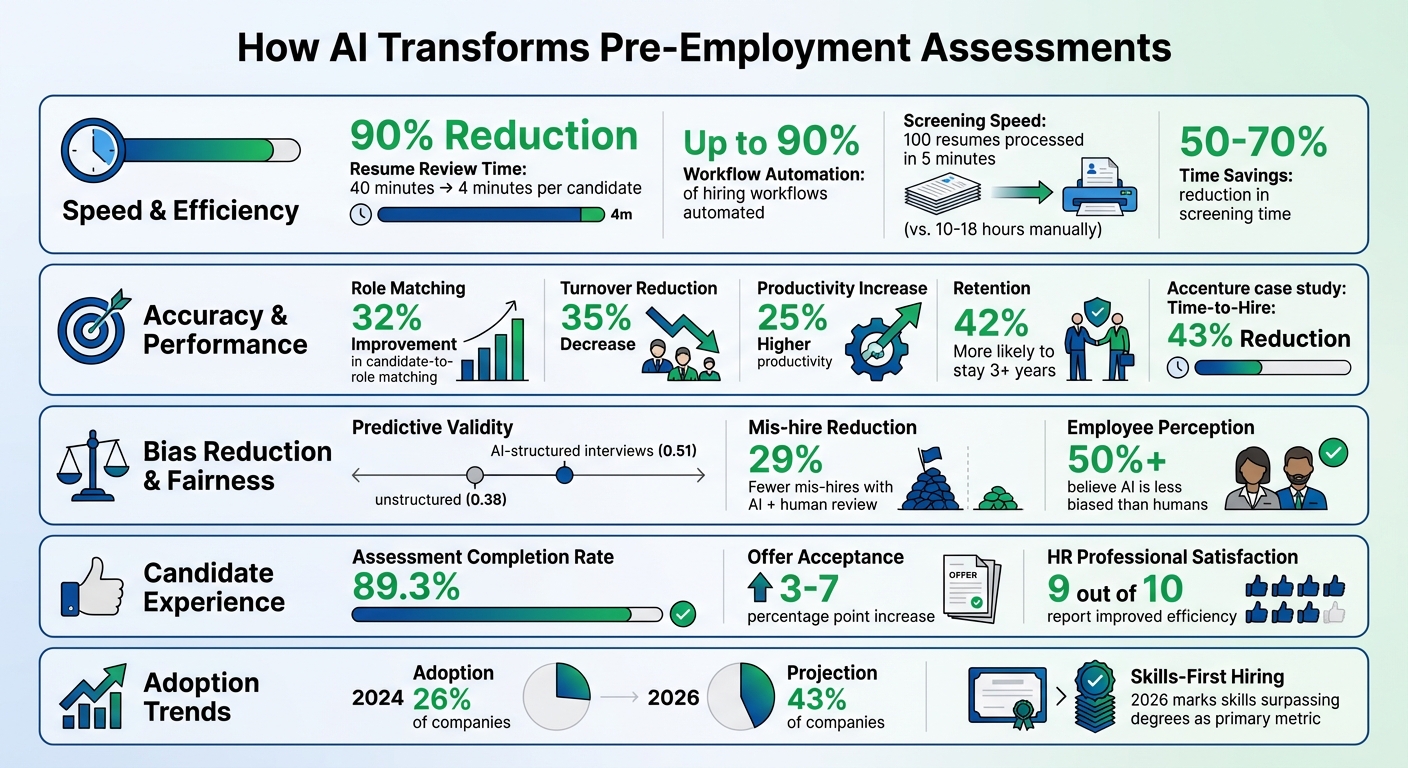
- Speed: AI reduces resume review time from 40 minutes to 4 minutes per candidate.
- Accuracy: Predictive analytics improve role matching by 32% and reduce turnover by 35%.
- Bias Reduction: AI removes identifiers like names and photos, focusing solely on skills and qualifications.
- Efficiency: AI automates up to 90% of hiring workflows, freeing recruiters to focus on decision-making.
- Transparency: Candidates receive instant feedback, improving their experience and engagement.
AI tools like Skillfuel integrate seamlessly with Applicant Tracking Systems (ATS), enabling smarter, faster, and more objective hiring processes. While AI enhances efficiency, human oversight remains critical for nuanced decisions.
AI Impact on Pre-Employment Assessments: Key Performance Metrics
Build an AI Agent for job fit assessment
sbb-itb-e5b9d13
How AI Improves Assessment Accuracy
AI transforms subjective evaluations into objective, data-driven insights. Machine learning models sift through thousands of past hiring decisions, performance data, and assessment outcomes to uncover patterns linked to job success. Instead of relying on subjective opinions, AI leverages diverse data points such as psychometric test results, structured interview scores, performance metrics, and turnover histories to provide a well-rounded evaluation of each candidate.
Companies using predictive analytics in hiring report impressive results: a 25% increase in productivity, a 35% reduction in turnover, and a 32% improvement in matching candidates to roles within the first year. Employees placed in roles through predictive methods are also 42% more likely to stay with the company for over three years. These benefits not only streamline hiring but also ensure better role alignment, underscoring the value of data-centric evaluation systems.
One standout capability of AI is its focus on substance rather than superficial keywords. Natural language processing identifies equivalent skills, expanding the pool of qualified candidates – sometimes by a factor of 10 for certain technical roles. These advancements set the stage for more accurate performance predictions, as explained below.
Using Machine Learning for Performance Prediction
Machine learning goes beyond candidate screening – it predicts future performance. These models estimate key metrics like first-year success, time-to-productivity, retention likelihood, and even promotion potential. By comparing role requirements with market benchmarks from top performers, they establish clear competency standards. Plus, as hiring and performance data accumulate, these systems continually refine their predictions.
Take IBM, for instance. By 2026, the company had removed degree requirements from over 50% of its job postings, using AI to focus on skills instead. The result? Hires from this approach performed as well as – or better than – those chosen based on traditional credentials. Similarly, Unilever integrated predictive analytics into video interviews, analyzing tone, language, and psychometric data. This reduced their hiring process by 75% while handling over 250,000 applications annually.
| Predictive Target | Data Source / Signal |
|---|---|
| First-year performance | Performance reviews, objective metrics (e.g., sales, NPS) |
| Retention risk | Turnover records, personality and motivation assessments |
| Time-to-productivity | Onboarding progress, technical skill proficiency scores |
| Cultural alignment | Team surveys, behavioral test results |
Adaptive Testing for Personalized Evaluation
AI doesn’t stop at predictive modeling – it also tailors assessments in real time. Adaptive testing adjusts the difficulty of questions based on candidates’ responses, offering a more accurate measure of their abilities beyond simple memorization. If a candidate excels, the system presents tougher challenges; if they struggle, it adjusts to pinpoint their skill level. This dynamic approach delivers a deeper understanding of a candidate’s skills, behaviors, and motivations – far more than a traditional resume ever could.
Game-based assessments add another layer by evaluating cognitive abilities and behavioral traits through real-time challenges. These tests consistently measure problem-solving and communication skills, using objective benchmarks and psychometric scales. By minimizing subjective impressions, AI ensures a standardized evaluation process.
For example, Accenture used predictive AI to assess applicants across more than 30 skills and cultural indicators. This led to a 43% reduction in average time-to-hire and boosted global candidate satisfaction scores. When combined with human judgment, AI-driven insights reduce mis-hires by 29% compared to using AI alone.
Automating Recruitment Tasks with AI
AI has transformed recruitment by taking over repetitive, time-consuming HR tasks, allowing recruiters to focus on evaluating candidates and making informed decisions. In fact, nearly 9 out of 10 HR professionals using AI in recruiting report noticeable improvements in efficiency and time management.
Today’s AI systems can automate up to 80–90% of the workflows for high-volume roles. Tasks like triaging applications, parsing resumes, scoring candidates, and managing schedules are now handled with ease.
Automated Candidate Screening
AI-powered screening tools can analyze resumes, applications, and cover letters, extracting key details like skills, experience, and accomplishments. This data is then standardized to enable fair comparisons between candidates. Unlike basic keyword filters, modern AI uses natural language processing to understand related skills and assess the depth of experience. For instance, if a resume mentions "Terraform", the system might identify this as expertise in Infrastructure as Code, ensuring qualified candidates aren’t overlooked.
After extracting the data, AI applies scoring rubrics tailored to job-specific requirements, such as certifications and must-have skills. Candidates are ranked accordingly, and the system generates clear explanations for why a candidate was shortlisted or excluded.
"AI candidate screening tools parse resumes, infer skills, and rank applicants against your job-relevant criteria – directly inside your ATS – so you can produce smaller, stronger slates in hours, not days." – Ameya Deshmukh
The time savings are undeniable. For example, manually screening 300 applications for a single role can take 10–18 hours. AI, on the other hand, can process 100 resumes in just 5 minutes. This efficiency can reduce screening time by 50% to 70%, speeding up the hiring process significantly.
| Task | Manual Workflow | AI-Automated Workflow |
|---|---|---|
| Resume Review | Quick skims; inconsistent criteria | Instant parsing; skills-based ranking with notes |
| Candidate Matching | Basic keyword searches | Semantic analysis with related skill detection |
| Shortlist Creation | Days of manual comparison | Ranked lists generated in minutes |
Once candidates are scored, AI integrates seamlessly with Applicant Tracking Systems (ATS) to streamline the recruitment process further.
Integration with Applicant Tracking Systems
AI acts as a smart layer within your Applicant Tracking System, connecting via APIs to automatically process new applications and update candidate records. This eliminates the need for manual data entry, saving recruiters from switching between tools or copying information by hand.
Features like "Match Scores" can be mapped to ATS custom fields, while real-time syncing through webhooks ensures all data stays updated. Testing these integrations with sample resumes can help confirm accuracy and reliability.
AI tools are compatible with major ATS platforms like Greenhouse, Lever, Workday, iCIMS, Oracle, SAP, and Zoho Recruit. For teams using Skillfuel, AI can centralize candidate data and automate stage transitions, keeping all recruitment activities within a single dashboard.
Beyond screening, AI handles entire workflows – from deduplicating candidate profiles to scheduling interviews. It manages complex scheduling tasks, coordinating across time zones, sending confirmations, and rebooking when necessary. By automating these steps, AI not only reduces manual effort but also sets the foundation for a more streamlined hiring process.
Reducing Bias in Hiring Decisions
AI is reshaping hiring processes by introducing structured, objective methods that reduce bias and improve decision-making. By standardizing evaluation criteria and hiding non-relevant details – like names, photos, addresses, and graduation years – AI minimizes the influence of implicit bias during pre-employment assessments. Instead of relying on subjective impressions, AI enforces competency-based assessments, ensuring evaluations remain consistent and focused on job-related skills. However, achieving this level of impartiality requires rigorous standards and constant oversight.
The results are encouraging. According to a 2024 Gartner survey, over half of employees believe humans are more prone to bias in hiring than AI. AI-powered structured interviews have shown a predictive validity of about 0.51, compared to 0.38 for unstructured interviews.
"AI reduces bias in mass hiring by removing identifying data from resumes, enforcing structured, skills-based criteria, standardizing interviews and scorecards, and continuously monitoring fairness metrics."
- Ameya Deshmukh, Director of Recruiting
Setting Standards for Unbiased AI Systems
To ensure fairness, organizations must regularly audit their AI systems. For instance, conducting monthly adverse impact analyses using the four-fifths rule can help identify potential bias. This rule flags an issue when a protected group’s selection rate falls below 80% of the highest group’s rate.
Frameworks like the NIST AI Risk Management Framework (RMF) provide guidelines for addressing bias, ensuring transparency, and maintaining oversight. These frameworks encourage the creation of governance tools such as decision policies, bias testing logs, and change control records. Legal measures, such as NYC Local Law 144, mandate annual independent audits of automated hiring tools, while the EEOC reminds employers that they remain accountable for AI-driven hiring outcomes. Additionally, defining clear "must-have" versus "nice-to-have" competencies before screening helps prevent evaluation drift. Maintaining immutable, timestamped digital records ensures auditability throughout the process.
Despite these rigorous measures, human insight remains essential for making final hiring decisions.
Combining AI with Human Review
While AI brings efficiency and consistency, human judgment adds critical context and nuance. A hybrid approach combines the strengths of AI and human decision-making. AI can handle initial triage, generate "why matched" rationales, and enforce structured evaluations, while humans oversee high-stakes decisions like final offers or sensitive rejections. For example, using AI-driven scorecards for interview evaluations allows interviewers to submit independent scores, reducing anchoring bias. Human oversight ensures careful review of borderline candidates and final-round decisions.
"The real shift isn’t replacing recruiters; it’s augmenting them with accountable AI Workers that enforce structured, job-related evaluation and produce auditable proof."
- Ameya Deshmukh, Director of Recruiting
Platforms like Skillfuel exemplify this balance by centralizing candidate data and automating routine tasks, while still leaving final hiring decisions to human recruiters. This integration allows AI to manage repetitive tasks with accuracy, freeing recruiters to focus on evaluating motivation, building relationships, and closing candidates effectively.
Better Candidate Experience with AI Assessments
A smooth and transparent assessment process does more than just evaluate candidates – it actively engages them while boosting your employer brand. AI takes the guesswork and delays out of traditional assessments, offering a responsive experience that values candidates’ time and builds trust from the start.
Instant Feedback for Candidates
AI-powered assessments provide immediate, structured feedback, highlighting candidates’ strengths and areas for improvement – even for those not selected. This kind of transparency matters. In fact, 86% of talent leaders surveyed in 2025 acknowledged that AI is essential in recruitment, partly because it enables real-time communication throughout the hiring process.
Additionally, AI chatbots are available around the clock to answer FAQs, share timelines, and keep candidates updated. Automated email and SMS reminders further ensure high completion rates – reaching as much as 89.3% – while reducing the uncertainty that can cause candidates to lose interest. Companies using fully AI-driven hiring systems have even reported offer acceptance rates climbing by 3 to 7 percentage points, thanks to better communication and engagement.
This level of instant communication sets the foundation for smoother and more accessible digital experiences.
Clear and Accessible Assessment Platforms
Modern AI platforms are designed with accessibility in mind, often adopting mobile-first designs and fast load times so candidates can complete assessments anytime, anywhere. Many aim for a "time-on-task" of under 20 minutes, minimizing fatigue and reducing the likelihood of candidates dropping out. Browser-based interfaces eliminate the need for app downloads or complex logins, making it easier for candidates to start and finish assessments without unnecessary technical hurdles.
Platforms like Skillfuel illustrate this approach by centralizing candidate data and automating repetitive tasks, all while maintaining an intuitive, user-friendly interface. Features like clear instructions, multilingual support, and accessible formats ensure that candidates can fully engage with the process, regardless of their background or device. By integrating automated scheduling, transparent scoring, and instant updates, AI-powered platforms deliver a seamless, consumer-grade experience that aligns with the expectations of today’s job seekers.
Conclusion
AI is reshaping how talent is evaluated. By relying on objective and consistent criteria, it removes biases like favoring specific universities or job titles. Using natural language processing, AI can focus on the essence of a candidate’s experience. For instance, it recognizes that phrases like "built performance dashboards" and "created analytics reporting" reflect the same core skills, even if worded differently. This shift towards a skills-first approach brings an entirely new level of efficiency.
These efficiency gains are game-changing. AI-powered systems can now create and validate competency standards in mere minutes, a process that used to take days. Platforms using these tools have reported reducing time-to-hire by over 40% while also improving candidate satisfaction. Achieving this kind of speed and precision manually would be nearly impossible – especially as 2026 marks the year when skills officially surpass degrees as the primary hiring metric.
Beyond efficiency, AI also ensures compliance. Competency-based tools provide clear, auditable documentation for screening decisions, which is vital for adhering to new regulations like the EU AI Act and NYC Local Law 144. Plus, by automating the scoring and ranking of work samples and case studies, AI enables recruiters to apply practical assessments to all candidates – not just a select few in the final stages.
A platform like Skillfuel highlights this transformation by centralizing candidate data, automating repetitive tasks, and offering an easy-to-use interface that supports large-scale, skills-based hiring. With AI-assisted recruitment adoption projected to hit 43% in 2026 – up from 26% in 2024 – companies lagging behind risk losing ground to competitors who are seeing 25% higher productivity and 35% lower turnover. By integrating AI-driven tools, organizations can streamline their hiring processes while gaining a competitive edge in both precision and fairness.
FAQs
What data does AI use to predict job success?
AI reviews a wide range of candidate information to predict job performance. This includes analyzing resumes, skills, experience, education, and structured application responses. It also examines work samples, assessment results, and even details like interview notes, transcripts, and logistical factors such as response times or scheduling habits. By identifying patterns across these data points, AI helps streamline evaluations and contributes to quicker, more balanced hiring decisions.
How do companies audit AI hiring tools for bias?
Companies are taking steps to ensure AI hiring tools are fair and unbiased. They’re implementing policies, conducting regular audits, and incorporating human oversight into the process. To minimize bias, they standardize decision-making, remove identifiable sensitive data, and rely on structured scorecards for evaluations. Tracking fairness metrics, such as adverse impact, also plays a key role. By continuously monitoring these systems, businesses can tackle biases, including those stemming from historical data.
How much human review should stay in an AI-driven assessment?
AI is great at handling repetitive tasks and evaluating skills-based criteria with precision. But when it comes to more nuanced decisions, human involvement is essential. Human reviewers step in to provide oversight, address potential biases, and ensure fairness in the final judgment.
By combining AI’s efficiency with human insight, assessments can achieve a balance that’s both accurate and equitable. This partnership ensures that while AI handles the heavy lifting, humans maintain the necessary checks to uphold integrity in the evaluation process.