
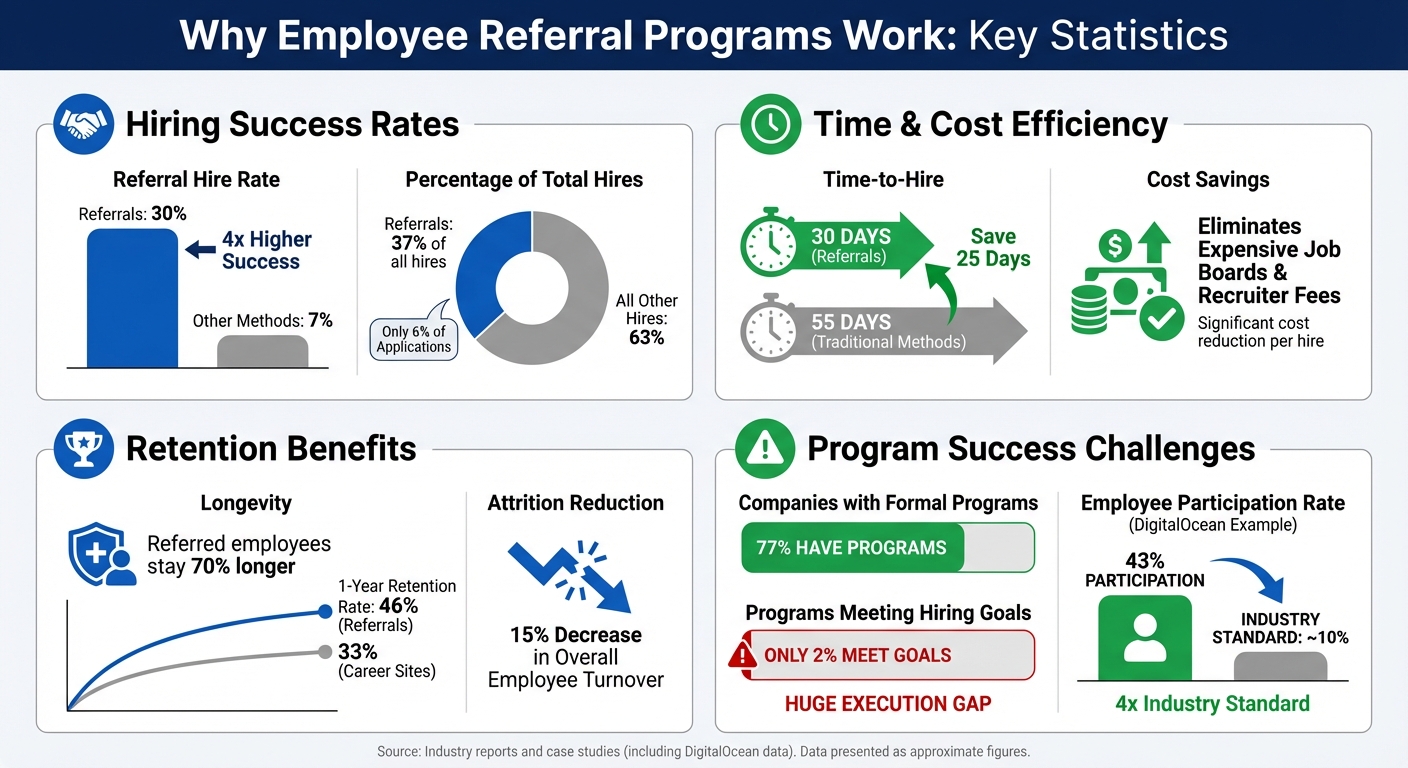
Employee referral programs are one of the most effective ways to hire top talent. They bring in higher-quality candidates, reduce hiring costs, and boost retention rates. Here’s why they work and how to make them successful:
- Better Hiring Outcomes: Referred candidates are hired 30% of the time, compared to 7% for other methods, and stay 70% longer.
- Cost Savings: Referral programs eliminate the need for expensive job boards or recruiter fees.
- Faster Hiring: Referrals take an average of 30 days to hire versus 55 days for traditional methods.
- Retention Benefits: 46% of referred employees stay after one year, compared to 33% from career sites.
To build an effective program, focus on these key elements:
- Clear Goals: Align the program with company hiring priorities and track metrics like time-to-hire and retention rates.
- Tiered Rewards: Offer bonuses based on role difficulty and split payments to encourage quality and retention.
- Automation: Use tools to track referrals, update employees, and manage payouts seamlessly.
- Gamification: Add leaderboards and badges to engage employees.
- Transparency: Clearly outline rules, provide updates, and acknowledge referrals quickly.
- Fraud Prevention: Implement safeguards like staggered payouts and automated fraud detection.
- Employee Motivation: Combine cash rewards with non-cash incentives like charitable donations or PTO.
- Simplicity: Make the referral process straightforward and accessible, integrating it with existing tools.
- Targeted Roles: Focus referrals on high-priority or hard-to-fill positions.
- Consistent Promotion: Regularly remind employees about the program and share success stories.
Pro Tip: Platforms like Skillfuel simplify referral tracking and reward management, ensuring employees stay engaged and the program runs smoothly. By combining automation, transparency, and engagement strategies, you can turn your team into a powerful recruiting force.
Employee Referral Program Statistics: Hiring Success Rates and ROI
The Power of an Employee Referral Program | AIHR Learning Bite
sbb-itb-e5b9d13
1. Clear Goals and Objectives
Having clear objectives is the backbone of any successful referral policy. Without defined goals, employees can feel directionless, and it becomes nearly impossible to measure success. Interestingly, only 2% of companies report that their referral programs actually meet their hiring goals.
To make the most of your referral program, focus on filling critical roles – whether they’re technical positions, leadership roles, or urgent vacancies. For instance, HubSpot incentivizes employees with a $10,000 bonus for referring developers who stay for at least four months. Likewise, Intel saw an increase in hires from underrepresented groups (from 32% to 41%) by doubling referral bonuses for these candidates.
Alignment with Organizational Goals
Setting measurable objectives is key to aligning your referral program with broader company goals. Metrics like the Referral Hire Rate (aiming for 30–40% of total hires), Time-to-Hire (targeting around 30 days versus the 55-day average for traditional methods), Cost-per-Hire, and the 1-Year Retention Rate can help showcase the program’s value to leadership.
"Without this foundation [defined goals], your program is just a map with no destination – confusing, aimless, and ultimately ignored." – Vicky Liu, Author, Juicebox
By tying these metrics to organizational priorities, you not only sharpen the program’s focus but also create a framework for boosting employee involvement.
Effectiveness in Driving Employee Engagement
Transparency is a game-changer when it comes to employee engagement. Sharing real-time updates about a referral’s progress – whether they’ve reached the phone screen, been scheduled for an interview, or received an offer – builds trust and keeps employees invested. Automated notifications at every stage ensure the program stays top-of-mind. DigitalOcean, for example, achieved a 43% participation rate – four times the industry standard – by offering a $3,500 referral bonus along with a $1,500 charitable donation.
2. Tiered Reward Systems
Flat bonuses might seem straightforward, but they can actually hurt referral quality. Why? When the reward is the same for every hire, employees might prioritize quantity over quality – referring anyone they know just to claim the bonus. Tiered reward systems address this issue by aligning incentives with what matters most: the difficulty of the role, retention rates, and sustained engagement. This structure not only improves the quality of hires but also supports long-term retention, aligning perfectly with recruitment goals.
One effective approach is splitting payouts into milestones. Instead of paying the full bonus upfront, offer 50% when the candidate starts and the remaining 50% after 90 days of employment. This staggered payment model encourages employees to recommend candidates who are likely to succeed long-term. It’s no surprise that 54% of organizations now use installment payments to safeguard the quality of their hires.
Impact on Referral Quality and Retention
Tiered systems naturally lead to better hires. By scaling bonuses based on the complexity of the role – ranging from $250–$500 for entry-level jobs to $5,000–$10,000 for executive positions – employees focus on filling the roles that are hardest to staff and deliver the most impact. For example, Stripe managed to cut its time-to-hire by 35% and now sources 55% of its engineering hires through a referral program that includes bonus "kickers" for speed.
Retention is another major win. Referred hires stay 70% longer than those sourced through other channels, and referral programs can lower overall employee turnover by 15%. By tying the second half of the bonus to a retention milestone, employees are incentivized to refer candidates who will thrive in the company – not just anyone who might not stick around.
Effectiveness in Driving Employee Engagement
Tiered systems also help keep your best referrers engaged without driving up costs across the board. Rewarding repeat referrers with escalating bonuses – like a 25–50% increase for a third successful referral within a year – recognizes your top talent scouts while staying mindful of budget constraints. You can also mix cash rewards with non-monetary perks, such as extra PTO or donations to a favorite charity. These options not only align with company values but also appeal to a wide range of employee motivations.
3. Automated Tracking and Management
Relying on spreadsheets and email chains for referral tracking is a recipe for inefficiency. These manual methods bog down HR teams with repetitive tasks and leave room for errors. Automated tracking systems, on the other hand, streamline the entire process. From collecting resumes to updating statuses and distributing rewards, everything operates from a single, user-friendly dashboard. This approach not only simplifies referral management but also makes it scalable for growing organizations.
Ease of Implementation and Scalability
Automation takes a huge load off administrative teams. In fact, modern referral platforms can reduce administrative tasks by up to 70%. These systems handle everything from notifying recruiters to verifying rewards, all without manual input. James Arnold, a Principal Recruiter and Talent Acquisition Expert, emphasizes the importance of focus for smaller companies. He warns that failing to manage referrals effectively can damage a company’s brand if backlogs pile up.
Integration with your Applicant Tracking System (ATS) is another game-changer. When your referral platform syncs with your ATS, data flows smoothly from submission to hire. This eliminates manual data entry, avoids duplicate records, and ensures no candidates are overlooked. Mobile-friendly platforms add an extra layer of convenience, allowing employees to refer candidates on the spot – like at networking events or conferences.
Effectiveness in Driving Employee Engagement
Transparency is critical for keeping employees invested in a referral program. Real-time updates and personalized dashboards let referrers track their candidate’s progress through the hiring process. This builds trust and motivates employees to stay engaged. Automated reward systems further enhance the experience by verifying hires and triggering bonus payments quickly. This removes the need for HR to manually manage payouts, ensuring employees feel appreciated without delay. When communication is this seamless, it not only encourages participation but also leads to better hiring outcomes.
Impact on Referral Quality and Retention
Automation doesn’t just make things easier – it delivers better results. Faster tracking and automated follow-ups ensure referred candidates move through the hiring process efficiently. While referrals make up only 6% of applications, they account for a staggering 37% of all hires. Additionally, AI-powered systems can match candidates to the most suitable roles based on their skills and experience, increasing the likelihood of successful, long-term hires.
"Referred candidates are of higher quality than applicants from the general public and are more likely both to receive and accept an offer, stay at the job longer and perform better" – Harvard Business Review
4. Gamification and Recognition
Once you’ve got streamlined tracking and clear rewards in place, gamification can elevate your employee referral program by introducing an element of competition.
Gamifying referrals transforms what might feel like a passive task into an engaging challenge. Employees tap into their natural desire for achievement and acknowledgment, striving to stand out among their peers. Tools like leaderboards, badges, and progress bars add excitement, turning referrals into an ongoing, interactive experience.
Effectiveness in Driving Employee Engagement
Gamification has a proven track record of boosting engagement. For instance, gamified elements can increase employee engagement by 48%, while leaderboards alone can drive a 35% jump in referral volume. Real-time updates and visible leaderboards not only keep employees informed but also encourage friendly competition. As Jürgen Ulbrich, CEO & Co-Founder of Sprad, explained:
"Since we introduced a leaderboard, our employees perceive the referral program much more positively and engage significantly more".
Progress markers play a crucial role in this process. For example, progress bars showing how close employees are to earning a badge or advancing to the next reward tier can motivate them to stay involved. The impact is substantial: gamified referral programs have been shown to boost monthly engagement by 71% and increase monthly active users by 62%.
When gamification is paired with transparent tracking and tiered rewards, it creates a well-rounded strategy that sustains hiring momentum over time.
Alignment with Organizational Goals
A key to long-term success lies in rewarding the process, not just the outcome. Offering points or recognition for smaller milestones – like when a candidate reaches the interview stage or when an employee shares a job posting – keeps employees engaged and ensures the referral pipeline remains active. Tiered rewards work particularly well for filling challenging roles, as higher-value incentives can encourage employees to focus their efforts on the positions that matter most.
Framing gamification around the idea of "building the team" instead of simply "earning a bonus" also shifts the focus toward quality over quantity. This approach motivates employees to prioritize candidates who are a good match for the company’s culture and long-term goals.
Impact on Referral Quality and Retention
Public recognition adds an extra layer of accountability. Knowing that their referrals will appear on leaderboards or be highlighted in company updates encourages employees to be more selective about the candidates they recommend. The results speak for themselves: referred hires tend to stay 70% longer with their employers and have a 46% retention rate after one year, compared to just 33% for hires from career sites.
Interestingly, while monetary rewards are effective, offering excessively high bonuses can sometimes backfire. Research suggests that moderate incentives – ranging from $1,000 to $2,500 – paired with visible recognition often lead to the best outcomes. Employees in these scenarios are more likely to focus on finding candidates who are a strong fit, often turning to trusted former colleagues or close professional connections. These "strong-tie" referrals are three times more likely to result in a successful hire.
5. Transparent Rules and Conditions
Clear objectives and automated systems are key, but transparent rules are what truly tie an effective referral program together. While gamification might grab attention initially, it’s the clarity of the program’s rules that keeps employees engaged over the long haul. When people know exactly how the process works and can track their referrals in real-time, they’re far more likely to stay involved.
Here’s a telling statistic: 77% of organizations have formal referral programs, yet only 2% hit their hiring targets. Why? The main issue is often a lack of clarity and responsiveness. As Pin aptly put it:
"Silence kills future participation faster than anything else".
Effectiveness in Driving Employee Engagement
One of the quickest ways to lose employee interest is the dreaded “black hole” effect – when referrals are submitted but never acknowledged. To combat this, many companies set up a 48-hour Service Level Agreement (SLA) to acknowledge every referral. This simple step fosters trust and prevents frustration. Real-time notifications also help keep referrals front and center, ensuring employees stay engaged. Additionally, publishing a monthly list of high-priority, hard-to-fill roles can guide employees to focus their efforts where they’re needed most.
Alignment with Organizational Goals
Transparent rules work best when they align with the company’s broader goals and automated processes. For instance, tiered bonus structures – like paying half the reward upon hire and the rest after 90 days – emphasize the importance of long-term fit rather than just filling a position. Intel offers a great example of this in action: to boost diversity, the company doubled its referral bonus to $4,000 for hiring women, minorities, and veterans. This initiative led to an increase in underrepresented hires from 32% to 41%. Clear guidelines on role eligibility and milestone criteria empower employees to make more strategic referrals.
Impact on Referral Quality and Retention
Transparency doesn’t just enhance engagement; it also improves the quality of referrals and boosts retention. When employees know their referrals will be evaluated fairly and receive feedback – even if not selected – they tend to be more thoughtful in their recommendations. Well-designed referral programs can even reduce overall attrition by 15%.
Inclusivity plays a critical role here as well. Research indicates that women of color are 35% less likely than white men to receive employee referrals. By implementing clear and inclusive rules that encourage diverse referrals, companies can help address biases and avoid the risks of homogenous hiring patterns, which could lead to EEOC compliance issues.
This level of transparency also paves the way for seamless referral tracking using tools like Skillfuel.
6. Fraud Prevention Measures
Protecting a referral program from fraud is essential to maintain its integrity and credibility. Without proper safeguards, these programs can become easy targets for abuse – whether through self-referrals or discount-sharing schemes that deplete budgets without bringing in meaningful hires. The key is finding the right balance: strengthening security measures while ensuring the process remains accessible for genuine participants. This layer of protection builds on the transparency discussed earlier, ensuring trust remains intact.
Alignment with Organizational Goals
Fraud prevention doesn’t just protect budgets; it ensures rewards go to the right people. Referral fraud makes up 21% of all fraud in e-commerce businesses, and similar risks exist in employee referral programs. When fraud isn’t addressed, it distorts hiring metrics, wastes money on illegitimate payouts, and undermines the trust of employees who follow the rules.
A striking example of referral fraud occurred in 2014 when an Uber user, Blake Jared, exploited a loophole by modifying his referral code to "uber$20FreeRide." He shared it widely, earning over $50,000 in ride credits before Uber’s systems identified the issue and shut down his account. To prevent such abuse, some companies split bonus payouts over time, ensuring that referrals are tied to long-term success rather than quick cash grabs.
Ease of Implementation and Scalability
Modern tools make fraud detection both effective and scalable. Automated tracking systems are particularly adept at identifying suspicious patterns. For instance, velocity checks can flag accounts that submit an unusually high number of referrals in a short period – like five in an hour – often a sign of bot activity or referral farming. Similarly, IP address monitoring and device fingerprinting can identify self-referrals by detecting multiple accounts created from the same device.
Other measures, like email pattern recognition, block temporary or alias email addresses (e.g., "name+1@domain.com") commonly used by fraudsters. Setting redemption limits – such as capping how many times a code can be used or how much one person can earn – further prevents abuse without discouraging legitimate participants. These automated solutions are designed to grow with your program, handling thousands of referrals without requiring manual oversight. Together, they ensure only genuine referrals make it through.
Impact on Referral Quality and Retention
Interestingly, offering larger bonuses can sometimes backfire. A study of 10,000 workers revealed a "bonus size paradox", where overly generous incentives led employees to prioritize quantity over quality, referring anyone they could to claim the reward. By keeping incentives moderate and pairing them with strong fraud prevention measures, companies can maintain a focus on quality referrals.
Non-cash incentives, such as paid time off, gift cards, or charitable donations, also help reduce fraud. These rewards naturally attract employees who are genuinely invested in building a strong team, rather than those simply chasing a payout. This approach filters out opportunists and ensures the program remains aligned with its ultimate goal – bringing in top talent.
7. Employee Motivation Research
Understanding what truly drives employees is key to creating successful referral programs. Surprisingly, only 2% of companies report achieving their hiring goals through referral programs. This low success rate often stems from an overreliance on generic cash bonuses. While money matters, it’s not the only factor. Employees are also motivated by altruism, professional pride, and the desire to work alongside trusted colleagues.
Effectiveness in Driving Employee Engagement
Bigger bonuses don’t always mean better results. Research shows that overly generous financial incentives can actually lower candidate quality. This "bonus size paradox" happens when employees focus on quantity over quality. Companies that mix financial rewards with other incentives see much better engagement. Take DigitalOcean, for instance. In 2025, they added a $1,500 charitable donation to their $3,500 referral bonus, achieving a 43% participation rate – four times the industry average. By aligning rewards with employees’ values, companies can encourage high-quality referrals while boosting participation.
Alignment with Organizational Goals
Motivation research also helps shift the perception of referrals from a simple cash transaction to a meaningful team-building opportunity. When employees see referrals as a way to shape their teams, they naturally focus on finding candidates who fit the organization’s values and long-term goals. This approach also supports broader objectives like diversity, equity, and inclusion.
Impact on Referral Quality and Retention
The strength of the referrer-candidate relationship plays a huge role in referral success. "Strong-tie" referrals – those involving former colleagues known for at least a year – are nearly three times more likely to result in successful hires than weaker connections made through social media. Additionally, referred candidates are hired at a 30% rate, compared to just 7% from other sources. To maintain quality, companies often keep bonuses in the $1,000–$2,500 range for most roles and use tiered payouts, splitting the reward between the hire date and a 90-day retention milestone. Simplifying the referral process further enhances engagement and improves hiring outcomes.
8. Simple and Accessible Process
Even the most attractive incentives won’t succeed if submitting referrals feels like a hassle. Manual systems – think spreadsheets and email chains – create unnecessary obstacles, discouraging employees from participating. The fix? Use digital tools to centralize and automate the process. These platforms handle everything: collecting resumes, updating statuses, and notifying recruiters automatically. By simplifying submissions, companies make it easier to track referrals and maintain strong engagement.
Effectiveness in Driving Employee Engagement
Modern tools that integrate with everyday communication platforms like Slack make referrals a breeze. With just "two clicks", employees can submit candidates without leaving their workflow. This ease of use encourages participation. As Deel highlights:
"For a referral program to be successful, it also needs to be convenient to participate in".
Ease of Implementation and Scalability
Automation doesn’t just simplify – it scales. Mobile-friendly platforms allow employees to make referrals on the go. Whether they’re at a conference, an industry event, or even a casual gathering, employees can act immediately. This real-time capability significantly increases submission rates.
Impact on Referral Quality and Retention
Automation paired with transparent updates builds trust in the referral program. Skillfuel emphasizes the importance of clarity:
"When employees are unsure of the status of their referrals or feel that their efforts go unacknowledged, they’re less likely to participate".
Real-time dashboards eliminate guesswork, showing employees exactly where their referrals stand in the hiring process. The benefits are clear: referred candidates are hired about 25 days faster than through traditional methods (30 days vs. 55 days) and tend to stay with their employers 70% longer. Introducing the referral program during onboarding ensures new hires are aware of it from the start, setting the tone for early participation and long-term engagement.
9. Quality-Focused Hiring Strategies
Limiting referrals to specific, high-priority roles can help maintain the quality of candidates. When referrals are open for all positions, it becomes harder to identify top-tier talent, particularly for senior technical or leadership roles, as they often get lost among less suitable submissions.
Alignment with Organizational Goals
Offering overly generous incentives can sometimes backfire. When referral rewards are too high, employees may focus on quantity, referring anyone they know to claim the reward, rather than prioritizing quality candidates. Google’s approach, called "High-Incentive, High-Bar", ensures a balance. They offer bonuses ranging from $2,000 to over $15,000 but pair this with a rigorous interview process to maintain hiring standards.
Impact on Referral Quality and Retention
Referral hires often outperform candidates from other sources. Particularly effective are "strong-tie referrals", where employees recommend former colleagues they have worked with closely for at least a year. These trusted connections tend to align more naturally with the organization’s standards. HubSpot saw a 40% improvement in referral quality by adopting an "Enablement-First" strategy, which involved equipping employees with interview guides and market insights.
Splitting referral bonuses – half paid at the time of hiring and the rest after 90 days – can also encourage employees to focus on recommending candidates who will be a long-term fit. Referral hires have a 46% retention rate after one year, compared to just 33% for hires from career sites. Additionally, well-executed referral programs can lower overall attrition rates by 15%.
10. Consistent Program Promotion
Even the best referral programs can fall flat if employees forget they exist. Keeping the program consistently visible ensures it stays top-of-mind, encouraging high-quality referrals. While referrals make up just 6% of job applications, they account for an impressive 37% of all hires. By regularly highlighting referral opportunities, companies can keep their recruitment efforts engaging and effective.
Effectiveness in Driving Employee Engagement
Promoting a referral program internally is just as crucial as external recruiting efforts. Sharing specific success stories can drive more engagement than generic announcements. For instance, instead of merely stating the bonus amount, show how employees used their rewards – whether it was for a dream vacation, a home down payment, or donating to a cause. This approach makes the incentives feel relatable and within reach. Highlighting referral successes during company-wide meetings can also foster a sense of pride and encourage employees to see themselves as active contributors to hiring.
Ease of Implementation and Scalability
Automation can take the hassle out of keeping referral programs front and center. Automated systems ensure employees are regularly reminded of openings without HR needing to send individual emails. These tools, combined with efficient tracking systems, help maintain employee engagement over time. Introducing the referral program during onboarding sets the expectation for participation from the start. Providing a centralized "Referral Kit" – accessible via shared drives or platforms like Slack – can further empower employees. These kits might include culture guides, job descriptions, and tips for identifying strong candidates. HubSpot, for example, saw a 40% improvement in referral quality after adopting this approach. For urgent or hard-to-fill positions, running time-sensitive contests can also generate a surge in referrals.
Impact on Referral Quality and Retention
Focusing promotion efforts on specific roles can boost both the quality of referrals and employee retention. Instead of advertising every open position, companies can share a monthly "priority referral" list that highlights hard-to-fill or specialized roles, helping employees focus on what matters most. Framing the ask as "Who do you know that fits our culture?" can lead to referrals with greater long-term potential. Building trust is key: acknowledging every referral within 48 hours and providing regular updates on candidates’ progress – whether they’re in phone screens, interviews, or nearing an offer – keeps employees motivated and prevents burnout. Data shows that referred hires stay with their employers 70% longer than those hired through other methods. By combining promotional tactics with tools like Skillfuel, companies can cultivate a culture where referrals are a natural part of recruitment.
Using Skillfuel for Referral Tracking
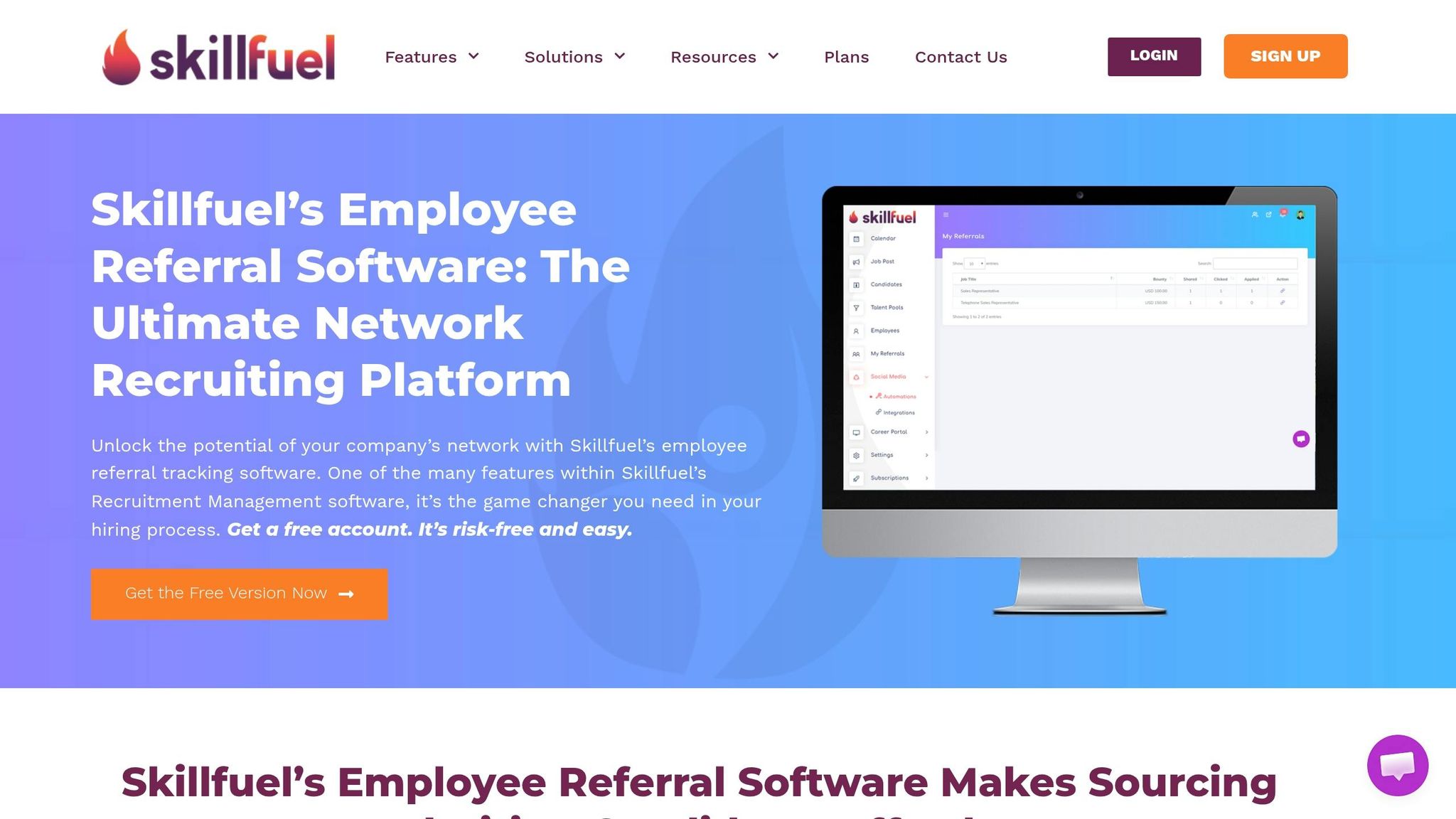
Skillfuel takes referral management to the next level, offering a platform designed to simplify and improve the process. Relying on spreadsheets and email chains for referrals can bog down HR teams, but Skillfuel eliminates that hassle. Its visually friendly dashboard consolidates all referral data, letting HR teams track each candidate’s journey – from submission to job offer. This ensures referrals don’t disappear into a "black hole" where updates are scarce.
The platform also automates incentive management, making it easier to distribute rewards. For example, Skillfuel tracks probation periods based on job type and alerts payroll when it’s time to process payouts. Weekly reminders to hiring teams ensure that high-priority referrals get the attention they deserve.
Skillfuel’s gamification features, like customizable leaderboards, add a competitive edge by recognizing top referrers in real time. Designed with today’s mobile-first workforce in mind, the platform allows employees to submit referrals and check updates directly from their phones, no matter where they are.
Its advanced analytics tools give HR teams valuable insights. They can monitor conversion rates, identify which referral sources yield the best candidates, and spot potential hiring roadblocks. This turns guesswork into clear, actionable data. As Skillfuel puts it:
"In one beautiful UI, you gain full visibility into the critical aspects of your employee referral program".
With analytics and automation working together, Skillfuel makes referral management more efficient for organizations of all sizes.
For pricing, Skillfuel offers a free plan that supports basic referral tracking for up to three active job postings. Paid plans start at $49/month for 10 active postings and go up to $249/month for unlimited postings.
Conclusion
Creating a referral program that works requires consistent effort and attention. The best programs mix clear goals, fair incentives, and easy-to-follow processes that employees are motivated to use. What sets successful programs apart is regular tracking and fine-tuning. By monitoring metrics like referral-to-hire conversion rates, participation levels, and employee retention, you can pinpoint areas for improvement and keep the program effective.
Although 77% of companies have formal referral programs, many still struggle to meet their hiring targets. This often happens because programs start strong but lose momentum over time. Conducting quarterly reviews can help address this by adjusting bonuses, focusing on hard-to-fill roles that have remained open for over 30 days, and tweaking communication strategies based on actual results.
Technology can make or break a referral program. Manual tracking through spreadsheets or email can create unnecessary friction, discouraging employees from participating. Tools like Skillfuel simplify the process by automating everything – from tracking candidate progress to handling incentive payouts. These platforms also improve engagement by sending automated updates to employees at every stage of the referral process (like interviews, offers, or rejections), encouraging them to keep referring candidates.
Combining technology with regular audits keeps your referral program energized. Adhering to strict service level agreements (SLAs) is equally important. For example, ensuring referrals are acknowledged within 48 hours helps maintain trust and enthusiasm among employees. Companies like Stripe and Ramp have demonstrated how strict SLAs and fast referral processes can significantly reduce time-to-hire while boosting employee participation.
FAQs
What metrics should I track to prove a referral program is working?
Tracking the right metrics is essential for understanding how well your referral program is performing. Keep an eye on participation rates, the number of referrals, hires made through referrals, the retention rates of referred employees, and the time-to-hire for these candidates. These data points provide valuable insights into the program’s effectiveness and overall efficiency.
How do I set referral bonuses without hurting candidate quality?
To create an effective referral bonus program, focus on offering balanced, thoughtfully designed rewards and communicating them clearly. Avoid setting bonuses too high, as this might lead to an influx of low-quality referrals. Instead, aim for incentives that are appealing yet maintain high standards. Options like cash rewards, gift cards, or public recognition can all work well.
Pair these rewards with a targeted approach – clearly define the roles you’re focusing on and follow up promptly with referrers. Regularly assess the program’s performance by reviewing the quality of referrals and hiring outcomes. Adjust bonuses as needed to keep the program productive and aligned with your goals.
How can I prevent referral fraud without adding employee friction?
To safeguard your referral program from fraud while keeping it easy for employees to participate, it’s crucial to set clear rules and boundaries. Start by defining who qualifies for rewards, limiting how often referrals can be made, and specifying how long referrals remain valid.
Transparency is essential here. Make sure employees fully understand these guidelines. Clear communication builds trust and encourages compliance, ensuring the program runs smoothly for everyone involved.