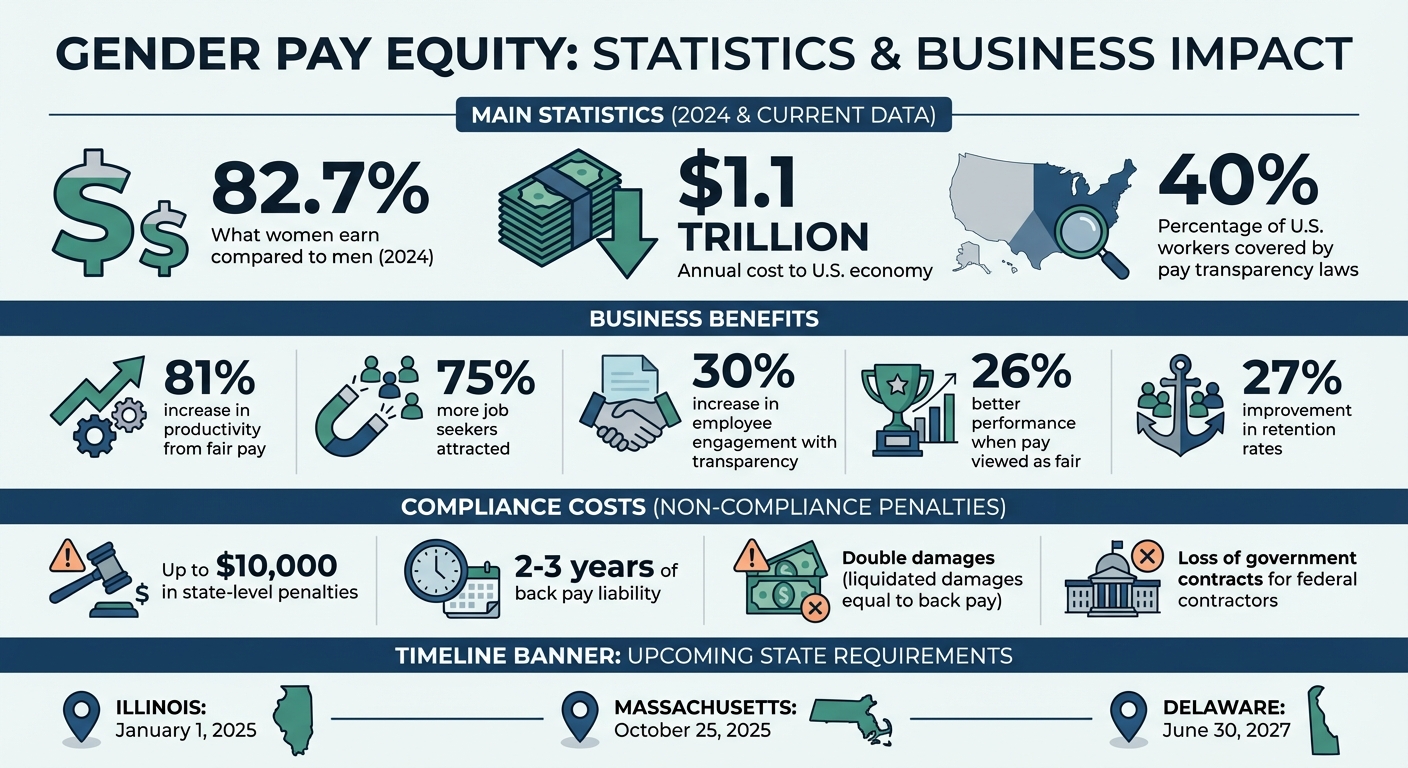
Gender pay equity starts with fair hiring practices. In the U.S., women working full-time earned just 82.7% of what men made in 2024, costing the economy $1.1 trillion annually. Recruiters play a critical role in addressing this disparity by adopting transparent salary practices and avoiding bias.
Key takeaways:
- Laws are tightening: States like California, New York, and Illinois now require salary transparency and ban asking about salary history.
- Businesses benefit: Fair pay boosts productivity by 81% and attracts 75% more job seekers.
- Compliance is costly if ignored: Violations can lead to back pay, damages, and reputational harm.
To ensure compliance, recruiters need training in:
- Offering standardized salaries based on objective criteria.
- Avoiding unconscious bias in job postings and interviews.
- Conducting pay audits to identify and fix gaps.
Tools like Skillfuel can simplify training, automate fair hiring practices, and track compliance. Gender pay equity isn’t just a legal requirement – it’s essential for building trust and retaining top talent.
Gender Pay Gap Statistics and Business Impact 2024
Gender Pay Equity Regulations in the United States
Key Laws Governing Gender Pay Equity
Understanding the key federal laws surrounding gender pay equity is crucial for recruiters. The Equal Pay Act of 1963 (EPA) requires equal pay for "substantially equal" work, focusing on the actual skills and responsibilities of a job rather than job titles. Similarly, Title VII of the Civil Rights Act prohibits pay discrimination based on sex, regardless of whether jobs are directly comparable. As the U.S. Department of Labor emphasizes:
"Job content (not job titles) is what determines whether jobs are ‘substantially equal.’"
The EPA applies to employers with an annual gross business volume of at least $500,000, while Title VII covers most employers with 15 or more employees. Employers can justify pay differences under specific conditions, such as seniority systems, merit systems, incentive systems tied to production, or any "factor other than sex." However, courts have ruled that relying solely on salary history is no longer a valid defense.
In addition to federal laws, many states have introduced stricter requirements. For example, some states mandate salary range disclosures in job postings and prohibit asking about salary history. Illinois will require pay range disclosures starting January 1, 2025, with similar laws set to take effect in Massachusetts on October 25, 2025, and Delaware on June 30, 2027. Non-compliance with these laws can result in penalties of up to $10,000.
These regulations are not optional. Employers face serious financial and legal repercussions for failing to comply.
Penalties for Non-Compliance
The financial consequences of violating pay equity laws can be severe. Under the EPA, employers may be liable for up to two years of back pay, or three years in cases of willful violations. The U.S. Equal Employment Opportunity Commission explains:
"The remedy should include a salary increase and back pay in the amount of the unlawful difference in pay."
In addition to back pay, employers may owe liquidated damages equal to the full amount of back pay, effectively doubling the financial penalty. They are also required to cover the plaintiff’s attorneys’ fees and court costs. Notably, organizations must address pay disparities by raising the lower salary; reducing the higher salary to achieve equity is not allowed.
Courts may also impose injunctive relief, requiring employers to overhaul their compensation systems and policies. Federal contractors face even stricter oversight under Executive Order 11246, which allows the OFCCP to conduct compliance evaluations. Systemic discrimination can lead to the loss of government contracts.
These penalties highlight the importance of recruiters understanding and adhering to gender pay equity laws. Proper compliance training is essential to avoid costly violations and ensure fair compensation practices.
sbb-itb-e5b9d13
Gender Equity Community Training Recording
Preparing Recruiters for Compliance
To tackle gender pay equity compliance, organizations need to establish a strong foundation. This involves two key steps: conducting a thorough pay equity audit and revising internal policies to match current regulations. These steps create a clear framework that helps recruiters make informed and fair hiring decisions.
Conducting a Pay Equity Audit
A pay equity audit is an essential tool for identifying pay gaps and gathering the data needed to address them. Start by assembling a cross-functional team – pulling in members from HR, legal, finance, and operations – to outline the audit’s scope, goals, and methodology. Leadership buy-in is critical to ensure the process is effective and supported.
Dr. Marna van der Merwe, Lead Subject Matter Expert at AIHR, highlights the importance of clear communication when collecting employee data:
"Clearly communicate the purpose of data collection and how you’ll use the information. This fosters trust and encourages participation. At the same time, implement robust safeguards – such as anonymization, restricted access, and aggregate reporting – to protect employee privacy."
The next step involves gathering detailed data from HRIS or payroll systems. This data should include base salaries, bonuses, benefits, job titles, performance metrics, tenure, and demographic information. Employees should be grouped into comparable categories based on consistent criteria such as job level, responsibilities, and required skills. Regression analysis or similar statistical methods can then be used to pinpoint pay disparities while accounting for factors like education and experience.
Real-world examples show how impactful these audits can be. For instance, in 2018, Salesforce invested $3 million to correct pay gaps found during its annual audit. This effort not only boosted productivity by 10% but also earned the company a top rating on the Corporate Equality Index. Similarly, Starbucks achieved gender pay equity in 2024, ensuring women earned 99.6 cents for every dollar earned by men in comparable roles.
The audit’s goal is to determine whether any pay gaps are justifiable – for example, due to performance or seniority – or if they require adjustments. From there, organizations can create a plan to address inequities and set a regular schedule for audits, whether annually or biannually. While 75% of organizations now perform regular pay equity reviews, nearly half do so infrequently, leaving room for unnoticed disparities. These findings are essential for updating internal policies to maintain compliance.
Updating Internal Policies for Compliance
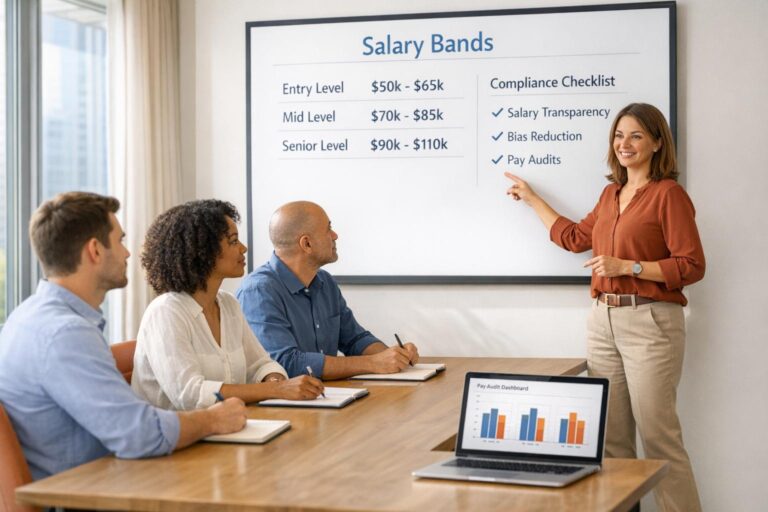
The insights gained from an audit should guide updates to internal policies aimed at closing pay gaps. One effective step is standardizing pay structures by creating clear salary bands and job frameworks. This reduces the potential for bias or inconsistency when setting starting salaries, providing recruiters with clear guidelines for offers.
Another key update is eliminating salary history inquiries. Update job applications and interview protocols to comply with state laws that prohibit asking about prior salaries. Job descriptions should also be revised to focus on actual responsibilities and required skills, ensuring fair pay for "substantially equal work". Adobe’s Strategic Action Plan is a great example: after addressing compensation gaps, the company saw a 30% increase in applications from diverse candidates thanks to clearer salary ranges and targeted recruitment efforts.
Pay transparency is becoming both a regulatory requirement and an advantage for attracting talent. Including salary ranges in job postings can reduce unconscious bias during the hiring process. Currently, about 40% of U.S. workers are covered by pay transparency laws. Companies that adopt transparent practices often see a 30% boost in employee engagement. Employees who view their pay as fair are also more likely to perform better – by up to 26% – and stay longer, with retention rates improving by as much as 27%.
Organizations should also formalize how they justify pay variations, documenting legitimate reasons such as seniority, merit-based evaluations, or incentive programs. Recruiters need clear processes to explain higher starting salaries based on factors unrelated to gender. Despite the importance of these steps, only 54% of HR leaders conduct pay equity audits annually, and one-third of HR professionals lack a formal pay equity strategy.
Core Training Modules for Recruiters
Updated policies are only effective when paired with targeted training. These modules give recruiters the tools they need to address gender pay equity throughout the hiring process. Each module focuses on areas where pay gaps often arise and offers practical strategies to tackle them.
Recognizing and Addressing Unconscious Bias
Unconscious bias can creep into hiring decisions, often without recruiters realizing it. Studies reveal that identical candidates may receive different compensation offers based solely on their gender, with men often offered higher pay – leading to an average gender pay gap of 13% in some regions. Training in this area helps recruiters identify and address these biases.
For instance, job postings often include coded language that unintentionally discourages women from applying. Words like "competitive", "leading", or "active" can alienate potential female candidates. Similarly, vague "culture fit" criteria can perpetuate bias. Instead, recruiters should use objective, gender-neutral standards and evaluate candidates based on skills and qualifications, not subjective impressions.
Bias training should also address name-based discrimination, as studies show that resumes with "white-sounding" names are often favored over identical ones with diverse names. Combining this training with diverse hiring panels and standardized evaluation metrics can help reduce these biases. Ultimately, crafting inclusive job descriptions is the next step in creating an equitable hiring process.
Creating Gender-Neutral Job Descriptions
Job descriptions play a pivotal role in achieving pay equity. Research shows that removing gender-coded language can increase application rates by 29%. Additionally, gender-neutral postings are filled faster – by about two weeks – and reduce cost-per-application by 41%.
To make job descriptions more inclusive, recruiters should replace terms like "rockstar" or "ninja" with neutral alternatives such as "skilled professional" or "specialist." Focus on outcomes rather than rigid methods. For example, instead of saying "must lift 50 lbs", use "moves equipment weighing up to 50 lbs." Here’s a quick comparison:
| Masculine-Coded | Neutral/Inclusive |
|---|---|
| Rockstar, Ninja, Guru | Skilled Professional, Specialist |
| Aggressive, Dominant | Results-oriented, Effective |
| He/She will… | You will… |
| Digital Native | Proficient with digital tools |
Another key issue is "requirements inflation." Women are statistically less likely to apply unless they meet every qualification listed, while men often apply when they meet just 60%. To address this, limit required qualifications to 3–5 essential items. Avoid strict year-based experience requirements and focus on core competencies instead.
Pay transparency is equally important. With 16 U.S. states requiring salary disclosures by 2026, including a reasonable salary range and benefits in job postings signals a commitment to fairness. This is crucial since 61% of applicants prioritize salary information when evaluating job listings. Violating transparency laws, such as in New York City, could result in hefty fines. As Steven Lu from Pin emphasizes:
"The words in your posting are filtering candidates before a recruiter ever sees a resume."
Tools like Gender Decoder, Textio, and Ongig can help recruiters identify and eliminate hidden biases in job descriptions. After creating inclusive postings, the next step is to ensure fairness during interviews.
Structured and Fair Interview Processes
Structured interviews are essential for reducing bias. By evaluating all candidates using the same set of questions and criteria, recruiters can focus on skills and qualifications rather than subjective impressions. Replacing vague "culture fit" assessments with standardized, skill-based questions ensures a more equitable process.
Diverse hiring panels are another effective tool. These panels bring multiple perspectives to the table, helping to counteract individual biases. Proskauer Rose LLP highlights the importance of workplace training in this area:
"We provide workplace training for employees, management, and human resources professionals on a variety of key issues, including preventing discrimination and harassment and fostering respectful working environments."
By using objective performance metrics to evaluate candidates, recruiters can further ensure fairness. Once interviews are standardized, maintaining consistency in salary discussions becomes the next critical step.
Managing Salary Discussions and Offers
Salary negotiations are a key moment where pay gaps can widen. To avoid this, recruiters should adhere strictly to established salary bands, ensuring consistent and equitable compensation for all candidates.
Implementing Training and Tracking Compliance with Skillfuel
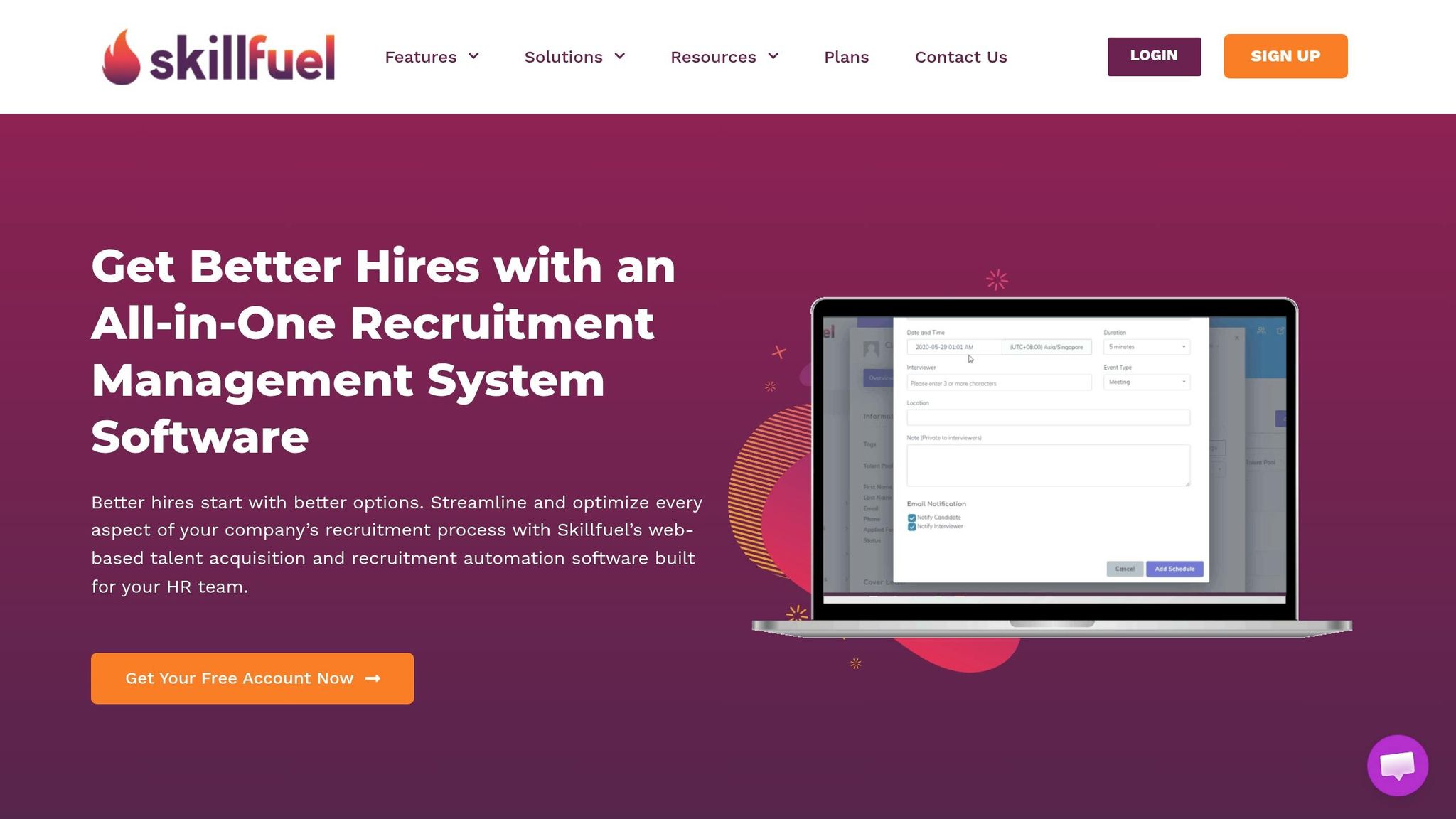
Training recruiters on gender pay equity is just one piece of the puzzle. To ensure compliance, HR teams also need reliable tools to provide consistent training and monitor adherence to regulations. Skillfuel’s recruitment automation platform simplifies this process by standardizing hiring practices and minimizing manual tasks that often lead to inconsistencies or bias. Here’s how Skillfuel helps streamline both training and compliance tracking.
Using Skillfuel for Recruiter Training
Skillfuel’s centralized dashboard makes it easy to manage training and track progress across the organization. For companies operating in multiple states, the platform’s multi-location management feature ensures that recruiters are trained according to the specific pay equity laws in their areas. This tailored approach helps organizations stay compliant, no matter where they operate.
To further reduce bias, Skillfuel automates key processes. For example, workflows create standardized job postings that include salary ranges and use gender-neutral language. The platform also automates job advertisements across social media channels, helping recruiters reach a broader and more diverse pool of candidates.
Skillfuel offers four pricing options to fit different organizational needs:
- Free ($0/month): Includes access to a job portal and up to three active job postings.
- Basic ($49/month): Adds employee referral features and supports up to 10 active postings.
- Grow ($99/month): Provides multi-location support and allows 30 active postings.
- Pro ($249/month): Offers unlimited postings and custom domain options.
All paid plans come with robust customer support through email, chat, and phone, ensuring smooth implementation for HR teams.
Monitoring Compliance with Skillfuel
Initial training is important, but ongoing monitoring is essential to maintain compliance. Skillfuel addresses this with powerful tracking tools. Its centralized candidate repository enables HR teams to monitor hiring decisions across the organization, making it easier to conduct regular pay equity audits. The Kanban workflow system offers clear visibility into candidate progress, which helps quickly identify any inconsistencies in salary discussions.
Skillfuel’s applicant tracking system keeps a detailed audit trail of job postings, evaluations, and salary offers. This ensures adherence to salary bands and standardized interview processes. If patterns emerge – such as repeated lower salary offers – HR teams can use this data to adjust policies or provide additional training.
The platform also helps organizations stay current with regulatory changes. Features like real-time calendar sync and automated candidate communication ensure every interaction aligns with the latest compliance standards. Additionally, Skillfuel’s GDPR compliance and strong data security measures safeguard sensitive salary and demographic information during audits. By combining these tools, organizations can maintain compliance and uphold fair hiring practices at every step.
Conclusion
Achieving gender pay equity isn’t something that can be tackled with a single audit or training session. It requires a consistent, long-term commitment, built on structured processes and the right tools to ensure fair hiring practices at every stage. This guide has explored how focused training and tools like Skillfuel can lead to measurable progress in closing pay gaps. As compensation expert Andy Sims puts it:
"DEI training improves pay equity outcomes only when it is embedded directly into compensation workflows – offer decisions, merit calibration, promotion reviews, and range management."
With persistent pay disparities and increasingly strict regulations, ensuring pay equity is no longer optional – it’s a necessity for businesses.
Meeting these challenges requires actionable steps. Recruiters need more than just awareness; they need access to defined salary ranges, documented justifications for decisions, and timely training. Combined with ongoing audits, these measures help identify and address disparities quickly. This integrated approach – structured training, clear policies, and continuous monitoring – forms the foundation of this guide’s strategy.
Steps like addressing unconscious bias, automating equitable salary practices, and understanding key laws like the Equal Pay Act are crucial. Standardized processes that remove subjectivity from salary decisions further support these efforts. Platforms like Skillfuel play a vital role by automating job postings with salary ranges, tracking hiring decisions through centralized dashboards, and maintaining audit trails for real-time compliance. Together, these targeted strategies make pay equity a measurable goal that benefits both employees and the organization.
FAQs
What should recruiters do if a candidate asks for a salary outside the range?
If a candidate asks for a salary that falls outside the company’s range, recruiters should take the opportunity to explain the reasoning behind the established salary limits. Emphasize that the range is built on principles of fairness and transparency. Clearly outline why the range is in place and how it aligns with efforts to maintain equitable pay practices, ensuring consistency and openness throughout the hiring process.
How often should we run pay equity audits to stay compliant?
Conducting pay equity audits on a regular basis – ideally once a year – plays a key role in ensuring compliance and addressing any disparities. These reviews not only help your organization stay in line with gender pay equity laws but also allow you to proactively spot and resolve potential issues before they escalate.
What records should recruiters keep to prove pay equity compliance?
Recruiters need to keep detailed records to show they’re meeting gender pay equity regulations. Important records to maintain include:
- Compensation data: This includes salary, bonuses, and any additional benefits offered.
- Job roles and descriptions: Clearly outline responsibilities and requirements for each position.
- Performance evaluations: Document how performance is assessed and rewarded.
- Demographic information: Track data related to gender and other relevant factors.
These records not only promote transparency but also serve as essential evidence during audits or reviews.