
Gamification is transforming hiring by replacing boring, traditional processes with interactive, game-like experiences. By integrating tools like puzzles, simulations, and challenges, companies can keep candidates engaged, assess skills more effectively, and leave a positive impression.
Key takeaways:
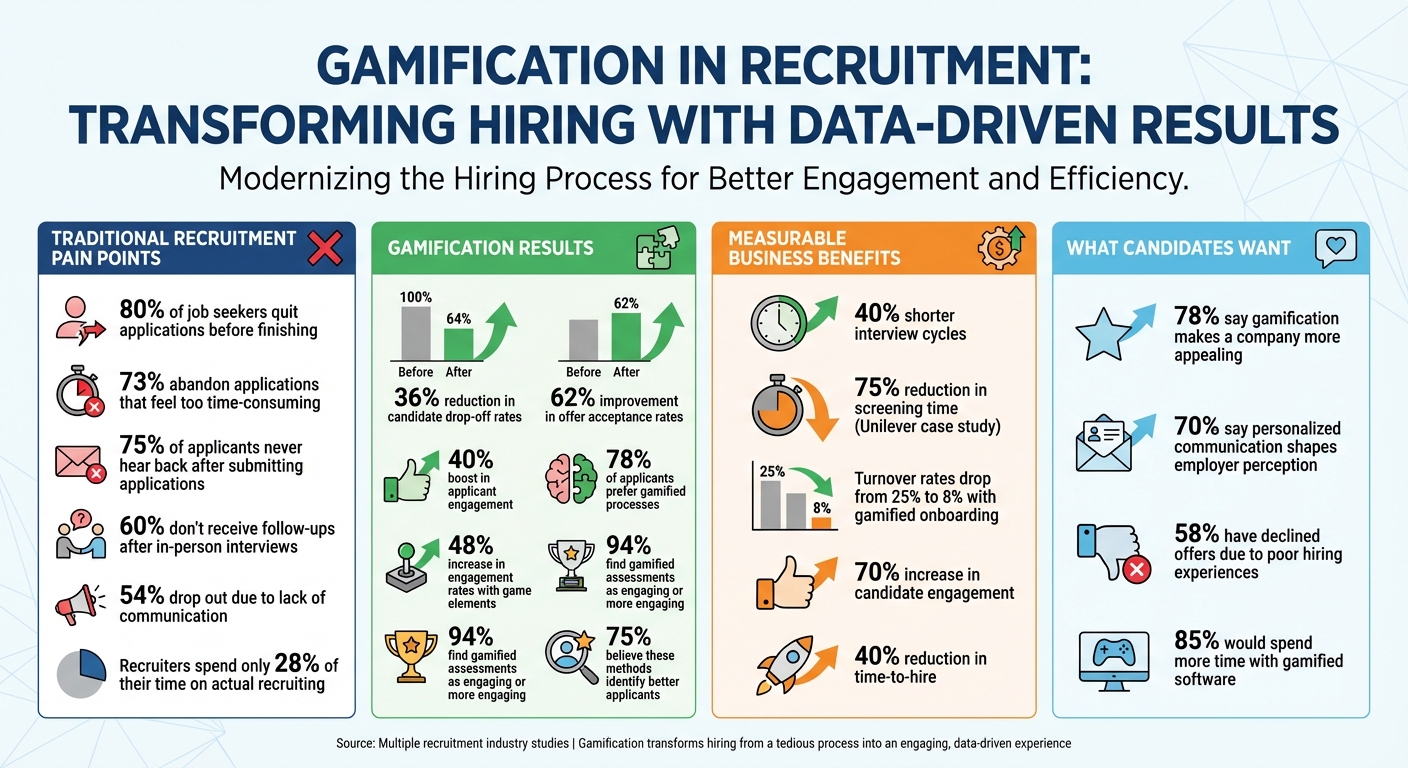
- Engagement boost: Gamified applications reduce drop-off rates by 36% and improve offer acceptance by 62%.
- Real-time feedback: Candidates receive instant updates, reducing frustration and improving motivation.
- Skill assessment: Simulations and challenges provide objective data on problem-solving, decision-making, and more.
- Stronger employer brand: A fun, interactive process enhances the candidate’s perception of the company.
Platforms like Skillfuel make it simple to add gamification to recruitment, offering tools like interactive career pages, dashboards, and automation for better results. Gamification isn’t just a trend – it’s a smarter, more engaging way to hire.
Gamification in Recruitment: Key Statistics and Impact Metrics
Gamification and why hiring should be fun, Iako Jikia
sbb-itb-e5b9d13
Common Recruitment Challenges That Reduce Engagement
Recruitment teams face hurdles that can frustrate job seekers and drive away top talent. Tackling these challenges is key to boosting candidate engagement.
High Drop-off Rates During Applications
Did you know that up to 80% of job seekers quit applications before finishing them? Long, repetitive forms that ask candidates to re-enter details already on their resumes are a major culprit. On top of that, application processes that take more than 23 minutes – especially on mobile devices – are linked to higher drop-off rates.
The numbers are telling: 73% of candidates abandon applications that feel too time-consuming, and 43% quit early in the process when forms are overly complex. Delays in communication make things even worse. When employers take anywhere from 6 to over 24 hours just to acknowledge an application, candidates often lose interest – or accept offers elsewhere. Add in impersonal communication, and it’s easy to see why engagement suffers.
Impersonal Candidate Experiences
Generic emails and stiff interview formats can make candidates feel undervalued. A staggering 75% of applicants never hear back after submitting their applications, and 60% don’t receive follow-ups even after in-person interviews. This "black hole" experience leaves candidates feeling like just another number in the system.
"If candidates feel like they are just another number, or worse, like they’re being ghosted, they’re more likely to disengage in the process." – Airswift
Poor communication has real consequences: 54% of candidates drop out of a recruitment process due to lack of communication. On the flip side, 70% of job seekers say personalized communication plays a big role in shaping their perception of an employer. When companies fail to meet these expectations, they risk losing candidates who could have been a perfect fit.
Difficulty Assessing Skills Accurately
Beyond application issues and impersonal interactions, traditional hiring methods often fall short when it comes to evaluating candidates’ skills. Relying solely on resumes or outdated testing formats can make it hard to identify the best talent. Then there are "unicorn" job descriptions – those that demand perfection across every single qualification – which discourage capable candidates from even applying.
Another issue? Recruiters spend just 28% of their time on actual recruiting, with the rest eaten up by manual tasks and coordination. This inefficiency can lead to mismatched expectations. Candidates frequently discover during interviews that the role, team dynamics, or growth opportunities don’t align with what was advertised. When reality doesn’t match the promise, candidates are more likely to walk away, taking their skills with them.
How Gamification Solves Recruitment Problems
Gamification addresses common recruitment challenges like high drop-off rates and impersonal application processes by turning them into engaging, interactive experiences. Instead of tedious forms, gamified applications captivate candidates, with 78% of applicants preferring gamified processes .
"Gamification mitigates a great deal of hiring issues, allowing employers to present their potential candidates in a captivating way to interact with the company even before getting their foot in the door." – Forbes
Making Applications Interactive
Game mechanics – like points, badges, leaderboards, and progress bars – tap into candidates’ competitive instincts and offer clear milestones . Features such as real-time progress tracking and rewards keep candidates motivated. For example, interactive video interviews with timed challenges add an element of urgency, turning a typically one-sided process into a dynamic exchange. This approach also eliminates the dreaded "black hole" of traditional applications by providing transparency, showing candidates their standing at every stage.
The table below contrasts traditional application methods with gamified alternatives, highlighting how this shift can reduce drop-offs:
| Traditional Application Element | Gamified Application Alternative |
|---|---|
| Static text-based forms | Interactive quizzes, puzzles, and platform games |
| One-way submission (no feedback) | Real-time feedback, scores, and progress bars |
| Passive resume review | Active skill-based challenges and coding competitions |
| Monotonous/stressful experience | Competitive elements like leaderboards and digital badges |
| Standard Q&A interviews | Scenario-based simulations and VR work environments |
Gamified applications go beyond just being interactive – they also mimic the challenges candidates would face in real work environments.
Simulating Real Job Scenarios
Gamified simulations immerse candidates in realistic job scenarios, allowing them to showcase their skills in action . These simulations test critical abilities like decision-making, problem-solving, and teamwork, offering insights that traditional resumes simply cannot . For instance, Unilever reduced its screening time by 75% by using science-based mobile games to evaluate cognitive and behavioral traits. Every action and choice is tracked, providing recruiters with objective data that minimizes bias and helps identify the best fit more efficiently . Candidates also appreciate this method, with 94% finding gamified assessments as engaging or more engaging than traditional ones.
Providing Feedback and Motivation
One of gamification’s standout features is real-time feedback. Instead of waiting weeks for updates, candidates receive instant results detailing their strengths and areas for improvement. This immediate feedback loop keeps candidates motivated and reduces the anxiety of being left in the dark. Features like progress bars, micro-goals, and story-driven challenges transform assessments into missions. For roles emphasizing collaboration, team-based challenges and leaderboards push candidates to excel. A great example is Google’s Code Jam, which offers a $15,000 championship prize, using competitive rewards to attract top-tier talent.
Benefits of Gamification for Candidate Engagement
Gamification addresses the challenges in recruitment by creating a more dynamic and engaging process. It’s not just theory – companies have reported a 40% boost in applicant engagement through gamified hiring methods. Plus, many candidates find these processes more appealing, helping to strengthen the employer’s reputation.
Increased Candidate Motivation and Retention
Gamification taps into the "Mastery-Status Cycle", shifting candidates’ focus from the stress of landing a job to the satisfaction of showcasing their skills. Features like challenges, progress bars, and achievement badges create a sense of accomplishment, motivating candidates to stay engaged. For instance, engagement rates rise by 48% when work-related activities include game elements, and 85% of users say they’d spend more time with software that incorporates these features.
Mobile-friendly challenges make it easy for candidates to participate from any device, which is especially helpful in high-volume hiring. Real-time feedback loops also address a common frustration: the dreaded "black hole" where resumes vanish without updates. By providing instant validation and visible progress, candidates remain involved and motivated.
Better Candidate Experience and Employer Brand
Gamification turns recruitment into an interactive and enjoyable process, reducing stress and encouraging candidates to express themselves authentically. This matters because 58% of candidates have declined job offers due to poor hiring experiences. By making the process more engaging, companies not only fill roles but also build a reputation for respecting candidates’ time and creating a positive experience.
Immersive simulations go a step further by offering a realistic preview of the job. This transparency helps candidates decide if the role is right for them, leading to better matches and lower turnover. In fact, organizations using gamified onboarding have seen turnover rates drop from 25% to 8%.
Data-Driven Insights for Hiring Decisions
Gamified assessments provide objective, performance-based data that traditional interviews often miss. These tools track skills like problem-solving, time management, and decision-making, offering a more comprehensive view of each candidate. AI-driven systems analyze this data to predict which candidates are best suited for specific roles, while real-time performance metrics reveal how individuals handle workplace scenarios.
"Game-based assessments allow us to tap into someone’s full potential by capturing an individual’s attention and increasing their motivation for the assessment by making it short and fun."
– Leonie Grandpierre, Head of Science, Equalture
Standardized gamified criteria also ensure fairness. By focusing on anonymized performance data rather than demographic details, these tools minimize unconscious bias. Additionally, gamified assessments are harder to manipulate than traditional personality tests because they evaluate unconscious behaviors in immersive settings. The results speak for themselves: 75% of candidates believe these methods identify better applicants, while companies report interview cycles that are 40% shorter and offer ratios that are 62% higher.
These advantages highlight how Skillfuel’s gamification tools can streamline recruitment and improve hiring outcomes.
Using Skillfuel with Gamification Strategies
Skillfuel makes it easy to incorporate gamification into recruitment without requiring technical know-how. By combining customizable career pages, centralized dashboards, and automation tools, it creates a streamlined, data-driven hiring process. These features not only keep candidates engaged but also address common recruitment challenges effectively.
Customizable Career Pages for Candidate Interaction
With Skillfuel, recruiters can turn ordinary job postings into interactive experiences using its drag-and-drop editor. Instead of relying on text-heavy applications, recruiters can add elements like quizzes, scenario-based questions, and progress bars to make the process more engaging. The platform ensures a seamless connection to relevant job pages while maintaining a consistent employer brand. Real-time feedback can also be integrated into the application process, keeping candidates informed every step of the way.
This approach resonates with candidates – 78% say gamification makes a company more appealing. In a job market where 74% of employers face challenges filling open positions, these interactive features help companies stand out and attract top talent.
Tracking Engagement with Centralized Dashboards
Once candidates engage with the interactive career pages, Skillfuel compiles all the data into a centralized dashboard for better insights. Its visual Kanban boards provide real-time updates on candidate progress through the gamified recruitment funnel, making it easy to spot bottlenecks or stages with high drop-off rates. This eliminates the need for spreadsheets and fragmented workflows.
Given that 82% of companies recognize data as essential for talent acquisition decisions, Skillfuel’s unified dashboard becomes a powerful tool. It tracks metrics like challenge completion rates and candidate progression, while its real-time collaboration features allow recruitment teams to share feedback seamlessly. This level of insight enables recruiters to refine their gamification strategies and improve outcomes.
Automation and Real-Time Tools
Skillfuel also uses automation to keep candidates engaged throughout the hiring process. Personalized messages are sent at key moments, such as after a candidate completes a challenge or advances to the next stage. The platform’s real-time interview scheduler syncs with popular calendar apps, allowing recruiters to quickly book interviews when candidates are most interested.
Gamification, combined with automation, can reduce time-to-hire by 40%. Skillfuel’s 24/7 mobile access ensures recruiters can monitor assessments and respond instantly, while built-in GDPR compliance guarantees secure handling of candidate data. These tools not only simplify recruitment but also boost candidate engagement by 70%.
Measuring Gamification Impact on Recruitment
Once gamification strategies are in place, it’s important to evaluate their effectiveness. Tracking how candidates respond to gamified elements and assessing hiring outcomes can reveal whether these methods truly enhance engagement. These insights provide a solid basis for refining the recruitment process.
Key Metrics to Track
To measure the impact of gamification, focus on three main areas: engagement, efficiency, and behavioral performance.
- Engagement metrics: These reveal how candidates interact with gamified features. For instance, application completion rates can show whether challenges encourage or discourage participation. Candidate satisfaction scores (CSAT) offer a glimpse into their overall experience. Additionally, tracking the number of attempts candidates make on challenges can highlight their persistence and level of interest.
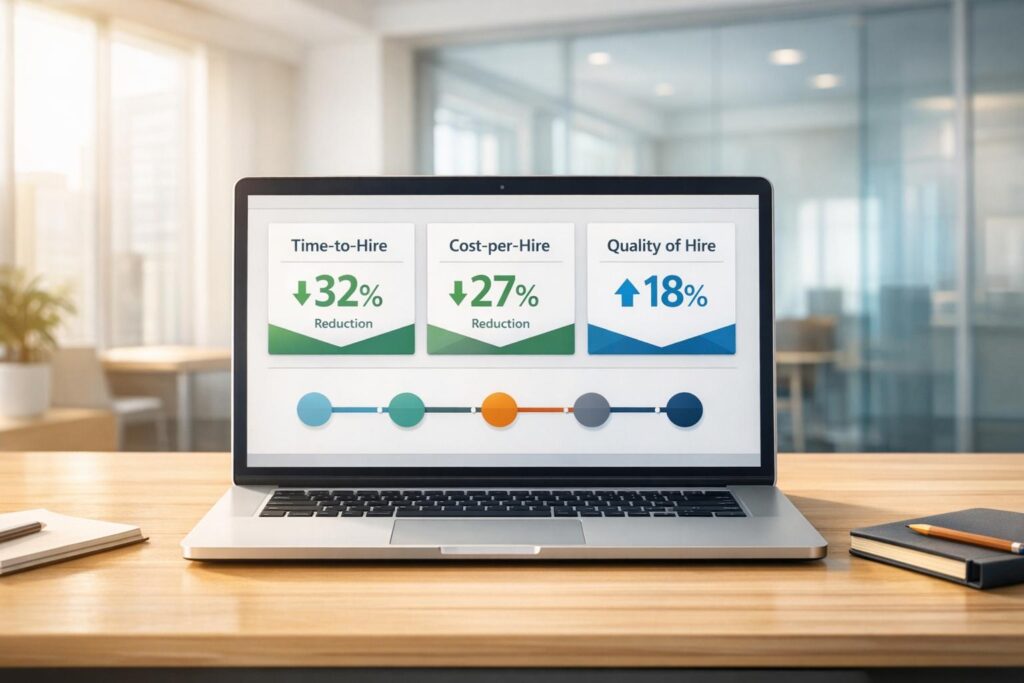
- Efficiency metrics: These assess how gamification affects the speed and cost of hiring. Time-to-hire and the length of interview cycles can indicate whether gamification speeds up decision-making. Meanwhile, cost-per-hire shows the financial impact of these methods.
- Behavioral and task-based indicators: These metrics provide a closer look at candidates’ problem-solving and technical skills. For example, tracking adjustment speed, decision-making paths, and consistency can reveal how candidates handle pressure and solve problems. Metrics like completion speed, accuracy, and error rates further assess their technical abilities and focus.
"Candidate elimination is done at a much faster pace as it allows firms to test specific skills like time management, creative and innovative thinking etc." – Dr. Manu Melwin Joy
Using Data to Improve Recruitment
Collecting data is just the first step – it’s how you use it that makes the difference. By analyzing these metrics, recruiters can identify weak points in the hiring process and make necessary adjustments. For example, dashboards can highlight stages where candidates frequently drop out, making it easier to simplify or clarify those steps. If gamified tasks show high drop-off rates, adjusting their length or difficulty can help retain more candidates.
Predictive analytics takes it a step further by transforming gameplay behaviors into hiring insights. Reaction patterns, decision quality, and other gameplay data often provide more reliable indicators of future job performance than traditional resume claims. This approach also helps reduce bias by focusing solely on candidates’ performance rather than demographic factors. Regular audits of gamification data against demographic trends can ensure fairness and prevent unintentional algorithmic bias.
Finally, automating feedback to candidates – delivering quick, clear results – respects their time and enhances your employer brand.
Conclusion
Gamification tackles some of the biggest challenges in recruitment – like high candidate drop-off rates, impersonal hiring processes, and limited ways to assess skills. By swapping out traditional application forms for interactive challenges and live simulations, companies can keep candidates engaged while collecting solid, objective data on how they perform under pressure.
The numbers speak for themselves: companies using gamified assessments report 40% higher engagement, a 36% drop in candidate drop-offs, and a 62% improvement in offer acceptance rates. Plus, 78% of job seekers find gamified processes more appealing. This approach not only enhances the candidate experience but also strengthens your employer brand. It creates a hiring process that’s faster, more equitable, and better at attracting top talent.
"Gamification mitigates a great deal of hiring issues, allowing employers to present their potential candidates in a captivating way to interact with the company even before getting their foot in the door." – Forbes
The key to achieving these results lies in using the right tools. Platforms like Skillfuel offer features such as customizable career pages, centralized dashboards, and automation tools that make it easy to integrate gamification into your recruitment strategy. These tools allow HR teams to adopt gamification without the need to completely revamp their existing systems.
To start, consider piloting gamified assessments on a smaller scale to measure ROI before rolling them out across your organization. Make sure the game mechanics align with the skills required for each role, be transparent about what’s being evaluated, and use the data to refine your approach over time. The idea isn’t to replace human judgment but to give recruiters better insights for making informed hiring decisions.
FAQs
How do you choose the right game challenges for each role?
To pick the right game challenges, zero in on the specific skills and qualities the job demands. Choose or design challenges that test these abilities – like problem-solving or communication. The tasks should be engaging, closely tied to real-world job situations, and tailored to the role’s requirements. Formats such as puzzles, simulations, or scenario-based tasks can be excellent tools for evaluating candidates effectively.
Can gamified assessments reduce hiring bias fairly?
Gamified assessments offer a way to tackle hiring bias by relying on objective data derived from how candidates perform in game-like scenarios. Instead of subjective judgments, these tools emphasize measurable behavioral and cognitive responses, which are less likely to be influenced by unconscious biases.
That said, these assessments aren’t completely free from bias. Careful implementation is essential to ensure they address fairness, particularly when evaluating candidates from diverse backgrounds. Tools like AI-driven analysis are making strides in improving consistency and equity in these processes.
What metrics prove gamification improves hiring ROI?
Gamification boosts hiring ROI by focusing on key metrics such as higher candidate engagement, more accurate assessments, and an improved overall candidate experience. Research on gamified recruitment methods indicates that these elements lead to better-quality hires and shorter time-to-fill periods.