
Managing cross-border hiring compliance is essential to avoid legal, financial, and operational risks when expanding your workforce globally. Companies must follow local labor laws, tax regulations, and data protection rules specific to the country where employees work. Here’s what you need to know:
- Non-compliance risks: Fines, legal disputes, tax penalties, and reputational damage. For example, Infosys paid $34M in 2013 due to I-9 violations in the U.S.
- Key challenges: Navigating local labor laws, worker classification (employee vs. contractor), and immigration requirements.
- Labor law differences: Notice periods, severance pay, working hours, and vacation policies vary widely by country.
- Tax obligations: Employer contributions and statutory benefits differ across regions, impacting payroll costs.
- Compliance tools: Use global hiring platforms to automate contracts, payroll, and data privacy management.
- Regular audits: Stay updated on changing laws and conduct compliance checks to avoid penalties.
Global Mobility Risks Expanding Companies Often Overlook in Cross-Border Hiring
sbb-itb-e5b9d13
Common Compliance Challenges in Cross-Border Hiring
Hiring across borders means navigating a maze of legal systems, tax codes, and immigration rules. What works in one country often doesn’t translate to another, making it crucial to address these challenges early. A key starting point is understanding local labor laws, which can vary dramatically from one region to another.
Local Labor Laws and Tax Requirements
Employment laws differ widely across countries. For example, while the U.S. operates under "at-will" employment, many nations mandate notice periods and severance payments. In Indonesia, terminating an employee might require severance equal to nine months’ salary, and in the Netherlands, dismissals often need approval from an employment tribunal. Working hours also differ – France enforces a 35-hour work week, while Indonesia follows a 40-hour standard. Additionally, the EU’s Working Time Directive limits weekly hours and mandates rest periods. Paid leave policies also vary: most countries require employers to offer 10 to 30 days of annual paid vacation, whereas the U.S. has no federal paid leave requirement.
"Employment law is local. The rules that govern your relationship with an employee are determined by where they work, not where your company is headquartered." – Michael Chen, Global EOR Expert, EOR Network
Taxation adds another layer of complexity. Employers must withhold income taxes and manage social security contributions, which vary significantly. For instance, Indonesia’s BPJS adds 10–12% to gross salaries, while employer contributions in Europe can range from 20% to over 40% of total employment costs. Some countries also require statutory bonuses, such as Indonesia’s THR, the Philippines’ 13th-month pay, and Mexico’s Aguinaldo. Without a local subsidiary, hiring abroad can even trigger unexpected corporate tax obligations, complicating financial planning.
Properly classifying workers is another critical issue that can save companies from major legal and financial pitfalls.
Employee vs. Contractor Classification
Misclassifying workers can lead to serious consequences. Tax authorities often use a "substance-over-form" test: if a contractor works set hours, uses company equipment, and integrates into the team, they may be reclassified as an employee. This can result in back taxes, unpaid benefits, and hefty penalties.
The financial risks are real. Uber, for instance, settled a class-action lawsuit in California for $8.43 million in 2022, averaging $8,000 per affected driver. They also paid $100 million to New Jersey for unpaid payroll taxes due to misclassification. FedEx faced a $228 million settlement in California, and Nike risked tax fines exceeding $530 million.
Classification rules vary by region. In the U.S., the federal government uses an "economic realities" test to evaluate whether a worker is dependent on the employer, while California applies the stricter ABC test (updated by AB 1514 starting January 2026). Germany relies on labor court rulings with strong worker protections, and the UK enforces IR35 regulations. Misclassification penalties in the U.S. can be severe, including fines of $50 per unfiled W-2, 1.5% of wages for failing to withhold taxes, and up to 20% of wages plus 100% of unpaid FICA taxes for intentional violations. Criminal fines can reach $1,000 per worker.
Work Authorization and Immigration Requirements
Ensuring employees have valid work permits and visas is another critical step, yet it’s a common stumbling block. In the U.S., for example, employers must complete Form I-9 for every hire, physically verifying original documents within three business days of the start date. Some states, like Arizona and Georgia, require the use of E-Verify in addition to this process.
Visa processes can be challenging. The H-1B visa lottery receives over 400,000 applications for just 85,000 spots, leaving applicants with about a 1 in 5 chance of selection. Other visa categories, such as the L-1 for intracompany transfers, require the employee to have worked abroad for at least one of the past three years. O-1 visas, designed for individuals with extraordinary ability, demand extensive documentation of achievements.
Immigration delays can disrupt hiring timelines, and the costs of hiring a foreign worker in the U.S. – including certifications, visa fees, and legal expenses – can range from a few thousand dollars to over $10,000 per employee. Automated systems can help track visa and document expiration dates, ensuring compliance and uninterrupted work authorization. Addressing these challenges is essential for creating a compliant and efficient global hiring strategy.
Building a Global Compliance Framework
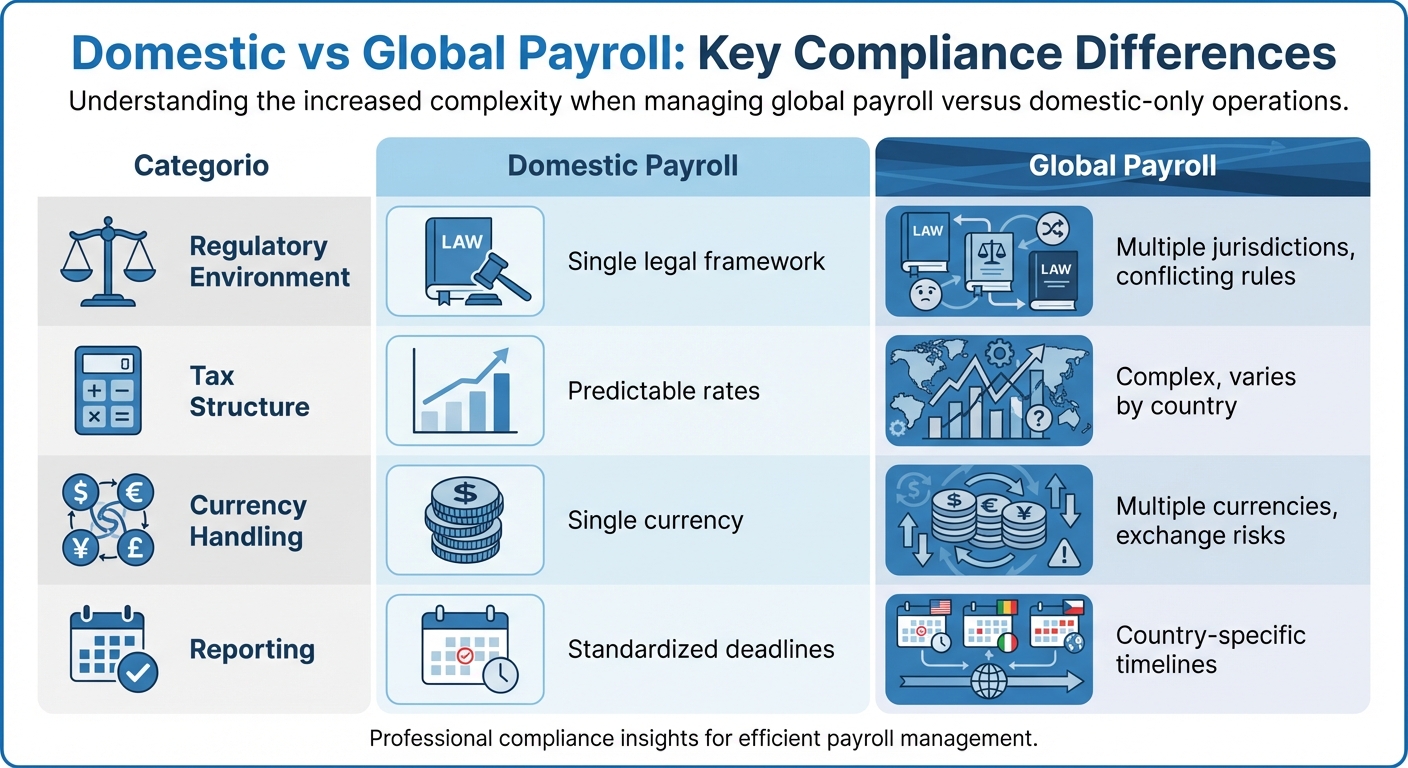
Domestic vs Global Payroll: Key Compliance Differences
Navigating the maze of local labor laws, worker classifications, and immigration rules can be overwhelming. A global compliance framework helps streamline these processes, providing consistency across the company while aligning with local legal requirements. This approach minimizes the risk of costly violations and avoids the chaos of managing inconsistent practices.
For instance, creating a baseline policy template with localized legal addenda can prevent serious missteps. Imagine using a U.S.-style "at-will" employment contract in Germany, where such agreements are unenforceable. In March 2026, a European SaaS company successfully onboarded four engineers in Germany using Blue Card-compliant templates and automated workflows. They completed the process in just 11 days, saving five months of administrative time and roughly €42,000 compared to establishing a local entity.
"Employment laws usually apply based on where the employee works, not where the company is headquartered." – Native Teams
A solid global compliance framework should cover three main areas: hiring policies and contracts, payroll and benefits administration, and data privacy management. Each area requires a careful balance between global consistency and local customization. For example, while your hiring process might follow a global standard, contracts must include specific clauses for local regulations, such as mandatory bonuses like the Philippines’ 13th-month pay. This structure ensures a smooth hiring process and aligns payroll and data management with regional requirements.
Standardized Hiring Policies and Contract Templates
When creating hiring templates, it’s essential to combine a global baseline with country-specific addenda that address local labor laws. A one-size-fits-all approach simply won’t work. For example, a contract suitable for California won’t meet Germany’s strict dismissal protections.
The solution? Build templates with two layers: a global baseline for core policies and country-specific add-ons for local legal requirements. This ensures every contract includes vital elements like statutory benefits, working hour limits, and termination rules. For instance, contracts for Brazilian hires must include the 13th-month salary, while French contracts need to account for the 35-hour work week and mandatory rest periods.
Automated workflows can simplify this process, flagging missing clauses and ensuring compliance with local laws. Regular updates are also crucial, as labor laws and tax rates often change. To stay ahead, have local legal experts or your global HR platform review templates on a quarterly basis. For example, in early 2026, a U.S.-based fintech startup hired a marketing lead in India with a $28,000 salary. They completed onboarding in just nine days, including FRRO registration and local tax compliance, without encountering legal issues.
Platforms like Skillfuel can further streamline hiring by automating contract generation while seamlessly integrating localized legal requirements.
Additionally, secure, self-serve platforms can help protect sensitive employee data like Social Security numbers, banking details, and medical records. This reduces access risks and simplifies audits, especially under regulations like GDPR, which can impose fines of up to 4% of annual revenue for violations.
Once hiring templates are aligned with local standards, the next step is to ensure payroll and benefits systems meet regional requirements.
Payroll, Benefits, and Data Privacy Management
Managing global payroll involves juggling multiple currencies, diverse tax structures, and varying reporting deadlines. Here’s a quick comparison:
| Category | Domestic Payroll | Global Payroll |
|---|---|---|
| Regulatory Environment | Single legal framework | Multiple jurisdictions, conflicting rules |
| Tax Structure | Predictable rates | Complex, varies by country |
| Currency Handling | Single currency | Multiple currencies, exchange risks |
| Reporting | Standardized deadlines | Country-specific timelines |
Start by developing a core global payroll policy with country-specific adjustments. This should account for local labor laws, tax policies, and pay cycle requirements. Always pay employees in their local currency to avoid exchange rate issues and comply with mandated pay schedules. For example, France requires monthly payments, while other countries may permit biweekly schedules.
Worker classification is another critical factor. Misclassifying employees as independent contractors can lead to hefty penalties – often exceeding €20,000 per worker in Europe.
When managing benefits, distinguish between statutory benefits (like paid leave, pensions, and national healthcare) and supplemental benefits (like private insurance or wellness programs). Statutory benefits are mandatory and must be provided before offering extras. In countries like Brazil and the Philippines, employers are legally required to pay a 13th-month salary – and sometimes even a 14th-month bonus.
Integrate data privacy regulations like GDPR and LGPD directly into contracts and payroll workflows. In the U.S., unauthorized employment violations can cost up to $28,619 per worker.
To reduce errors and ensure compliance, use centralized platforms for gross-to-net payroll calculations. These systems handle country-specific deductions for social security, pensions, and withholding taxes. Partnering with in-country experts or an Employer of Record (EOR) can help you stay updated on local tax rates and labor laws. EOR services typically charge a 5% to 12% markup on salaries or a flat monthly fee, and they can onboard employees in as little as 5–14 days – far faster than the 3–9 months it often takes to set up a local entity.
Finally, maintain audit-ready records. Keep detailed payroll documentation for the legally required duration in each jurisdiction. This ensures you’re prepared for government audits and able to demonstrate compliance with local regulations.
Using Technology to Manage Compliance
Modern recruitment management software simplifies the challenge of navigating global compliance. Relying on manual tools like spreadsheets, email threads, or disconnected systems can increase risks. Instead, these platforms centralize hiring workflows, automate compliance checks, and safeguard candidate data across different jurisdictions. The right technology transforms compliance into an automated, audit-ready process.
These tools act as a single source of truth for global hiring, replacing scattered records with centralized dashboards that track every candidate interaction. This level of visibility is crucial for managing diverse labor laws, data privacy regulations, and work authorization rules. For instance, one global company saved 375 hours annually and reduced security management time by 75% by automating its compliance processes. These advancements integrate seamlessly with standardized workflows, ensuring global compliance is both secure and efficient.
"GDPR applies the moment a candidate from an EU country submits their CV to your system – regardless of where your company is based." – Treegarden
Companies with standardized recruitment processes see measurable benefits. For example, they reduce average time-to-hire by 26%. Additionally, tailoring job descriptions to local markets can boost application completion rates by 35–45%. These results stem from using technology that adjusts to regional needs automatically, avoiding the errors and delays of manual systems.
Automated Workflows and Centralized Dashboards
Automated workflows remove the need for manual tracking of compliance requirements across various countries. Platforms like Skillfuel allow you to set up region-specific compliance checkpoints. This ensures candidates meet local legal standards before advancing in the hiring process.
Centralized dashboards offer real-time insights into hiring activities across regions. With role-based access control, regional managers can only view data relevant to their jurisdiction, protecting sensitive information such as salary details or offer letters. Time zone–aware scheduling further reduces coordination errors when arranging interviews across different regions.
Skillfuel’s automated workflows and centralized dashboards simplify compliance management, ensuring consistent processes across multiple countries while keeping sensitive data secure.
GDPR Compliance and Data Security
Data privacy violations can result in severe penalties. Under GDPR, fines can reach €20 million or 4% of global annual turnover, whichever is higher. The regulation applies as soon as a candidate from an EU country submits their resume, regardless of where your company is based.
Built-in GDPR features streamline compliance by automating consent capture, managing data retention periods, and executing deletion workflows without manual effort. Many platforms now include continuous security monitoring, with hourly checks and automated evidence collection for audits. This is increasingly critical, as 77% of organizations require compliance with standards like ISO 27001 when selecting tools and suppliers.
Skillfuel’s GDPR-compliant tools, such as automated data retention policies and secure storage, help protect candidate information and simplify audits, especially when dealing with multiple jurisdictions.
Customizable Career Pages and Automated Communication
Customizable career pages do more than enhance branding – they also ensure compliance with regional regulations. For example, with growing laws around salary transparency in Europe, career page builders allow companies to adapt job posting disclosures for each market without requiring additional development work.
These tools also let you configure application forms by region, collecting only the data permitted by local laws. For instance, application forms can automatically adjust to meet the legal requirements of individual jurisdictions. Localized landing pages can include mandatory legal disclosures tailored to specific regions.
Automated communication tools ensure candidates receive timely, professional updates regardless of their time zone. Systems can send acknowledgment emails, scheduling invitations, and other stage-specific messages in multiple languages immediately after a candidate applies. Every interaction is logged, creating an audit trail that supports compliance audits and resolves disputes.
Skillfuel’s customizable career pages and automated communication features not only maintain compliance but also improve the candidate experience across diverse markets.
Regular Monitoring and Compliance Audits
Cross-border hiring compliance isn’t something you can set and forget. Regulations change often, and staying compliant requires consistent attention. What worked six months ago might leave your company exposed to penalties today. By regularly monitoring and auditing your compliance processes, you can identify and address potential issues before agencies like ICE or local tax authorities come knocking. This proactive approach ties into a broader strategy that combines technology and expert partnerships to simplify global compliance.
Skipping these audits? That could mean heightened legal and financial risks for your company.
"Immigration compliance touches every single hire you make in America… you’re operating in the same federal framework that can shut down operations overnight if you get it wrong." – Joanne Farquharson, President & CEO, Foothold America
Staying Updated on Regulatory Changes
Keeping track of regulatory changes across multiple countries is no small feat – it requires a structured system. For instance, new paid leave programs will roll out in Delaware, Maine, and Minnesota in 2026, while California is set to implement rules for automated decision-making that same year. Using centralized compliance platforms can make life easier by tracking these updates in real time and sending alerts when regulations change in your hiring locations.
To stay ahead, subscribe to regulatory newsletters and leverage AI tools for real-time updates. These tools can flag upcoming changes months in advance, giving you time to adjust employment contracts, payroll systems, and onboarding procedures. It’s a good idea to have local legal experts review employment agreements quarterly to ensure compliance with the latest laws on benefits, severance, and termination. Automated systems can also help track visa expiration dates and re-verification deadlines, reducing the risk of work authorization lapses. Missing these deadlines could lead to fines of up to $28,619 per employee for repeat offenses.
By feeding these updates into your audit process, you can maintain compliance on an ongoing basis.
Conducting Regular Compliance Audits
Scheduled audits are a critical tool for catching compliance gaps early. Start by defining the scope – focus on one location at a time and prioritize areas like tax laws, wage and hour requirements, and proper classification of employees versus contractors.
Develop country-specific checklists that cover essentials like employment contracts, payroll records, tax documents, and data privacy policies. Work with local teams to gather documentation and confirm that practices align with local laws. For example, you might check compliance with EU pay transparency rules or verify adherence to state-specific minimum wages in the U.S.
"Audits are a great opportunity for leadership to gather and look at opportunities for their company to grow and learn new best practices to help their employees thrive." – Taylor Fike, Partner at Fike Advisors
After completing the audit, categorize findings by risk level – high, medium, or low – and assign corrective actions to local managers with clear deadlines. A rotating three-year audit schedule can help you focus on different priorities: legal compliance in year one, payroll accuracy in year two, and strategic alignment in year three.
Some companies are moving from annual audits to continuous monitoring. AI-assisted tools can track compliance in real time and cut the time and cost of audits by up to 95%. These tools integrate well with a global compliance framework, reinforcing the proactive measures discussed earlier.
Working with Payroll Providers and EOR Services
Employer of Record (EOR) services can simplify compliance when hiring in countries where you don’t have a legal entity. Acting as the legal employer, the EOR handles payroll, tax withholdings, and local labor law compliance, allowing you to hire local talent without setting up a foreign subsidiary.
EOR providers often boast 99% payroll accuracy and maintain expertise in over 180 countries. They track regulatory changes, update employment contracts to align with new laws, and manage benefits administration according to local standards.
When choosing an EOR or payroll provider, check their compliance history and audit processes. Ensure they provide thorough documentation for your records, as missing paperwork can become a problem during audits. Many providers also offer self-serve onboarding platforms, where new hires can securely input sensitive information like Social Security numbers and banking details, reducing the risk of data breaches.
These partnerships work hand-in-hand with your internal audits, easing the challenge of managing compliance across multiple jurisdictions while keeping your operations on solid legal ground.
Conclusion
Building a compliant cross-border hiring strategy isn’t just about following the rules – it’s about creating a solid foundation for your global team while avoiding legal and financial pitfalls. Tackling challenges like navigating local labor laws and preventing misclassification is only the beginning. A global compliance framework is crucial for standardizing contracts, managing payroll accurately, and safeguarding employee data across different regions.
Technology plays a key role in this process. With 72% of employers projected to struggle with filling roles by 2026 – especially in AI-related fields – platforms like Skillfuel can streamline global hiring. These tools centralize candidate information, automate tedious administrative tasks, and ensure proper record-keeping for compliance audits. This not only helps verify that every hire meets legal standards but also gives you an edge in the competitive global talent market.
Staying ahead of regulatory changes is equally important. For example, stricter immigration rules – like the UK’s Skilled Worker salary threshold increase to £41,700 in 2026 or the $100,000 supplemental fee for certain US H-1B petitions – make regular monitoring essential. Quarterly reviews and scheduled audits can help you catch potential compliance gaps before they lead to costly penalties.
For many companies, partnering with an Employer of Record (EOR) is a game-changer. By 2026, 85% of businesses reported that using an EOR ensured full compliance with local contracts, payroll, taxes, and benefits – all without the need to establish a local legal entity. An EOR can significantly cut down on setup time and expenses, allowing you to onboard top talent in as little as 5–14 days, compared to the months it takes to establish a local presence.
FAQs
What’s the safest way to verify work authorization for cross-border hires?
The best way to confirm work authorization for cross-border hires is to stick to established legal procedures. For example, in the United States, employers need to complete Form I-9, which verifies both the employee’s identity and their eligibility to work. This form must also be kept on file in case of audits. Additionally, tools like E-Verify can be used to validate work authorization, depending on legal requirements and the employee’s country of origin.
How can I avoid misclassifying someone as a contractor in another country?
Misclassifying employees as contractors can lead to serious legal and financial consequences. To prevent this, it’s crucial to understand and follow local labor laws and employment classifications, as these rules differ from country to country.
The classification often hinges on factors like how much control the company has over the worker’s tasks, the level of independence the worker has, and the overall nature of the working relationship. For example, if a company dictates when, where, and how tasks are completed, the worker might legally be considered an employee rather than a contractor.
To navigate these complexities, consider consulting with local legal experts who are familiar with labor laws in your region. Additionally, leveraging compliance tools can help ensure classifications are accurate, protecting your business from potential penalties.
Do I need a local entity, or can an Employer of Record handle compliance?
When deciding between setting up a local entity or using an Employer of Record (EOR), it all comes down to your goals and strategy. An EOR allows you to hire internationally without the hassle of creating a local entity. They take care of legal, tax, and HR responsibilities, making them a solid choice for quick and straightforward expansion.
However, if you’re aiming for a long-term presence or planning to manage a larger workforce, having a local entity might give you greater control and ensure smoother compliance with local regulations.