
Diversity analytics transforms hiring by using data to identify and address gaps in representation across demographics like gender, ethnicity, and age. Companies leveraging these insights see better hiring outcomes and stronger business performance. For example:
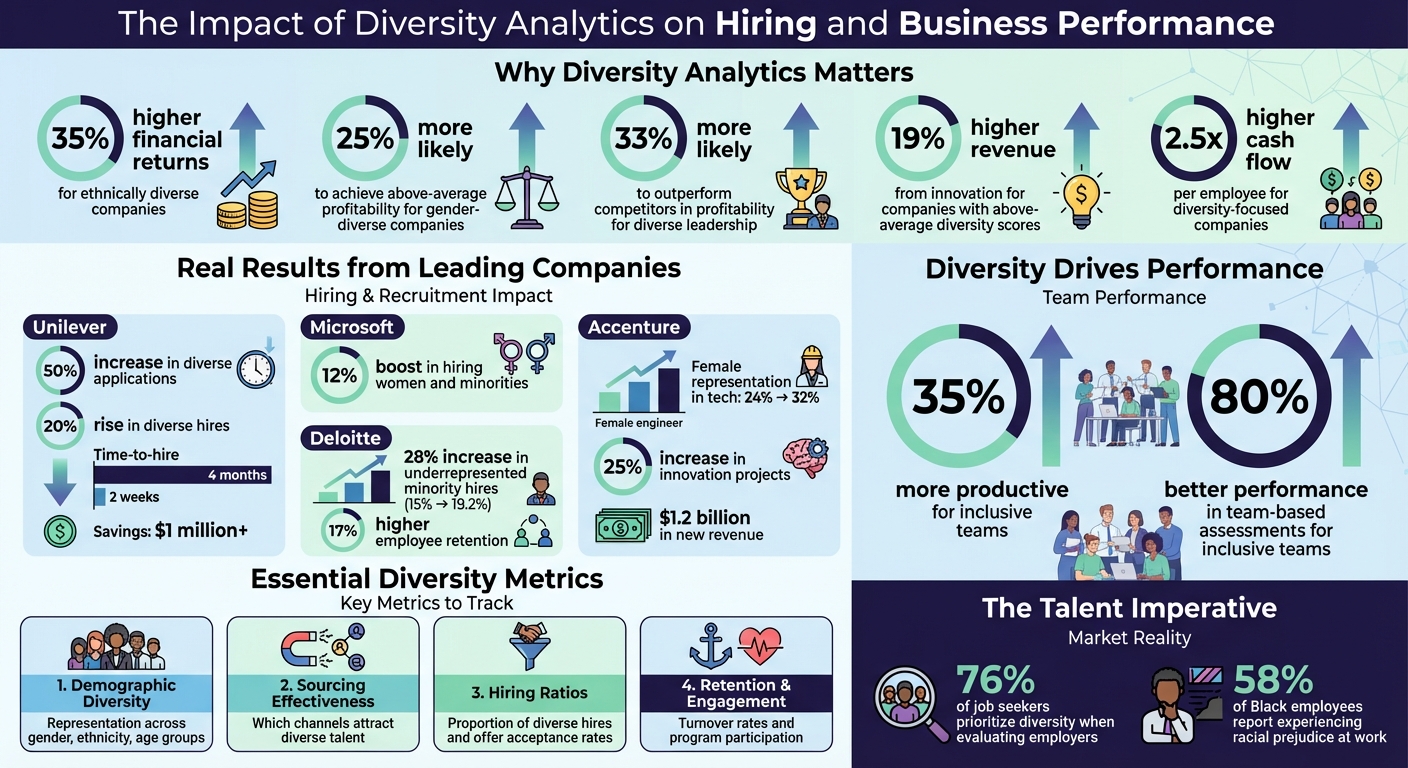
- 35% higher financial returns for ethnically diverse companies.
- 50% increase in diverse applications at Unilever through anonymized resumes and AI tools.
- 12% boost in hiring women and minorities at Microsoft via real-time diversity tracking.
Key metrics to track include demographic diversity, sourcing effectiveness, hiring ratios, and retention rates. Tools like Skillfuel help monitor these metrics, ensuring fairer hiring practices and measurable progress toward diversity goals. Regular data reviews and actionable strategies are essential for sustaining improvements.
With 76% of job seekers prioritizing diversity, adopting diversity analytics isn’t just practical – it’s essential for attracting top talent and driving success.
Diversity Analytics Impact: Key Statistics and Business Benefits
What is Diversity Analytics?
Defining Diversity Analytics
Diversity analytics is all about measuring how well different demographic groups are represented in hiring processes. According to Manatal, it relies on numerical data to evaluate inclusion efforts, providing measurable insights instead of relying on assumptions.
This approach tracks key demographics – such as gender, race, age, LGBTQ+ status, socioeconomic background, and neurodivergence – throughout the hiring journey, from applications to final hires. By identifying where underrepresented groups may be falling out of the process, companies can take targeted action to improve.
The impact of diversity is clear: companies that prioritize it see 2.5 times higher cash flow per employee, and inclusive teams are over 35% more productive. However, challenges remain – 58% of Black employees report experiencing racial prejudice in the workplace.
With this foundation in mind, let’s look at the metrics that help quantify these efforts.
Key Metrics to Track
To put diversity analytics into action, focus on tracking specific metrics at each stage of the recruitment process. Here’s what to monitor:
- Demographic diversity: Measure the percentage of applicants, candidates, and hires from various demographic groups to assess representation.
- Diversity sourcing: Identify which recruitment channels – like job boards, social media, or referrals – are most effective in attracting diverse talent pools.
- Diversity hiring metrics: Examine the proportion of hires from underrepresented groups and compare offer acceptance rates across demographics. If there’s a gap between offers made and accepted, it could indicate issues with pay equity or your company’s reputation.
- Retention and engagement: Look at turnover rates and participation in initiatives like mentoring programs to evaluate whether inclusion efforts create a supportive, long-term environment.
sbb-itb-e5b9d13
Diversity Analytics: Uncover organizational anomalies via machine learning
Benefits of Using Diversity Analytics in Recruitment
Diversity analytics brings a data-driven perspective to hiring, offering tangible ways to improve outcomes. Here’s how it makes a difference:
Better Candidate Diversity
Diversity analytics helps HR teams pinpoint where underrepresented candidates exit the hiring process. By analyzing these drop-off points, companies can uncover issues like biased job descriptions or screening practices that may unintentionally narrow their talent pool.
For example, Unilever anonymized resumes and incorporated AI-driven assessments, leading to a 50% increase in diverse applications and a 20% rise in diverse hires within a year. Similarly, Microsoft’s Diversity and Inclusion Dashboard uses real-time pipeline data to identify and resolve disparities. This initiative resulted in a 12% boost in hiring women and underrepresented minorities.
These tools don’t just expand candidate pools – they also promote fairer, more objective evaluations.
Better Decision-Making
Data removes much of the uncertainty from hiring decisions. Analytics tools can automatically remove demographic details from resumes during early screenings, ensuring hiring managers focus solely on skills and qualifications. This is critical, as 62% of recruiters admit they struggle with inadequate candidate data, often leading to unintentional bias.
"Data is the powerful tool that allows us to move beyond anecdotal evidence and assumptions. It provides insights into our hiring processes and helps us identify areas where we can improve." – Adrian Thomas, Global Talent Acquisition Director
Salesforce offers a great example of data-driven success. By tracking gender representation across company levels and setting measurable goals, they increased women in leadership roles from 24% to 30% over three years. Their approach replaced gut instincts with concrete metrics, holding hiring managers accountable for progress.
Business and Innovation Benefits
Beyond improving hiring practices, diversity analytics contributes to broader business success. Companies with diverse teams are 35% more likely to see higher financial returns, while those in the top quartile for gender diversity are 25% more likely to achieve above-average profitability. Inclusive teams also outperform their peers by 80% in team-based assessments.
Operational efficiency is another advantage. IBM used predictive models to analyze job descriptions for bias and anticipate workforce needs. This approach reduced employee turnover by 29% and improved hiring efficiency. Predictive hiring methods can also speed up the recruitment process by 16%, all while reducing bias. These results show that diversity and efficiency can go hand in hand, benefiting both the organization and its workforce.
How to Implement Diversity Analytics in Hiring
Integrating diversity analytics into your hiring process takes intentional steps, starting with data collection and moving toward actionable insights. Here’s how you can make it work effectively.
Step 1: Review Current Hiring Data
Start by assessing the data you already have. Pull information from your ATS, spreadsheets, and other recruitment tools. Look at employee demographics and recent applicant pools to establish a baseline. This helps you identify where diversity gaps exist. Make sure to clean and standardize your data for consistency – centralized, accurate data is crucial for uncovering meaningful insights. Research shows that organizations with well-organized data are far better equipped to refine their hiring strategies.
Step 2: Track Diversity Across the Hiring Funnel
To spot where diversity challenges arise, track metrics at every stage of the hiring process – from application submission to final job offers. Metrics like the Diverse Sourcing Ratio and conversion rates can reveal where candidates from underrepresented groups may be dropping out.
Take Unilever as an example. In February 2026, the company revamped its hiring process using Pymetrics, incorporating AI-powered video interviews and neuroscience-based games. This approach cut their average time-to-hire from four months to just two weeks, saving over $1 million. More importantly, it resulted in their most ethnically and gender-diverse hiring class to date.
You should also evaluate the diversity of your interview panels and conduct pay equity analyses to ensure fairness across demographic groups.
Step 3: Use Analytics Tools and Set Goals
Once you’ve mapped out the hiring funnel, it’s time to put analytics tools to work. Platforms like Skillfuel provide centralized dashboards and real-time metrics, allowing you to monitor diversity data seamlessly across all hiring stages.
Collaborate with leadership to set clear KPIs such as Quality of Hire, Diversity Ratios, and Offer Acceptance Rates. Define measurable, time-bound goals. For example, A/B testing job descriptions can help identify which versions attract more diverse applicants. With 85% of CHROs prioritizing data literacy within HR and Talent Acquisition teams, training hiring managers to interpret dashboards and identify bias patterns is an essential step.
Step 4: Analyze Results and Improve Strategies
Once tracking systems are up and running, schedule regular reviews – monthly or quarterly – to compare current performance against past benchmarks. Pay attention to post-hire metrics to ensure your new hires align with your diversity goals.
Chipotle offers another example. During its spring hiring push in February 2026, the company used an AI assistant to manage candidate interactions and scheduling for 20,000 seasonal roles. This tool increased application completion rates from 50% to 85% and slashed the average time-to-hire from 12 days to just 4 – a 67% improvement.
Use these insights to tweak your strategies. If certain job boards aren’t yielding diverse candidates, redirect your efforts elsewhere. If your interview panels lack representation, consider policies that require mixed demographics. Regularly reviewing data and making adjustments ensures your hiring process stays inclusive and efficient.
Best Practices for Maintaining Diversity in Recruitment
Maintain Compliance and Data Security
Safeguarding candidate data is critical, especially with regulations like GDPR, CCPA, and the EU AI Act setting strict standards. The stakes are enormous: by 2025, the global average cost of a data breach reached $4.44 million, and non-compliance can result in severe penalties. For instance, in May 2023, Meta was fined $1.3 billion by the Irish Data Protection Commission for transferring EU user data to the U.S. without proper GDPR safeguards.
Recruitment platforms like Skillfuel can make compliance easier by offering features such as encryption for data at rest and in transit, multi-factor authentication, and role-based access controls. It’s also essential to collect only necessary data and anonymize personal details when possible. A great example of this is blockchain security company Ledger, which implemented automated compliance monitoring across its multi-cloud environment in 2025–2026. This approach helped them track policy violations and protect sensitive customer data before deployment. Automated compliance reporting not only reduces manual errors but also demonstrates a proactive approach to regulatory agencies, showing that compliance is an ongoing priority.
However, protecting data is just one piece of the puzzle. Encouraging responsible practices among leadership is equally important for achieving meaningful diversity outcomes.
Build a Culture of Accountability
Diversity goals require consistent measurement and enforcement to be effective. Success should be tracked against clear benchmarks, monitoring diversity at every stage of the hiring process – attraction, application, interview, offer, and hire. This helps identify where biases might exist and holds teams accountable for any drop-offs in the pipeline.
Providing hiring managers with training on diversity dashboards and bias recognition is a powerful way to address these challenges. The benefits are clear: companies with more diverse teams are 35% more likely to achieve financial returns above their industry average, and inclusive teams outperform their peers by 80% in team-based assessments. Despite these advantages, disparities remain – white women hold nearly 19% of C-suite roles, while women of color occupy just 4%. Publishing diversity data publicly can help, signaling to employees and job seekers that diversity is a genuine priority, not just a box to check.
Accountability doesn’t stop here – it naturally feeds into the need for ongoing strategy refinement.
Monitor and Adjust Over Time
Diversity efforts aren’t a one-and-done task. They require continuous monitoring and fine-tuning. Regularly reviewing hiring data and tracking key performance metrics – such as retention, promotion rates, and employee reviews – is essential for long-term success.
Take a closer look at intersectional data, examining factors like race, gender, veteran status, and socioeconomic background. Candidate surveys can also provide valuable insights, uncovering hidden barriers in the hiring process. For example, if certain interview panels consistently reduce pipeline diversity, swift adjustments can prevent these issues from derailing broader goals. By staying adaptable, organizations can ensure their diversity efforts remain aligned with workforce trends and organizational objectives.
These ongoing efforts make diversity analytics a powerful tool for driving measurable, data-driven improvements in hiring practices.
Conclusion
Diversity analytics shifts hiring from guesswork to a precise, data-driven approach that yields measurable outcomes. By analyzing metrics like applicant demographics, diversity within hiring funnels, and final hiring results, HR teams can uncover biases, dismantle barriers, and create workplaces that are genuinely inclusive. The numbers back this up: companies with diverse leadership teams are 33% more likely to outperform competitors in profitability, and those scoring above average in diversity report 19% higher revenue from innovation [McKinsey & Company, 2020].
The real-world impact is undeniable. For instance, between January and December 2023, Deloitte increased hires from underrepresented minorities by 28% (rising from 15% to 19.2%) by using analytics to track applicant demographics at every stage. This effort also led to 17% higher employee retention [Deloitte 2024 Global Impact Report]. Similarly, Accenture boosted female representation in tech roles from 24% to 32% over 18 months with diversity analytics, driving a 25% increase in innovation projects and generating $1.2 billion in new revenue [Accenture 2023 Inclusion Report]. These examples highlight how diversity analytics can reshape hiring and business outcomes.
Ready to take action? Start by auditing your hiring data. Tools like Skillfuel offer features such as applicant tracking, diversity dashboards, and real-time analytics to help HR teams monitor gender and ethnicity ratios throughout the hiring process. Set specific goals – like increasing diverse hires by 15% next quarter – and track your progress consistently. These steps can anchor your inclusive hiring strategy.
Sustained progress demands ongoing effort. Regular monitoring, adherence to regulations, and fostering accountability are essential. As Harvard Business Review notes, "data‐driven diversity efforts yield 19% higher revenue growth", underscoring the importance of continuous refinement.
With 76% of job seekers now prioritizing diversity and inclusion when evaluating employers [Glassdoor survey, 2023], embracing diversity analytics isn’t just a moral imperative – it’s a strategic advantage. Organizations that integrate these tools into their recruitment strategies can attract top talent, fuel innovation, and achieve stronger financial performance. The path is clear: make diversity analytics a cornerstone of your hiring approach.
FAQs
What data should we collect for diversity analytics without violating privacy laws?
When gathering data to promote fair and inclusive hiring practices, it’s crucial to align with privacy laws. One effective approach is to focus on non-identifiable, aggregated data. For example, you can track the demographic composition of applicants and hires, such as their gender, ethnicity, or age groups. This kind of data helps you understand trends without compromising individual privacy.
Avoid collecting personally identifiable information (PII) unless you have explicit consent. Transparency is key – clearly communicate how the data will be used and ensure applicants feel confident about their privacy being respected.
To support inclusive hiring efforts, look at metrics like the representation of diverse groups in your applicant pools and how those groups are reflected in hiring outcomes. This way, you can promote fairness while maintaining a strong commitment to protecting individuals’ privacy.
How do we find where diverse candidates drop out of our hiring funnel?
Tracking the right metrics at every stage of your hiring funnel is essential. Focus on key indicators like candidate demographics, time spent in each stage, interview-to-offer rates, and screen-to-interview rates. Pay close attention to stages where diversity starts to decline – these could signal critical drop-off points. By analyzing this data, you can pinpoint bottlenecks or biases in the process and take specific steps to ensure diverse candidates remain engaged throughout the hiring journey.
How can we set realistic diversity hiring goals and measure progress over time?
To set practical diversity hiring goals, begin by examining your current workforce data to understand where you stand. This baseline will help you create clear, measurable objectives that align with your broader business goals – like boosting representation within a set period. Keep an eye on key metrics, such as hiring and retention rates, to monitor progress. Using analytics tools can offer valuable insights, helping you adjust your strategies to stay on track and in line with workforce trends.