
Onboarding automation fails when teams automate the wrong steps, skip preboarding entirely, or misconfigure their HRIS onboarding workflow so that new hires feel ignored during the exact weeks when retention is decided. Roughly 20% of new hires quit within the first 45 days, according to Yomly/Workplace Research data cited by EMP Trust HR. The mechanism behind that 90-day turnover is a compounding friction cascade, where each missed automation trigger makes the next failure worse.
TL;DR: Seven specific breakdowns in HRIS onboarding workflows create compounding employee onboarding friction that pushes people out before their first quarter ends. The root cause is almost never “bad culture fit.” It’s misconfigured sequences, missing preboarding, wrong clock-start dates, and zero visibility for managers. Fixing the mechanism, step by step, changes the math on new hire retention.
Mistake 1: Automating Paperwork but Skipping Preboarding
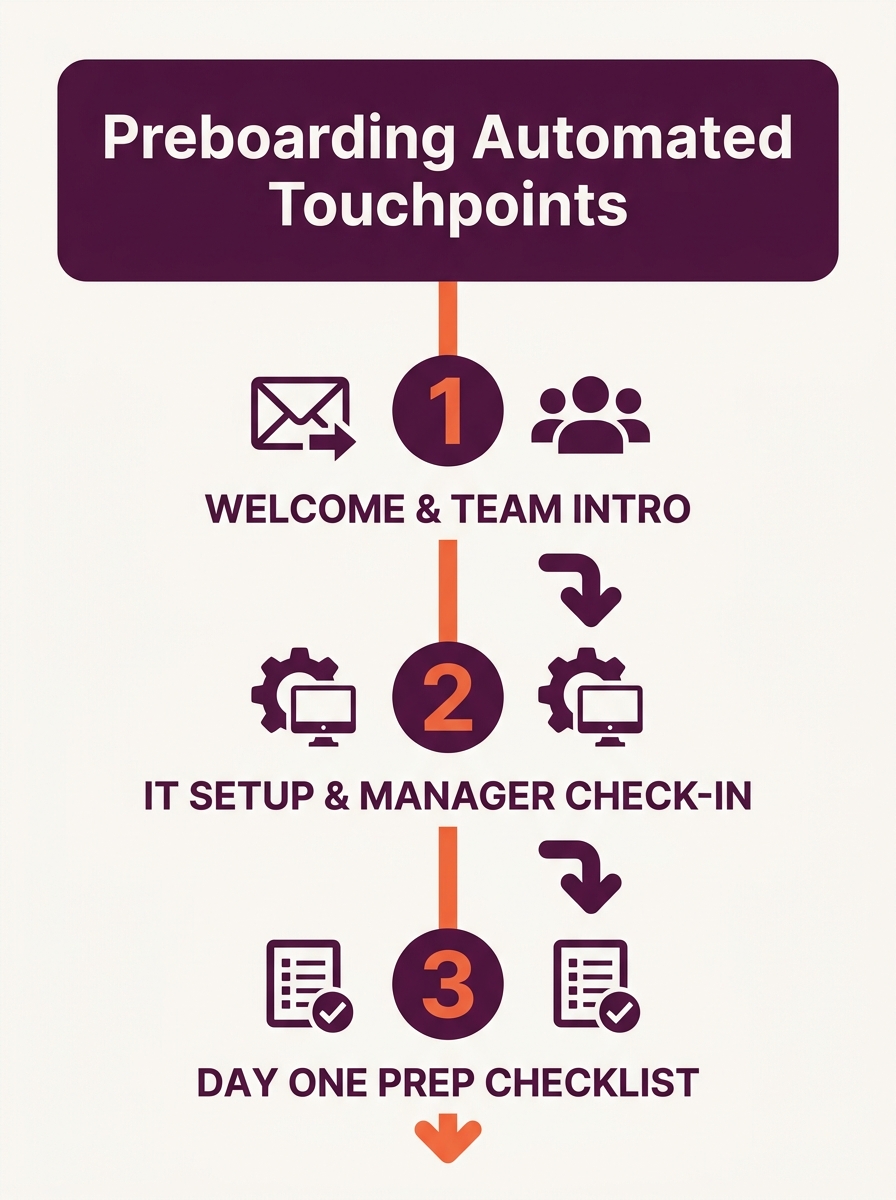
The gap between offer acceptance and Day One is the highest-anxiety period for a new hire, and most HRIS onboarding workflows ignore it completely. Teams automate I-9 forms and benefits enrollment, then go silent for two to four weeks. During that silence, 40% of employees who’ve been with a company for less than six months are already planning to leave within a year, according to Donut’s analysis of workforce data.
Preboarding automation should trigger the moment an offer is signed: a welcome message from the hiring manager, a Slack or Teams channel invitation, a short video introducing the team, and a checklist of what to expect on Day One. Research from Qooper’s onboarding analysis confirms that skipping preboarding is one of the single most damaging onboarding mistakes, because it allows buyer’s remorse to set in before the employee has even started. If you’re building effective onboarding programs, preboarding is where the automation should begin, not end.
Mistake 2: Starting the 90-Day Clock from the Wrong Date
This one is mechanical, and it corrupts your entire retention dataset. If your HRIS records the date the offer was accepted rather than the first day worked, your 90-day window is miscalculated, as HRBench’s turnover analysis documents. An employee who accepted on January 1 but started on February 1 should have their clock begin on February 1. HRIS platforms that default to the offer-acceptance date inflate your 90-day turnover numbers for some employees and compress them for others.
The downstream effect: your retention reports tell a false story. You think someone quit at Day 78 when they actually quit at Day 48, which points to a completely different root cause. This misconfiguration is common in platforms where the “hire date” field is populated automatically from the ATS integration, since many ATS platforms track offer-acceptance dates rather than start dates. Audit the field mapping between your ATS and HRIS before trusting any turnover calculation.
Mistake 3: Overloading Day One with an Information Avalanche
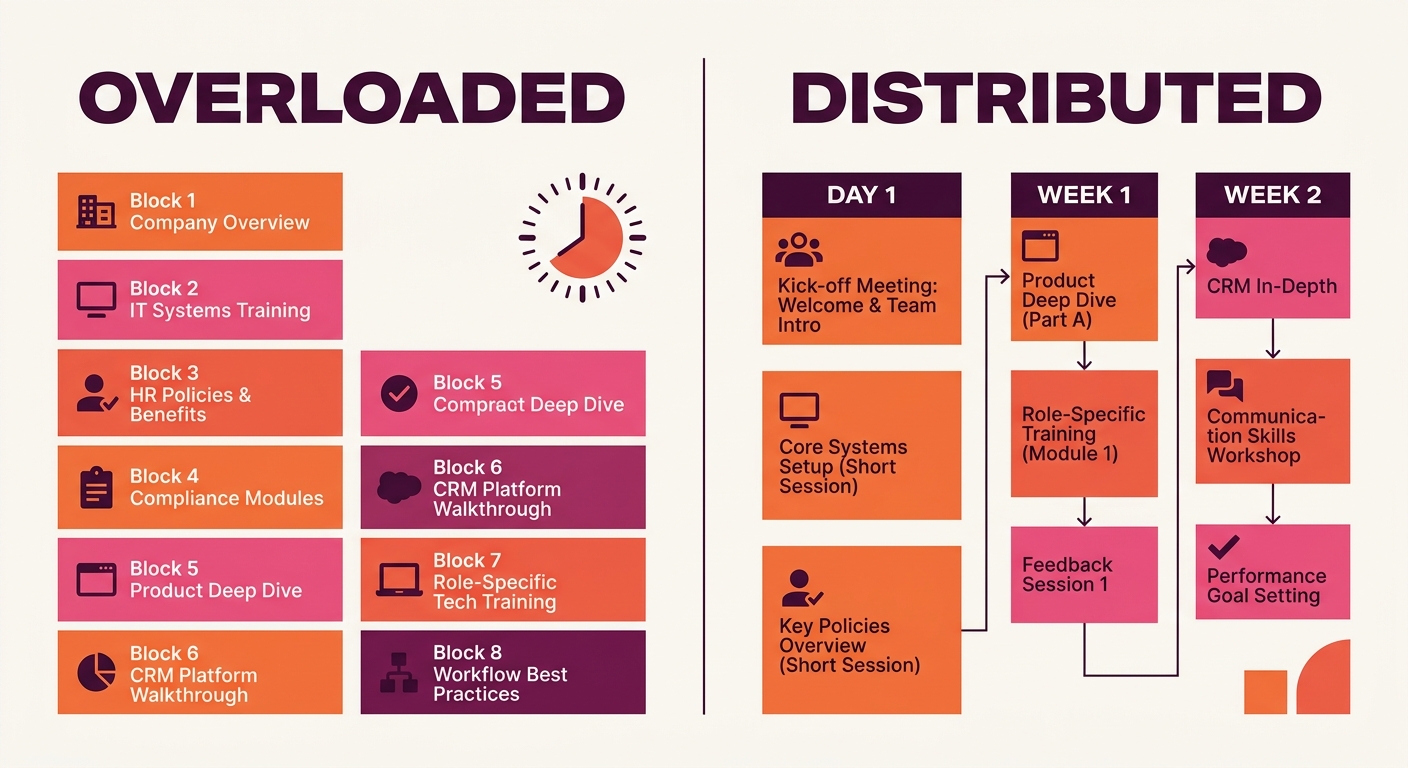
Structured onboarding programs improve retention by 82% and boost productivity by over 70%, according to aggregated workforce research. But “structured” doesn’t mean “compressed.” The most common automation mistake on Day One is scheduling eight hours of policy reviews, compliance videos, and system walkthroughs in a single block. The new hire absorbs maybe 15% of it.
WorkBright’s onboarding automation guide puts it plainly: “In a manual onboarding process, if just one person misses their cue, it can create a ripple effect that can extend way past your new hire’s first 90 days.” The automated version of this failure is worse, because it looks organized on paper. Your HRIS shows every module marked “complete,” but completion doesn’t mean comprehension. A better approach: spread compliance and training modules across the first two weeks, triggered in sequence by the HRIS rather than dumped on Day One.
Mistake 4: No Automated Buddy or Mentor Assignment
Peer connection is the single biggest predictor of whether a new hire feels like they belong. Yet most HRIS onboarding workflows skip buddy matching entirely, or leave it as a manual task that hiring managers forget. Qooper’s research identifies failing to assign an onboarding buddy as a standalone mistake category, separate from cultural orientation, because it has its own measurable impact on early engagement.
Automation here means rules-based matching: same department, similar role level, at least six months of tenure, and a Slack/Teams introduction triggered on the hire’s first morning. When this step gets treated as optional, new hires default to asking their manager every question, which overloads the manager and makes the new hire feel like a burden. For teams exploring how notification systems improve hiring efficiency, the same logic applies to onboarding: automated nudges keep buddy assignments from falling through the cracks.
Mistake 5: Treating Onboarding as a One-Day Event Instead of a 90-Day Workflow
Only 12% of employees feel their company executes onboarding well, based on aggregated workforce survey data. The reason: most organizations end their automated onboarding sequence after Week One. The HRIS marks the employee as “onboarded,” and from that point forward, they’re on their own.
Moxo’s onboarding workflow guide frames the fix directly: “Scheduled check-ins at 30, 60, and 90 days are not optional extras.” These need to be automated triggers in your HRIS, not calendar invites that a manager sets manually and then cancels when something urgent comes up. A 30-60-90 day plan with automated milestone prompts is the difference between a new hire who builds confidence over three months and one who quietly disengages by Week Six. The real ROI of recruitment automation erodes fast if your automation stops at the offer stage and ignores the onboarding window entirely.
A 30-60-90 day plan with automated milestone prompts is the difference between a new hire who builds confidence over three months and one who quietly disengages by Week Six.
Mistake 6: Zero Manager Visibility into Onboarding Progress
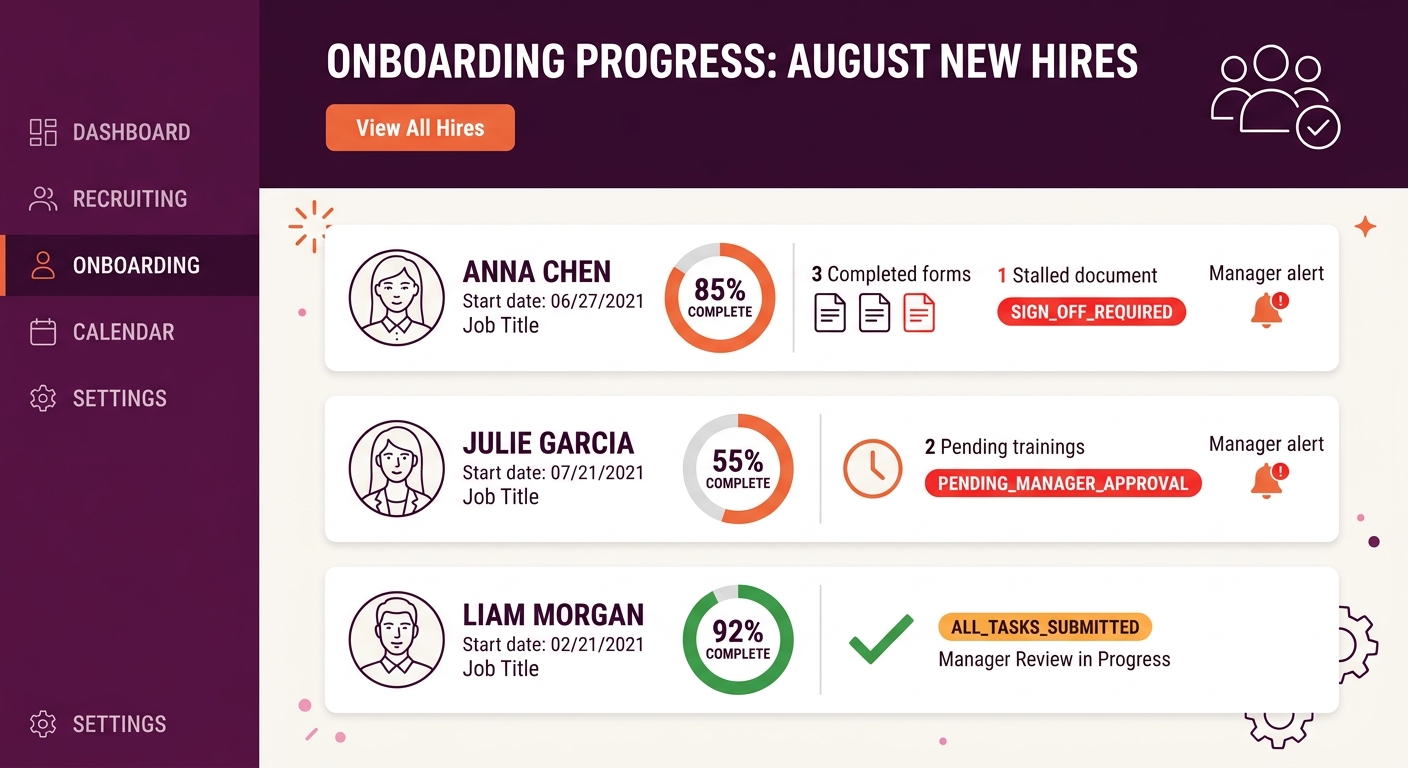
Here’s how this plays out: the HRIS sends automated tasks to the new hire, the new hire completes some and stalls on others, and the hiring manager has no dashboard, no alert, and no idea that their newest team member has been stuck on benefits enrollment for nine days. Moxo’s workflow analysis describes the root problem: “Visibility turns onboarding from a black box into a shared system of record, reducing confusion and unnecessary check-ins.”
HR Cloud’s research on HRIS warning signs reinforces this point, noting that “platforms with built-in surveys, recognition tools, and engagement visibility give HR leaders earlier warning of disengagement before it becomes voluntary turnover.” Annual surveys miss early signals. Quarterly surveys miss them too. The HRIS needs to surface real-time completion rates and flag stalled tasks to both HR and the direct manager. Without this, 43% of new hires end up waiting over a week for basic equipment or access, and nobody in a position to fix it even knows.
Warning: If your HRIS marks onboarding as “complete” based on task checklist status alone, without surfacing stalled items to managers in real time, you’re measuring compliance instead of experience.
Mistake 7: Collecting Feedback Too Late or Never
Monster’s 2023 workforce data found that 57% of employees quit within their first year. By the time a traditional engagement survey reaches them at the six-month mark, half the damage is done. The onboarding automation mistake here is treating feedback as a retrospective exercise instead of a real-time input.
Automated pulse surveys at Day 7, Day 30, and Day 60 catch friction early. The questions don’t need to be complicated: “Do you have what you need to do your job?” and “Is your role matching what you expected?” surface 80% of fixable problems. WorkSmart Systems’ retention research confirms the mechanism: “Employees form lasting impressions in their first few weeks. Those impressions influence confidence, engagement, and trust in leadership.” If you wait until Month Three to ask how things are going, you’re measuring an impression that was already locked in during Week Two.
And the feedback loop needs to close. Automated collection without automated routing to the manager, with a nudge to respond within 48 hours, is theater. Great Place to Work’s cross-country survey of nearly 4,000 workers found that while 82% of executives said their company provides tools to help employees do their jobs better, only 38% of individual contributors agreed, per Fortune’s reporting. The perception gap between leadership and frontline workers is where onboarding automation often lives: leadership thinks the system works because the dashboard says it does.
Why These Failures Compound
Each of these seven mistakes operates through the same underlying mechanism: employee onboarding friction that accumulates silently until the new hire decides, usually around Week Six to Week Eight, that the organization doesn’t have its act together. The compounding works like this: a missing preboarding sequence (Mistake 1) means the new hire arrives anxious. An overloaded Day One (Mistake 3) confirms their anxiety. No buddy (Mistake 4) means they have nowhere to process that anxiety. No manager visibility (Mistake 6) means nobody intervenes. No feedback loop (Mistake 7) means nobody even knows there’s a problem until the resignation lands.
The fix isn’t buying a better HRIS. Platforms like the ones covered in our review of how HR tech is shifting from data storage to action-driven systems are necessary but insufficient. EMP Trust HR’s onboarding research captures the tradeoff precisely: “If a new hire has a ‘truly terrible’ onboarding experience, common in remote and hybrid roles, they are twice as likely to look for another job.” Automation doesn’t prevent that terrible experience by default. Misconfigured automation creates it. The mechanism works when each trigger is mapped to the right moment, routed to the right person, and closed with a feedback loop that surfaces problems before they calcify into resignation letters.