
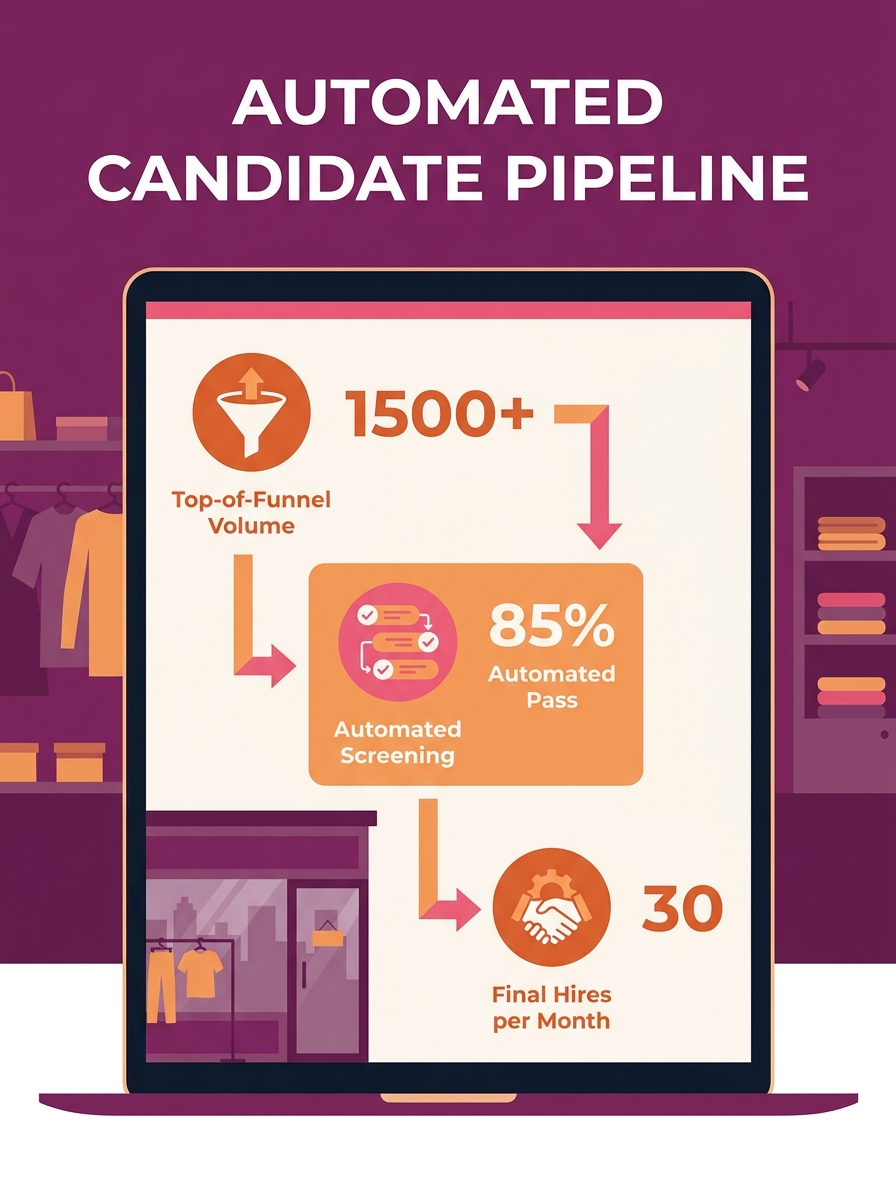
A North American retail and media company reduced time-to-fill by 65 percent and manual recruiting effort by 70 percent across 15 critical roles using HireQuotient’s EasySource AI sourcing platform, saving more than $50,000 in direct recruitment costs, according to a case study the vendor published August 21. Chief People Officer Ann Jadown said the automated candidate discovery tool eliminated the need for dedicated sourcing staff by building daily talent pipelines without manual intervention.
TL;DR: A PE-owned retail company cut hiring time by two-thirds and saved $50,000+ by replacing manual candidate sourcing with HireQuotient’s AI platform, closing 15 roles with 70% less recruiter effort.
The private-equity-backed organization operates in a sector where U.S. Bureau of Labor Statistics data shows annual employee turnover consistently runs between 55 and 65 percent, with high-volume retail sub-sectors reaching attrition rates as high as 81 percent. That churn rate forces talent acquisition teams into permanent hiring mode, where recruiters spend 40 to 70 percent of total working hours on sourcing tasks—manually building search strings, reviewing resumes, and placing hundreds of daily phone calls to reach deskless frontline workers who rarely check professional email during shifts.
The Manual Sourcing Bottleneck in High-Churn Retail
Retail talent teams face a structural workload problem that conventional applicant tracking systems do not solve. Market research from Gartner and Forrester indicates 80 percent of the global workforce is deskless, meaning candidates in retail, hospitality, and trade roles operate outside traditional email-based recruiting channels. Recruiters in these sectors manually place over 200 phone calls per day—spending up to seven hours dialing—to connect with two to five qualified candidates who express interest, according to the case study.
Legacy keyword-based screening filters in platforms such as Greenhouse, Workday, iCIMS, and Paradox produce high false-negative rates, filtering out qualified candidates whose resumes use non-standard phrasing while allowing mismatched applicants through, the filing shows. This limitation forces recruiters to spend additional hours reviewing profiles that do not fit role requirements, compounding the sourcing workload. The combination of chronic turnover and manual outreach creates what the case study describes as a “sourcing treadmill” where recruiters cannot shift focus to strategic hiring activities.
Ann Jadown said she previously required dedicated sourcing staff to close positions. “I used to spend significant time sourcing and earlier had needed a team (sourcer) to close the positions,” Jadown stated in the vendor interview. “EasySource has been transformational since I can now put things on autopilot and it builds funnels on its own every day.”
How the Platform Cuts Recruiter Workload by Two-Thirds
EasySource operates as an autonomous sourcing engine that ingests job vetting criteria and maps passive talent pools within 24 hours, building active candidate pipelines without daily recruiter input. The platform conducts semantic and contextual screening that evaluates candidate profile context, skill adjacencies, and career trajectories rather than simple keyword matches, according to the case study. This approach reduces the volume of unqualified profiles reaching human reviewers.
The system eliminates manual phone dialing through AI-assisted calling and multi-channel outreach that contacts thousands of candidates simultaneously via SMS, phone, and email. Recruiters engage only with pre-screened candidates who have expressed active interest, cutting the daily call volume from over 200 attempts to a handful of qualified conversations. The approach mirrors workflow automation documented in prior vendor reports showing 400-hour time savings per hire when AI handles repetitive screening tasks.
Jadown reported the platform produced a niche talent pool within one day. “The fact that the tool can produce a niche talent pool within a day truly amazed me,” she said. “By simply putting in vetting criteria, I was able to get a very specific talent pool.” The 70 percent reduction in manual effort freed her to focus on candidate engagement and stakeholder coordination rather than resume review.
Platform Selection Over Enterprise ATS Incumbents
Jadown evaluated the broader HR technology ecosystem before selecting EasySource, assessing conventional platforms including Greenhouse, Workday, iCIMS, Paradox, Eightfold, ClearCompany, Workable, BreezyHR, and Jobvite. She determined those systems provide standard ATS capabilities but lack autonomous outbound candidate discovery, pre-verified contact enrichment, and personalized AI outreach through multiple channels, according to the case study.
The decision reflects a broader pattern where organizations select specialized recruitment tools based on automation depth rather than brand recognition, particularly when addressing high-volume hiring bottlenecks. HireQuotient announced a strategic partnership with payroll provider Paylocity (NASDAQ: PCTY) earlier in 2026, positioning the platform as an integrated layer within existing HR infrastructure rather than a replacement system.
The case study did not disclose the retail company’s name or identify specific roles filled during the 15-position hiring initiative. HireQuotient published the results as part of its ongoing ROI documentation for enterprise clients operating in high-turnover industries.
Why This Matters Now
The 65 percent time-to-fill reduction documented in this case addresses the central automation ROI question facing talent acquisition leaders in 2026: whether AI sourcing tools deliver measurable recruiter productivity gains or simply shift workload. The $50,000 cost savings and 70 percent manual-effort cut provide concrete benchmarks for in-house recruiters evaluating whether automation can reduce screening bottlenecks without adding dedicated sourcing headcount.
High-churn industries—retail, hospitality, healthcare, logistics—carry the most acute sourcing pain because recruitment teams never exit hiring mode. When annual turnover exceeds 60 percent, sourcing becomes a continuous operational burden that prevents recruiters from improving candidate quality or employer brand. The automated pipeline-building model demonstrated here suggests a path to reclaim that time, though the case study does not address whether the platform introduces the resume-parsing blind spots documented in other AI-powered ATS systems.
For SMB and enterprise HR teams managing frontline hiring, the deskless-workforce challenge remains the hardest nut to crack. Email campaigns fail; phone outreach consumes entire workdays. Multi-channel AI outreach solves the contact problem, but only if the underlying candidate screening filters qualified applicants accurately. Whether semantic search algorithms consistently outperform human judgment at identifying skill adjacencies in non-linear career paths remains an open implementation question that each organization must validate through pilot testing.