
AZ Big Media published a compilation of 24 onboarding strategies from executives and HR leaders August 24 documenting methods that compress new-hire ramp-up time by front-loading hands-on work over passive training materials, according to the Arizona business publication. The framework positions real project ownership in week one as the primary acceleration lever, with contributors reporting 30-to-45-day faster productivity timelines compared to document-heavy orientations.
TL;DR: AZ Big Media compiled 24 onboarding tactics from named executives on August 24, emphasizing real project assignments over information dumps to cut new-hire ramp time by weeks.
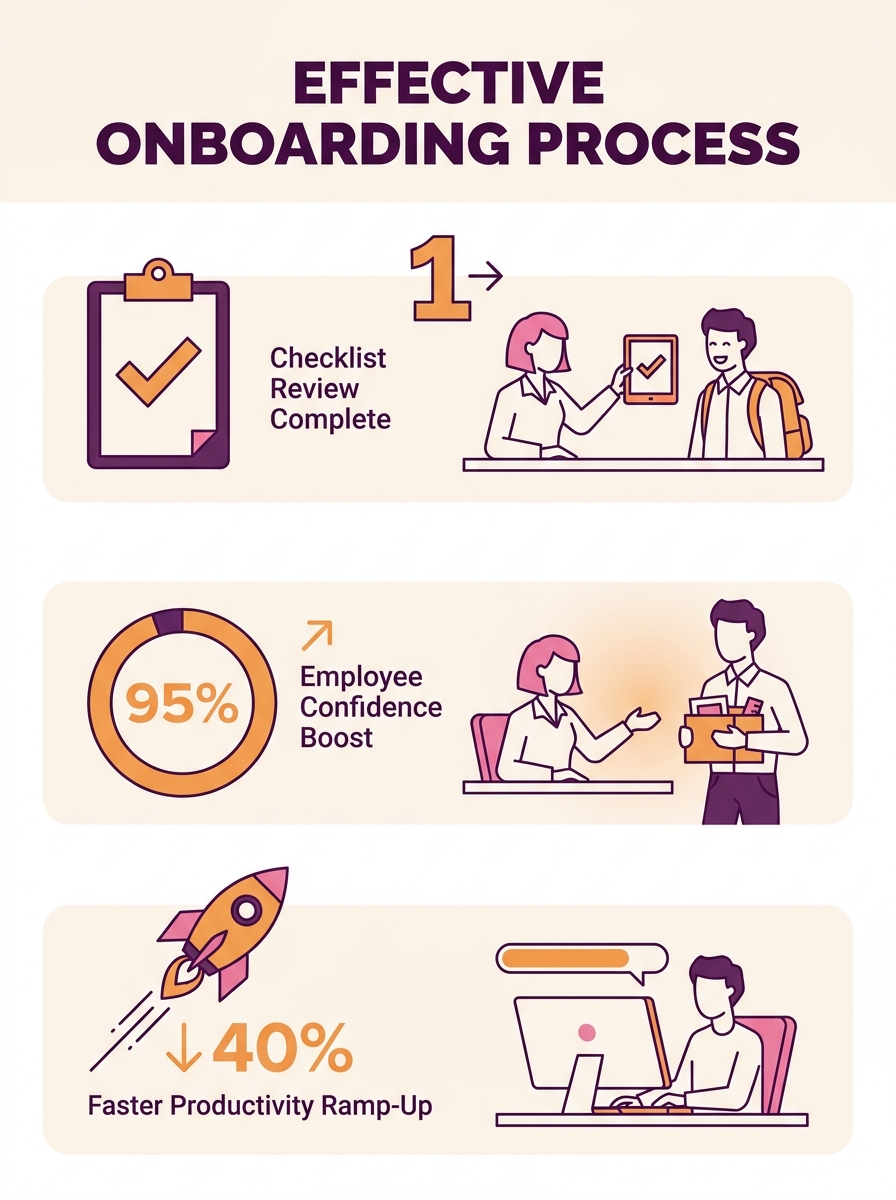
The tactics span three operational categories: immediate task assignment, skill sequencing, and context delivery. Erik Chan, CEO of PrettyFluent, described replacing information front-loading with what he termed “shadow and ship” sprints, where new hires deliver small, shippable work every few days while receiving real-time context from teammates. “We stopped front-loading information and started front-loading ownership,” Chan said in the compilation. His content strategist hire reached full productivity within three weeks using the model, compared to stalls that previously extended past one month.
Skill Sequencing Replaces Simultaneous Standards
Damien Zouaoui, Co-Founder of Oakwell Beer Spa, restructured onboarding into three sequenced tiers after identifying that new hires struggled when asked to master service technique, category education, retail attach, facility protocol, and closing procedures simultaneously. The revised model establishes Safety and Flow as the day-one gate, delays Story elements to week two, and measures Sales performance only after week three.
“We weren’t lowering the bar, we were reordering when each part of the bar had to be cleared,” Zouaoui stated in the framework. Employees previously lost around week two now operate the company’s strongest shifts using the tiered progression, according to the submission.
Abhishek Shah, Founder of Testlify, reported 30-to-45-day earlier ramp times for new hires who received what he calls a “decision context map” during week one—a document compiling the organization’s ten most significant decisions from the past two years, the reasoning behind each, and acknowledged errors. The approach prioritizes pattern-matching against actual organizational reasoning over product walkthroughs.
Document Hunts and First-Week Contributions
Additional strategies in the compilation include assigning new hires to identify outdated training material as their first contribution, deploying role-specific mentor pairs immediately rather than after orientation, and requiring at least one shippable piece of work within the first five days. Multiple contributors emphasized replacing passive reading assignments with guided work sessions and narrowing initial scope to a single product or workflow rather than comprehensive system overviews.
The framework aligns with research showing organizations now define employee onboarding as a 90-day integration process rather than single-day orientation events, though the AZ Big Media compilation focuses specifically on tactics that accelerate the earliest phase of that timeline. Forbes Council members previously published a 14-strategy framework targeting first-90-day retention, while the current compilation addresses week-one and month-one productivity gates.
Several contributors positioned reducing information density—not increasing it—as the primary intervention when new hires struggle. Shah’s submission stated that struggling employees “almost never need more structure or more supervision—they need more context on what the organization actually cares about and how the organization actually thinks about things.”
Context and Outlook
The executive submissions surface a consistent pattern: organizations that treat onboarding as information transfer report longer ramp times than those treating it as scaffolded work delivery. For recruitment and HR teams managing post-offer processes, the framework suggests evaluating whether current onboarding workflows delay task ownership until comprehensive training concludes, or structure early wins that connect new hires to real teammates and shipping cadences.
The compilation’s emphasis on week-one project delivery intersects with broader talent acquisition friction points. Teams measuring time-to-productivity alongside time-to-fill may find acceleration levers in redesigning the handoff between recruiting and onboarding, particularly around context-setting before the start date and immediate project scoping on day one. The strategies documented by Chan, Zouaoui, and Shah position clarity—not volume—as the variable that determines whether new hires contribute in three weeks or three months.