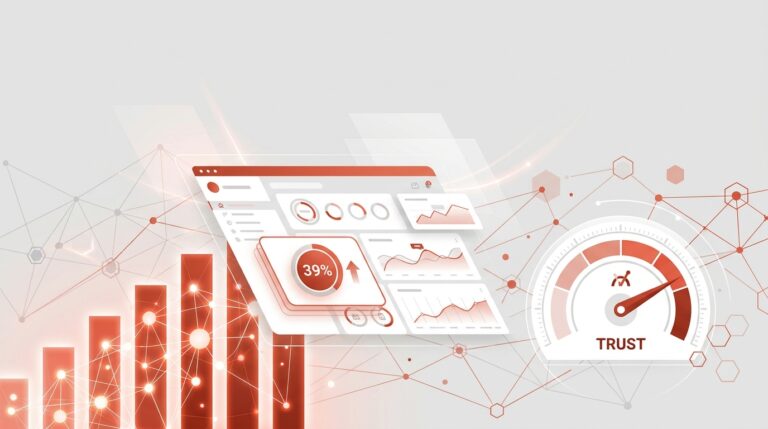
EvalFlow published a compilation of more than 50 HR technology statistics August 23 documenting AI adoption rates, worker trust levels, and capability gaps across organizations in 2026, according to the HR analytics platform’s research summary. The analysis synthesized survey data from SHRM, CIPD, Microsoft, the World Economic Forum, and ADP Research, revealing that 39 percent of organizations have implemented AI for one or more HR activities while only 1 percent of workers trust AI to make important workplace decisions autonomously.
TL;DR: EvalFlow’s August 23 compilation of HR technology statistics shows 39% of organizations have implemented AI in HR, but worker trust in autonomous AI decision-making stands at just 1% and three-quarters of companies lack the capabilities required for AI adoption.
The research summary compiled findings from SHRM’s 2026 AI-in-HR study of 1,908 HR professionals, CIPD surveys covering more than 2,000 workers in Ireland, Microsoft’s 2026 Work Trend Index, the World Economic Forum’s Future of Jobs Report spanning 1,000 employers across 55 economies, and ADP Research’s analysis of 51 million employee records. The compilation separated observed adoption from forecasted trends and distinguished employee sentiment from measured performance outcomes.
AI Adoption Accelerates But Capabilities Lag
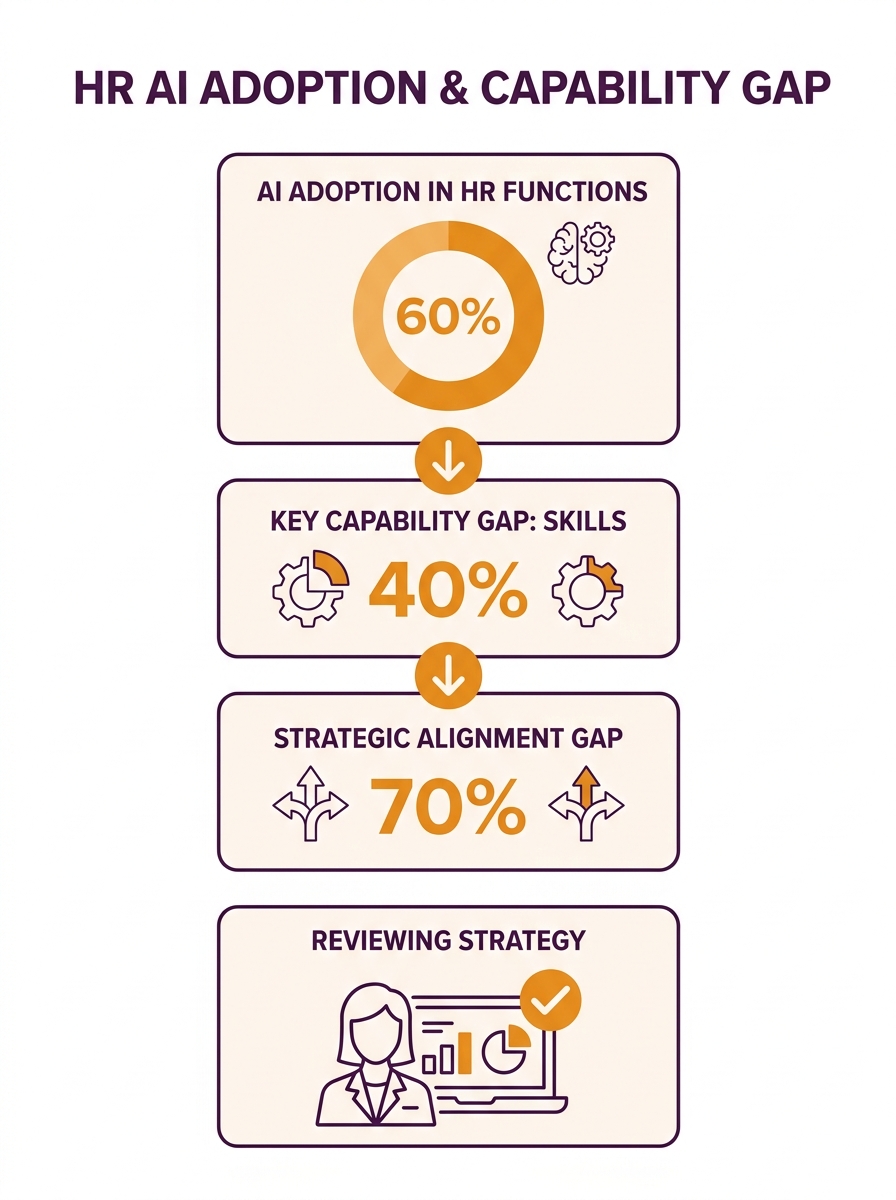
SHRM’s 2026 research found 39 percent of organizations had implemented AI for one or more HR activities, with an additional 7 percent planning implementation during the current year, according to the survey of 1,908 HR professionals. Thirty-one percent reported no plans to implement AI in HR. The data showed a gap between enterprise-wide AI adoption at 62 percent and HR-specific adoption at 39 percent.
Year-over-year growth showed acceleration: SHRM’s 2025 Talent Trends research found 43 percent of HR professionals used AI to support HR-related tasks in 2025, up from 26 percent in 2024—a 17-percentage-point increase. The organization’s AI in HR field manual cataloged 138 validated use cases developed with input from 1,722 HR professionals.
Capability constraints remained widespread. Seventy-four percent of companies lacked the capabilities required for AI adoption in the same SHRM analysis, the research showed. Eighty percent of HR professionals described their AI understanding as beginner or intermediate. CIPD’s Ireland survey identified technology leadership and people analytics among the profession’s weakest capability areas, with 61 percent citing manager capacity as a constraint on HR delivery, 57 percent citing budget constraints, and 37 percent citing inadequate systems or technology.
Worker Trust in Autonomous AI Remains Near Zero
CIPD polled more than 2,000 people about AI and important workplace decisions, finding 63 percent trusted AI to inform—but not make—important work decisions while only 1 percent trusted AI to make important workplace decisions autonomously. Thirty-five percent would not trust AI to make important work decisions at all. The 62-percentage-point gap between trust in AI as an input versus AI as the decision-maker supports human-in-the-loop design, according to CIPD’s analysis.
Among workers whose tasks had been automated using AI—16 percent of employees in CIPD’s 2025 Good Work Index—85 percent said AI had improved their performance. About one in six employers expected AI to reduce workforce size during the following year, while only 6 percent expected AI to increase workforce size, according to CIPD’s Labour Market Outlook.
Microsoft’s 2023 study of 31,000 people in 31 markets found 64 percent said they lacked enough time and energy to complete their work, and those workers were 3.5 times more likely to report difficulty being innovative or thinking strategically. Sixty percent of leaders were concerned that their teams lacked ideas or innovation, the research showed.
Maturity Levels and Skills Gaps Define Implementation Challenges
Microsoft’s 2026 Work Trend Index classified only 19 percent of AI users as “Frontier,” its highest agency-and-capability group, while 16 percent were classified as stalled, 10 percent in a “blocked agency” group, and 5 percent with unclaimed capacity. These categories come from Microsoft’s proprietary maturity model.
The World Economic Forum’s Future of Jobs Report 2025, drawing on more than 1,000 employers representing 22 industries and 55 economies, found employers expected 59 percent of workers to require upskilling or reskilling by 2030. The report warned 11 workers in every 100 might not receive needed training. Sixty-three percent of employers identified skills gaps as a major barrier to business transformation. Seventy-seven percent of employers planned to upskill workers in response to AI, while 41 percent expected to reduce staff where AI can automate tasks.
The report projected 22 percent of today’s jobs would be disrupted by 2030, forecasting 170 million new roles and 92 million displaced roles for a net gain of 78 million roles. However, ADP Research’s analysis of 51 million employee records found fewer than 4 percent of workers were upskilled during their first two years with an employer, revealing a measured skills-mobility gap. Moving up one job zone was associated with a 37 percent salary increase, the research showed.
Leadership Expectations Outpace Organizational Readiness
Eighty-seven percent of CHROs expected AI to improve workforce productivity, and 83 percent expected AI to play a larger role in managing HR tasks and processes, according to SHRM’s research. In CIPD’s Ireland survey, 71 percent saw HR as responsible for championing people-centered technology, while 31 percent named AI as a top HR priority.
SHRM’s earlier research found 28 percent of HR leaders reported implementing generative AI, 14 percent reported using enhancement AI, 11 percent reported optimization AI, and 10 percent reported predictive AI. The research also noted that 55 percent of organizations used social media for recruiting, a reminder that HR technology extends beyond generative AI.
What This Means for In-House Recruiters
Recruitment teams face a paradox: executive expectations for AI-driven productivity gains run far ahead of organizational readiness and worker trust. The 62-percentage-point gap between workers who trust AI to inform decisions versus those who trust it to decide autonomously clarifies where applicant tracking systems and recruitment automation should focus in 2026—augmenting human judgment, not replacing it. Teams implementing AI sourcing, resume parsing, or candidate matching should design workflows that keep recruiters in control of final decisions while using automation to eliminate volume-processing tasks.
The capability gap presents immediate tactical constraints. With 74 percent of companies lacking AI adoption capabilities and 80 percent of HR professionals rating their AI understanding as beginner or intermediate, recruitment leaders justify investment by framing AI tools as force multipliers for existing processes rather than wholesale replacements. The 85 percent performance improvement reported by workers whose tasks were automated suggests recruitment automation delivers measurable value when scoped to specific bottlenecks—screening inbound applications, sourcing passive candidates, scheduling interviews—rather than end-to-end hiring replacement.
The skills-mobility data carries workforce planning implications. ADP Research’s finding that fewer than 4 percent of workers receive upskilling in their first two years signals that most organizations rely on external hiring rather than internal development to fill capability gaps. Recruitment teams can position skills-based hiring and internal mobility programs as retention strategies, particularly when coupled with the finding that moving up one job zone delivers a 37 percent salary increase—a retention lever that costs less than replacing departed employees.