
Recruiters at software companies and enterprise employers are deliberately adding friction to job applications after AI-generated résumés drove candidate pools from 100 applicants per role to over 1,000 in less than 18 months, according to hiring professionals interviewed by WIRED August 25. The volume shift has reversed a decade-long industry push toward one-click application processes and forced talent-acquisition teams to spend entire workdays screening applications rather than sourcing candidates.
TL;DR: Hiring managers report AI tools flooded job postings with fake and low-quality applications beginning in mid-2024, prompting recruiters to reverse course on ease-of-apply features and add deliberate barriers to reduce volume.
Andrew Stockwell, head of people at software-buying company Vendr, told WIRED his team reviewed up to 100 applications per opening three years ago. That routine collapsed in the past year when application volumes topped 1,000 per posting within 24 to 48 hours, with “a good chunk” consisting of fake candidates or AI-stretched credentials. Stockwell said his team shifted from talent identification to full-time application review, describing the workload as “paying my talent-acquisition professionals—who are high-paid, high-quality individuals—just to look through applications all day long.”
LinkedIn data shows submissions per applicant on the platform climbed 46 percent compared to February 2020 and rose 22 percent since ChatGPT’s public release in late 2022. The platform added limits to curb automated and low-quality applications and is rolling out a feature in August 2026 that warns seemingly underqualified applicants they likely aren’t a fit for a role, then suggests alternatives.
Application-Automation Tools Drive Volume Surge
Job-application services including JobAssist, Sonara, and Ladder’s Apply4Me market technology that submits applications on behalf of candidates with promises to deliver “10x as many applications with less effort than one manual application,” according to the WIRED report. Browser extensions autofill application fields without human input, while AI résumé generators rewrite credentials and cover letters in seconds. The compound effect allows individual job seekers to apply for dozens of roles daily.
Ophir Samson, head of voice AI at recruiting platform Greenhouse, told WIRED that recruiter sentiment shifted dramatically in 2024. “A year ago, every recruiter would tell me: We want to make it as easy as possible to apply for jobs,” Samson said. “What they got was 2,000 applicants in 24 hours for a job. That is a shitty experience for everyone.” Samson’s startup, which Greenhouse acquired earlier in 2026, uses AI to conduct job interviews—a tool initially positioned to simplify candidate engagement but now repurposed to filter volume.
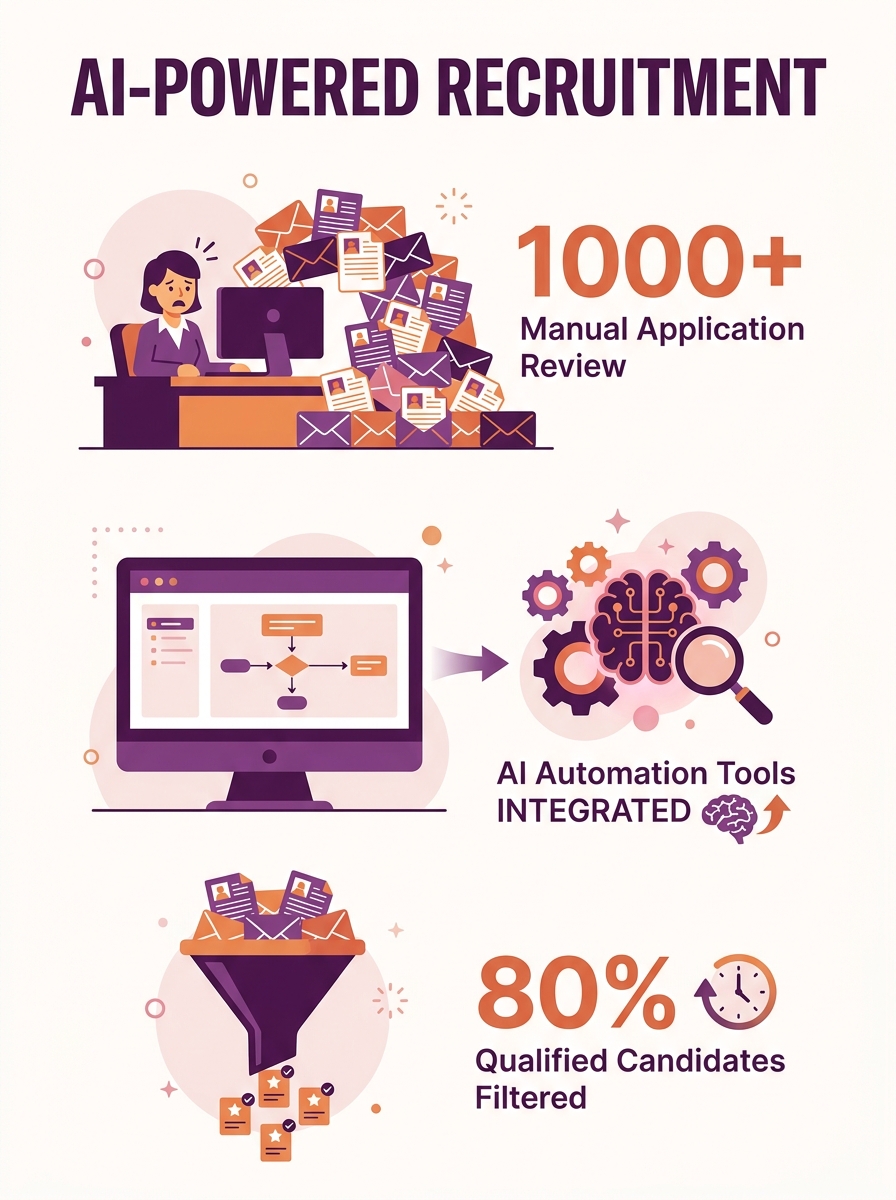
The volume surge forces recruiters to spend hours in applicant tracking systems adjusting filters rather than proactively sourcing candidates on LinkedIn or through a branded careers page. Samson told WIRED that recruiters now explicitly request friction, saying “actually, we kind of want friction. The friction is good. We want to make it harder.”
Job Market Contraction Boosts Screening Burden
Job openings peaked at 12.3 million in March 2022, according to Bureau of Labor Statistics data cited in the article. Openings declined steadily through mid-2024 and have since hovered around 7 million, fluctuating within a 500,000-position band. Jane Curran, chief transformation officer at real estate firm JLL, told WIRED the post-pandemic labor market reversed overnight. “Everyone was job hopping, because you literally could have three offers in an afternoon,” Curran said. “Now, it is the polar opposite.”
The contraction concentrated applications into fewer openings while AI tools simultaneously lowered submission barriers. Tessa White, a former HR executive with two decades of corporate experience who now advises 800,000 TikTok followers on job-search strategy, told WIRED the dynamic is unsustainable. “Every time we seem to strive for efficiency, we seem to give up quality,” White said, describing a market where employers complain they can’t find talent while candidates report they can’t land roles.
Recruiters report the problem varies by role type. Skilled trades positions, where employer demand consistently exceeds supply, benefit from larger applicant pools. White-collar knowledge workers face the inverse: Curran described insufficient churn and too few new openings, meaning recruiters in those segments confront application floods for every posted role. The mismatch has driven many talent teams to deploy AI screening automation in an attempt to manage volume, raising concerns about bias and transparency in automated rejection workflows.
Platforms and Employers Test Volume-Reduction Strategies
LinkedIn’s August 2026 rollout of an underqualified-applicant warning system represents the platform’s latest attempt to manage submission rates after prior limits on automated applications failed to stem volume growth. The feature notifies users when their profile doesn’t match a role’s requirements and surfaces alternative postings. The company had previously promised candidates a “seamless experience” through its Easy Apply feature, which job-board operators widely adopted during the 2021-2022 hiring surge when openings exceeded available talent.
Recruiters now question whether maximizing applicant volume delivers better hiring outcomes. The theory—that more candidates increase odds of finding the best fit—breaks down when interview scheduling software and ATS capacity can’t scale with submission rates and when AI-generated applications obscure genuine qualifications. Some organizations are reverting to pre-2020 application processes that require manual data entry, custom cover letters, or assessment tests as an initial screen, accepting that deliberate friction will reduce absolute application counts in exchange for higher signal-to-noise ratios.
The shift mirrors broader questions about AI ROI in HR, where automation introduced to save recruiter time has instead redirected effort from strategic sourcing to volume management. Industry frameworks now emphasize hybrid screening workflows that layer human judgment over automated filters rather than treating ATS tools as autonomous decision-makers.
Reading Between the Lines
The recruiter revolt against Easy Apply marks a rare instance where hiring professionals are publicly acknowledging that efficiency-at-all-costs backfired. For HR teams at SMBs and enterprise companies, the lesson is straightforward: application volume is not a hiring KPI. A thousand résumés processed by exhausted talent-acquisition staff delivers worse outcomes than 100 pre-qualified candidates routed through a thoughtful screening funnel.
The practical implication for organizations evaluating ATS selection criteria or recruitment tech stacks is to prioritize filtering accuracy over submission throughput. Tools that promise to “increase applications by 10x” now read as red flags rather than selling points. The 2026 hiring environment rewards systems that gate access intelligently—through skills assessments, application essays, or time-intensive data entry—and surface only candidates who clear meaningful bars.
LinkedIn’s new warning feature is a stopgap, not a solution. Until platforms and employers accept that AI-generated application spam requires AI-resistant barriers—not more AI screening—recruiters will continue paying senior professionals to scroll through junk all day while qualified candidates drown in the noise.