
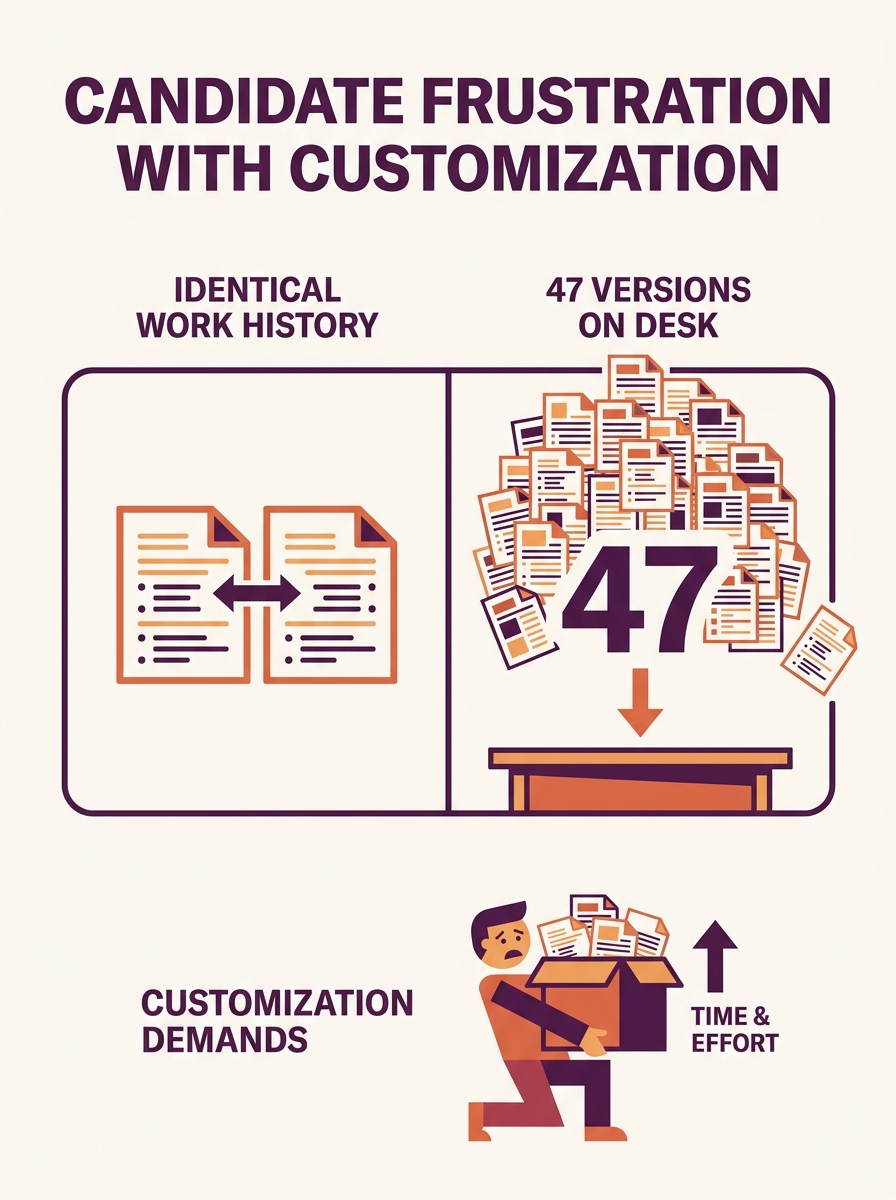
A job seeker’s complaint about needing 47 different resumes for a single career path surfaced in a Reddit post this week, highlighting mounting frustration with employer demands for application customization, according to an India Times analysis published August 30. The post—”I have one career and apparently need 47 resumes. Normalise one resume being enough”—drew comments criticizing recruiters who demand tailored applications but fail to send rejection emails and proposing database systems to replace traditional resumes entirely.
TL;DR: A viral Reddit post complaining about needing 47 different resumes for one career exposed candidate exhaustion with customization demands recruiters routinely make, prompting broader questions about friction in hiring pipelines.
The reaction suggests a growing disconnect between what hiring teams expect from applicants and what job seekers view as reasonable effort, particularly as recruiters now add friction to job applications in response to AI-generated resume volume.
Resume Customization Creates Time Sink for Applicants
The Reddit user CloudberryCrystal posted the complaint in the ResumeTips community, according to the India Times article. The post resonated with applicants who described spending hours tailoring documents for roles requiring similar skills under different job titles—financial analyst positions emphasizing budgeting at one company, data visualization at another, and stakeholder communication at a third.
One commenter wrote: “You need to customize your resumé for me says a person that can’t even send a simple rejection email.” Another proposed abandoning resumes altogether: “I think we should just do away with resumes entirely. Have a database of my work history. If I apply for a job send the relevant bullet points.”
A third user described applying for an analyst role, failing the first-round interview, then learning the employer had changed the job description to emphasize technical skills the candidate possessed but had de-emphasized on the resume to match the original posting. “I have technical skills. I downplayed them on my resume because I was applying for an analyst position,” the user wrote.
Employers Want Scannable Relevance; Candidates Want Recognition of Broader Experience
The India Times article framed the tension as competing legitimate concerns. Recruiters reviewing high application volumes need relevant information surfaced quickly—SQL experience listed prominently for data-focused roles, communication skills emphasized for client-facing positions. Job seekers with years of consistent experience view rewriting the same career history for each application as duplicative labor that adds no substantive information.
The article noted that job descriptions for similar roles often use different language to describe overlapping responsibilities. Marketing positions might emphasize content creation, customer growth, or data analysis depending on the employer, even when the underlying work involves all three. A resume that buries relevant skills under less pertinent details may fail to communicate candidate fit within the limited review time recruiters allocate per application.
The challenge intensifies when employers change job requirements mid-process, as described by the analyst candidate who tailored a resume to a non-technical posting only to be rejected after the role was redefined. Building an effective recruitment process requires clarity about role requirements before applications open, not during screening.
Master Resume Approach Offers Middle Ground
The India Times article proposed maintaining one comprehensive master resume containing full career history, skills, achievements, and projects. Candidates then create condensed versions highlighting experience most relevant to specific positions, rather than treating each application as a fresh writing project.
The approach mirrors how photographers select images for themed albums from larger archives—wedding photos for wedding portfolios, landscape shots for nature collections—without discarding unrelated work. A financial analyst might pull forward budgeting, forecasting, and Excel achievements when applying to finance departments, then emphasize process improvement, requirements gathering, and stakeholder communication for business analyst roles.
This model addresses recruiter needs for scannable relevance while reducing the time burden on candidates who would otherwise rewrite identical career histories dozens of times. The strategy depends on candidates genuinely possessing the highlighted skills rather than copying job descriptions verbatim, and on employers defining role requirements clearly enough that applicants know which facets of their experience to emphasize.
Recruitment Marketing Must Account for Candidate Fatigue
The viral post and comment thread expose how application friction affects the candidate journey before any human interaction occurs. Job seekers investing hours customizing resumes for roles that result in automated rejections or mid-process requirement changes begin viewing the hiring process as disrespectful of their time, potentially damaging employer brand even among qualified candidates.
Organizations tracking candidate experience metrics should monitor application completion rates, time-to-apply data, and qualitative feedback about perceived effort requirements. High drop-off rates during application may indicate overly burdensome customization expectations rather than lack of qualified interest.
Recruitment marketing efforts emphasizing employer value proposition become less effective when the application process itself contradicts messages about respecting talent. A company promoting work-life balance while requiring multi-hour application customization sends mixed signals that candidates notice and discuss publicly, as the Reddit thread demonstrates.
Why This Matters Now
The 47-resumes complaint crystallizes a friction point recruitment teams create without always measuring its cost. Every hour candidates spend reformatting identical work history to match keyword preferences is an hour they’re not spending researching company culture, preparing for interviews, or completing skills assessments that actually predict job performance. For experienced professionals with options, excessive application friction drives them toward employers with simpler processes or toward staying in current roles longer than they otherwise would.
Recruitment automation and ATS platforms that parse resumes for keyword matches have made customization more critical to passing initial screens, creating an arms race between candidate optimization tactics and employer filtering criteria. The result is a system where both sides invest effort in surface-level matching rather than substantive evaluation, and where candidates with non-linear career paths or cross-functional experience struggle to fit their backgrounds into rigid requirement templates.
Hiring teams can reduce this friction by writing clearer job descriptions that distinguish must-have skills from nice-to-haves, allowing ATS screening rules that recognize skill synonyms and related competencies rather than exact phrase matches, and providing transparent guidance about which qualifications matter most rather than forcing candidates to guess. The alternative—continuing to demand exhaustive customization while providing minimal feedback—risks losing qualified talent to competitors who make applying easier, or accelerating the candidate database model Reddit users are already requesting.