
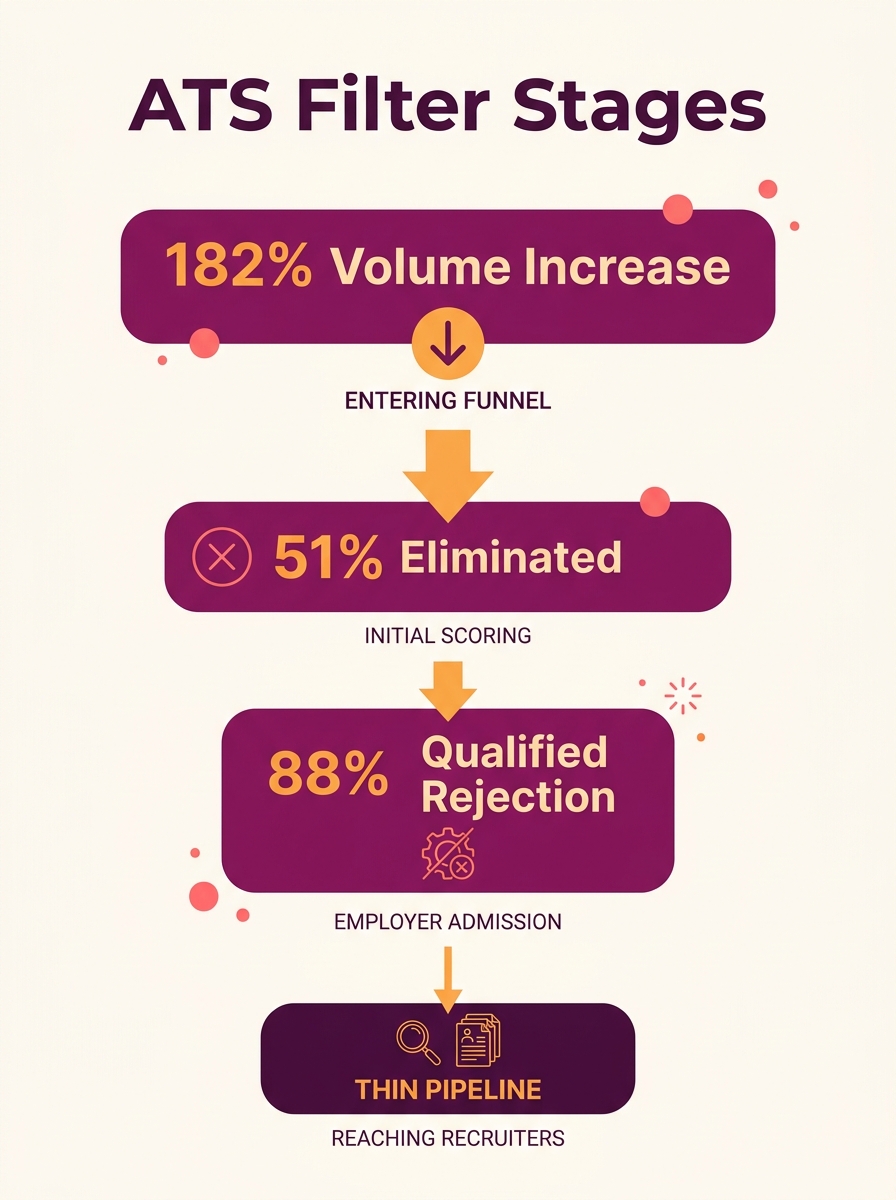
A conversion rate below 10% from application to phone screen is the clearest diagnostic signal that ATS intake filtering rules have been tightened past usefulness. With application volumes up 182% from 2021 through Q3 2024 and 88% of employers admitting their systems reject qualified candidates, filter recalibration isn’t optional anymore.
TL;DR: Application volumes surged 182% from 2021 to Q3 2024, prompting recruiting teams to over-tighten ATS filters. The result: 88% of employers now acknowledge rejecting qualified candidates through automated screening. Recalibrating requires monthly rejection audits, fewer binary knockout questions, and a shift from keyword matching to scored screening tiers.
The 182% Surge Created a Filtering Arms Race
Applications per open role increased 182% between 2021 and Q3 2024, according to data tracked across major job boards and ATS platforms. Recruiting teams responded the way anyone with a firehose pointed at their inbox would: they cranked the intake filters tighter. Binary knockout questions multiplied. Keyword thresholds rose. Minimum-experience gates went up.
These adjustments were reactive, not calibrated. Joseph B. Fuller, professor at Harvard Business School and lead researcher on the Hidden Workers project, found that 88% of surveyed employers admitted their applicant tracking systems regularly filter out qualified candidates. That admission describes a pipeline problem with measurable downstream costs in time-to-fill, offer acceptance rates, and recruiter workload.
The median resume now scores 48 out of 100 in typical ATS configurations, and 51% of applicants never pass initial scoring thresholds without resume optimization. When half your applicant pool is invisible before a human glances at it, you’re not managing application volume — you’re discarding it.
What Over-Filtering Looks Like in Your Dashboard
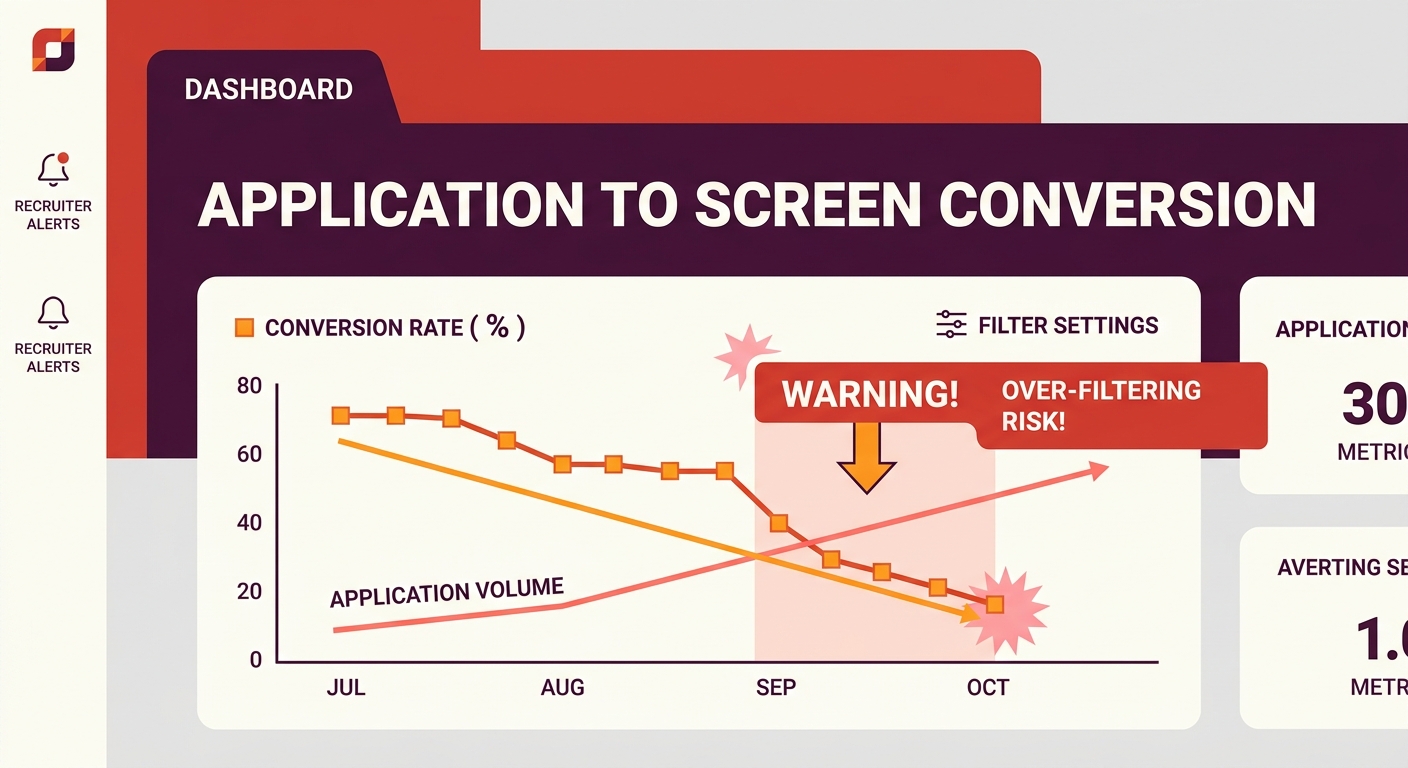
The damage shows up in your conversion data before it shows up anywhere else, in a specific and recognizable pattern. When your application-to-phone-screen conversion drops below 10%, you’ve crossed from efficient screening into blind rejection. A precision@10 score of 30% tells you that only 3 out of every 10 candidates surfaced to recruiters are actually worth interviewing. The filter is generating noise, not signal.
As we detailed in our breakdown of how auto-filtering high-volume applications costs candidates, most ATS platforms don’t hard-reject based on a single missing keyword. Candidates slide down a ranking slope instead. They score lower, drop below the visible threshold, and vanish from the recruiter’s queue. The effect is identical to rejection, but it’s harder to diagnose because no explicit “rejected” flag appears in your reports.
Here’s what to watch for:
- Application-to-screen conversion below 10%: Your filters are eliminating candidates faster than recruiters can evaluate them.
- Precision@10 at or below 30%: The candidates your system surfaces aren’t the right ones, which means the ones it hides might be.
- Time-to-hire increasing despite high volume: More applications should reduce time-to-hire. If it doesn’t, the filter is the candidate rejection bottleneck.
- Offer-decline rates climbing: You’re reaching the candidates your ATS surfaces, but they’re not the best available.
Knockout Questions Are Eliminating Half the Pipeline
Binary knockout questions are the single most aggressive filter in any ATS configuration. Legal eligibility to work, mandatory licensure for regulated roles, willingness to relocate for on-site positions: these belong as knockouts. Everything else belongs in a scored screening step.
Poorly configured knockout questions eliminate roughly 50% of applicants before any skills-based evaluation occurs. A question like “Do you have 5+ years of experience in X?” applied as a binary gate will reject a candidate with 4 years and 11 months of directly relevant experience, along with every career-changer who’s done the actual work under a different title.
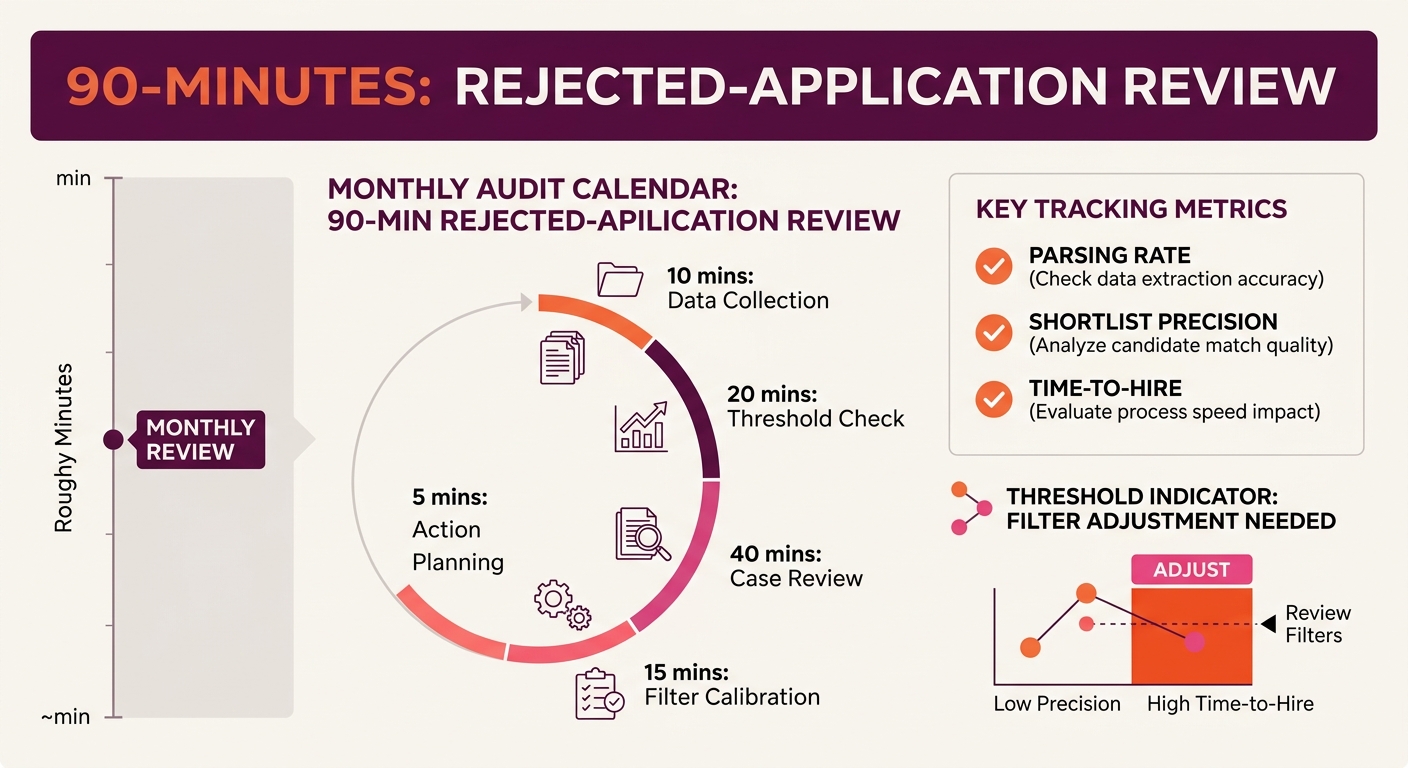
Warning: Test your own knockout questions by reviewing the last 30 rejected applications. If more than 3-4 of those 30 would have warranted a phone screen, your binary gates need immediate adjustment. This 25-30 application audit takes about 90 minutes and is the fastest way to diagnose over-filtering.
Move non-critical requirements into weighted scoring tiers. A candidate who meets 7 of 9 criteria should rank lower than one who meets 9 of 9, but they shouldn’t disappear entirely. The distinction between “ranked lower” and “eliminated” is where most teams lose their best hires.
Keyword Gaps Compound the Problem
ATS keyword mismatch is a well-documented failure mode, and the 182% volume increase has made it worse. When a job description asks for “cross-functional collaboration” but candidates write “stakeholder engagement” on their resumes, the ATS scoring engine treats them as different competencies. They’re not. But the system doesn’t know that unless you’ve built synonym mapping into your configuration.
Older ATS versions rely on literal keyword matching with no semantic layer. Even newer platforms with NLP capabilities have documented accuracy gaps at the skill-extraction level, with field-level accuracy for skills ranging from 0.75 to 0.85 while basic fields like name and email hit 0.99. That 15-25% error rate on the fields that actually determine screening decisions is where qualified candidates fall through.
The median resume scores 48 out of 100 in typical ATS configurations, and 51% of applicants never pass initial thresholds. When half your applicant pool is invisible before a human glances at it, you’re discarding volume, not managing it.
Keyword density matters too. According to Zimyo’s ATS configuration research, keyword density above approximately 3% per 100-word block can trigger stricter filtering in some systems, penalizing candidates who keyword-stuff their resumes. Running a keyword mismatch audit against your active job descriptions is the fastest way to close these gaps and takes less time than reviewing the resumes your system already rejected.
Recalibration Without Losing Screening Speed
The fear behind every ATS filter recalibration conversation is volume. If you loosen the filters, won’t recruiters drown in unqualified applications? The answer depends on which filters you loosen and what you replace them with.
A three-tier approach — what we’d call the Volume-Signal-Speed recalibration model — keeps throughput manageable while recovering hidden talent across three dimensions: intake gating, scoring logic, and assessment timing.
| Filter Type | Over-Filtered State | Recalibrated State | Volume Impact |
|---|---|---|---|
| Binary knockout questions | 6-8 yes/no gates including experience, education, skills | 2-3 gates covering legal eligibility and mandatory licensure only | +40-60% more candidates pass initial gate |
| Keyword matching | Exact-match on 10+ terms | Synonym-mapped scoring across 5-7 core competencies | +20-30% more candidates ranked visible |
| Experience thresholds | Hard minimum (e.g., “5+ years required”) | Weighted score (4 years = partial credit, 6 years = bonus) | +15-25% more candidates enter scoring |
| Assessment timing | Upfront assessment before any human review | Conditional assessment triggered at scoring confidence thresholds | Reduces candidate abandonment by 30-40% |
Conditional assessment timing deserves particular attention. Research from HR Interests on talent pipeline management notes that poorly timed assessments in high-volume hiring increase candidate abandonment and skew pipeline data. Triggering assessments only when scoring confidence requires validation preserves throughput without front-loading friction.
And once candidates clear your recalibrated filters, the downstream workflow matters just as much. Connecting your ATS output to automated interview scheduling removes the dead time between “shortlisted” and “contacted” that causes top candidates to accept competing offers. Teams with employee referral tracking in place also see better filter-to-hire ratios, since referred candidates arrive with built-in signal that compensates for any looseness in keyword-based scoring.
The Monthly 25-Application Audit
Recalibration is a one-time event. Maintenance is ongoing. The most reliable cadence documented across the available research: have a recruiter spend 90 minutes each month manually reviewing 25-30 rejected applications against the actual job requirements. Not the ATS criteria. The real requirements.
Document how many of those rejected candidates would have been worth a phone screen. If the number exceeds 3-4 out of 30, your filters are miscalibrated. Track three metrics monthly alongside this manual audit:
- Parsing rate: What percentage of incoming applications parse correctly into structured data? Teams that audit their resume parsing accuracy catch compound failures where a parsing error causes a scoring error causes a rejection.
- Shortlist precision@N: Of the top N candidates your system surfaces, how many actually advance past phone screen?
- Time-to-hire: Not time-to-shortlist. A fast shortlist that produces slow hires means the shortlist is wrong.
What To Watch Next Quarter
The 182% volume increase happened across a specific window. Whether it plateaus, continues, or reverses will determine how aggressively teams need to recalibrate through Q3 and Q4 2026.
Several unknowns remain in the data. No widely-cited study has isolated how much of the volume increase comes from AI-assisted mass applications versus genuine candidate interest growth. The 75% resume rejection rate frequently cited in recruiting media is, as DAVRON’s analysis notes, “more folklore than proven fact.” The real rejection rate varies enormously by role type, industry, and ATS configuration.
What the data does tell us: ATS intake filtering rules set during the 2022-2024 volume spike are almost certainly miscalibrated for the current market. If your team hasn’t audited those settings since they were tightened, the qualified candidates your system rejects this week are interviewing at your competitors by Friday. The numbers make the case for recalibration clearly enough. Whether your filters reflect those numbers is the open question only your own 90-minute audit can answer.