
Three methods dominate how recruiting teams run a job description audit for ATS keyword gaps: manual side-by-side comparison, automated scanning tools, and competitor-benchmarked vocabulary expansion. Each catches different types of terminology mismatch, and most teams need a deliberate combination rather than a single approach.
TL;DR: The average unoptimized resume misses 52% of keywords from its target job description. Three audit approaches fix this from the employer side: manual keyword comparison (free, slow), automated scanning tools (fast, surface-level), and competitor-benchmarked vocabulary expansion (thorough, requires cross-functional effort). The right choice depends on your posting volume and how aggressively your ATS filters on exact-match terms.
Where the 52% Keyword Gap Comes From
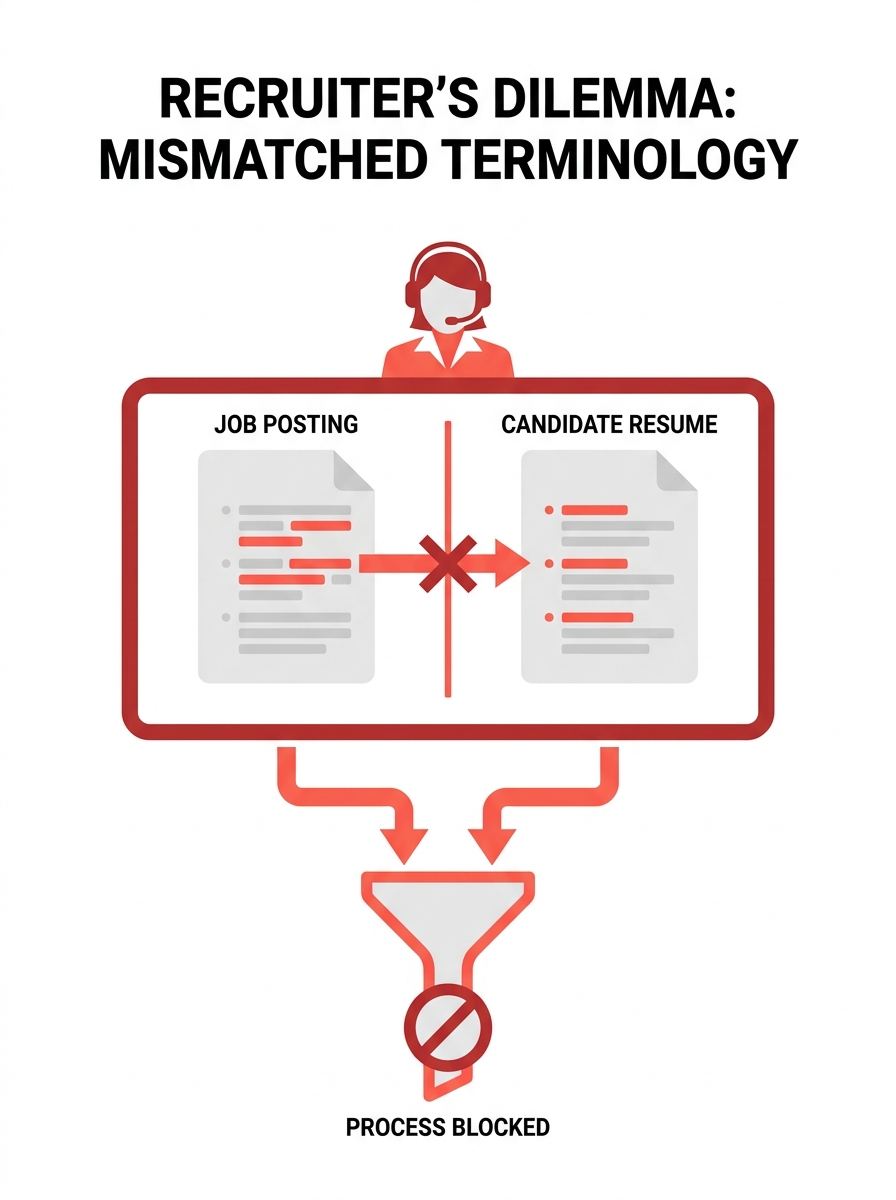
The person writing a job description and the person submitting a resume almost never use the same vocabulary for identical skills. ResumeAdapter’s Q1 2026 pipeline analysis puts the number at 52%: that’s the share of target keywords the average unoptimized resume is missing. The gap has a clear structural cause.
Candidates describe experience using the language of their previous employer. Hiring teams describe the role using the internal terminology of their current organization. The ATS sits between them, enforcing literal matches that neither side designed with the other in mind. Joseph B. Fuller, professor at Harvard Business School and lead researcher on the Hidden Workers project, found that 88% of surveyed employers admitted their applicant tracking systems regularly filter out qualified candidates. His team traced the root cause to credential inflation and vocabulary rigidity in job postings, where “nice-to-have” requirements were coded as mandatory filters.
The downstream impact is measurable: 49% of companies incorrectly eliminate candidates for lacking bachelor’s degrees in roles that don’t functionally require them. And the keyword layer compounds the problem further. A posting requiring “project management” screens out every resume listing “program management” or “PMO experience,” even when the work is identical. Three audit approaches attack this problem from different angles, each with distinct strengths and blind spots.
Running a Manual Side-by-Side Audit
A manual audit starts with your job description next to five or six resumes from candidates your team already considers strong. You highlight every skill term, certification, and tool name in the job posting, then check whether those exact phrases appear on the resumes. Where they don’t, you’ve found a terminology mismatch that your resume screening filters are likely enforcing.
This approach catches problems automated tools miss entirely. A human reviewer notices that your posting says “client relationship management” while your best account managers write “customer success” or “account management” on their resumes. That kind of synonym gap is invisible to tools that only scan for presence or absence of specific strings.
The tradeoff is time, and it’s significant. A thorough manual audit takes 45 to 90 minutes per job description when done properly. For a team posting 5 to 10 roles per month, that’s manageable. For a team posting 50 or more, it becomes unsustainable without dedicated headcount.
Manual audits also depend heavily on who’s doing the review. A recruiter who understands the functional domain will spot synonym gaps that a generalist coordinator will miss. If you’re running a manual process, the hiring manager needs to be in the room, or at least reviewing the marked-up output, to validate that two different phrases genuinely describe the same competency.
Tip: When running a manual audit, pull rejected applicant resumes specifically. Comparing your job description against people who were filtered out reveals the exact terms your ATS treated as missing, even when the underlying skill was present.
The method works best for low-volume, high-stakes roles where a single bad candidate rejection is expensive. Think director-level hires, specialized engineering positions, or roles that have been open for 60+ days with a thin pipeline. If you’re troubleshooting why your recruitment process keeps producing weak shortlists, a manual keyword audit on your top three problem requisitions will surface answers faster than any dashboard.
What Automated Scanning Tools Actually Measure
Automated ATS scanning platforms extract 30 to 60 keywords from a job description, scan a resume for their presence, and compute a match score. According to Resume Optimizer Pro’s 2026 audit framework, these tools weight hard skills at 2x and certifications at 2x, while soft skills receive only 0.5x weighting in the final score calculation. That hierarchy means a missing certification name penalizes a candidate four times more than a missing soft-skill phrase.
The strength here is throughput. You can paste a job description into a scanning tool, run it against a batch of sample resumes, and get a match-score report in seconds. For teams posting 20+ roles per month, this speed difference is the entire argument.
But scanning tools have a fundamental limitation: they measure keyword presence, not keyword equivalence. If your job description says “data visualization” and a candidate’s resume says “Tableau dashboards,” a basic scanner won’t recognize those as the same skill unless someone has pre-loaded the synonym mapping. The Huntr Blog’s research team, after analyzing 1.7 million applications and interviewing recruiters at Amazon, Microsoft, and two Fortune 500 companies, confirmed a key finding: “No major applicant tracking system auto-rejects resumes” based on a single universal score, and most formatting rules circulating online are outdated. ATS platforms use configurable filters that recruiters set up, often without understanding the downstream impact on candidate rejection rates.
Automated scanning works best as a first pass to identify the most obvious ATS keyword gaps: missing certification names, absent tool references, omitted industry-standard terms. It doesn’t replace the judgment calls that a manual review provides. And the real risk with scanning tools is false confidence. A team that runs automated scans and sees 80% match scores may assume the job description is fine, when the remaining 20% gap contains exactly the synonym clusters that are filtering out top candidates. As Avua’s recruitment glossary puts it: “A job description that is internally logical but uses non-standard terminology, vague requirements, or inflated credential criteria will be poorly matched by AI systems regardless of its structural quality.”
Competitor-Benchmarked Vocabulary Expansion
The third approach works from the outside in. Instead of comparing your job description against resumes, you compare it against how other employers describe the same role. Pull 8 to 12 postings for the same position title from competitors and job boards, map every skill term, tool name, and qualification phrase they use, then check your own posting for gaps.
This method surfaces ATS keyword gaps that neither manual review nor automated scanning will find, because the gap isn’t between your posting and your candidates. The gap is between your posting and the broader labor market’s vocabulary. If every other company hiring a “DevOps Engineer” lists “infrastructure as code” and you list “automated deployment scripting,” you’re describing the same competency in language candidates aren’t actually using on their resumes.
The tradeoff is effort and cross-functional coordination. A proper competitor benchmark takes 2 to 4 hours and requires someone who understands the role deeply enough to judge whether two different phrases describe the same work. It also requires buy-in from hiring managers, who may resist changing their preferred terminology. And the output needs to feed back into your ATS configuration, not just the job posting text, because filter criteria and posting language can diverge.
This is where teams that have already addressed their employer brand and ATS alignment have an advantage. When brand messaging and ATS filter criteria are audited together, vocabulary expansion becomes a shared project rather than a one-sided fix.
Competitor benchmarking works best for recurring, high-volume roles where small improvements in candidate pass-through rates compound across dozens or hundreds of postings. If your pipeline problems are tied to parsing accuracy rather than keyword selection, this method won’t help, because the issue sits upstream of vocabulary.
All Three Methods, Compared
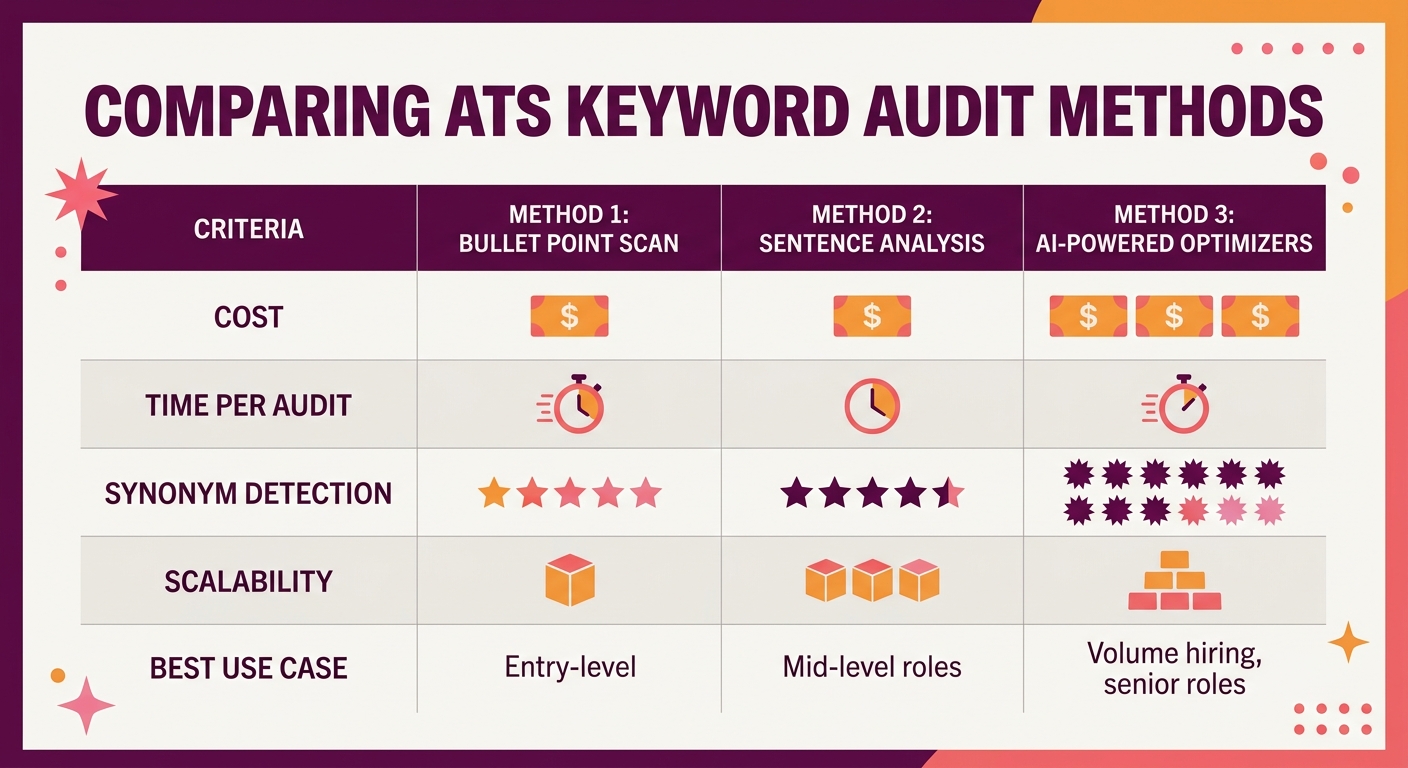
| Attribute | Manual Side-by-Side | Automated Scanning | Competitor Benchmark |
|---|---|---|---|
| Time per audit | 45–90 minutes | 2–5 minutes | 2–4 hours |
| Synonym detection | Strong (human judgment) | Weak (literal match only) | Strong (market-wide view) |
| Scalability | Poor above 10 roles/month | Strong at any volume | Moderate (batch-friendly) |
| ATS filter integration | Requires manual config update | Some tools export filter suggestions | Requires manual config update |
| Best for | High-stakes, low-volume roles | First-pass screening of all postings | Recurring, high-volume positions |
| Cost | Staff time only | $50–300/month for team licenses | Staff time plus job board access |
| Primary blind spot | Misses market-wide vocabulary shifts | Misses synonym equivalence | Doesn’t catch resume-specific phrasing |
How To Choose Between These Three
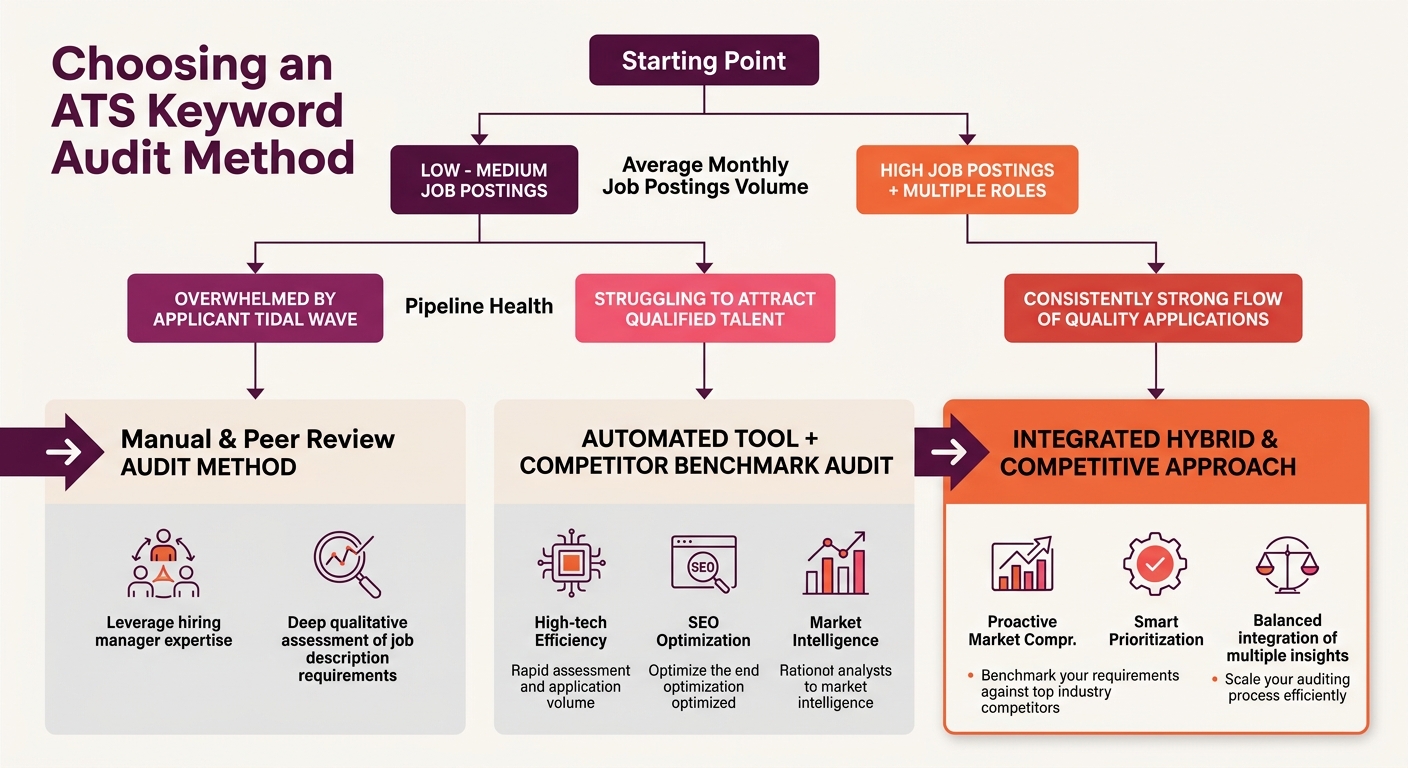
The honest answer is that no single method works alone, and the right combination depends on your posting volume and pipeline health.
If you’re running fewer than 10 open requisitions at a time, start with manual audits on your highest-priority roles. The per-role investment is high, but so are the per-role stakes. Layer in an automated scanner as a quality check before each posting goes live.
If you’re running 20 or more requisitions simultaneously, automated scanning is your baseline. Run every job description through a scanning tool before posting, flag anything below a 75% match score against sample resumes from your existing talent pool, and escalate flagged postings for manual review. Add competitor benchmarking on a quarterly cycle for your top 5 to 10 most-posted role types.
If your problem is chronic (the same role stays open for 90+ days across multiple postings, or your candidate rejection rate exceeds 85% before human review), competitor benchmarking should be your first move. The vocabulary gap is likely systemic, and fixing individual postings won’t address the underlying pattern. Understanding how candidates experience your process through mapping the candidate journey will reveal whether keyword mismatch is the primary bottleneck or one problem among several.
A revised job description that still runs through unchanged screening rules produces the same rejection patterns with slightly different wording.
The teams that get the best results from these audits share one habit: they feed audit findings back into their ATS filter configuration, not just their job description text. Referrals convert at 28% compared to 2-5% from cold job board applications, which means every percentage point you recover through better keyword matching across your ATS filters has a measurable impact on pipeline quality. The compliance implications of automated screening rules make this feedback loop worth formalizing, because undocumented filter criteria create both hiring gaps and legal exposure.
Whatever combination you pick, run it on a schedule. Vocabulary drifts as industries evolve and new tools enter the market. A keyword audit done once catches today’s mismatches. A keyword audit done quarterly catches the ones forming right now, before they cost you another six months of thin pipelines and unexplained rejections.