
Employee onboarding spans the first 90 days of employment and encompasses five distinct phases from pre-boarding through structured feedback check-ins, according to guidance published July 27 by HR software provider Netchex, which distinguishes the extended integration process from single-day orientation events that many organizations mistakenly treat as complete onboarding.
TL;DR: Netchex’s July 27 framework positions employee onboarding as a 90-day structured process covering pre-boarding, orientation, role training, cultural integration, and scheduled check-ins—not the one-day administrative orientation many companies mistake for complete onboarding—linking the distinction directly to early-tenure turnover prevention.
The framework arrives as recruitment teams increasingly scrutinize post-hire processes after witnessing qualified candidates accept offers but exit within their first quarter, creating costly re-hiring cycles that nullify recruitment investments.
Five-Phase Framework Extends From Offer Acceptance Through First Quarter
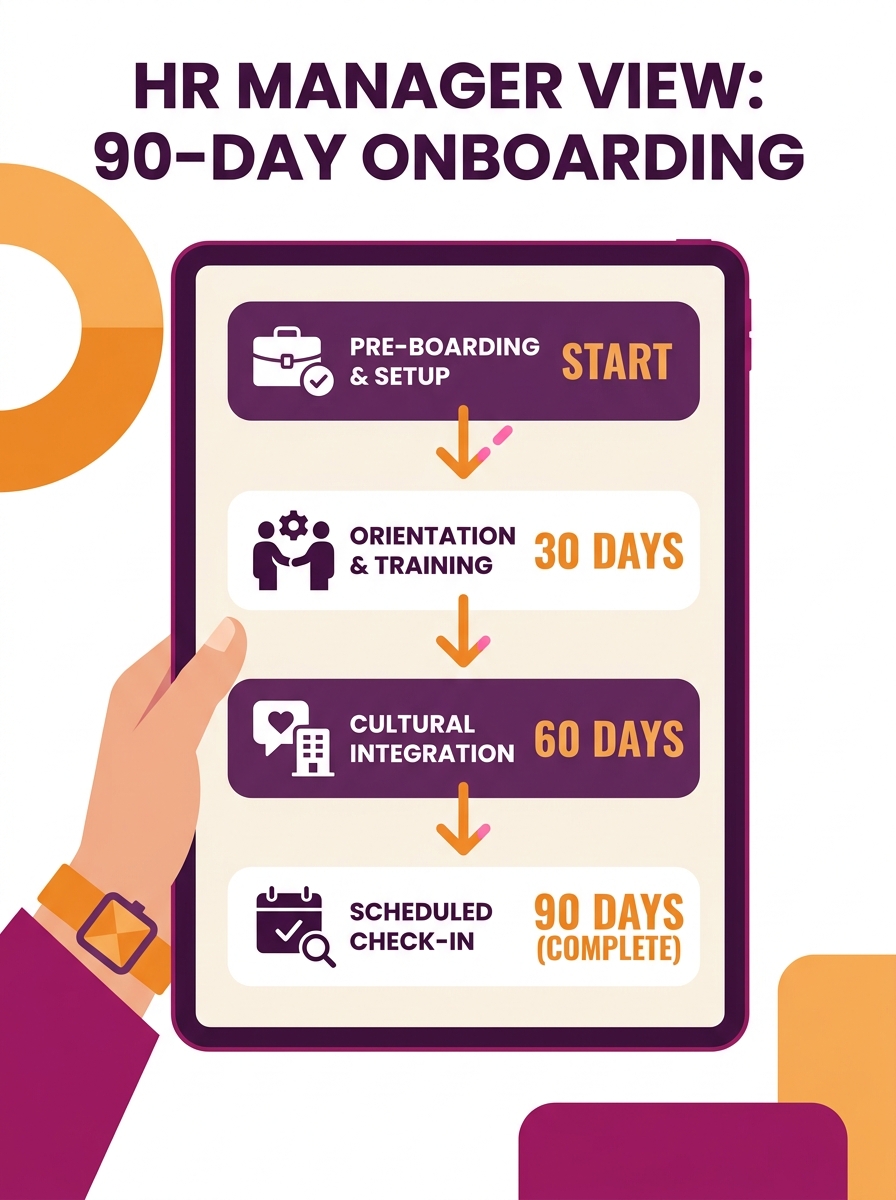
Netchex’s guidance defines employee onboarding as the structured integration process beginning when a candidate accepts an offer and continuing through the new hire’s first 90 days. The framework divides onboarding into five components: pre-boarding activities between offer acceptance and day one, orientation covering administrative setup and introductions, role-specific skills training, cultural integration explaining team dynamics and decision-making patterns, and scheduled check-ins at 30-, 60-, and 90-day intervals.
The distinction between orientation and onboarding forms the framework’s central premise. Orientation represents the administrative portion—forms, policy acknowledgments, system access, workspace introductions—typically completed within the first day or two. Onboarding encompasses orientation as one component within a longer integration timeline that extends across the first quarter, according to the Netchex analysis.
Organizations that conflate the two terms often complete paperwork and building tours on day one, then leave new hires to navigate role expectations and team workflows without structured guidance during weeks two through twelve when questions accumulate but formal support disappears, the framework notes.
First-Quarter Turnover Drives Framework Emphasis on Extended Structure
A significant portion of employee turnover occurs within the first 90 days of employment, Netchex reported, with disorganized starts—paperwork delays, unclear daily responsibilities, disconnects between hiring promises and actual role scope—accounting for much of that early attrition. The cost of replacing an employee who exits in the first quarter includes recruiting expenses, lost productivity during the vacant period, and training investment in the departed employee, compounded by disruption to the team that was expecting the new hire to reach productivity.
Structured onboarding processes reduce early turnover risk by establishing clear expectations before confusion builds, providing support channels during the period when new hires absorb the most new information, and catching problems through scheduled check-ins rather than discovering dissatisfaction months later during formal performance reviews, according to the guidance.
The framework positions the 30-, 60-, and 90-day check-in cadence as the mechanism that prevents small frustrations from becoming resignation triggers. These touchpoints create formal opportunities for managers to identify gaps in training, clarify misaligned expectations, and address logistical friction points while the new hire still feels invested in making the role work.
Mobile-First Workflows Address Deskless Employee Onboarding Gap
Onboarding software designed for office environments assumes new hires possess company email addresses and desktop computer access on day one, which doesn’t reflect how hourly and deskless employees start work, Netchex’s framework states. Restaurant servers, warehouse associates, and healthcare aides require onboarding paperwork, training materials, and schedule access that function from personal phones, ideally completed before their first shift rather than consuming work time during it.
The provider’s onboarding tools handle W-4 forms, I-9 verification, direct deposit enrollment, and policy acknowledgments through mobile workflows, enabling new hires to complete administrative requirements before arrival so managers can dedicate first-shift time to operational training instead of form completion, according to the company’s published guidance. This workflow approach particularly benefits industries with high hourly turnover where compressing administrative setup creates more time for retention-critical training activities.
Recent industry discussion has centered on post-hire processes as the final stage where recruitment investments either convert to productive employees or evaporate through preventable early exits. The Forbes Council onboarding framework published July 20 similarly emphasized cultural integration and structured touchpoints across the first quarter, suggesting converging practitioner consensus around extended onboarding timelines rather than day-one-only orientation approaches.
What Happens Next
Recruitment and HR teams evaluating their onboarding effectiveness can audit where their current processes stop. Organizations that consider onboarding complete after orientation—typically within the first week—leave new hires navigating role ambiguity and team dynamics without structured support during the period when turnover risk peaks. The 90-day timeline Netchex published provides a reference benchmark for teams extending their formal onboarding beyond the first week.
For talent acquisition functions measured on time-to-fill and offer acceptance rates, early-tenure turnover creates a recurring penalty that resets hiring timelines and compounds recruiter workload. Structured onboarding with scheduled check-ins functions as a retention lever that protects the recruitment team’s upstream work, converting accepted offers into employees who remain past their first quarter. Teams can implement 30-, 60-, and 90-day manager check-ins as a minimum intervention without requiring full process overhauls.
The mobile-first consideration applies primarily to industries hiring hourly and deskless populations—restaurants, retail, warehousing, healthcare—where requiring desktop access for pre-employment paperwork creates a barrier between offer acceptance and day-one readiness that structured digital workflows can eliminate.