
Tightening ATS intake filtering rules was the natural response to the 182% surge in application volumes between 2021 and Q3 2024. The result: 88% of employers now acknowledge their systems screen out qualified candidates before a recruiter ever reviews them. Which filtering model you run determines whether you lose 20% of good applicants or 50%.
TL;DR: Binary knockout gates, weighted scoring tiers, and hybrid conditional filters each handle high application volumes differently and lose different types of qualified candidates. Knockout gates are the bluntest and most destructive, eliminating 50% of pipelines per gate. Weighted scoring buries candidates under parsing errors. Hybrid models that combine tiered scoring with minimal binary gates and conditional assessments produce the strongest pipeline quality with 30-40% less candidate abandonment.
Three filtering configurations sit behind virtually every ATS in production. Recruiting teams rarely choose between them deliberately. The default settings ship with the platform, someone adds a few knockout questions during implementation, and the system runs for months without anyone checking what it’s actually rejecting. When candidate rejection rate analysis finally happens (if it happens), the numbers are ugly.
The comparison below breaks down what each configuration does to your qualified candidate pipeline loss, where each one fails, and which one fits different hiring contexts.
Binary Knockout Gates and Their 50% Pipeline Problem
A single yes/no gate question like “Do you have 5+ years of experience in X?” can eliminate 50% of your pipeline before any nuance enters the screening process. Binary knockout filtering is the most common default in ATS configurations because it’s simple to set up and immediately reduces the stack of applications a recruiter has to review.
The appeal is obvious for application volume management. If you’re getting 400 applications per role and your recruiter can meaningfully review 40, you need a 90% reduction somewhere. Knockout gates deliver that reduction fast. They also deliver it blindly.
Binary gates can’t account for a candidate with 4 years of direct experience plus 3 years of adjacent experience in the same skill area. They can’t accommodate a career changer with transferable competencies who doesn’t tick the exact box. They can’t compensate when the parser misreads a date range and turns 6 years into 2. As Forbes contributor Kara Dennison reported in March 2026, “the algorithms designed to increase hiring efficiency are systematically screening out qualified candidates before human reviewers ever see them,” with the bias worsening for shorter resumes and less common names.
PeopleNTech’s 2026 ATS assessment put it plainly: “When knockout questions are set too aggressively, when keyword filters are overly rigid, or when configuration defaults are never revisited, genuinely qualified candidates can be screened out before any human reviews their profile.” The report singled out career changers, non-traditional candidates, and people re-entering the workforce as the groups most affected by rigid filtering.
Binary gates work for one category of question: legal eligibility and mandatory licensure. “Are you authorized to work in the US?” “Do you hold a current RN license?” These are genuinely binary qualifications where there’s no middle ground. For everything else, knockout questions trade pipeline quality for processing speed at a ratio that destroys your candidate pool.
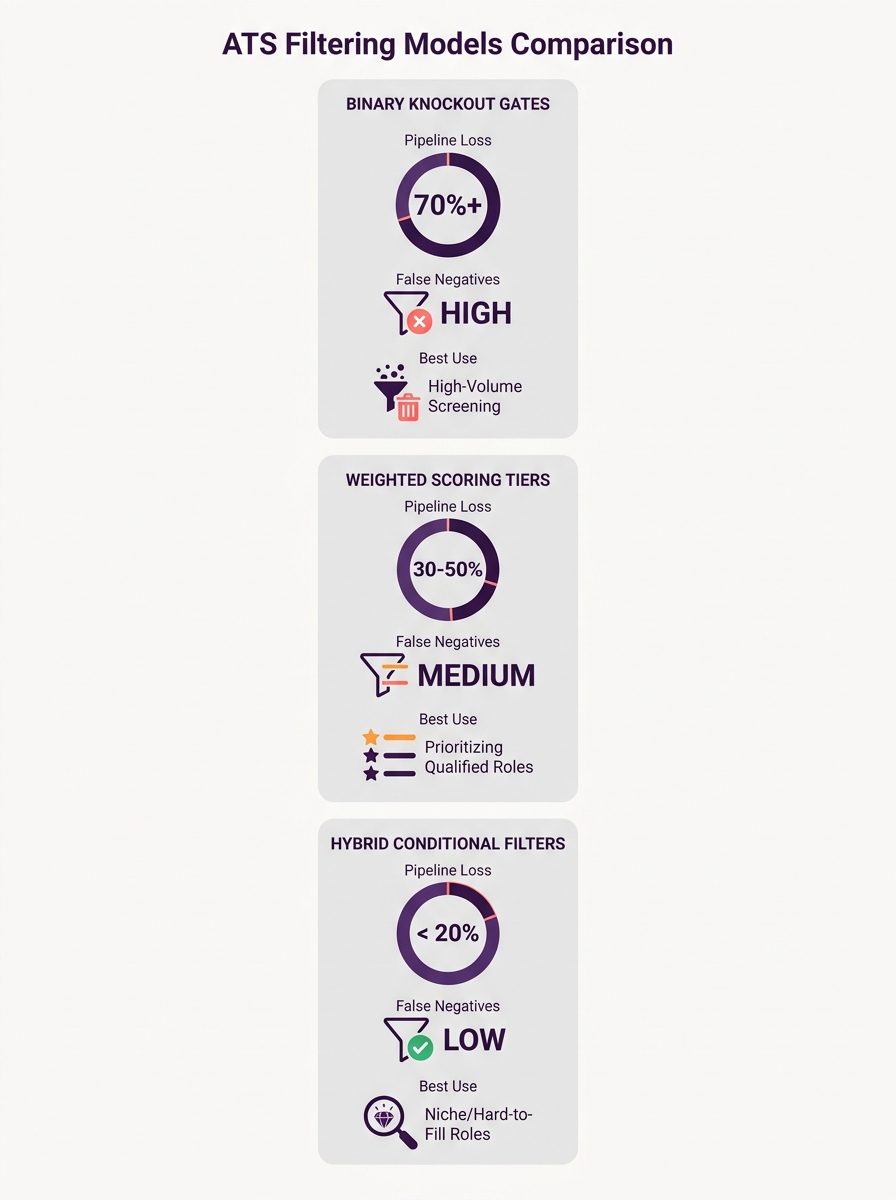
| Attribute | Binary Knockout Gates | Weighted Scoring Tiers | Hybrid Conditional Filters |
|---|---|---|---|
| Setup complexity | Low (yes/no questions) | Medium (scoring rubrics) | High (rules + scoring + triggers) |
| Pipeline reduction | 50%+ per gate | Graduated; top-N surfacing | 20-30% via gates, rest via scoring |
| False negative rate | High | Medium | Low |
| Career-changer friendly | No | Partially | Yes |
| Recruiter review load | Very low | Medium-high | Medium |
| Best for | Legal/licensure gates only | Under 200 apps per role | 200+ apps per role |
What Weighted Scoring Gets Right (and Where It Still Fails)
Weighted scoring replaces pass/fail gates with a numerical rank, assigning points across multiple criteria and surfacing the top-scoring applicants for review. The 2021 Harvard Business School “Hidden Workers” study, frequently cited in ATS discussions, found that more than 90% of companies use technology to rank and filter candidates. The study drew an important distinction: ranking is different from automatic rejection. Weighted scoring systems don’t technically reject anyone. They bury low-scoring candidates so far down the list that no recruiter ever scrolls to them, which produces the same practical outcome.
The numbers tell the story. The median resume scores 48 out of 100 in typical ATS configurations. That means 51% of applicants never pass initial scoring thresholds without optimizing their resume for the specific system. When Precision@10 drops to 30%, only 3 of every 10 candidates surfaced to the recruiter are actually interview-worthy. The system is generating noise, not signal.
When Precision@10 drops to 30%, only 3 of every 10 candidates surfaced to the recruiter deserve an interview. The filtering model is generating noise, not signal.
Weighted scoring also inherits every problem from resume parsing limitations. EDLIGO’s 2025 analysis of 1,000 rejected resumes found a 4% ATS parsing failure rate for plain DOCX files compared to 18% for PDFs. Single-column layouts achieved 93% parsing accuracy versus 86% for two-column designs. When the parser misreads a skill or drops a job title, the scoring model penalizes a candidate for information that was on the resume but never made it into the system.
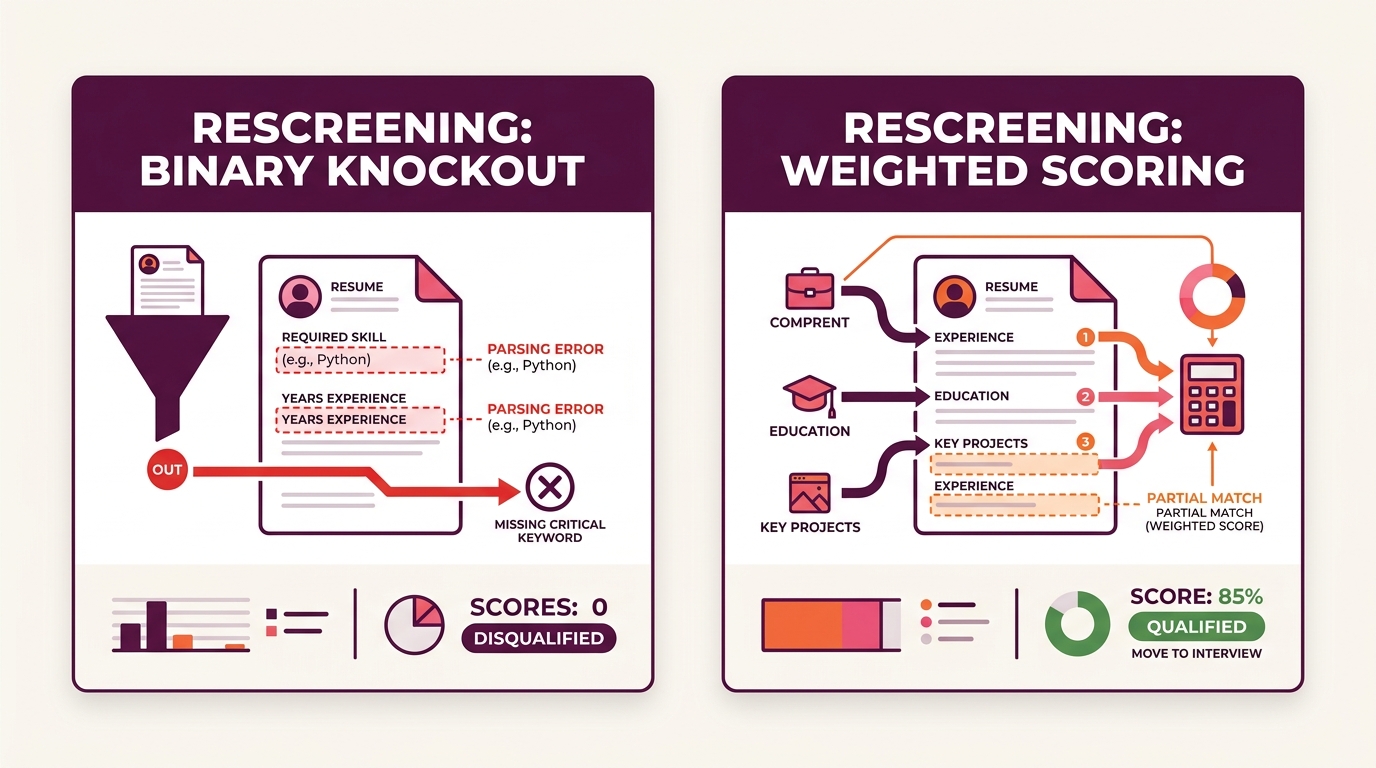
ATS screening optimization for weighted scoring requires regular calibration. If you’re running weighted tiers, pull your Precision@10 metric monthly. Review the top 10 candidates surfaced for your last 5 closed requisitions and count how many actually advanced past phone screen. A score below 50% means your weighting formula needs adjustment, and auditing keyword gaps in your job descriptions is the first place to look.
Hybrid Conditional Filters as the Middle Path
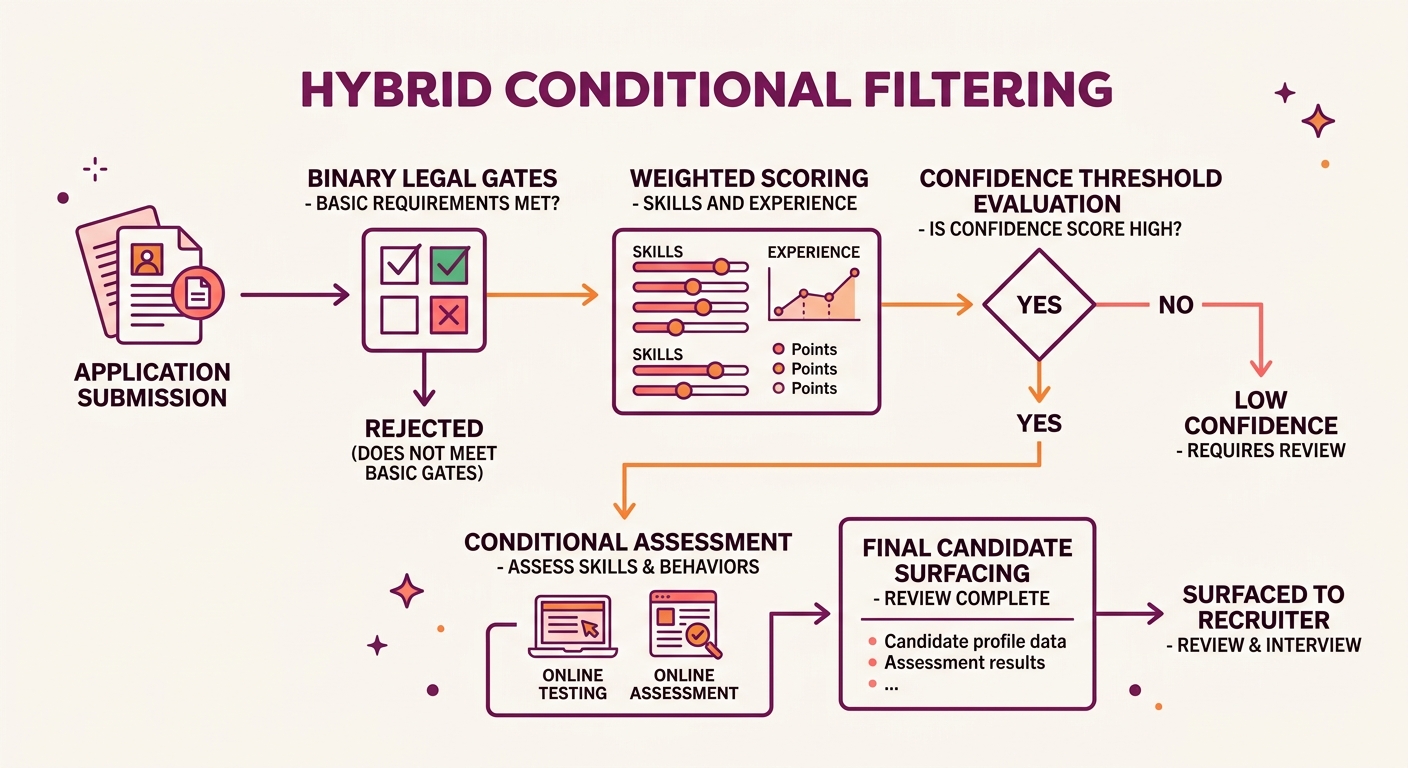
Hybrid conditional filtering combines a minimal set of binary gates (limited to 2-3 legal and licensure requirements) with weighted scoring for everything else, then adds a third layer: conditional assessments triggered by scoring confidence. When a candidate falls into an uncertain scoring band, the system prompts a short skills verification or work sample instead of auto-burying them.
This approach directly addresses the biggest failure mode of both alternatives. Binary gates lose qualified people with non-traditional backgrounds at a rate of 50% per gate. Weighted scoring buries them under parsing errors that hit 18% of PDF resumes. Hybrid models create a middle zone where borderline candidates get a second chance through a different evaluation method.
The data supports the approach. Shifting from upfront assessments to conditional assessments triggered by scoring confidence reduces candidate abandonment by 30-40% while improving pipeline quality. That reduction matters because every abandoned application represents wasted sourcing spend and a candidate who walked straight to a competitor’s career page instead. ResearchGate’s ATS data analysis noted that while ATS systems “enhance efficiency, fairness and cost-effectiveness,” challenges remain around “balancing automation with human judgment,” a gap that hybrid models explicitly try to close.
Tip: Run a monthly rejection audit by manually reviewing 25-30 rejected applications per open role. This candidate rejection rate analysis catches false negatives from all three filtering approaches and gives you concrete data on how your configuration performs against real applicants, not hypothetical ones.
Configuration is the tradeoff. Hybrid models take roughly 2-3x the setup time of a scoring-only system. You need to define your binary gates (keep them to 2-3 maximum, all legal or licensure), build your scoring rubric with synonym mapping to bridge keyword gaps between how candidates describe their skills and how your job descriptions list them, set your confidence thresholds for when conditional assessments trigger, and design those assessments. The operational cost is higher than either alternative. But so is the yield.
How to Choose Between These Three
The right filtering model depends on three variables: your application volume per role, your recruiter capacity for manual review, and your tolerance for false negatives in the pipeline.
Binary knockout gates belong in exactly one place: legal eligibility and mandatory credentials. If you’re using them for experience thresholds, education requirements, or skill matching, you’re eliminating qualified candidates at a rate that compounds with every gate you add. One aggressive knockout question cuts your pipeline in half. Two of them leave you with 25%. Three leave you sourcing candidates all over again for a role that already received 400 applications.
Weighted scoring tiers work well for roles receiving fewer than 200 applications, where the recruiter can review the top 20-30 candidates and the scoring model’s error rate (Precision@10 between 30-50%) doesn’t compound into massive qualified candidate pipeline loss. Above 200 applications, scoring alone produces too many false negatives in the mid-tier to rely on without a secondary evaluation layer.
Hybrid conditional filters are the strongest approach for high-volume roles, especially positions that attract career changers, non-traditional candidates, and applicants from adjacent industries. The setup investment is real. The 30-40% reduction in candidate abandonment and the higher interview-to-offer ratio are also real.
The filtering model is the first thing to audit when your conversion rate from application to phone screen drops below 10%. Count how many of your current ATS gates are truly binary requirements versus preferences someone dressed up as requirements during a rushed intake meeting. If more than 2-3 gates exist and any of them screen for experience level, education tier, or specific keyword presence, you’re running a system that was designed to reduce recruiter workload but is instead reducing your access to the people you spent money attracting. The math doesn’t support keeping it that way.