
Time-to-hire, the metric recruiters obsess over, measures the wrong starting line. It tracks days from candidate application to offer acceptance, according to Workable’s recruiting metrics documentation. The actual hiring clock starts earlier, at the job requisition, where 40% of companies experience delays that never show up in recruitment dashboards.
TL;DR: The biggest source of hiring process delays sits upstream of your ATS: the job requisition workflow. Between the moment a hiring manager identifies a need and the moment a job post goes live, most companies lose 5–10 days to approval chains, unclear ownership, and manual handoffs. Fixing time-to-hire means fixing what happens before candidates ever see your listing.
Two Clocks, Two Starting Lines
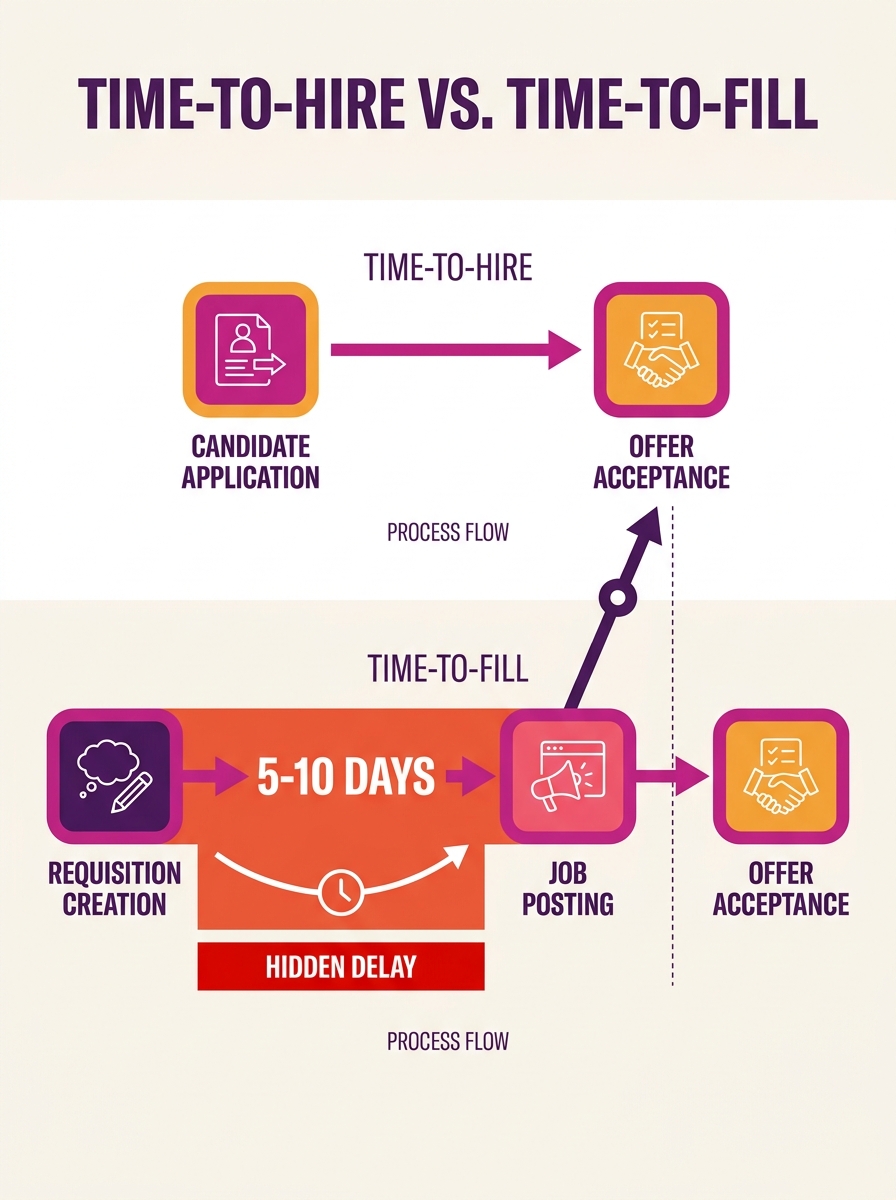
The recruiting industry tracks two metrics that sound similar but measure fundamentally different things. Time-to-hire measures the period from when a candidate enters the pipeline to job offer acceptance. Time-to-fill, by contrast, can begin much earlier: when a hiring manager submits a new job position for approval, when the recruiting team receives the requisition, or when the post goes live, depending on how each organization defines it.
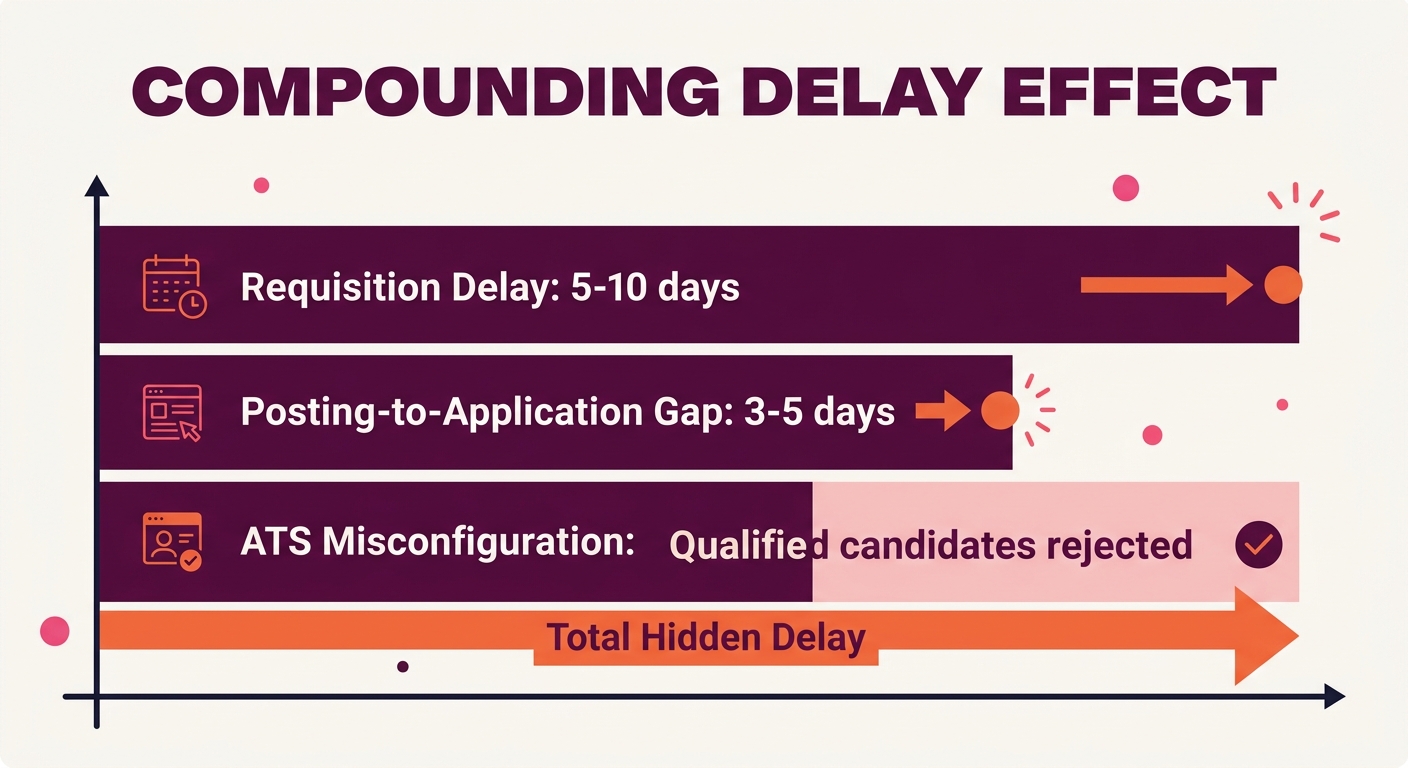
That definition gap creates a blind spot. A team might report a 25-day time-to-hire and feel good about their pipeline speed while a 5-to-10-day requisition delay sits completely outside the measurement window. According to a June 2026 guide from Apps365, most companies lose 5–10 days of hiring time before a single candidate is contacted, and the cause isn’t slow sourcing. It’s a requisition stuck in approvals.
If your ATS starts the clock when the job post goes live, you’re measuring only the downstream half of the process. The upstream half, your job requisition workflow, is where the real ATS intake bottleneck begins forming.
The Approval Chain Problem
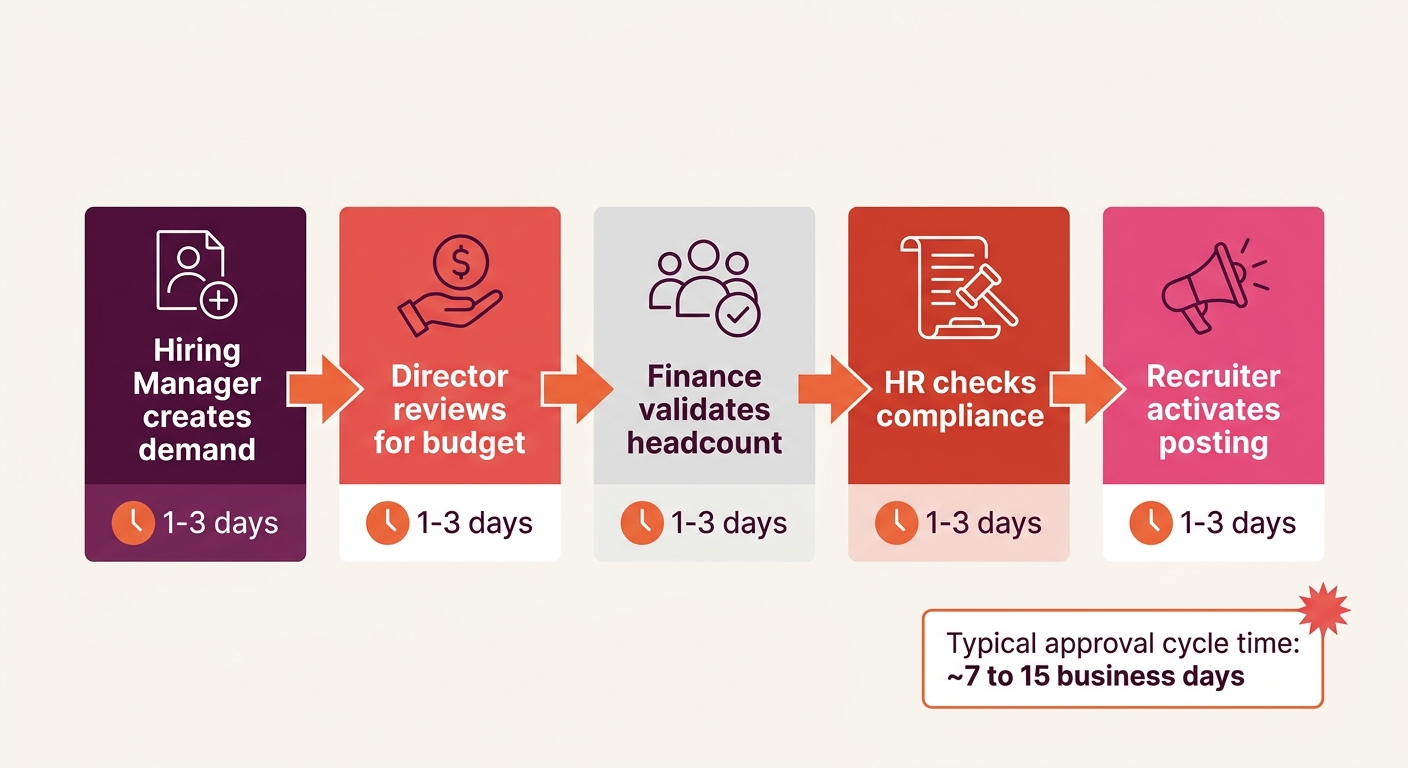
Why do requisitions stall? The answer is structural. Approval involves multiple stakeholders with different priorities, leading to communication breakdowns that make the process time-consuming and complex. A hiring manager writes the requisition. Their director reviews it for budget alignment. Finance validates the headcount against the plan. HR checks the job description for compliance. Each handoff introduces a potential stall point.
Industry research shows that 40% of companies experience hiring delays due to poorly managed requisition approvals. That number makes more sense when you picture a typical approval chain: 3 to 5 people, each with a different response time, a different email backlog, and a different sense of urgency about the role.
A Reddit thread on r/humanresources documented one team’s experience tracking their recruitment bottlenecks over six months. The conclusion was striking: “the biggest delays are not in sourcing candidates, but in internal processes — unclear role definitions, too many approval layers, or slow feedback loops after interviews.” The requisition stage was a primary offender.
And this problem compounds. When approval delays push job postings back by a week or more, the candidates who would have applied during that window move on to other opportunities. By the time your listing goes live, the talent pool has already shifted.
From Approved Requisition to Live Posting
Even after approvals clear, there’s another gap most teams underestimate. The handoff from “approved” to “posted” involves several steps that don’t happen automatically without configuration: formatting the job description for the ATS, selecting distribution channels, configuring screening questions, and setting up intake filters.
Clear ownership at each stage of the requisition process prevents delays, as Deel’s HR practitioner guide notes. But ownership often gets murky in this middle zone. The hiring manager thinks the recruiter will post it immediately. The recruiter is waiting for final job description edits. Nobody explicitly owns the gap between “approved” and “live.”
This is where time-to-hire optimization efforts usually fall short. Teams invest in faster screening tools and interview scheduling automation, which matters. Broader vendor guidance cites reductions of around one-third in hiring cycle time when automation is used effectively. But those gains only apply to the post-application portion of the process. If 5–10 days are already gone before a single resume arrives, shaving 2 days off interview scheduling addresses the smaller problem.
If you’re evaluating free recruitment software or upgrading your current ATS, pay attention to how the platform handles the requisition-to-posting handoff. Some systems treat the requisition as a separate module. Others build it directly into the workflow so approval triggers automatic posting. That architectural difference determines whether your team inherits the gap or eliminates it.
If 5–10 days are already gone before a single resume arrives, shaving 2 days off interview scheduling addresses the smaller problem.
How ATS Misconfiguration Compounds Pre-Pipeline Delays
Once the listing goes live, a poorly configured ATS can stack another layer of delay on top of the requisition bottleneck. Teams that treat application volume management as a configuration problem to solve once during implementation end up with stale screening rules that reject qualified candidates, something we’ve covered extensively when discussing why tightening intake filters backfires.
Here’s the compounding effect: a 7-day requisition delay pushes your posting live a week late. Then overly aggressive intake filters reject a portion of qualified applicants who do apply. Now you’re running a sourcing deficit on a timeline that was already behind. The signal that something is wrong shows up when time-to-hire increases despite high application volume. As we’ve noted in analyzing the application volume crisis and intake recalibration, more applications should reduce time-to-hire. When the opposite happens, the filter is the candidate rejection bottleneck.
A June 2026 report from The Interview Guys found that recruiters now spend 3 to 4 hours a day reviewing AI-generated summaries and hunting for errors in them. That’s time spent cleaning up post-application processes that could be spent on upstream work: refining requisition templates, aligning with hiring managers on role requirements, and ensuring the ATS is configured before the listing drops.
The sequence matters. As recruitment process research consistently recommends: “Get the role, the workflow, and the decision rules right, then add technology and measurement to speed execution and protect candidate experience.” Technology applied to a broken pre-pipeline process accelerates the wrong things.
Measuring the Pre-Pipeline Window
You can’t fix what you don’t track, and most ATS dashboards don’t surface the requisition-to-posting gap as a discrete metric. Here’s a practical way to expose it:
- Record the date the hiring manager first submits the requisition (not when it’s approved, but when it’s submitted).
- Record the date the job posting goes live in your ATS.
- Calculate the delta. That number is your pre-pipeline window.
- Track it per department, per approver, per role level. The patterns will tell you where the friction lives.
If your pre-pipeline window averages 8 days and your time-to-hire averages 22 days, you’re spending 27% of your total hiring cycle on internal process before a single candidate knows the job exists. That’s the number your hiring manager needs to see, because it reframes the urgency conversation away from “recruiting is slow” and toward “our approval process is slow.”
Tip: If your ATS doesn’t natively track requisition submission dates, add a custom field. Even a manual timestamp gives you the data to calculate pre-pipeline delay and identify which departments or approvers create the longest gaps.
Where the Requisition Model Breaks
The mechanism described above assumes a linear flow: manager identifies need, submits requisition, chain approves, recruiter posts, candidates apply. Real organizations don’t operate that cleanly. Three scenarios consistently break the model.
Backfill urgency overrides the process. When someone quits and the team is drowning, hiring managers skip the formal requisition and go straight to informal recruiting. They ask for referrals, reach out on LinkedIn, and tell the recruiter to “just post it.” The role eventually gets requisitioned retroactively, creating compliance gaps. A recent Effective Hiring analysis warned that legal exposure often begins long before the background check, sometimes at the posting itself.
Requisition templates don’t match the actual role. If your templates haven’t been updated to reflect current responsibilities, the approved requisition produces a job description that attracts the wrong candidates. We’ve analyzed how keyword mismatches in job descriptions create silent rejection patterns downstream, and the root cause often traces back to a stale requisition template that nobody has revised in 18 months.
Approval chains designed for caution don’t adapt to speed. A 4-person approval chain might make sense for a new senior hire but adds unnecessary days when you’re backfilling a well-understood role for the third time. Organizations that apply a single approval workflow to every requisition, regardless of role type or precedent, build delay into every hire by default.
None of these breakdowns show up in standard time-to-hire reporting. They live in the gap between organizational intent and process reality, and they explain why two companies using the same ATS can have wildly different hiring speeds. The technology is identical. The job requisition workflow, the human layer underneath it, is what diverges.