
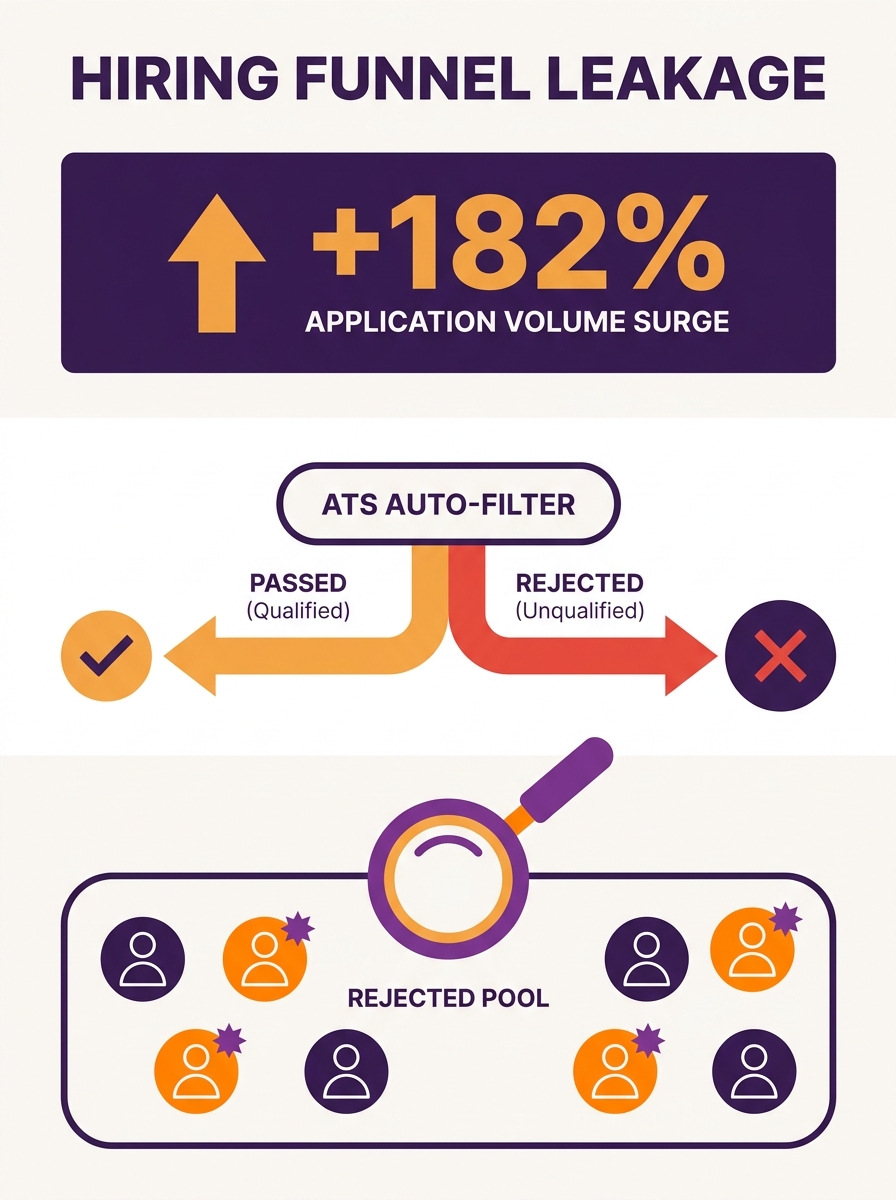
Application volumes to open roles climbed 182% between 2021 and Q3 2024. Recruiting teams responded by cranking ATS intake filtering tighter. The predictable outcome: 88% of employers now say their systems filter out qualified candidates before a human ever sees them. These seven rules help you recalibrate without drowning in unscreened resumes.
TL;DR: High-volume hiring automation has overcorrected. Tighter ATS filters were supposed to save recruiters time, but they’re rejecting qualified people at scale. Recalibrating requires measuring rejection accuracy, auditing keyword coverage, and building feedback loops between hiring managers and your screening logic.
The candidate quality vs. speed trade-off is real, but most teams have tilted so far toward speed that quality has collapsed. The resume screening bottleneck isn’t volume anymore. It’s false negatives: good candidates eliminated by filters that were never tested against hiring outcomes. Application volume management doesn’t mean rejecting more people faster. It means rejecting the right people accurately.
Below are seven rules for recalibrating your ATS intake filtering without reverting to manual chaos.
Audit your rejection rate before you change a single filter
Very low conversion rates from application to screening indicate over-filtering, bad knockout question setup, or screening logic that’s too strict. Pull your numbers before making any changes. What percentage of applicants make it past your automated filters to human review? If it’s under 10%, your filters are almost certainly eliminating qualified people alongside unqualified ones.
The median resume scores 48/100 on first ATS submission, and 51% never reach passing thresholds without optimization. That means your system is designed to reject the majority of applicants by default. Whether that majority actually contains zero good hires, or whether your thresholds are miscalibrated, is a question you can answer only with data.
Run this baseline check: take your last three closed requisitions and compare the profiles that made it through automated screening against the profiles that got rejected. If you find candidates in the reject pile who match or exceed the qualifications of people you interviewed, your filters need work. Teams using centralized ATS platforms report reducing cost per hire by 30% and engaging candidates 3x faster than fragmented systems, but centralization alone doesn’t fix a calibration problem.
Treat knockout questions as scalpels, not sledgehammers
Knockout questions are the bluntest instrument in your ATS. A single yes/no gate (“Do you have 5+ years of experience in X?”) can eliminate 50% of your pipeline before any nuance enters the process. Teams using pre-screening questions to auto-reject early report cutting pipeline volume by half, which sounds efficient until you realize the definition of “unqualified” was set by a hiring manager who spent 90 seconds on the intake form.
Limit knockout questions to genuine, non-negotiable requirements: legal eligibility to work, required certifications where licensing is mandatory, willingness to relocate if the role is on-site. Everything else belongs in a scored screening step, not a binary gate.
When your job descriptions contain keyword gaps, knockout questions compound the problem. A candidate who uses “customer success” instead of “client relationship management” already faces a keyword mismatch. Adding a knockout question about “CRM experience” (meaning the software, not the function) creates a second filter that screens out the same person for a different reason. You’re stacking penalty on top of penalty for candidates who are perfectly capable of doing the work.
Measure shortlist precision, not throughput speed
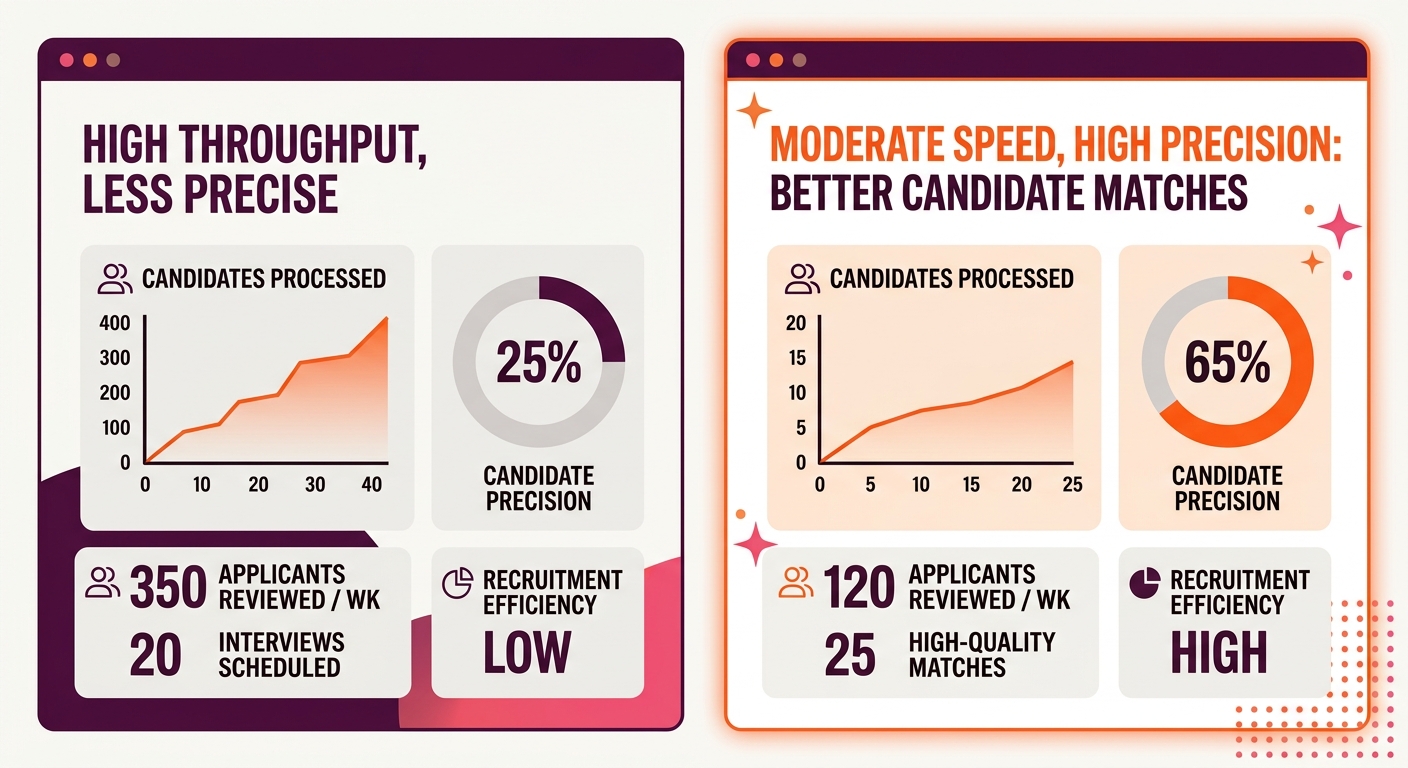
The default KPI for high-volume hiring automation is time-to-shortlist: how fast does the system produce a list of candidates for recruiter review? But speed without accuracy is waste. If your shortlist contains 20 candidates and your hiring manager rejects 18 of them at first glance, your system is fast and useless.
Better metrics exist. An AI-powered screening guide for HR leaders recommends tracking parsing rate, shortlist precision@N, time-to-shortlist, and time-to-hire together. Precision@N measures what percentage of your top-N shortlisted candidates actually advance to interview. A precision@10 of 30% means 7 out of every 10 shortlisted candidates are wasted effort for the recruiter who opens the queue.
| Metric | What It Measures | Target Range | Red Flag |
|---|---|---|---|
| Parsing rate | % of resumes successfully extracted | Above 95% | Below 90% means format-based rejection |
| Precision@10 | % of top-10 shortlist advancing to interview | Above 50% | Below 30% signals filter miscalibration |
| Time-to-shortlist | Hours from posting to first shortlist | Under 48 hours | Over 72 hours loses candidate engagement |
| Time-to-hire | Days from application to offer acceptance | Role-dependent | 2x+ industry average for your role type |
Candidates who receive feedback within 48 hours are significantly more likely to accept offers. Speed matters, but only when it’s paired with accuracy.
Run a keyword mismatch audit every time you open a requisition
After analyzing 1.7 million applications and interviewing recruiters at major companies including Amazon and Microsoft, the Huntr Blog research team confirmed a finding that surprises most recruiting teams: “No major applicant tracking system auto-rejects resumes” based purely on keyword absence. The rejection happens through scoring thresholds and ranking algorithms, not hard blocks.
This distinction matters because it means your keywords don’t create a wall. They create a slope. Candidates with fewer matching keywords slide down the ranking until no recruiter ever scrolls far enough to find them. The effect is identical to rejection, but invisible in your reporting dashboards.
Before every new req goes live, compare the language in your job description against the language real candidates in your industry actually use on their resumes. If you ask for “stakeholder engagement” and your best applicants write “cross-functional collaboration,” you’ve created a gap that penalizes qualified people. We covered this exact audit process in our guide to finding hidden rejection rules in job descriptions.
Tip: Pull 10-15 resumes from your last successful hire in a similar role. List every skill term, job title variant, and certification abbreviation those candidates used. Compare that list against your new posting. Any term that appears on resumes but not in your job description is a scoring gap waiting to eliminate good applicants.
Review a sample of rejected applications every month
The most common ATS pitfall is set-and-forget filtering. You calibrate your screening criteria when you first configure the system, then never check whether those criteria still match reality. Job markets shift, candidate language evolves, and AI-generated resumes have changed what the average application looks like.
Many screening tools can’t detect AI-written resumes, so companies unknowingly prioritize applications built by a bot writer and a template over candidates who wrote their own materials. When hiring managers have to review overlooked applicants or constantly adjust filters, the time savings from automation evaporate entirely.
Set a calendar reminder. Once a month, pull 25-30 randomly selected rejected applications from your highest-volume roles. Have a recruiter spend 90 minutes reviewing them manually against the actual job requirements (not the ATS criteria, the real requirements). Document how many would have been worth a phone screen. If the answer is more than 3-4 out of 30, your filters need recalibration. If it’s more than 8, stop using those filters until they’re rebuilt from scratch.
The resume screening bottleneck isn’t volume. It’s false negatives: good candidates eliminated by filters that were never tested against hiring outcomes.
Separate “unqualified” from “differently formatted”
Resume parsing failures account for a large share of false rejections, and they have nothing to do with candidate quality. When an ATS can’t extract data from a resume correctly, it treats missing fields as missing qualifications. A candidate whose work history is perfectly strong but formatted in a two-column layout or an unusual file type will score lower than a weaker candidate with a clean, single-column Word document.
The technical limitations of AI resume parsing are well documented. Format-dependent parsing means your system makes qualification judgments based on document structure. And 99% of Fortune 500 companies use ATS platforms to screen candidates, so the scale of format-based false rejection across the economy is staggering.
If your parsing rate drops below 90%, you’re losing candidates to formatting before your screening logic even engages. Two fixes work: accept multiple file formats explicitly (and test that your parser handles all of them), and add a manual review step for any application that fails parsing entirely rather than auto-rejecting it. The candidates whose resumes break your parser aren’t necessarily bad candidates. They’re designers, academics, career-changers, and international applicants whose documents don’t match the template your system expects.
Build a feedback loop between hiring managers and your screening logic
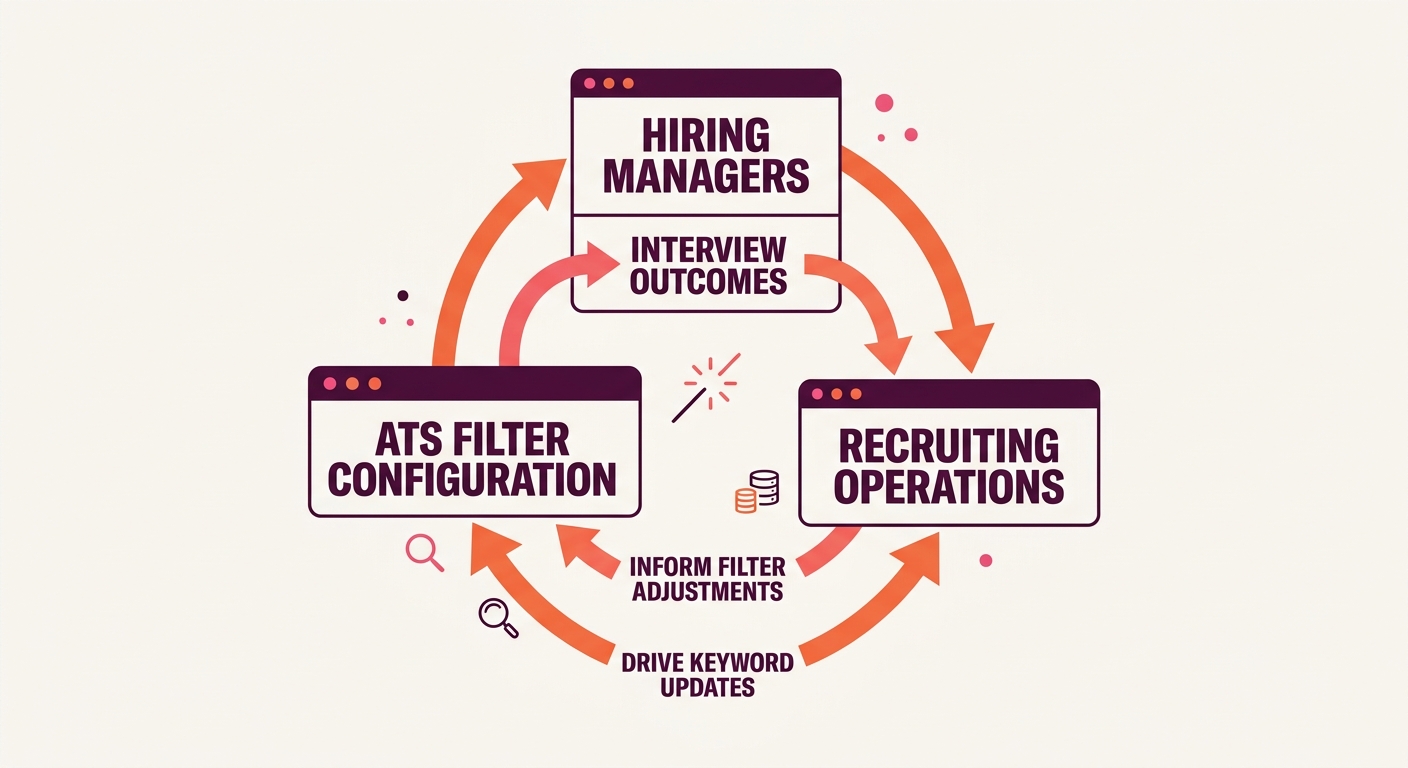
Recruiters can review ATS-rejected applications manually to determine if qualified candidates are being incorrectly filtered out, and high false-negative rates indicate that screening criteria are too narrow or too dependent on keywords. But this review only helps if the results feed back into system configuration.
Here’s what that looks like in practice: after every batch of interviews, the hiring manager flags candidates they wished they’d seen but didn’t. The recruiting operations team traces those candidates back through the ATS to identify where they were filtered out and why. Over time, this creates a dataset of filter failures that drives systematic improvement rather than one-off fixes.
For high-volume roles, this feedback loop matters more than any other single change. When you’re processing hundreds of applications per opening, even a 5% false-negative rate means dozens of qualified candidates disappearing per req. Those candidates don’t wait around. They accept offers from competitors with faster, more accurate processes. Consider pairing this loop with an employee referral program to create a parallel channel that bypasses ATS filtering entirely for referred candidates, giving you a built-in quality benchmark to measure your automated screening against.
When these rules break down
These seven rules assume a hiring context where candidate quality matters more than pure processing speed. That’s true for most roles, but there are exceptions worth naming.
Seasonal bulk hiring with minimal qualification requirements (warehouse staff, event crew, short-term retail) often benefits from aggressive auto-filtering because the cost of a false negative is low and the cost of manual review at scale is high. If you’re onboarding 300 workers in two weeks, a 10% false-negative rate is an acceptable trade-off against the operational cost of slowing down.
Roles receiving fewer than 20 applications don’t need calibrated filters at all. Turn off automated screening and have a recruiter read every resume. The math doesn’t justify the configuration time.
For everything between those extremes, the candidate quality vs. speed trade-off requires active, ongoing management. Your ATS intake filtering is a living system. Calibrate it like one: measure rejection accuracy, adjust thresholds, measure again after each hiring cycle. The teams that treat application volume management as a configuration problem to solve once during implementation will keep losing the candidates they spent real money to attract.