
Harvard Business School’s Hidden Workers report documented a problem most talent teams still haven’t fixed: 88% of surveyed employers admitted their applicant tracking systems regularly filter out qualified candidates. The root cause is a structural disconnect between what employer branding promises and what ATS scoring logic actually rewards.
The 88% Confession in the Hidden Workers Data
Harvard Business School professors Joseph Fuller and Manjari Raman, working with Accenture, surveyed more than 8,000 workers classified as “hidden” by automated hiring systems and over 2,250 executives across the U.S., U.K., and Germany. The finding that made the report impossible to ignore: 88% of employers agreed that qualified candidates were being screened out because they didn’t match the exact criteria baked into their ATS filters. The total pool of affected workers exceeded 27 million people in the U.S. alone.
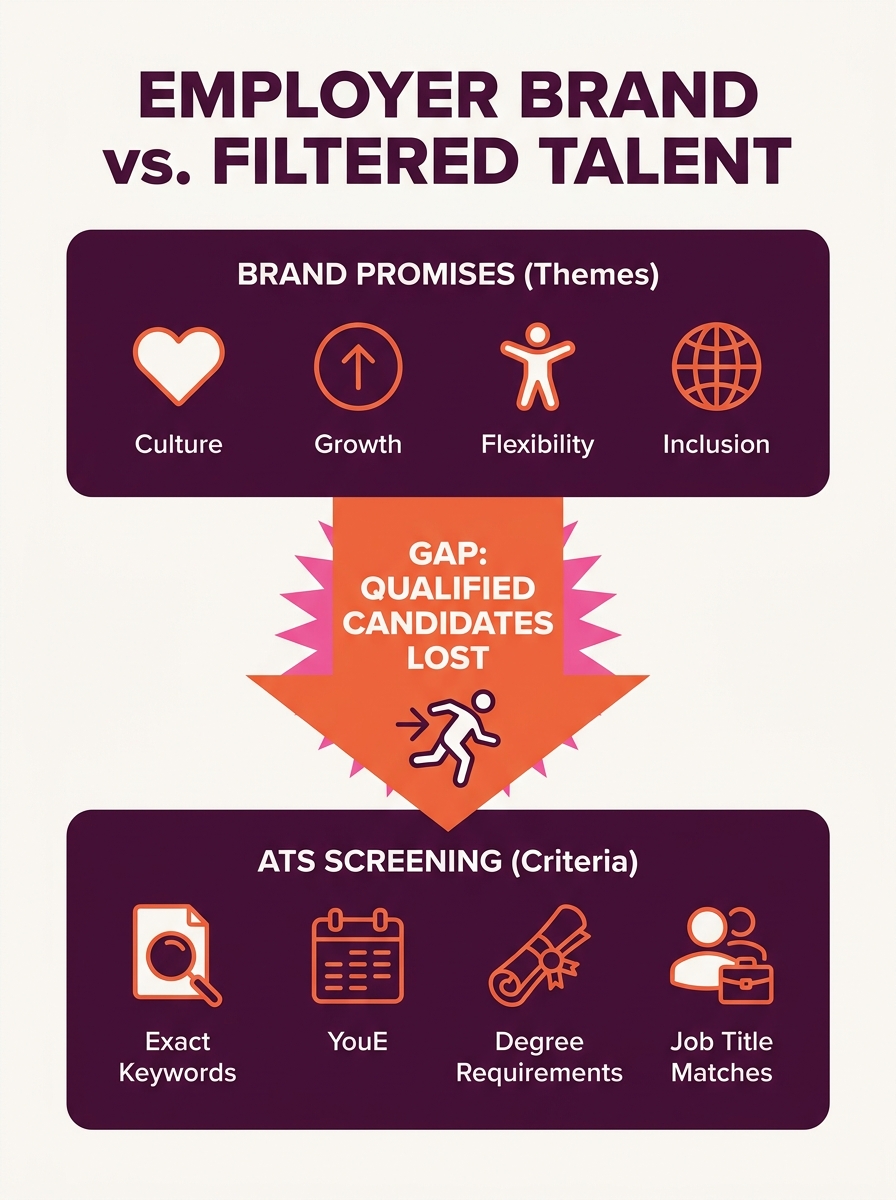
The study didn’t frame this as a technology failure. It framed it as a misalignment failure. Companies were spending real money on careers pages, social campaigns, and employee testimonials that emphasized culture, growth, and transferable skills. Then those same companies routed every applicant through keyword-matching algorithms that penalized anyone without the precise job title history or credential list the system expected.
This is the core of the candidate experience workflow mismatch. The marketing funnel says “we value potential.” The ATS scoring engine says “we value exact string matches.”
As People Managing People’s 2026 ATS analysis explains, an ATS assigns a score to each resume based on how well it matches the job description, checking for specific keywords, skills, experience, and education that the recruiter has marked as important. There’s no mechanism in most default configurations for weighing brand-aligned qualities like adaptability, cross-functional experience, or nonlinear career paths.
Where the Careers Page Writes Checks the Scoring Engine Won’t Cash
The Hidden Workers research broke the misalignment into identifiable patterns. Companies whose employer branding emphasized skills-based hiring and inclusive culture were, paradoxically, more likely to have rigid ATS configurations. The explanation wasn’t hypocrisy. It was organizational separation. The people writing the brand copy and the people configuring the ATS filters reported to different leaders with different KPIs.
Here’s what that looks like in practice. A company’s recruitment marketing might run LinkedIn campaigns featuring employee stories about career changers, veterans transitioning to tech, or self-taught developers who grew into senior roles. The brand promise is clear: we care about what you can do, not where you came from.
But the ATS job requisition for that same company requires a bachelor’s degree as a hard filter. Or it demands “5+ years of experience in [exact tool name]” as a knockout criterion. Anyone who doesn’t clear those binary gates never reaches a human reviewer, regardless of how well they match the spirit of the brand’s messaging.
The Reddit community r/jobsearchhacks surfaced a related mechanic: “If you list ‘project management’ in your skills section but there’s nothing in your experience that backs it up, some systems will actually flag that as a mismatch rather than a match.” This means the ATS actively punishes candidates who try to align themselves with broad brand language if their experience section doesn’t contain the corresponding keywords in the right context.
That dynamic turns recruitment marketing technical debt into a measurable cost. Every campaign dollar spent attracting a candidate who the system will auto-reject is wasted spend. And it gets worse: those rejected candidates form opinions about your brand based on the rejection experience, not the marketing experience. Research into how ATS screening speed affects employer brand perception consistently shows that silent rejections after a branded, high-touch application process create lasting negative sentiment.
The Notification Gap That Kills Brand Perception
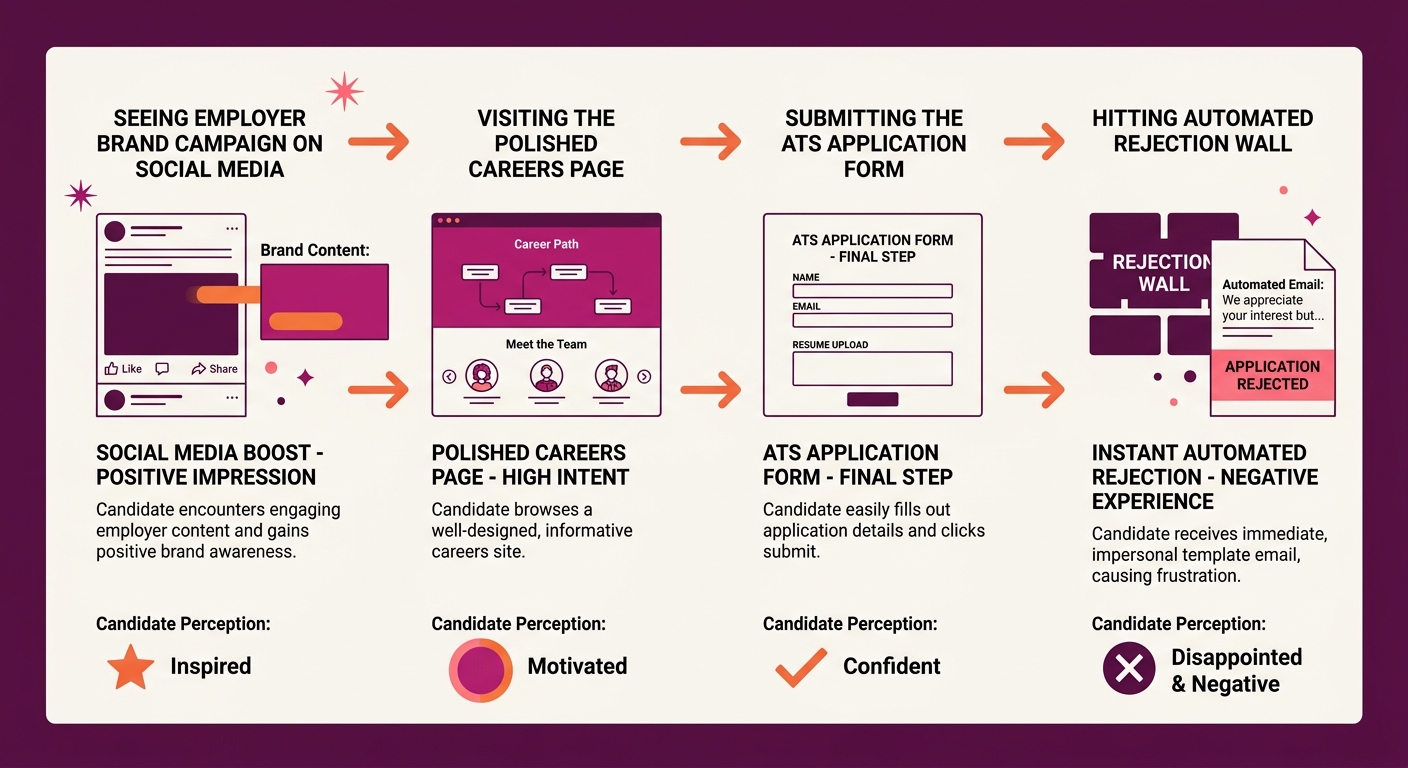
The Hidden Workers study found that the damage didn’t end at the filtering stage. Candidates who were auto-rejected rarely received any communication that acknowledged the disconnect between what attracted them and why they were screened out. Most got a generic rejection template or, worse, heard nothing at all.
This is where ATS messaging consistency collapses completely. The brand voice on the careers site is warm, specific, and human. The rejection email (if one exists) is a boilerplate paragraph that reads like it was written by a legal team in 2014. The gap between those two communication styles tells the candidate everything they need to know about whether the brand promise was real.
Every campaign dollar spent attracting a candidate who the system will auto-reject is wasted spend — and the rejected candidate’s Glassdoor review will cost you more than the campaign earned.
Teamtailor, an ATS and employer branding platform used by more than 12,000 companies in over 90 countries, has built its product thesis around this exact problem. Their approach treats the ATS and the employer brand as a single system rather than two separate functions. The logic is straightforward: if the tool that manages your hiring process is also the tool that manages your brand touchpoints, the messaging stays consistent because the data layer is shared.
But most organizations don’t work this way. The typical enterprise runs its employer brand through a marketing team using one set of tools and its applicant processing through an HR ops team using a completely different stack. The two systems don’t share data, don’t share terminology, and don’t share success metrics. The marketing team measures campaign engagement. The ATS team measures time-to-fill and cost-per-hire. Neither team measures the gap between candidates attracted and candidates the system actually allows through.
Content marketing for recruiting works best when the content reflects the actual hiring process, including its constraints. If your ATS requires specific certifications, your recruitment content should say so explicitly. If your system rewards certain keyword patterns, your job descriptions should be written with those patterns in mind, not written by the brand team and then separately configured by the operations team.
The Funnel Collapse Point Nobody Audits
The Hidden Workers data revealed that the collapse point in most hiring funnels sits between application submission and first human review. That’s the zone where the ATS is operating autonomously, scoring and filtering without any human oversight. And it’s the zone where employer brand ATS alignment fails hardest, because no one on the brand team ever sees what happens there.
Consider the math. If a company’s career campaign generates 500 applications for a role, and the ATS auto-rejects 75% based on keyword and credential filters, only 125 resumes reach a recruiter. Of those 375 rejected candidates, some percentage were genuinely unqualified. But the Hidden Workers research suggests that a significant portion were qualified people whose resumes didn’t conform to the system’s expected format, keyword density, or career-path linearity.
The problem compounds when you factor in resume parsing failures. Parsing engines that misread formatting, drop sections, or misclassify fields add another layer of false rejections on top of the intentional filtering. A candidate whose resume was perfectly written for the brand’s stated values can still be eliminated because the parser couldn’t extract their skills section from a two-column layout.
Organizations that have audited this gap typically find that their ATS filter criteria were set once during implementation and never revisited. Requirements drift. The market changes. The brand evolves. But the knockout filters inside the system stay frozen at whatever the hiring manager specified eighteen months ago. That’s the operational definition of brand promise fulfillment failure: the promise updates, the system doesn’t.
The Alignment Pattern That Survived the Harvard Scrutiny
The Hidden Workers study didn’t end at diagnosis. Fuller and Raman identified companies that had partially closed the brand-to-filter gap, and the pattern was consistent: those organizations had forced their talent marketing teams and their ATS configuration teams into the same room, working from the same data.
The specific interventions that worked weren’t exotic. They were operational:
- Shared keyword audits: The brand team and the ATS admin reviewed job descriptions side by side, comparing the language used in campaigns with the actual filter criteria. Wherever the campaign promised openness to nontraditional backgrounds, the filter had to accommodate those backgrounds explicitly.
- Rejection-reason tracking: Instead of a single “did not meet criteria” bucket, the ATS was configured to log which specific filter eliminated each candidate. That data flowed back to the marketing team so they could see where their campaigns were generating unprocessable demand.
- Notification redesign: The auto-rejection communications were rewritten to match the brand voice and, where possible, to explain what the candidate could do differently. This didn’t change the filtering, but it preserved the brand perception that the marketing team had worked to build.
These aren’t technically difficult changes. The reason most companies haven’t made them is organizational, not technological. The brand team doesn’t have access to ATS configuration data. The ATS admin doesn’t read the campaign copy. And neither team reports to the same person, so nobody owns the gap.
Harvard’s data showed that companies which did close this gap saw measurable improvements in quality-of-hire and candidate satisfaction scores. The researchers attributed this to a simple mechanism: when the filter criteria match the brand promise, the candidates who clear the filter are also the candidates the brand was designed to attract. The system starts selecting for the right things instead of selecting against the people the company actively recruited.
If your hiring stack is still running on filter logic that was configured during your last ATS implementation, the gap between your brand and your system has been widening every month. The fix isn’t a new ATS. The fix is making the people who write the brand promise and the people who configure the filters accountable to the same outcome.