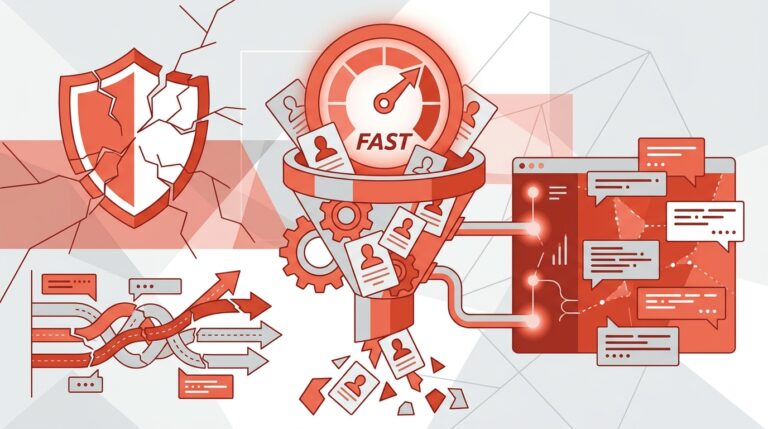
Seventy-two percent of candidates share negative hiring experiences on social media, and the primary source of those complaints is often the tool companies bought to improve hiring: their applicant tracking system. The ATS features that accelerate screening—keyword filters, auto-rejections, knockout questions—actively drive qualified talent away before a recruiter ever reviews their resume.
The Efficiency That Backfires
Every ATS sales pitch tells the same story: reduce time-to-fill, lower cost-per-hire, and let recruiters focus on high-value conversations instead of sorting through hundreds of resumes. By those metrics, modern applicant tracking systems deliver. According to LinkedIn’s hiring resources, tightening the recruitment funnel brings down cost per hire and frees budget for other priorities. Workday’s ATS documentation highlights how analytics dashboards reveal bottlenecks, time-to-fill metrics, and diversity patterns across the entire hiring pipeline. By any operational measure, the system works exactly as designed.
But the system is designed around recruiter efficiency, and ATS candidate experience gets treated as a side effect rather than a design goal. When 88% of employers themselves believe their ATS filters out qualified candidates, and 75% of qualified applicants get lost to poor configurations, you’re looking at a tool that solves one problem while quietly creating a much more expensive one. Average time-to-fill has increased by 23% since 2019, and 40% of HR time still gets burned on manual resume review because automated screening produced results nobody trusted. Anyone who’s spent time understanding how knockout questions accidentally filter strong applicants has seen this pattern up close.
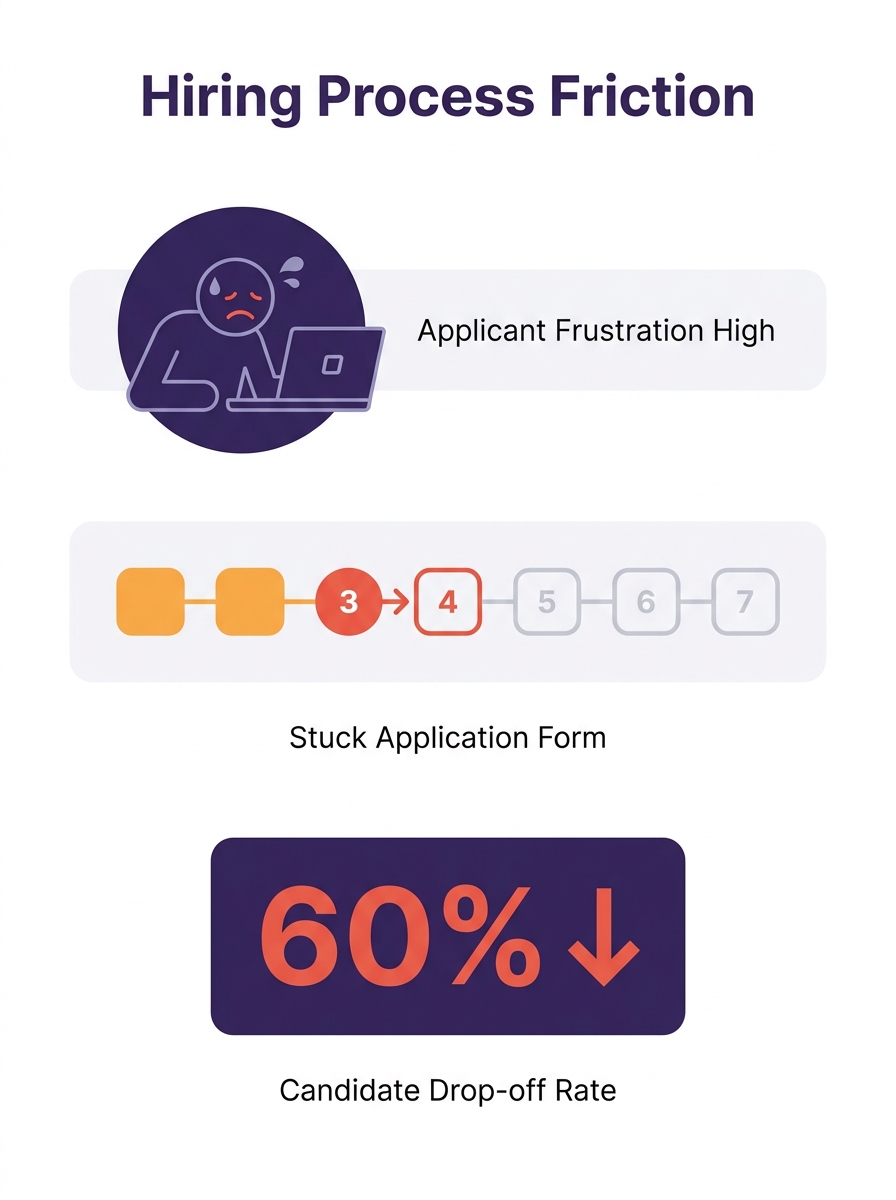
Recruitment funnel friction here is mechanical. An applicant spends 20 to 45 minutes completing a form, uploading a resume, re-entering every field the resume already contains, and answering screening questions. Then the system rejects them in seconds based on keyword matching that can’t distinguish between “program manager” and “project manager.” Over half of all applicants abandon the process within the first five to ten minutes, and 60% quit entirely when the application is too complex. Eighty percent of job seekers give up on applications they find overly complicated. The ATS did its job: it screened fast. It also screened out the people you needed.
When Rejected Candidates Become Your Loudest Critics
The damage from a bad employer brand hiring process doesn’t end when someone closes the browser tab. It compounds through channels you don’t control. Research from Vorecol on ATS impact on candidate experience and employer branding found that candidates are significantly more likely to share negative experiences than positive ones, and those stories directly deter future applicants from even starting the process. Platforms like Glassdoor made employer hiring processes visible to anyone with a search bar, and as Harvard Resource Solutions documented in their candidate experience research, experiences both good and bad now shape an organization’s reputation in real time. Candidates used to submit applications without knowing whether they were received, reviewed, or rejected. That era of silent tolerance is over.
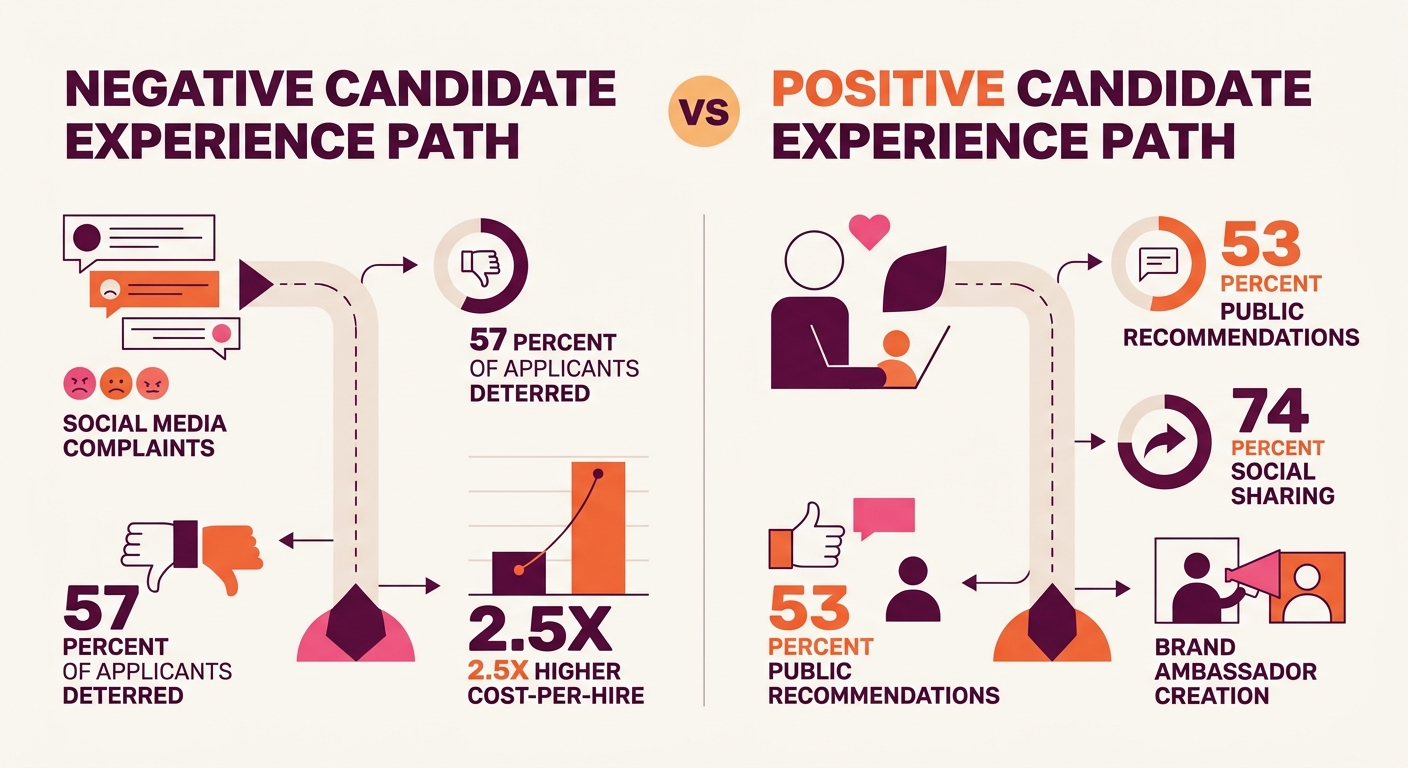
Here’s what the numbers look like in practice. Thirty-two percent of candidates who have a negative experience post about it publicly on LinkedIn or Glassdoor. Fifty-seven percent of job seekers refuse to apply to companies with poor reviews. And poor candidate experience increases cost-per-hire by 2.5x. You’re paying more to reach fewer people, and the people you’re reaching are already skeptical before they click “Apply.” We’ve explored this tension before when looking at why employer brands often look polished on LinkedIn but collapse during the actual hiring process, and the ATS is frequently the point of failure.
The math works in the other direction too. Fifty-three percent of candidates who have a positive experience post about it publicly, and 74% share good experiences within their social circles. ClearCompany’s research emphasizes that a well-configured ATS creates touchpoints that engage candidates and turn even unsuccessful applicants into brand ambassadors. The same tool that generates your worst Glassdoor reviews can generate your best ones. The difference is whether you configured it for speed alone or for speed plus communication.
Redesigning Communication Without Losing Speed
The fix isn’t slowing your funnel down. It’s adding communication layers to the fast screening you already have. The distinction matters because recruiters hear “improve candidate experience” and picture themselves writing individual emails to 300 applicants per opening. That’s not what applicant communication automation requires. When built with conditional logic and human handoff points, automated messaging keeps screening fast while eliminating the black-hole silence that generates so many negative reviews.
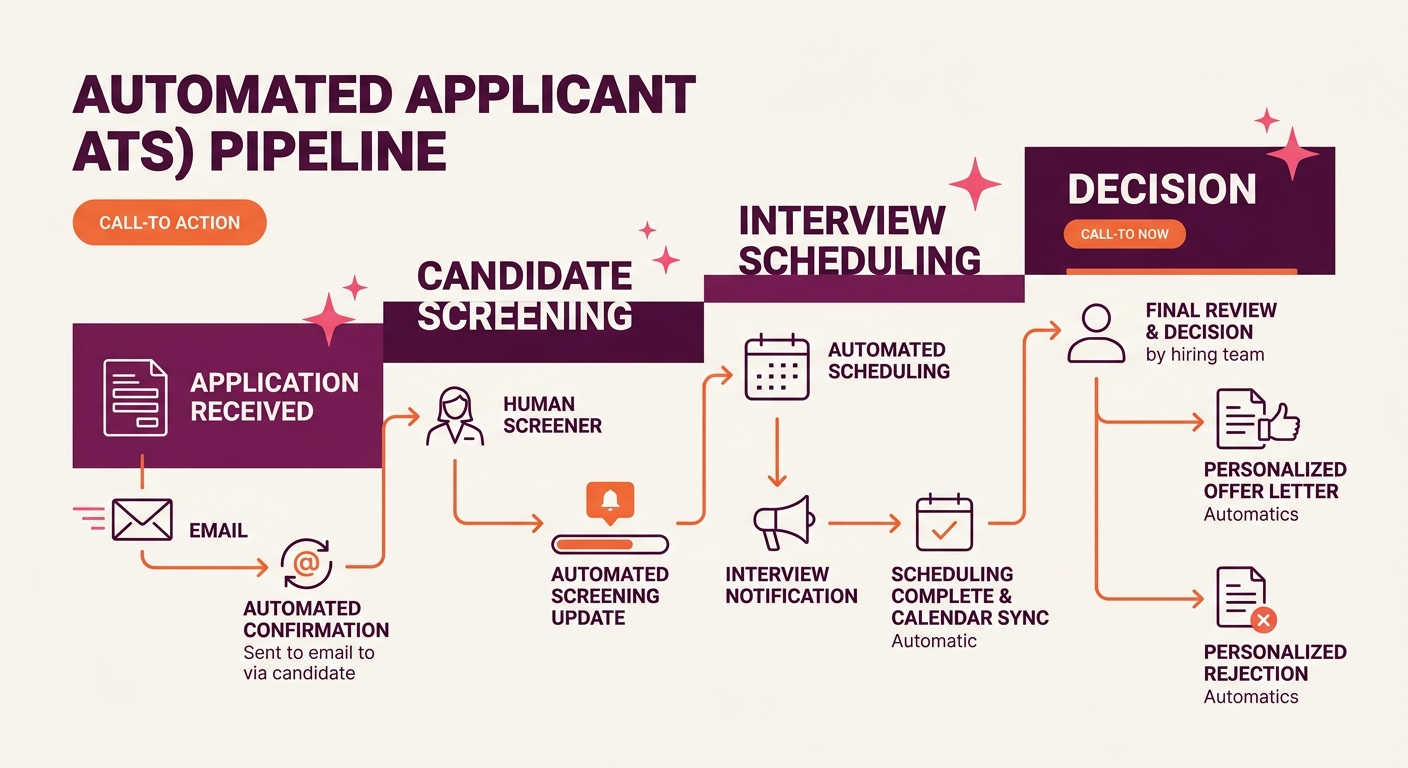
Effective automation systems include conditional logic, fallback rules, built-in pauses, and human handoffs when the situation demands a personal touch. Your ATS should send a confirmation email within minutes of application submission, a status update at each stage transition, and a personalized rejection with specific timing rather than a generic form letter three weeks later. Seventy-one percent of candidates want weekly status updates during an active process. And 58% say they’d reject even a dream role after a bad experience. The technology to deliver timely communication already exists in most modern ATS platforms; the gap is that teams configure the screening rules and skip the communication rules entirely.
There’s a real warning about over-automating, though. Lever’s research on recruitment automation pitfalls notes that candidates can immediately tell when communication lacks personalization, and 59% of HR decision-makers rank data privacy as a top concern when scaling automated messaging. The solution is using automation for scheduling, reminders, and stage-transition notifications while keeping direct engagement personal for finalists and passive candidates. If you’ve dealt with candidate ghosting problems rooted in poor follow-up automation, you know how fine the line is between helpful automation and impersonal noise.
The technology to deliver timely communication already exists in most modern ATS platforms. The gap is that teams configure the screening rules and skip the communication rules entirely.
Rejection deserves special attention. Keeping applicants fully informed of the recruitment process and letting them know as soon as possible whether they’ve been selected or rejected is the single most impactful thing you can do for your employer brand, according to research published by Exec.com on candidate relationship management. A candidate whose interview experience is respectful and timely, even when the news is bad, is more likely to recommend the company to others and apply again for future roles. Rejected candidates aren’t lost contacts. They’re future applicants, future customers, and active participants in your employer reputation. Eighty-seven percent of companies now use AI-driven recruitment tools, and the ones pulling ahead pair those tools with governance frameworks that keep automation compliant and auditable while preserving candidate dignity at every stage.
The Tension That Doesn’t Fully Resolve
The honest version of this argument is that speed and candidate experience exist in genuine tension, and no amount of configuration eliminates that tension completely. Every automated touchpoint you add takes time to build, test, and maintain. Every personalized rejection template requires someone to write it and someone to review whether it still sounds human after the 400th send. The recruiter who spends five extra minutes per rejected candidate across 200 applications per role has added 16 hours of work per opening. The cost of a damaged employer brand is higher than 16 hours, but the cost is diffuse and delayed, while the recruiter’s time is immediate and visible. That asymmetry is why so many teams default to speed and silence.
What the data supports clearly is that the ATS candidate experience problem is a configuration problem more than a technology problem. The tools already support automated status updates, conditional messaging, and personalized rejection workflows. The 92% application abandonment rate and the 2.5x cost-per-hire penalty aren’t inevitable consequences of using an ATS. They’re consequences of deploying one with screening rules tuned and communication rules ignored. Whether your team actually closes that gap depends on whether candidate experience metrics carry the same weight in your ATS configuration reviews as time-to-fill and cost-per-hire metrics do. For most organizations, they don’t yet, and that’s where the paradox continues to sit, waiting for someone with enough organizational influence to make the case that reputation costs are real costs, even when they’re hard to put on a dashboard.