
Competency benchmarking in hiring is about evaluating candidates based on specific skills, behaviors, and abilities required for a job, rather than relying on resumes or degrees. This approach uses measurable standards to assess job performance, ensuring fair and objective hiring decisions.
Key Takeaways:
- Focus on Skills: Prioritizes observable actions (e.g., clear communication) over vague traits or qualifications.
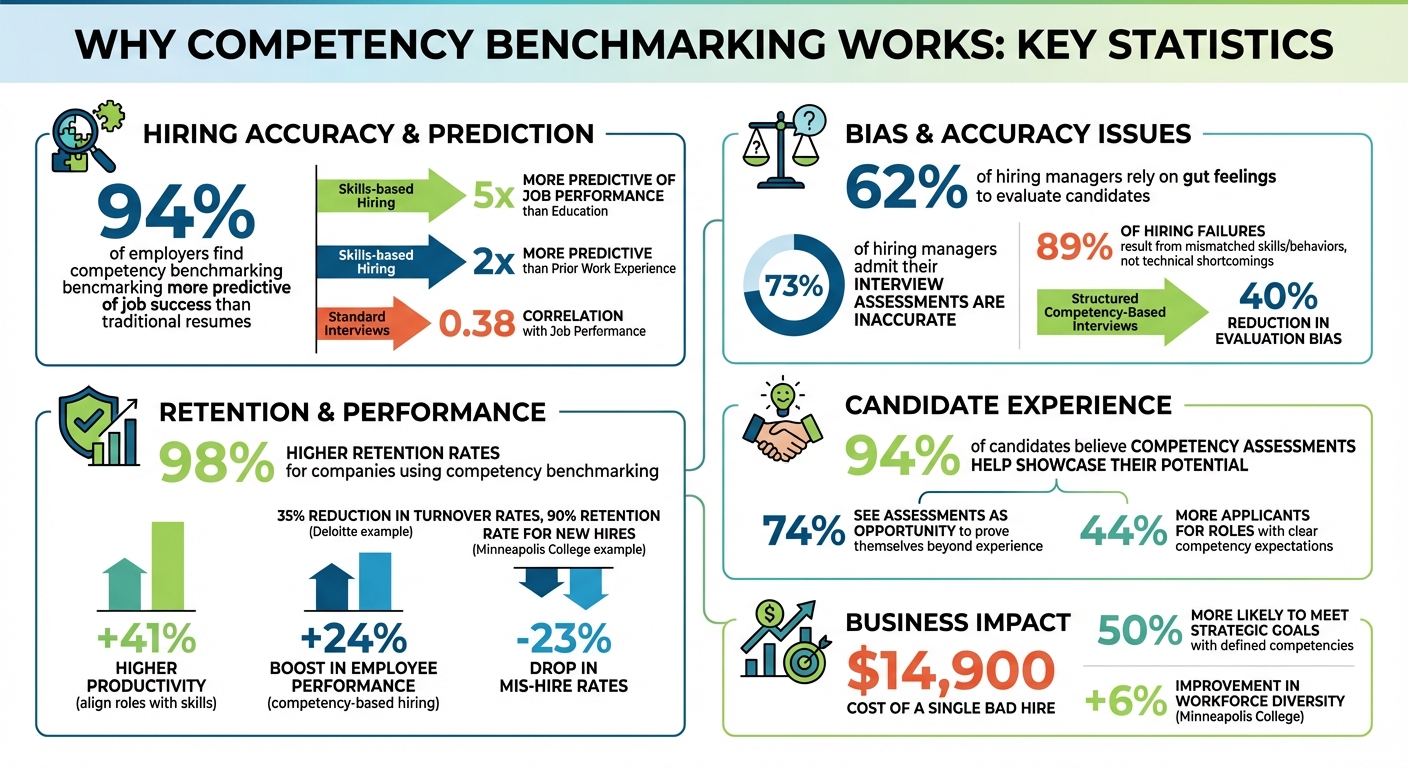
- Improved Hiring Accuracy: 94% of employers find it more predictive of job success than traditional resumes.
- Consistency and Fairness: Standardized evaluations reduce bias and ensure all candidates are judged equally.
- Retention and Productivity: Companies using this approach report 98% higher retention and 41% higher productivity.
Steps to Implement:
- Define role-specific competencies (e.g., technical, behavioral).
- Use tools like structured interviews and skills tests.
- Validate benchmarks with existing performance data.
- Integrate benchmarks into hiring workflows with recruitment software.
Competency Benchmarking Benefits: Key Statistics for Hiring Success
How to Implement Competency-Based Hiring: Future-proof your recruitment l WEBINAR
sbb-itb-e5b9d13
Benefits of Competency Benchmarking in Recruitment
Competency benchmarking brings consistency, relevance, and fairness to hiring processes, helping organizations build stronger, more effective teams. Let’s break down how these advantages enhance candidate selection.
Consistent Candidate Evaluations
Benchmarking replaces subjective opinions with a standardized system, ensuring every candidate is assessed against the same predefined criteria. Instead of relying on individual hiring managers’ personal preferences, structured rubrics and numerical scales – like scoring behaviors or skills from 1 to 5 – ensure a fair evaluation process.
This approach tackles the "halo effect", where a candidate’s strength in one area might unfairly influence their scores in unrelated areas. For example, excelling at coding doesn’t necessarily mean someone is a great team player, and each skill should be judged independently.
Evaluator training is also key. Calibration sessions, where multiple managers score the same sample candidates, help align expectations across teams and reduce unconscious bias. This ensures candidates are judged on observable and measurable factors – not on subjective elements like their appearance, name, or alma mater.
Alignment with Job Performance Requirements
Competency benchmarking ties hiring decisions directly to the traits and behaviors that predict success in a specific role. This begins by analyzing top performers within the organization to identify the qualities that make them effective. These "Level 3" attributes – such as attitude, motivation, and temperament – are more indicative of success than resumes or degrees.
In fact, hiring based on skills is five times more predictive of job performance than education and over twice as predictive as prior work experience. Companies that align roles with skills and strengths report 41% higher productivity, while those using skill-based hiring approaches are 98% more likely to retain top talent.
"A strong benchmark that focuses on the qualities that are truly predictive of on-the-job success leads to better hiring decisions, ensuring that organizations select the most qualified candidates." – Venessa Vasilakeris, McQuaig
Take Minneapolis College as an example. In November 2023, they removed degree requirements and minimum experience from their hiring process. By adopting competency-based benchmarking, they improved workforce diversity by 6% and achieved a 90% retention rate for new hires.
Improved Transparency in Hiring
Clear benchmarks define specific competencies for each role, removing ambiguity about what makes someone a "best fit". This transparency fosters trust: candidates understand how they’re being evaluated, and hiring teams have objective criteria to justify decisions. Together, these factors strengthen both consistency and alignment with performance goals.
Transparency also boosts candidate attraction. Roles that clearly outline expectations draw 44% more applicants. Additionally, 94% of candidates believe competency assessments help them showcase their potential, and 74% see them as an opportunity to prove themselves beyond their past experience.
"Competency-based assessments are the only way to widen your candidate pool without increasing the risk of a bad hire." – Ana Recio, SVP of Global Talent, SoFi
Internally, transparency promotes equity. Regular benchmarking ensures employees in similar roles are evaluated and compensated fairly, reducing resentment and preventing pay compression. Publicly linking roles to specific benchmarks also helps close gender and racial wage gaps by limiting the influence of unconscious bias.
How to Implement Competency Benchmarking in Hiring
Building a competency benchmarking system means translating roles into measurable, observable behaviors. Here’s how you can create a system that’s both efficient and objective.
Step 1: Define Key Competencies for Each Role
Start with a job analysis to pinpoint core responsibilities and match them to measurable competencies. Avoid vague terms like "good communicator." Instead, specify behaviors such as "provides clear, accessible project updates."
Organize competencies into four categories:
- Core: Universal values like integrity
- Functional: Skills specific to a department
- Technical: Hard skills unique to the job
- Behavioral: Interpersonal abilities
Observing your top performers can uncover overlooked traits, such as handling shifting priorities or navigating internal dynamics. Research shows that 89% of hiring failures result from mismatched skills or behaviors, not technical shortcomings.
Keep your framework manageable by limiting each role to 6–8 key competencies. Assign proficiency levels – Basic, Intermediate, Proficient, Expert – using concrete benchmarks. For example, a "Competent" project manager might successfully manage a $100,000 project within 10% of the budget, while an "Expert" might shape organizational strategies and mentor others.
Step 2: Create Assessment Tools
Once you’ve defined competencies, develop tools to measure them. Use structured behavioral interviews to uncover past examples of key behaviors. Skills tests and work simulations can provide insight into technical abilities and job performance.
Replace subjective questions with standardized scoring rubrics tied to your competency framework. These rubrics ensure objectivity and make it easier to compare candidates. For technical roles, focus more on technical assessments (e.g., a 70/30 split between technical and behavioral). Research indicates that organizations using competency-based hiring see a 24% boost in employee performance and a 23% drop in mis-hire rates.
After creating the tools, validate and fine-tune your benchmarks before rolling them out.
Step 3: Validate and Calibrate Benchmarks
Before implementing benchmarks fully, test them in real-world scenarios. Begin with content validation by having subject matter experts, managers, and top performers review the assessment materials to ensure they reflect actual job tasks. Then, conduct concurrent validation by testing current employees and comparing their scores with performance data – top performers should naturally score higher.
Hold calibration sessions where evaluators score the same candidate to ensure scoring consistency. Test the framework in one department before expanding it across the organization. Plan annual reviews of your benchmarks, adjusting the emphasis on specific competencies if performance data highlights consistent traits among high performers.
Step 4: Add Competency Benchmarking to Your Hiring Workflow
Start by listing required competencies in job postings to attract the right candidates. Use automated skills assessments and psychometric tests early in the screening process to filter applicants based on your benchmarks.
Centralize competency data within your recruitment software to streamline scoring and enable objective comparisons. For instance, Skillfuel‘s applicant tracking system provides a centralized dashboard that tracks competency scores throughout the hiring process, ensuring consistency across evaluators.
Leverage competency scores beyond hiring by tailoring training and development plans. Integrating these scores into onboarding helps new hires address skill gaps quickly. Companies with defined competencies are 50% more likely to meet their strategic goals, and organizations like Deloitte have seen a 35% reduction in turnover rates after adopting competency frameworks.
Tools and Techniques for Competency Benchmarking
Behavioral Interviews and Simulations
Behavioral interviews play a critical role in competency benchmarking by using scorecards and standardized evaluation forms to measure how candidates align with specific competencies. A popular method for structuring these interviews is the STAR technique – Situation, Task, Action, Result. This approach helps interviewers gather detailed examples of past behavior. For instance, instead of asking a hypothetical question like, "How would you handle a difficult client?", you could ask, "Can you describe a time when you resolved a conflict with a client using the STAR framework?"
Simulations and practical tasks are another effective way to gauge a candidate’s real-world skills beyond what’s listed on their resume. For example, technical roles might involve coding challenges in a relevant programming language, while management positions could include situational judgment tests. A real-world example comes from TPAY Mobile, which used automated screening processes between 2023 and 2024 to evaluate 500 candidates, ultimately hiring 20 individuals who met their precise technical benchmarks.
"Intelligent individuals demonstrated through coding tasks and analytical thinking." – Freddy Mounir, Platform Engineering Manager, TPAY Mobile
Assessment centers are particularly useful for high-volume hiring, as they allow multiple candidates to complete standardized tests at the same time. Before rolling out these tools on a larger scale, companies should pilot them with a smaller group to identify any technical glitches and gather feedback on the relevance of the questions. These structured assessments can also integrate with automated systems, offering a streamlined and objective way to evaluate candidates.
Recruitment Software Solutions
Modern recruitment software has become indispensable for competency benchmarking, enabling companies to integrate assessments into a unified, efficient process. Platforms like Skillfuel’s applicant tracking system centralize competency data, automate scoring, and minimize manual tasks. With features like a unified dashboard, Skillfuel ensures that automated skills assessments are seamlessly incorporated into hiring workflows, providing scalable and objective evaluations.
Look for software equipped with AI-powered benchmarking to compare candidate scores against both internal company metrics and broader industry standards. Some platforms even offer skill gap analysis, which identifies discrepancies between a candidate’s current abilities and the role’s requirements. The best systems support a range of assessment types – behavioral interviews, cognitive tests, and technical simulations – offering a comprehensive view of each candidate. By integrating these tools, companies can strengthen their hiring processes and make data-driven decisions. Considering that a single bad hire can cost a company up to $14,900, investing in advanced assessment software is a smart choice for organizations of all sizes.
Common Challenges in Competency Benchmarking
Challenge: Subjective Calibration
A major obstacle in competency benchmarking is the presence of subjective bias. Research highlights that 62% of hiring managers often rely on gut feelings to evaluate candidates – decisions that can be influenced by unconscious biases tied to factors like gender, race, or socio-economic background. On top of that, 73% of hiring managers admit their interview-based competency assessments are "somewhat" or "largely" inaccurate. The numbers back this up: standard interviews only predict job performance with a 0.38 correlation. Ben Schwencke, Chief Psychologist at Test Partnership, sums it up succinctly:
"Interviews measure only one thing effectively – charisma".
To address this, organizations should adopt structured frameworks with standardized rating systems. Structured, competency-based interviews have been shown to reduce evaluation bias by as much as 40%. Regular calibration meetings, where HR teams and hiring managers align on ratings by reviewing candidate data together, can also help reduce favoritism. Training staff to recognize and mitigate unconscious bias is another critical step. Additionally, conducting validation studies every 6 to 12 months ensures that benchmarks accurately reflect the traits of high performers.
Once subjective calibration is managed, the next challenge lies in seamlessly embedding these frameworks into existing workflows.
Challenge: Integration into Existing Processes
After tackling calibration issues, integrating competency benchmarking into current hiring workflows presents its own set of difficulties. Manual benchmarking can be time-consuming, prone to errors, and hard to scale, especially for organizations with limited resources. The solution? Start small and automate wherever possible. Launching a pilot program for one or two roles allows teams to identify potential issues and gather feedback before rolling out the framework on a larger scale.
Tools like Skillfuel can simplify the process by centralizing competency data and automating scoring within existing applicant tracking systems. This automation complements structured competency frameworks. Instead of rigid pass/fail criteria, consider using flexible performance ranges (e.g., 65% to 85%) to allow for more nuanced evaluations. Incorporating benchmarks directly into your current interview process – using tools like standardized scoring sheets and the STAR method – ensures consistency without requiring a complete overhaul. Dr. Chris Frost and Dr. Carter Gibson from HireVue emphasize:
"Benchmarking is not an exact science, and small variations are acceptable. That’s why we recommend working within ranges".
Conclusion
Competency benchmarking transforms hiring into a precise, data-driven process. By clearly defining success for each role and evaluating candidates against these standards, companies can reduce unconscious bias, improve hiring quality, and make quicker, more confident decisions. This structured method helps avoid costly hiring mistakes while offering a transparent way to assess talent. It simplifies decision-making and makes the hiring process more efficient.
Focusing on skills is essential for assembling high-performing teams. As Ana Recio, SVP of Global Talent at SoFi, explains:
"Competency-based assessments are the only way to widen your candidate pool without increasing the risk of a bad hire".
Modern tools like Skillfuel make this process easier by centralizing competency data, automating scoring, and integrating benchmarks directly into applicant tracking systems, reducing errors and saving time.
Start small by piloting your framework with one or two roles. Revisit and adjust your benchmarks every 6 to 12 months, and use performance ranges instead of rigid cutoffs. Benchmarking isn’t about perfection – it’s about creating a fair, consistent standard that identifies the right talent while giving candidates a clear way to showcase their abilities. With 94% of candidates believing assessments reveal their true potential, competency benchmarking is a win-win for both employers and job seekers. By adopting this approach, organizations can confidently build teams equipped for today’s challenges and tomorrow’s opportunities.
FAQs
How do you choose the right competencies for a role?
To choose the right competencies, start by examining the role’s primary responsibilities and pinpointing the behaviors, skills, and attitudes that contribute to success. Clearly define measurable behavioral indicators for each competency, making sure they align with the role and the organization’s values. Organize these competencies into clusters, establish proficiency levels, and revisit them periodically to ensure they stay aligned with changing business priorities and goals.
How can you prove your benchmarks actually predict job success?
To make sure benchmarks effectively predict job success, it’s crucial to validate them by comparing the profiles of top-performing employees with the outcomes of new hires. Regular updates based on real-world performance data are essential to keep these benchmarks relevant as job roles change over time. Tools like Skillfuel simplify this process by automating candidate assessments and fine-tuning benchmarks, ensuring they align closely with the requirements of each role. Validation is key – it confirms that benchmarks reliably forecast success by linking them to actual employee performance metrics.
How do you keep competency scoring consistent across interviewers?
To keep competency scoring consistent, rely on standardized tools such as scorecards with clear, predefined criteria, role-specific competencies, and anchored rating scales. Make sure interviewers are properly trained on how to use these tools and hold regular calibration sessions to ensure scoring practices stay aligned. Periodically reviewing and validating scores can highlight any inconsistencies, allowing you to address them and uphold the reliability of evaluations.