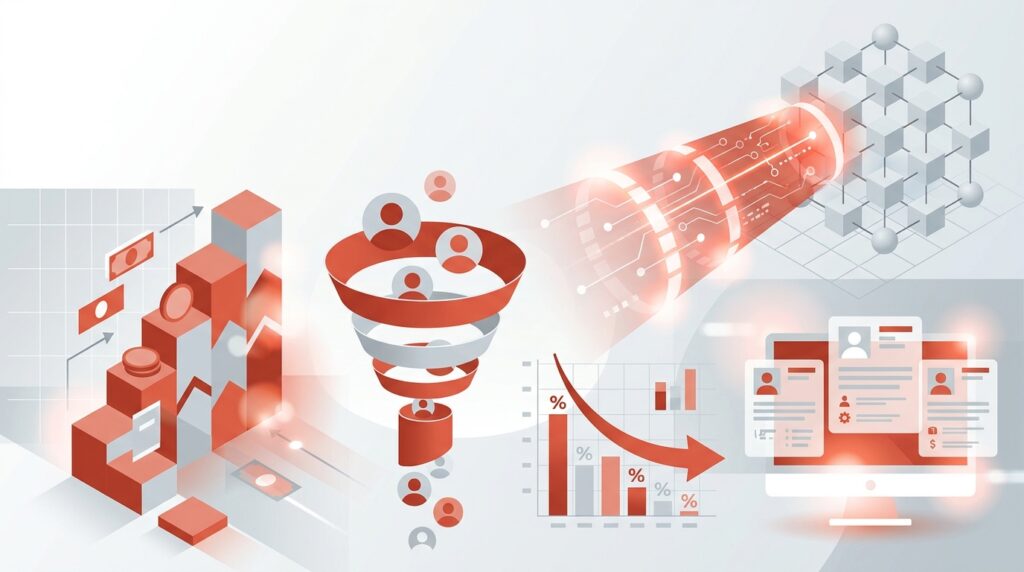
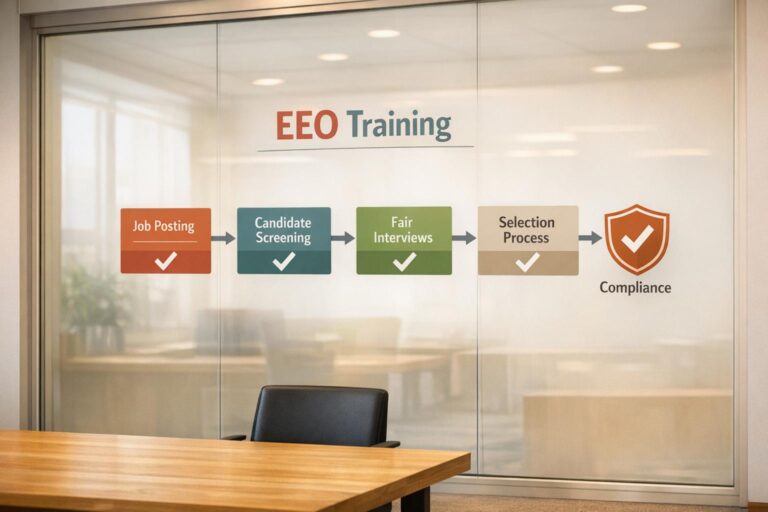
EEO training ensures your hiring practices follow federal laws, reducing legal risks and helping create a compliant, discrimination-free workplace. Here’s why it matters and what it covers:
- Prevents legal troubles: Training educates HR teams and hiring managers on avoiding discrimination claims by understanding laws like Title VII, ADA, ADEA, and GINA.
- Minimizes costly penalties: Non-compliance can lead to fines, back pay, and damages, with the EEOC recovering $513M in 2022 alone.
- Improves hiring processes: Learn how to maintain records, handle accommodation requests, and standardize evaluations to avoid bias.
- Boosts diversity: Proper training helps attract and retain candidates from various backgrounds, improving team performance and company reputation.
What Training Is Recommended For EEOC Best Practices? – Your Civil Rights Guide
What Happens When Organizations Ignore EEO Requirements
Overlooking Equal Employment Opportunity (EEO) requirements can lead to serious legal, financial, and reputational consequences. When discrimination claims arise, they often result in a formal investigation by the Equal Employment Opportunity Commission (EEOC). If intentional discrimination is proven, the case may escalate to a jury trial, where compensatory and punitive damages can be awarded. These outcomes highlight the importance of understanding and avoiding common hiring violations.
Frequent EEO Violations During Hiring
Many organizations fall into specific traps when they disregard EEO guidelines during the hiring process. These violations often stem from subjective decision-making influenced by stereotypes rather than objective criteria. For instance, failing to ensure a diverse candidate pool or using selection methods that disproportionately exclude certain groups can lead to discrimination claims. Examples include imposing height or weight requirements or conducting agility tests that unintentionally disqualify certain demographics. Even if the discrimination is unintentional, such practices can breach EEO standards.
Other common missteps include requesting sensitive medical or genetic information during the application process, automatically disqualifying candidates based on criminal records (which can disproportionately affect specific groups), and retaliating against applicants who have previously reported discrimination.
The Cost of Non-Compliance
Non-compliance with EEO requirements can come with hefty financial penalties. Organizations found guilty of discrimination may be required to provide "make whole" relief. This involves remedies such as hiring the victim, paying back wages, or offering front pay to compensate for future losses. The EEOC describes these remedies as follows:
"The ‘relief’ or remedies available for employment discrimination… may include: back pay, hiring, promotion, reinstatement, front pay, reasonable accommodation, or other actions that will make an individual ‘whole’ (in the condition s/he would have been but for the discrimination)."
In addition to these direct costs, employers may also face compensatory damages for financial losses and emotional distress. If the employer’s actions are deemed malicious or recklessly indifferent, punitive damages may be imposed – though these are not applicable to government entities. Legal costs can also pile up, as organizations may be required to cover attorneys’ fees, expert witness fees, and court costs for the prevailing party.
Key EEO Laws That Affect Hiring Decisions
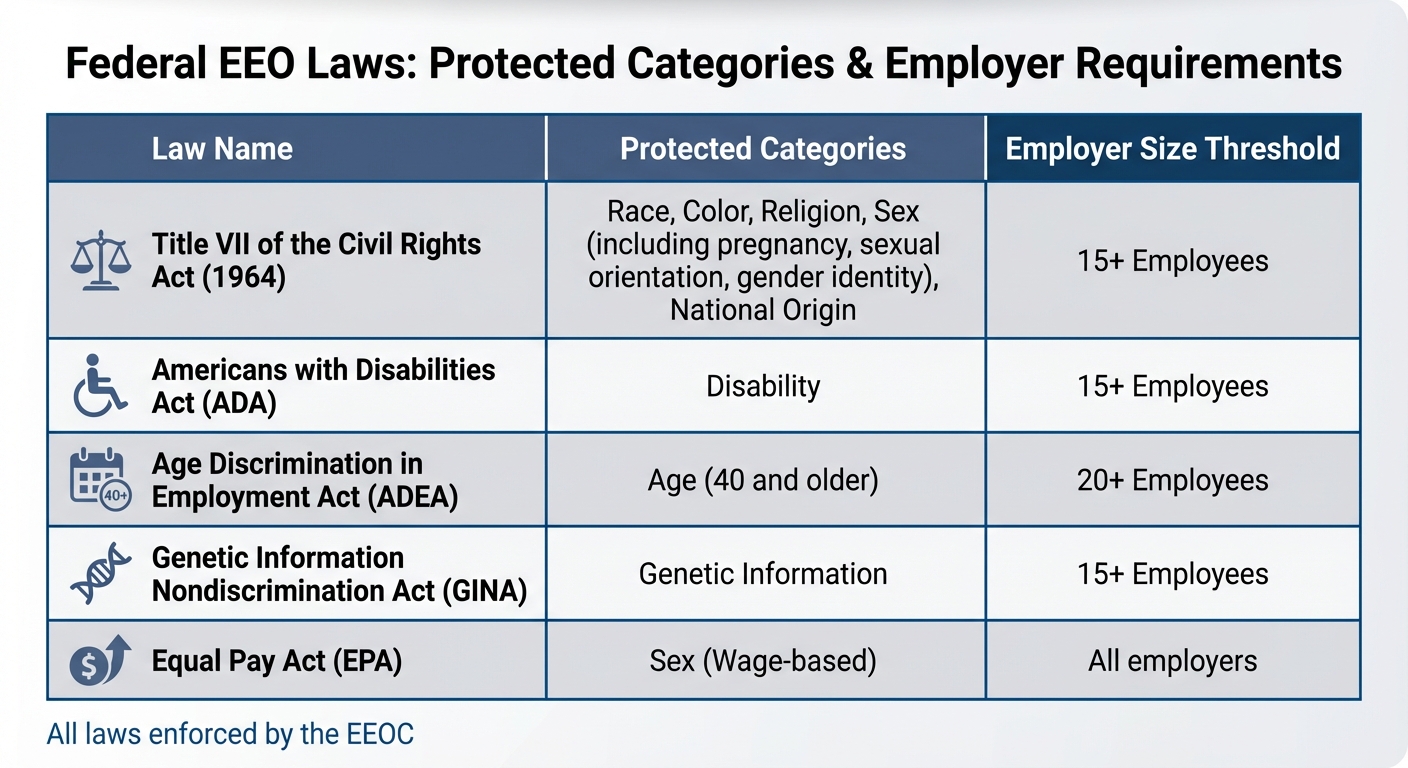
Federal EEO Laws: Protected Categories and Employer Requirements
Understanding federal hiring laws is critical to avoiding discrimination claims. The Equal Employment Opportunity Commission (EEOC) oversees several laws that influence how employers recruit, screen, and select candidates. These laws protect specific groups from unfair treatment and set clear boundaries for hiring practices. Additionally, they require employers to maintain detailed records and reports to prove compliance.
EEOC-Enforced Laws and Protected Categories
Title VII of the Civil Rights Act of 1964 is a foundational law that prohibits discrimination in hiring based on race, color, religion, sex (including pregnancy, sexual orientation, and gender identity), or national origin. It applies to private employers, state and local governments, and educational institutions with at least 15 employees.
The Americans with Disabilities Act (ADA) safeguards qualified individuals with disabilities. It requires employers to provide reasonable accommodations during the hiring process, such as offering sign language interpreters or modifying application materials. The ADA also prohibits asking about disabilities before extending a job offer.
The Age Discrimination in Employment Act (ADEA) protects applicants aged 40 and older from being unfairly passed over for younger candidates. This law applies to employers with 20 or more employees and prohibits job postings that include age preferences unless age is a legitimate occupational requirement.
The Genetic Information Nondiscrimination Act (GINA) prevents employers from using genetic information, like family medical history or genetic test results, in hiring decisions. It also restricts employers from requesting this information.
The Equal Pay Act (EPA) ensures that pay for a position is not determined by sex, offering protection against wage discrimination from the outset.
| Law | Protected Categories | Employer Size Threshold |
|---|---|---|
| Title VII | Race, Color, Religion, Sex, National Origin | 15+ Employees |
| ADA | Disability | 15+ Employees |
| GINA | Genetic Information | 15+ Employees |
| ADEA | Age (40 and older) | 20+ Employees |
| EPA | Sex (Wage-based) | All employers |
These laws not only establish fair hiring practices but also require employers to maintain thorough documentation.
Required Record-Keeping and Reporting
Compliance goes beyond fair hiring – employers must keep records that demonstrate objective decision-making. According to the EEOC, all personnel or employment records, including applications and resumes, must be retained for at least one year from the date of the record or related personnel action. If a discrimination charge is filed, all relevant records must be preserved until the case is resolved.
Organizations with 100 or more employees are required to file an annual EEO-1 Report, which details the workforce by job category, race, ethnicity, and gender. Federal contractors with at least 50 employees and contracts worth $50,000 or more must also submit this report. As stated by the EEOC:
"Employers who have at least 100 employees and federal contractors who have at least 50 employees are required to complete and submit an EEO-1 Report… every year."
Additionally, employers must display the "EEO is the Law" poster in a visible location for applicants and employees. Failure to post this notice can result in fines, which in 2021 were $576. These requirements ensure organizations can demonstrate compliance during audits or investigations.
Understanding these legal standards is essential for creating effective EEO training programs and avoiding potential hiring violations.
How EEO Training Helps Organizations Meet Compliance Standards
EEO training simplifies complex legal standards into actionable steps that HR teams and hiring managers can use in their daily operations. These programs help translate federal laws into fair hiring practices that hold up under audits or investigations. By focusing on practical application, training not only clarifies legal responsibilities but also strengthens an organization’s ability to handle compliance challenges. Let’s dive into what these programs cover and how they cater to different roles.
Training helps employees recognize and address discrimination before it escalates. According to the EEOC, "Ensuring that managers understand and consistently enforce your discrimination rules and policies may allow managers to quickly identify and resolve potential problems early, before they rise to the level of unlawful discrimination". This proactive approach minimizes legal risks while safeguarding both job candidates and the organization.
What EEO Training Programs Cover
EEO training focuses on the federal laws that shape hiring practices. Programs commonly include detailed discussions of Title VII of the Civil Rights Act, the ADA, the ADEA, GINA, the Equal Pay Act, and the Pregnant Workers Fairness Act. Each law is broken down with clear definitions of protected categories and real-world examples of prohibited behavior.
A key part of the training involves understanding reasonable accommodations. This includes legal obligations to provide adjustments for disabilities, religious practices, and pregnancy-related conditions under the PWFA. Practical examples – like offering sign language interpreters or granting extra time for assessments – help participants grasp these requirements.
Another critical area is retaliation prevention. Participants learn that applicants cannot face punishment for reporting discrimination or participating in related investigations. Training outlines proper complaint procedures, emphasizing confidentiality and the importance of objective investigations. Additionally, programs highlight the necessity of displaying the "EEO Is The Law" poster to demonstrate compliance efforts. Beyond these basics, role-specific modules provide more focused guidance tailored to different responsibilities within the organization.
Customized Training for Different Roles
While foundational training covers general compliance, specialized modules address the unique responsibilities of various roles. For general employees, the focus is on recognizing discrimination, understanding protected rights, and knowing how to report concerns. These sessions provide straightforward guidance on identifying illegal treatment during hiring and employment processes.
Managers and HR professionals receive more in-depth training to ensure they can enforce compliance effectively. Hiring managers, for example, learn how to create job postings that meet legal standards, conduct structured interviews, and objectively screen candidates to avoid mistakes during recruitment. Techniques like asking consistent questions for all candidates and using blind screening methods – such as removing photos and graduation dates – are emphasized to reduce unconscious bias.
Managers also receive guidance on handling accommodation requests through a structured, interactive process. This training ensures they know how to address these requests without delving into prohibited personal details. Additionally, they are trained on complaint handling and corrective action procedures to maintain compliance and resolve issues promptly.
sbb-itb-e5b9d13
Why EEO Training Benefits Hiring Teams
EEO training offers tangible benefits that go far beyond simply meeting legal requirements. By focusing on training programs that support compliance, organizations can see improvements in legal preparedness, workplace dynamics, and overall efficiency. This equips hiring teams to make informed, compliant decisions while reducing the risk of costly legal issues.
The financial stakes are high. In 2022, the EEOC recovered over $513 million in claims. Depending on the size of the employer, damage caps range from $50,000 for businesses with 15–100 employees to $300,000 for those with over 500 employees. Beyond these caps, victims may also recover attorney’s fees, expert witness fees, and court costs.
Reducing Legal Exposure and Preparing for Audits
Training plays a critical role in establishing a solid compliance record. The EEOC, which processed 73,485 discrimination charges in 2022, evaluates whether organizations have consistent procedures in place during audits. This includes documenting training completions with employee signatures, displaying EEOC-required posters (both physically and electronically for remote teams), and maintaining detailed hiring process records [26, 28]. In fact, 75% of organizations have updated their hiring practices to keep pace with changing legal requirements.
Mary Simmons, Vice President of HR Compliance at Asure Software, highlights the importance of clear reporting procedures:
"When discussing who to report problems to, report to ‘any manager (…) because your manager could be the one discriminating against you’".
Training ensures employees understand they can report concerns to any manager or HR representative, helping prevent issues from escalating into formal complaints. Regular internal audits can identify gaps in compliance before federal investigations occur. Additionally, structured interview protocols and clear, objective job descriptions create the consistency that auditors expect.
Improving Workplace Culture and Diversity
EEO training doesn’t just protect organizations legally – it also reshapes hiring practices to attract diverse talent and drive better business outcomes. Companies that embrace diversity report up to 2.5 times higher cash flow per employee. Those with gender-diverse executive teams are 25% more likely to achieve above-average profit margins, while ethnically and culturally diverse organizations outperform their peers by 36%. Inclusive teams also see a productivity boost of over 35%.
Diversity is increasingly important to job seekers. Seventy-six percent of candidates rank diversity as a key factor when choosing an employer, and 83% of Gen Z workers prioritize it when deciding where to work. However, biases in recruiting can cost companies up to 25% of their qualified diversity candidates. Training helps hiring teams address these challenges by promoting neutral qualification standards and inclusive communication practices [24, 25].
Pamela Pujo, DE&I Manager at CBRE, underscores the broader impact:
"A well-designed [DE&I] training program can elevate employee morale, boost customer satisfaction, and drive bottom-line business success".
Shane Green, Organizational Coach and Author, adds:
"Diversity awareness and focus must be a part of a company’s culture in all aspects… For training to be effective, the message must be reinforced regularly".
Jonathan Coffin, Associate VP at Indiana University, emphasizes the importance of ongoing effort:
"The most successful companies don’t view workshops as a one-and-done event but an opportunity to reinforce and build on a larger cultural commitment".
Modern training programs go beyond awareness by offering actionable strategies. For example, teams can audit job postings for biased language (like "ninja" or "energetic", which may unintentionally favor certain groups), adopt blind screening, and expand sourcing efforts to attract underrepresented candidates. These steps have been shown to improve candidate diversity significantly.
Using Software Tools for Compliance Tracking
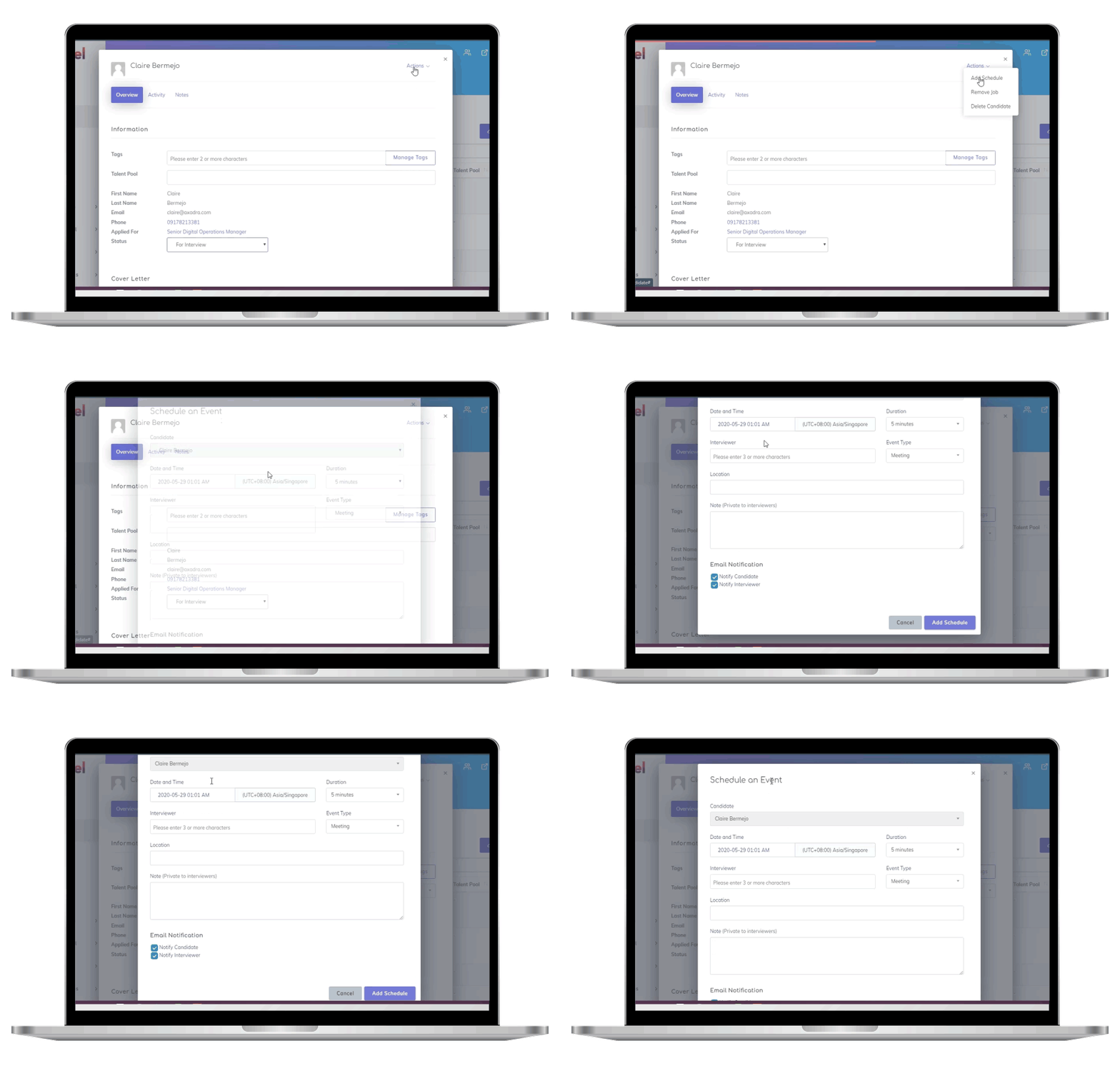
Technology plays a crucial role in supporting EEO compliance. Recruitment software automates processes like background checks, tracks applicant data, and generates reports required for audits. These tools create a detailed documentation trail, including job postings, screening processes, and interview evaluations.
Software can also reduce bias in hiring decisions. Platforms like Textio and Unitive flag biased language in job descriptions, while tools like Visier use analytics to identify sourcing channels that yield diverse, qualified candidates. By replacing subjective decision-making with data-driven insights, these tools help organizations meet both compliance and diversity goals.
To ensure audit readiness, companies should retain all applications and interview notes for at least one year. Digital systems make this easier by automatically storing and organizing records. When paired with training, these technologies create an integrated approach to compliance, setting the stage for tools like Skillfuel’s automated solutions.
Combining EEO Training with Skillfuel
EEO training provides the foundation for compliance, while Skillfuel takes it further by automating and reinforcing these principles. This recruitment management platform transforms training concepts into actionable, consistent processes. By centralizing compliance tasks, Skillfuel ensures HR teams can seamlessly apply EEO training across every stage of the hiring process. Essentially, it connects the dots between policy and practice.
Automating Fair Hiring with Skillfuel
Skillfuel tackles one of the toughest challenges in EEO compliance: maintaining fairness and consistency when managing large volumes of applicants. Its automated workflows objectively screen online applications, reducing the risk of disparate treatment discrimination. This is particularly important, as past compliance gaps have shown the risks of manual processes.
The platform’s centralized dashboard acts as a compliance hub. It stores digital signatures from completed EEO training sessions, a critical resource during EEOC investigations or audits. For organizations with remote employees, Skillfuel ensures accessibility by displaying electronic EEO notices and posters, meeting legal requirements regardless of location. Additionally, it standardizes selection procedures for all candidates within the same job category, aligning with ADA regulations to prevent discriminatory inquiries. This uniformity helps close gaps that often arise in manual hiring processes.
Monitoring Diversity Data and Compliance
Beyond automating screening, Skillfuel provides tools to monitor diversity and compliance metrics. Its reporting features analyze data to identify potential disparate impact issues before they escalate into EEOC complaints. By tracking applicant demographics at various hiring stages, HR teams can assess whether seemingly neutral procedures disproportionately affect protected groups. This is crucial, especially since employment testing and selection-related discrimination charges peaked at 304 in FY 2007.
Skillfuel also maintains a centralized application database, meeting the one-year record-keeping requirement. This automated system creates a clear audit trail, showing consistent application of hiring criteria. HR teams can verify that automated tests align with job-related and business necessity standards. Combined with ongoing EEO training, these capabilities shift organizations from merely reacting to compliance issues to proactively managing risks.
Conclusion
EEO training equips hiring teams with the tools to identify and address discrimination, but action must follow knowledge. It’s not enough to understand the principles – organizations need to embed these principles into consistent, measurable practices in every hiring decision. This combination of training and execution lays the groundwork for compliance supported by technology.
In 2022, the EEOC recovered over $513 million in claims. While avoiding penalties is important, the benefits of fair hiring go far beyond financial risk. Companies with diverse teams often see up to 2.5 times higher cash flow per employee. These figures highlight the strong business case for creating standardized, equitable hiring processes.
Skillfuel takes this a step further by automating fair hiring practices, ensuring that training doesn’t just stop at awareness. Its centralized tracking, structured workflows, and diversity monitoring tools transform EEO principles into daily practice. By verifying that hiring decisions meet job-related and business necessity standards, organizations can move from reacting to complaints to proactively preventing them.
"Ensuring that all employees involved in recruitment, hiring and promotion decisions understand their responsibilities may help prevent discrimination." – EEOC Small Business Resource Center
As highlighted, the key to a fair and efficient hiring process is combining thorough training with automation. The formula is simple: train, standardize, and automate. By integrating EEO training with recruitment technology, organizations can ensure fairness becomes an integral part of their hiring systems – not just an afterthought.
FAQs
How does EEO training help ensure compliance in hiring practices?
EEO (Equal Employment Opportunity) training is essential for organizations aiming to comply with federal hiring laws and regulations. It helps reduce the risk of legal troubles and hefty fines by ensuring that employees and managers understand and follow non-discrimination policies. Beyond compliance, this training promotes a workplace culture where diversity and fair treatment are prioritized throughout the hiring process.
Another key benefit of EEO training is raising awareness about employee rights and responsibilities, which can help prevent discrimination claims. It also keeps teams updated on any legal changes, allowing businesses to adapt quickly. Taking this proactive approach not only reduces legal risks but also boosts workplace morale, strengthens the company’s reputation as an employer, and creates a more inclusive and positive work environment.
How does EEO training help ensure fair and legal hiring practices?
EEO training is crucial for helping HR teams and hiring managers navigate employment laws effectively. It provides essential guidance on avoiding discrimination tied to race, gender, age, religion, disability, or other legally protected categories. This knowledge reduces the risk of unintentional hiring violations and promotes fair practices.
By emphasizing consistent, skills-focused hiring methods and thorough documentation, EEO training ensures recruitment processes are both fair and legally compliant. Maintaining detailed records – like interview notes and applicant data – can be invaluable during audits or investigations. This proactive strategy not only lowers legal risks but also encourages a workplace environment that values fairness and inclusivity.
How does technology help ensure compliance with EEO hiring laws?
Technology has become a game-changer in helping businesses comply with Equal Employment Opportunity (EEO) hiring laws by simplifying and automating critical recruitment tasks. Tools like applicant tracking systems (ATS) play a key role in this process. They allow companies to keep precise records, create compliance reports, and monitor diversity metrics – all of which support adherence to legal hiring standards. By centralizing applicant data, these systems make it easier to track demographics and ensure fair hiring practices.
On top of that, AI-powered tools are increasingly being used to screen candidates and assist in hiring decisions. However, it’s crucial for organizations to keep a close eye on these tools to avoid unintended biases that could lead to discriminatory practices. When used thoughtfully, technology can enhance transparency, accountability, and fairness in hiring, all while helping businesses reduce potential legal risks.