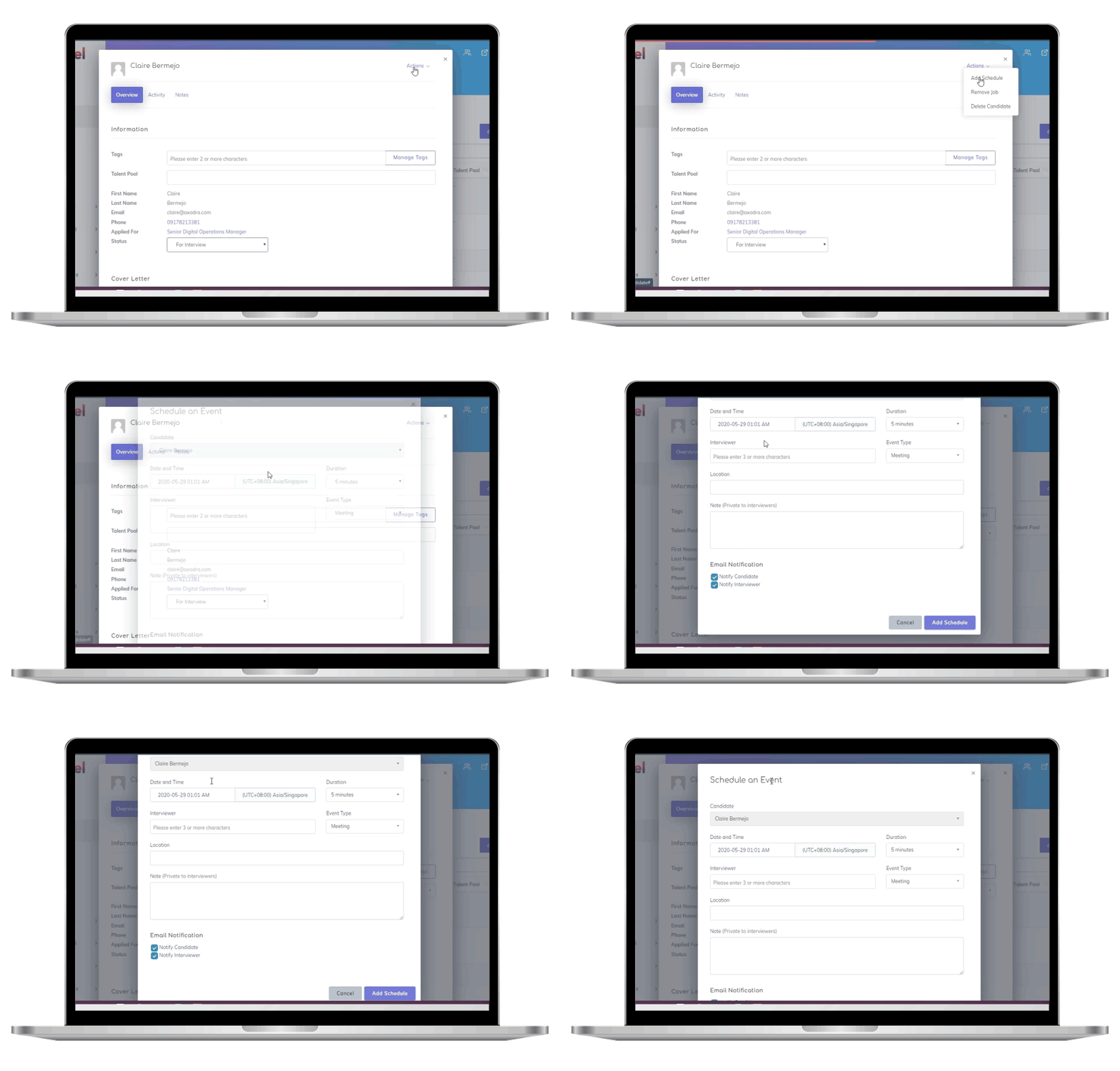

Programmatic job advertising replaces manual job board purchases with algorithmic, real-time bidding across hundreds of channels. Organizations running these campaigns with active weekly optimization achieve a 47% lower cost-per-apply than those treating the technology as set-and-forget, yet only 34% of enterprise companies have adopted the approach.
How the Bidding Loop Actually Works
Traditional job posting works on a fixed-fee model: you pay a flat rate per listing, per board, for a set duration, regardless of whether that posting produces three qualified applicants or three hundred unqualified ones. Programmatic job advertising inverts this entirely. Instead of locking you into 30-day slots, a programmatic platform distributes your ads across a network (Recruitics’ Reach network alone covers over 1,000 job sites), placing real-time bids on each impression or click the way Google Ads bids on search keywords. The algorithm decides where your ad appears, how much you pay for each placement, and when to pull spend from underperforming channels, all based on rules you configure around cost-per-apply targets, geographic priorities, and role urgency.
The process mirrors display advertising in e-commerce, but adapted for recruitment media spend. According to Joveo’s programmatic guide, the platform activates your hiring data to inform media buying decisions, create bidding rules, and generate machine-learning recommendations that automate job distribution based on your defined goals. Radancy describes the mechanism more precisely: algorithms use real-time bidding to deliver targeted ads across display, mobile, video, and social media channels, adjusting bids and budgets continuously to maximize investment. This candidate sourcing automation means that a nursing role in Phoenix and a warehouse role in Memphis each get routed to different boards, at different bid prices, at different times of day, without a recruiter touching a dashboard.
Where this gets interesting for your talent acquisition budget is in the speed of reallocation. Traditional campaigns require a human to notice poor performance, renegotiate with a vendor, and manually shift dollars. Programmatic platforms reallocate spend in hours rather than weeks. When campaigns are structured around role criticality, this speed advantage produces a 20–30% reduction in cost-per-hire according to current industry benchmarks. The technology works. The question is whether your team is actually using it correctly.
The Set-and-Forget Trap
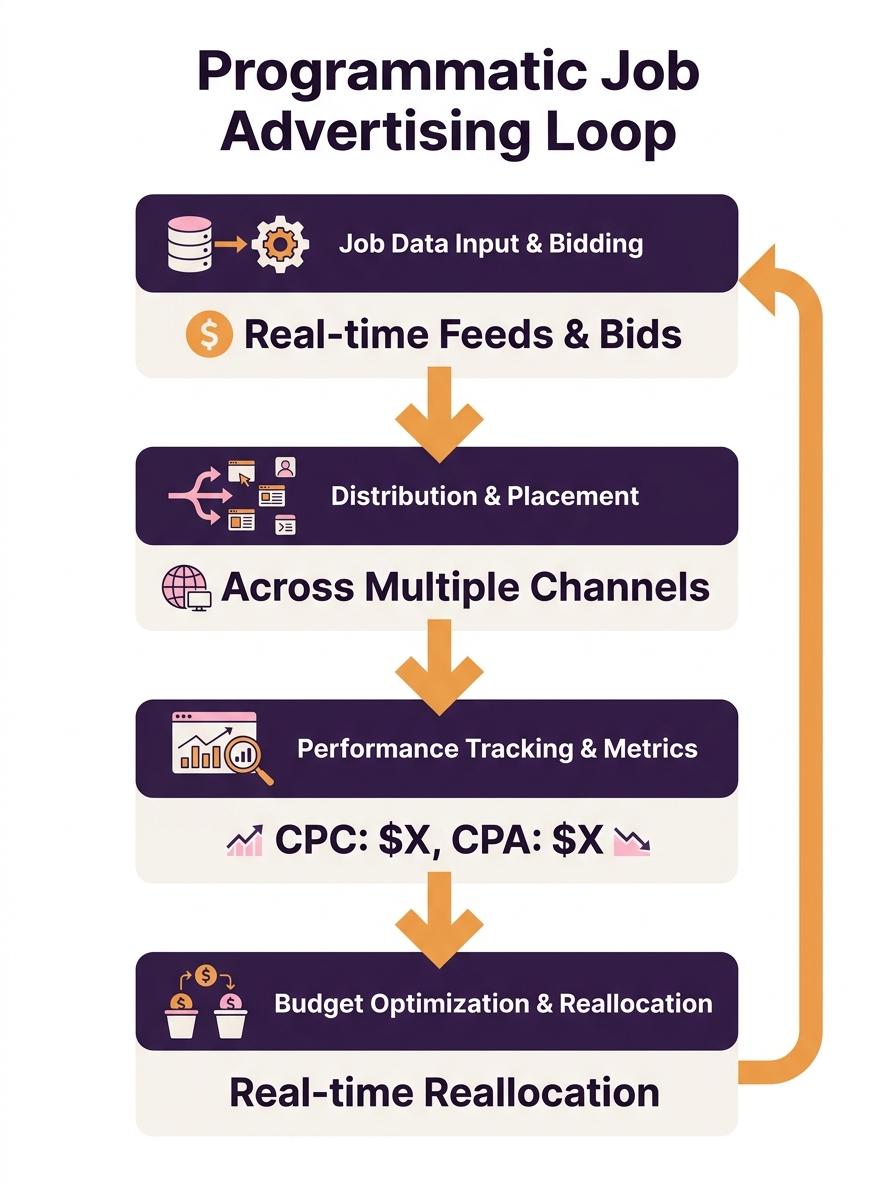
Here’s the part that vendors underplay: programmatic job advertising is frequently sold as a plug-and-play solution, and HR teams buy it that way. They onboard the platform, upload their job feed, set a monthly budget, and walk away. The result is exactly what you’d expect from any automated system running without supervision. Roughly 40% of recruitment media spend goes to underperforming channels when campaigns aren’t actively managed, according to aggregated industry data. Meanwhile, the average talent acquisition team still spends 40 hours a month on manual ad distribution even after adopting programmatic tools, suggesting that many organizations are running both the old manual process and the new automated one in parallel, paying twice for overlapping coverage.
The gap between organizations that get strong ROI from programmatic and those that don’t comes down to operational discipline. Companies that review campaign data weekly, define what constitutes a “quality application” before launching, and maintain exclusion lists for low-performing sources hit that 47% lower cost-per-apply number. Companies that set a budget ceiling and check back monthly end up overspending on high-volume, low-quality sources that generate clicks but not hires. The real ROI of recruitment automation tools depends entirely on whether someone is watching the machine and adjusting inputs. Automation without oversight is just faster waste.
This connects to a broader pattern in how HR teams approach recruitment marketing. Job board bidding requires the same analytical rigor as any paid media campaign. You need to know which boards produce candidates who actually get hired (not just candidates who apply), which job titles perform differently on different platforms, and where your competitors are bidding up prices for the same talent pools. Mecklenburg Electric Cooperative saw a 71% increase in qualified applicants after optimizing their job ad copy and targeting through isolved’s bidding framework. Zund America cut cost-per-hire by 65% and reduced recruiting time by half. These results came from active management of the bidding process, not from the technology running unattended.
Measuring What Matters After the Click
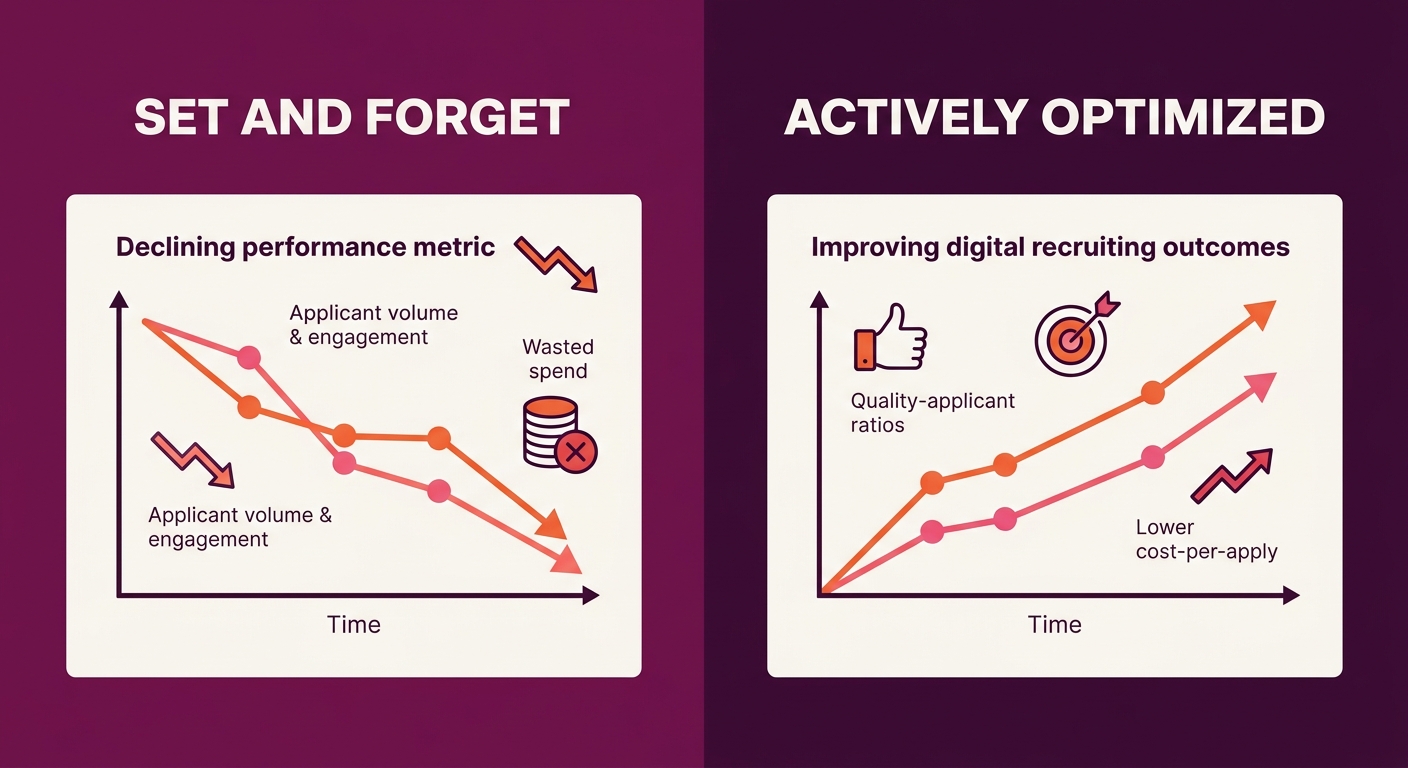
The biggest mistake HR teams make with programmatic spending has nothing to do with the bidding mechanics. It’s a measurement problem. Teams optimize for cost-per-click or cost-per-apply because those metrics are easy to pull from the platform dashboard. But a $3 cost-per-apply means nothing if 90% of those applicants are unqualified, and a $25 cost-per-apply is a bargain if half of those applicants reach the interview stage. The metric that actually matters is cost-per-qualified-apply (CPQA), and tracking it requires connecting your programmatic platform to your ATS so you can trace the path from ad impression to hire.
This is where the promise of full-funnel attribution enters the picture. Successful programmatic campaigns trace every dollar from initial impression through application, screening, interview, and offer. As Joveo notes, recruitment marketing platforms work best when built around hiring outcomes rather than process efficiency alone. The organizations that benefit most from programmatic job advertising are the ones that can answer a specific question: for each job board or channel in the network, what is my cost to produce one person who actually gets an offer? Companies using real-time analytics for their recruitment teams are better positioned to answer this because they already have the data infrastructure to connect spend to outcomes.
The sophistication gap here is real. Companies that automate their candidate sourcing through social channels and programmatic networks simultaneously need unified reporting to avoid double-counting conversions and overestimating the contribution of any single channel. Organizations using automation with integrated analytics have seen a 30–35% drop in total acquisition costs, but that reduction shows up only when the analytics layer connects ad spend to downstream hiring events. Without that connection, you’re optimizing for the wrong numbers and reporting inflated ROI to stakeholders who will eventually notice.
A $3 cost-per-apply means nothing if 90% of those applicants are unqualified, and a $25 cost-per-apply is a bargain if half of those applicants reach the interview stage.
Building content marketing strategies for recruiting often runs into the same attribution challenge. Organic content and paid programmatic ads feed into the same funnel, and without proper tagging and tracking, teams can’t separate which channel drove the hire. The programmatic platforms that offer full transparency with no hidden fees, as Wonderkind highlights in their 2026 platform comparison, are addressing this by making source-level spend data available in real time. That transparency is table stakes for any team serious about managing their talent acquisition budget with the same rigor they’d apply to a marketing budget.
Where the Promise Falls Apart
The uncomfortable reality about programmatic job advertising is that it works extremely well for a specific kind of hiring and poorly for others. High-volume, repeatable roles with clear qualification criteria and consistent demand across geographies are the sweet spot. Recruitics built their AMP sub-product specifically for organizations hiring similar talent profiles across multiple markets. If you’re filling 200 warehouse associate positions across 15 locations, programmatic bidding will almost certainly outperform manual job board purchasing, because the algorithm has enough data points and enough repetition to optimize meaningfully.
The model breaks down for specialized, low-volume, or senior roles. When you need one principal engineer or one VP of Finance, the algorithm doesn’t have enough signal to optimize. The bidding loop needs volume to learn, and a single-opening campaign on a 2-week timeline doesn’t generate enough data for the machine learning to improve on what a skilled recruiter could do manually with three well-chosen job boards and a LinkedIn InMail campaign. Teams that push all their requisitions into programmatic, including the roles where it adds no value, end up paying platform fees and management overhead on positions that would have filled faster through direct sourcing. The technology’s own limitations get obscured when every role, regardless of fit, gets funneled through the same system.
There’s also an open question about how programmatic interacts with the growing problem of AI-generated fake applications flooding recruiter pipelines. If your programmatic platform is optimizing for application volume, and an increasing share of those applications are fabricated, your cost-per-apply numbers look great while your actual pipeline quality deteriorates. Configuring ATS knockout questions at the intake stage helps filter noise, but the programmatic layer itself doesn’t distinguish between a real candidate and a bot submitting a generated resume. As synthetic applications become more common, the CPQA metric becomes even more critical, because cost-per-apply without quality verification is essentially a vanity metric dressed up as a performance indicator. The teams that win with programmatic will be the ones who resist the temptation to optimize for the easiest number to move and instead do the harder work of connecting every dollar to an actual human who showed up on day one.