
HR technology platforms are reaching a structural inflection point where competitive differentiation no longer comes from data visibility but from systems that convert intelligence into consistent organizational action, according to an analysis published May 27 by Prithvi Singh Shergill, Chief Experience Officer at School of Experiences. Shergill’s Forbes Human Resources Council piece outlines a four-phase progression—Data, Insight, Intelligence, and Inspired Action—arguing that despite unprecedented workforce analytics, many organizations still struggle to operationalize the information their dashboards surface.
TL;DR: An HR tech executive argues the industry is shifting from administrative efficiency and data dashboards to systems that reduce friction in executing on workforce intelligence, particularly as AI agents require governance layers that traditional systems of record must now provide.
The Administrative Efficiency Era Ends
For two decades, HR technology development centered on digitizing processes, centralizing employee data, and improving compliance at scale, according to Shergill’s analysis. That model enabled global expansion and operational consistency but was designed for environments where “people did the work and technology recorded the transaction afterward,” the article states.
AI fundamentally alters that transaction sequence. Technology now shapes decisions, guides workflows, and in some cases executes portions of work autonomously. The question facing enterprise HR platforms is whether they can evolve from information storage systems to systems that help organizations act on intelligence, Shergill wrote.
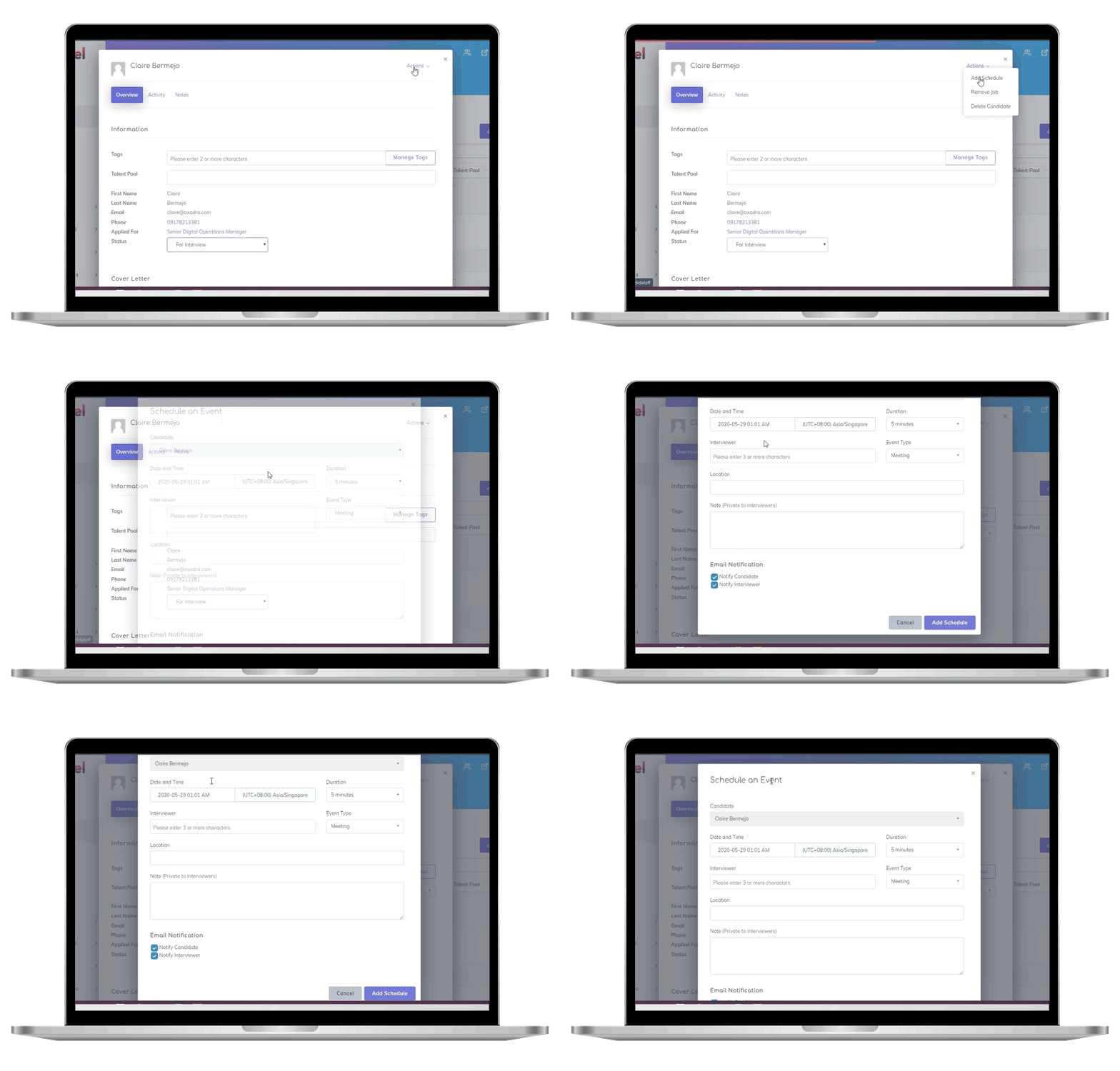
The shift affects recruitment platforms directly. An applicant tracking system that surfaces high-quality candidates but creates friction in scheduling interviews or routing approvals delivers visibility without execution. Modern interview scheduling software and workflow automation tools represent tactical responses to this execution gap, but Shergill’s framework suggests the requirement runs deeper—platforms must be architected to reduce the distance between insight and organizational action.
Visibility No Longer Solves the Core Problem
HR leaders invested heavily in dashboard-building over the past decade to surface engagement trends, attrition signals, productivity metrics, and capability gaps. “Yet despite unprecedented amounts of workforce data, in my experience, many organizations still struggle to consistently translate information from this data into insight that inspires action,” Shergill wrote.
Managers often identify problems long before they know how to intervene effectively, the analysis notes. Organizations flag capability gaps but struggle to operationalize reskilling at scale. Burnout indicators appear while workflows, incentives, and leadership behaviors continue unchanged. Real-time analytics for recruitment teams delivers similar tension—visibility into time-to-fill metrics or source-quality breakdowns means little if the system doesn’t surface what action to take next.
“The issue is no longer access to information; it is friction in enabling execution,” according to the Forbes piece.
The Four-Phase Framework
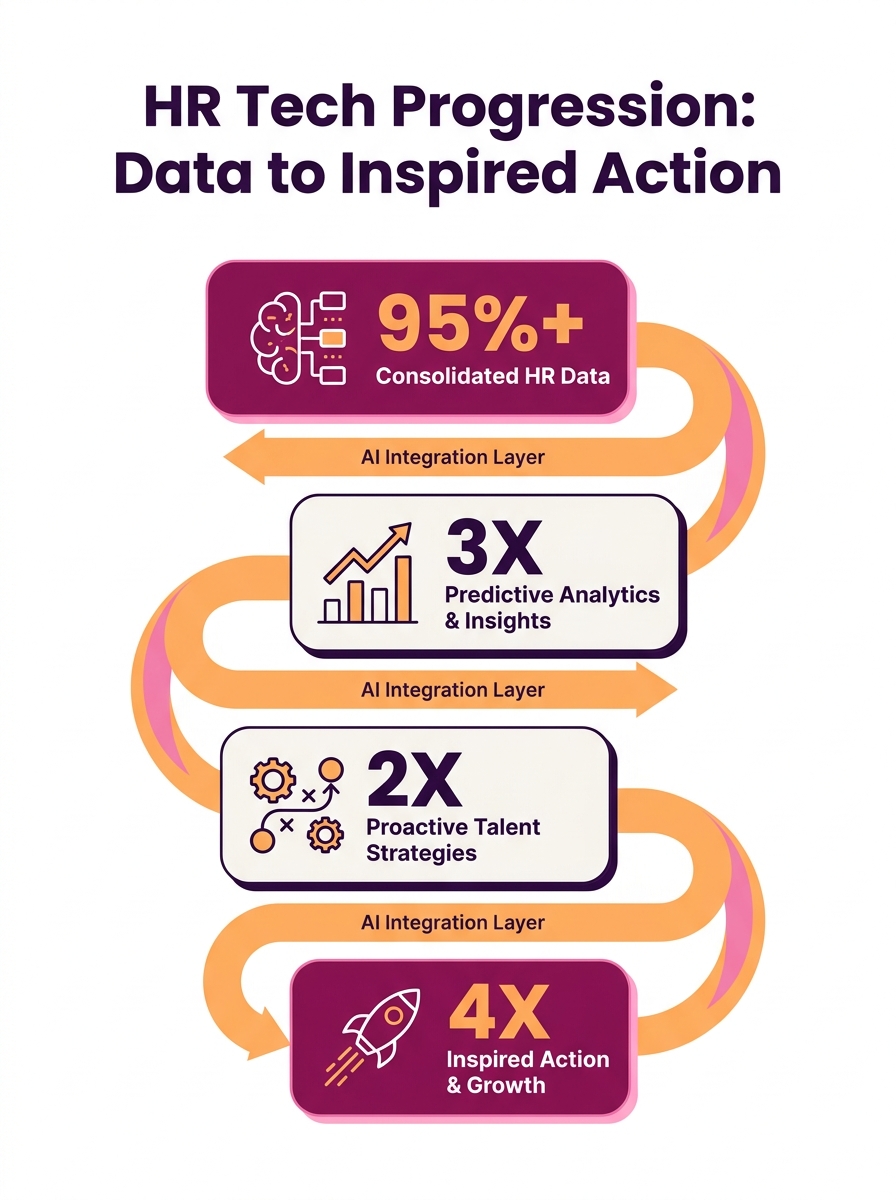
Shergill maps HR technology evolution across four connected layers. The first phase focused on data integrity. The second emphasized analytics and visibility—building dashboards to track workforce trends. AI now accelerates the third phase, where systems generate recommendations, predictions, and decision support.
The fourth phase—Inspired Action—represents where Shergill believes competitive differentiation will emerge. “The future value of HR technology will be defined by its ability to convert intelligence into action, consistently, responsibly and at scale,” the article states.
For recruitment teams, this translates directly to whether an ATS stops at surfacing qualified candidates (phase two) or extends to triggering next steps—auto-scheduling interviews, routing offer approvals, or prompting hiring managers when candidates stall in pipeline stages. Employee referral tracking systems that simply log referrals deliver phase-two visibility; those that automatically notify hiring managers of strong referral matches and pre-fill application fields deliver phase-four action.
AI Agents Require Governance, Not Replacement
Shergill rejects the narrative that generative AI will replace enterprise systems altogether, particularly in large, regulated, and globally distributed organizations. Enterprises still require governance, permissions, auditability, compliance controls, and process integrity. “Payroll cannot hallucinate. Compensation decisions cannot operate without guardrails. Workforce actions still require accountability structures,” the analysis states.
Systems of record are not disappearing, but their role is shifting from storing employee information to governing how intelligence gets operationalized across the enterprise, according to the piece. That distinction becomes critical as organizations deploy multiple AI agents simultaneously across finance, operations, customer systems, collaboration platforms, and HR environments. The challenge shifts from generating intelligence to orchestrating execution.
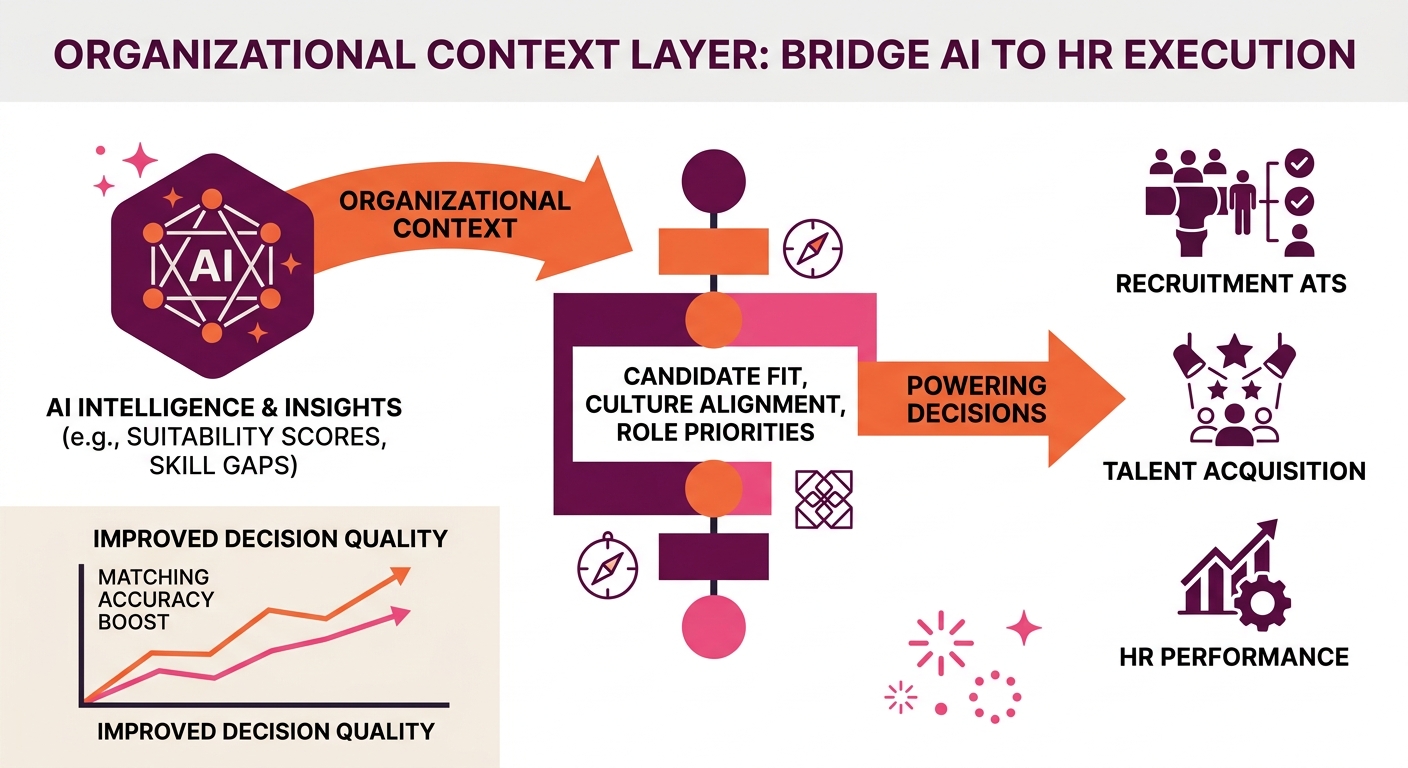
One of the most underestimated challenges in enterprise AI is organizational context, not model capability, Shergill wrote. In HR environments, context includes skills architectures, job frameworks, career pathways, organizational structures, compensation logic, and local regulatory requirements. Without that layer, AI may generate outputs that are not enterprise-relevant, the article argues.
From Process Administration to Organizational Adaptability
Shergill describes an evolving mandate for HR functions, shifting from process efficiency and policy administration toward enabling organizational adaptability, capability, and performance. The article outlines three connected outcomes:
Engage with empathy uses information to strengthen care through better understanding of employee well-being and workload signals, improve compensation transparency and equity, and enable timely recognition of contribution and growth.
Enable with expertise uses insight to build capability through continuous learning and skills development, align individual work with business outcomes, and provide visibility to career mobility pathways.
Enable to execute translates intelligence to inspire action that delivers clarity on goals and decision rights, improves communication speed and transparency, and reduces friction in organizational execution.
For recruitment leaders evaluating job portal development or ATS upgrades, the framework suggests asking whether the platform architecture supports all three layers—not just candidate data collection but tools that guide hiring managers toward better decisions and reduce the steps between identifying a strong candidate and extending an offer. The real ROI of recruitment automation tools increasingly depends on whether they deliver phase-four action capabilities rather than phase-two dashboards.
Context and Outlook
The strategic argument laid out in Shergill’s analysis aligns with observable platform development trends across the ATS and recruitment automation market. Vendors are layering AI-driven recommendations, automated next-step triggers, and workflow orchestration features on top of traditional applicant tracking databases. The competitive question is whether those features reduce genuine friction in hiring execution or simply add surface complexity to systems still architecturally designed for passive data storage.
For talent acquisition teams, the four-phase framework offers a lens for platform evaluation. Does your ATS surface time-to-hire by source (phase two), predict which sources will deliver quality hires next quarter (phase three), or automatically adjust job-board budget allocation based on those predictions (phase four)? Does your interview scheduler show calendar conflicts (phase two) or auto-propose three time slots to candidates based on interviewer availability and candidate timezone (phase four)?
Shergill’s emphasis on organizational context as the “next moat” in enterprise AI carries particular weight for recruitment. Skills taxonomies, competency frameworks, and job leveling structures are not generic—they are organization-specific assets that determine whether an AI recommendation is actionable or irrelevant. ATS platforms that allow teams to define and maintain those context layers may deliver differentiated value as AI capabilities commoditize. The shift from HR tech as administrative plumbing to HR tech as action-enabling infrastructure represents less a feature roadmap than an architectural rethinking of what enterprise people systems are built to do.