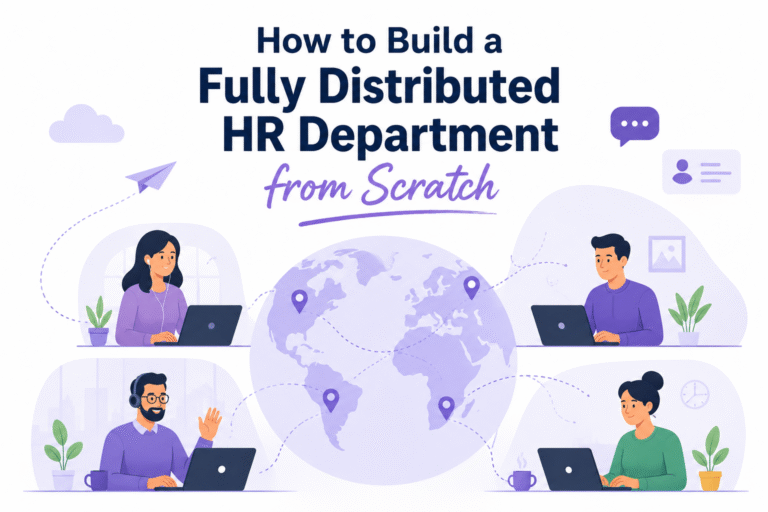
The traditional HR department consisting of a cluster of desks, manila folders, and an open-door policy is no longer the only way to run people operations. A growing number of companies are proving that HR can function just as effectively, if not more so, when the team is fully distributed across cities, time zones, and even continents.
Whether you’re a startup launching without a physical headquarters, a scale-up that went remote after the pandemic and never looked back, or an established business spinning up a remote-first HR function, building a distributed HR department from scratch is entirely achievable. It just requires the right structure, the right tools, and an openness to new processes.
This guide walks you through the basics, from legal foundations to candidate experience to help you understand what’s involved.
1. Start With Your Legal and Compliance Foundation
Before you hire a single remote HR professional or post a single remote job opening, you need to understand the compliance landscape. Employment law is jurisdiction-specific, which means a distributed HR team dealing with employees across multiple states or countries will face a patchwork of obligations around contracts, payroll, benefits, data protection, and notice periods.
What to do first:
- Map the geographies where you plan to hire and operate.
- Engage an employment lawyer or use an Employer of Record (EOR) service for jurisdictions where you don’t have an entity.
- Establish data handling policies that comply with GDPR, CCPA, or whichever data privacy regulations apply to your employee base.
- Decide early whether you’ll hire employees, contractors, or a mix of both. This can have significant legal implications.
Compliance isn’t glamorous, but getting it wrong is expensive. Build it into your foundation wherever possible.
2. Establish a Professional Business Presence Without a Physical Office

One of the first practical questions a distributed HR team faces is deceptively simple: where does the mail go?
Even in a remote-first world, your HR department will receive physical correspondence like government notices, signed contracts, benefits documentation, legal letters, and tax forms. Without a physical office, you need a professional, reliable address to receive and manage this mail.
A virtual mailbox solves this problem. Rather than using a personal home address (which creates privacy concerns) or a PO box (which many institutions won’t accept as a business address), a virtual mailbox gives your HR department a real street address. Mail is received, scanned, and made available digitally, so your team can review, forward, or shred correspondence from anywhere in the world. It also lends credibility when dealing with government agencies, financial institutions, and candidates who may want to verify your company’s legitimacy.
For a distributed HR team, a virtual mailbox is a necessity.
3. Build Your HR Tech Stack Around Async-First Workflows
A collocated HR team can solve a lot of problems with a quick hallway conversation. A distributed team cannot, so your technology has to carry the weight of coordination.
The guiding principle for selecting HR tech in a distributed context is async-first: tools that don’t require everyone to be online at the same time in order to function.
These are the core layers of a distributed HR tech stack.
Applicant Tracking System (ATS)
Your ATS is the backbone of distributed recruiting. It centralises candidate data, tracks pipeline stages, automates communications, and gives every hiring manager visibility into where candidates stand. An ATS eliminates the need for email chains and spreadsheets, which often lead to confusion in distributed teams. Look for one with role-based access, customizable pipelines, and integrations with your other tools.
Document and Contract Management
E-signature tools like DocuSign or PandaDoc allow offer letters, NDAs, and employment agreements to be sent, signed, and stored without paper changing hands. Pair these with cloud storage (Google Drive, Notion, or Confluence) for policy documents, employee handbooks, and onboarding materials.
HRIS (Human Resource Information System)
An HRIS is your single source of truth for employee data like contracts, salary information, performance reviews, and time-off records. In a distributed environment, this is especially critical because HR team members in different locations need access to accurate, up-to-date information without having to ask a colleague.
Communication and Project Management
For a distributed HR team’s own internal coordination, tools like Slack, Linear, or Asana help track projects, share context, and reduce dependency on synchronous meetings. Establish clear norms around response times, documentation, and where different types of information live.
4. Rethink Your Hiring Process for a Remote-First World
Recruiting looks quite different when you’re not meeting candidates in a lobby or hosting them in a conference room. The good news is that remote hiring often produces better outcomes. It expands your talent pool globally, reduces unconscious bias in early screening, and forces you to document your process more rigorously.
This is how to structure your remote hiring funnel.
Async Video Screening
Tools like Loom or HireVue allow candidates to record responses to pre-set questions on their own schedule. This works well for early screening, is fairer to candidates across time zones, and saves your team from scheduling dozens of 15-minute calls.
Structured Interviews via Video
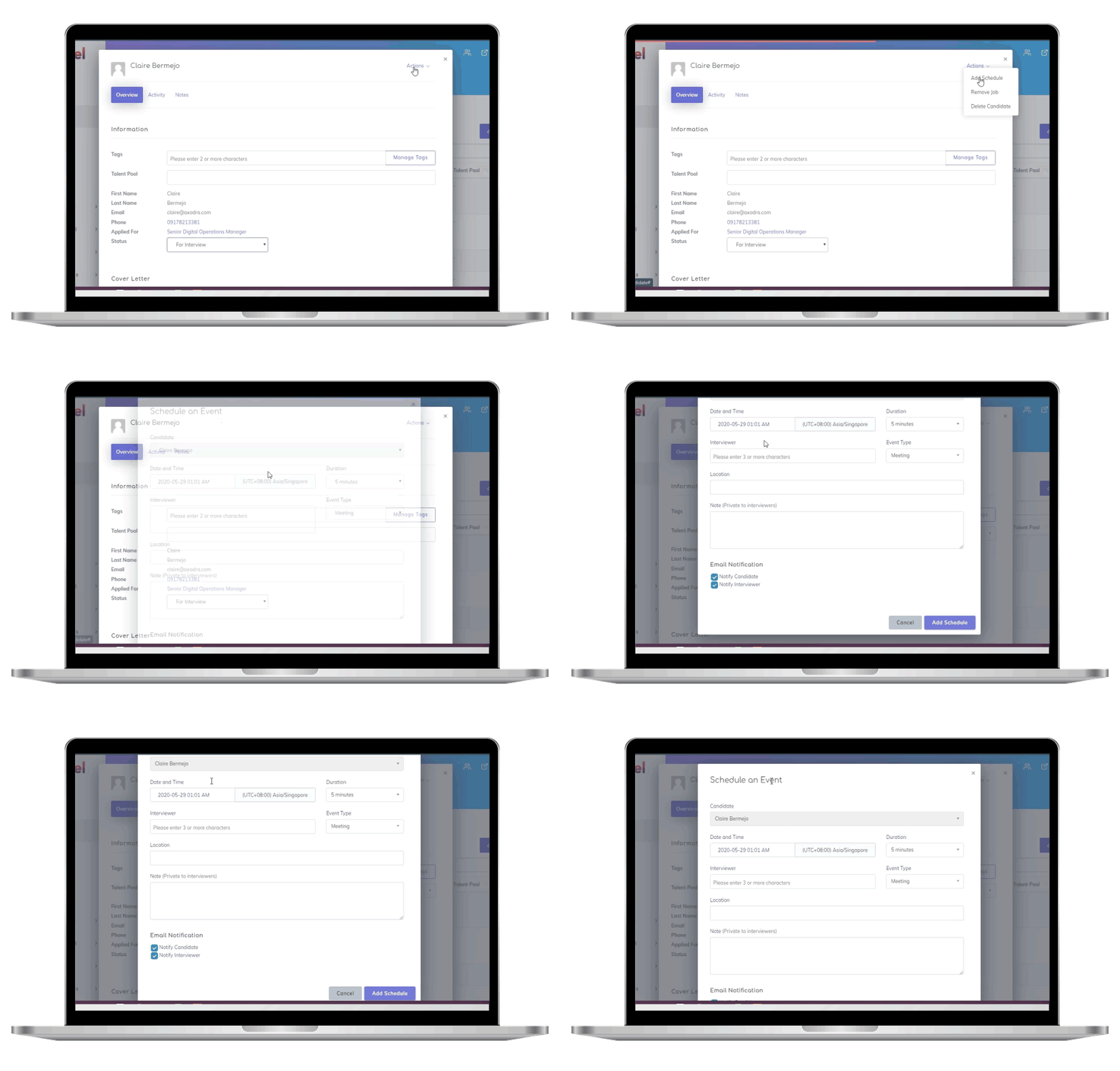
When you move to live video interviews, structure matters more than ever. Without the informal signals of an in-person meeting, interviewers need clear rubrics, consistent questions, and disciplined note-taking. Use an interview scheduling tool that lets you coordinate across time zones, send automated reminders, and capture interviewer feedback in one place so nothing falls through the cracks.
AI-Powered Interview Intelligence
One of the most practical advances for distributed hiring teams is the use of AI-assisted transcription and speaker identification in interviews. Speaker labels are an AI feature that automatically identifies and tags each person’s contributions in a recorded conversation, making transcripts far easier to review and share. For a distributed HR team where not every stakeholder can attend every interview live, speaker-labelled transcripts mean that a hiring manager in Amsterdam can review exactly what a candidate said in an interview conducted by a colleague in Austin. No context is lost, summarisation bias is avoided, and the outcome isn’t reliant on memory. This significantly improves hiring panel alignment and reduces the risk of important candidate details getting lost in translation.
Reference Checks and Background Screening
Use automated reference check platforms (like Checkr or Refapp) that send structured questionnaires to referees and return standardised responses. These integrate neatly with most ATS platforms and remove the need for phone-tag across time zones.
5. Design a Remote Onboarding Experience That Actually Works
Onboarding is where many distributed HR teams stumble. Without a physical environment to guide a new hire through the culture and context of a company, onboarding can feel impersonal, disorganised, and overwhelming.
What can help is designing onboarding as a product: something that has been deliberately built, tested, and iterated on.
Elements of effective remote onboarding include:
- Pre-boarding portal: Before day one, give new hires access to a self-service hub where they can complete paperwork, read the handbook, watch welcome videos, and get their equipment sorted.
- Buddy system: Pair every new hire with an onboarding buddy who is available for informal questions that don’t warrant a formal meeting.
- 30-60-90 day plan: Provide a clear roadmap for what the first three months should look like, with defined milestones and check-ins.
- Recorded onboarding sessions: Any live onboarding sessions should be recorded and made available asynchronously, with speaker-labelled transcripts so new hires can reference them later without having to scrub through an entire video.
- Culture touchpoints: Schedule informal virtual coffee chats, team intros, and optional social events that help new hires build relationships beyond their immediate team.
6. Build Performance Management Processes That Work Across Time Zones
Performance management in a distributed HR department requires moving away from observation-based evaluation (“I can see they’re working hard”) toward outcome-based evaluation (“they hit their targets, here’s the evidence”).
This is actually a more equitable system, and a distributed setup forces the discipline that many collocated companies never develop.
Putting these in place helps remote performance management:
- OKRs or KPIs for every role, documented and accessible in your HRIS.
- Regular 1:1 cadences, with meeting notes stored centrally so there’s a record of feedback and progress over time.
- Peer review cycles facilitated through your HRIS or a dedicated performance tool like Lattice or 15Five.
- Clear promotion and progression criteria, written down and applied consistently. This is especially important when managers and reports never share a physical space, since informal sponsorship and visibility can create inequity.
7. Protect Culture Deliberately
Culture can’t emerge naturally in a distributed team the way it might in an office. In a remote setup, you’ll need to actively design, communicate, and reinforce your company’s core values.
Your HR department plays a central role in this, even (especially) when HR is itself distributed. Concretely, this means:
- Write your values down in detail, with examples of what they look like in action.
- Make culture explicit in job postings, interviews, and onboarding.
- Build rituals like regular all-hands, team retrospectives, and virtual celebrations that are consistent and inclusive across time zones.
- Track culture through regular pulse surveys, so you can identify issues earlier than later.
8. Measure What Matters
A distributed HR department should be as data-driven as any other function in the business. Key metrics to track from day one:
- Time to hire. How long does it take from job opening to accepted offer?
- Offer acceptance rate. Are candidates saying yes when you extend offers?
- Onboarding completion rate. Are new hires finishing all onboarding steps within the target window?
- 90-day retention rate. Are the people you hired still there after three months?
- Employee Net Promoter Score (eNPS) Would your employees recommend working here?
These metrics give your distributed HR team a shared view of health and performance, without needing to be in the same room to discuss it.
Final Thoughts
Building a fully distributed HR department from scratch involves rethinking how HR operates when presence can’t be assumed, when mail needs to go somewhere reliable, when interviews happen across time zones, and when culture has to be a deliberate act rather than an ambient property of a shared space.
The teams that get this right tend to share a few traits: they document everything, they choose tools that serve async workflows, they measure outcomes rather than activity, and they treat the candidate and employee experience as a product to be designed and refined continuously.