
A job posting that asks for “client relationship management” will screen out every resume listing “account management” or “customer success,” even when all three phrases describe identical work. This vocabulary mismatch between job descriptions and incoming resumes is the primary driver of candidate screening failures in ATS-filtered hiring, and the fix starts with the posting itself.
How the Gap Forms
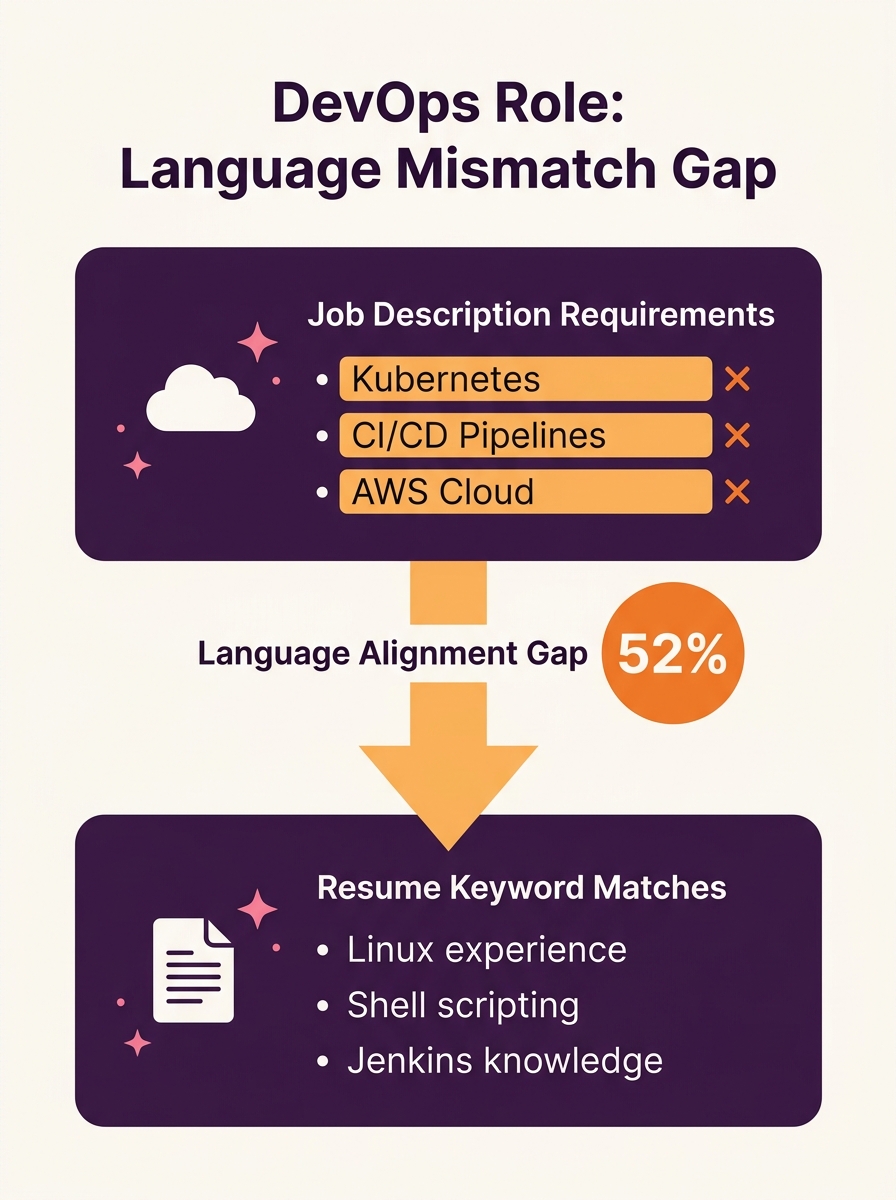
The person writing the job description and the person submitting a resume almost never use the same vocabulary for the same skills. The average unoptimized resume is missing 52% of the keywords from its target job description, according to ATS scanning benchmarks. That number reflects a two-sided problem: candidates describe their experience in the language of their previous employer, while hiring teams describe the role in the language of the current organization’s internal terminology. The ATS sits between them, enforcing a literal match that neither side designed with the other in mind.
The Harvard Business School Hidden Workers study, led by Joseph B. Fuller, found that 88% of surveyed employers admitted their ATS regularly filters out qualified candidates who don’t exactly match hiring criteria. Fuller’s team framed the problem as a “shortage” manufactured by screening infrastructure rather than an actual talent deficit. The distinction matters for anyone running a job description audit: the system isn’t broken in some exotic technical sense. It’s doing exactly what you told it to do. The gap lives in the instructions you wrote.
Consider a concrete example. A hiring manager writing a DevOps posting might require “CI/CD pipeline experience,” while a qualified candidate’s resume says “continuous integration and deployment using Jenkins.” Both describe the same competency. A rigid keyword-matching ATS will score them as a mismatch because “CI/CD pipeline” doesn’t appear as a literal string. Multiply that mismatch across every required qualification in a posting with 15 to 20 listed requirements, and you start to see how a 52% keyword gap accumulates without either party making an obvious error. The employer’s brand promise attracts the right people, but the mismatch between recruitment marketing and system configuration rejects them at the gate.
Parsing Accuracy Compounds the Problem
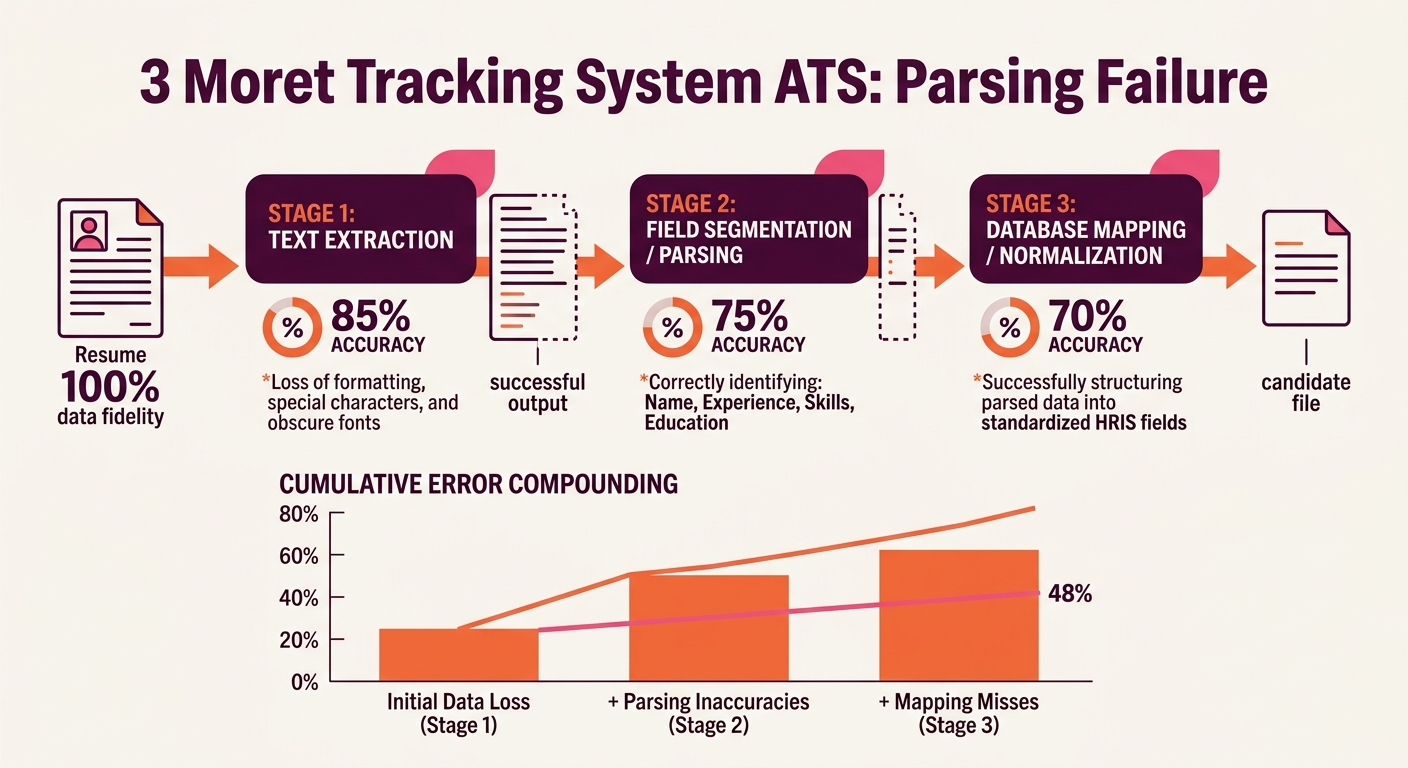
The keyword gap gets worse when the ATS parser itself misreads resume content. Technical audits of major platforms show that resume parsing accuracy varies dramatically by vendor tier: enterprise systems like Workday and SuccessFactors achieve 70–80% accuracy, mid-market platforms like BambooHR and Greenhouse land between 60% and 75%, and parsing success rates drop further based on file format. A simple .docx file parses correctly about 85% of the time, text-based PDFs hit 75%, and formatted .docx files with tables or columns fall to 60%.
These parsing failures create a second layer of invisible rejection. As we’ve covered in our technical audit of resume parsing failures, the breakdowns happen at three auditable layers: text extraction, field segmentation, and database mapping. A candidate whose resume contains the right keywords can still be rejected or rendered invisible if the parser misclassifies their job title field or garbles their skills section. The 92% of recruiters who use their ATS as a searchable database rather than an auto-rejection tool face a specific version of this problem: the candidate record exists in the system, but corrupted fields mean they never surface in keyword searches across the ATS.
So when you’re running a job description audit for ATS keyword optimization, you need to account for both the vocabulary gap and the parsing gap simultaneously. A posting filled with acronyms and compound phrases gives the parser more chances to fail, because each hyphenated term or slash-separated phrase introduces an ambiguity the parser has to resolve. Simpler, more explicit language in the job description reduces parsing errors on the resume side because it encourages candidates to mirror that same plain phrasing in their applications. The audit isn’t about dumbing down your requirements. It’s about writing them in a way that both humans and machines can interpret consistently.
Running the Audit
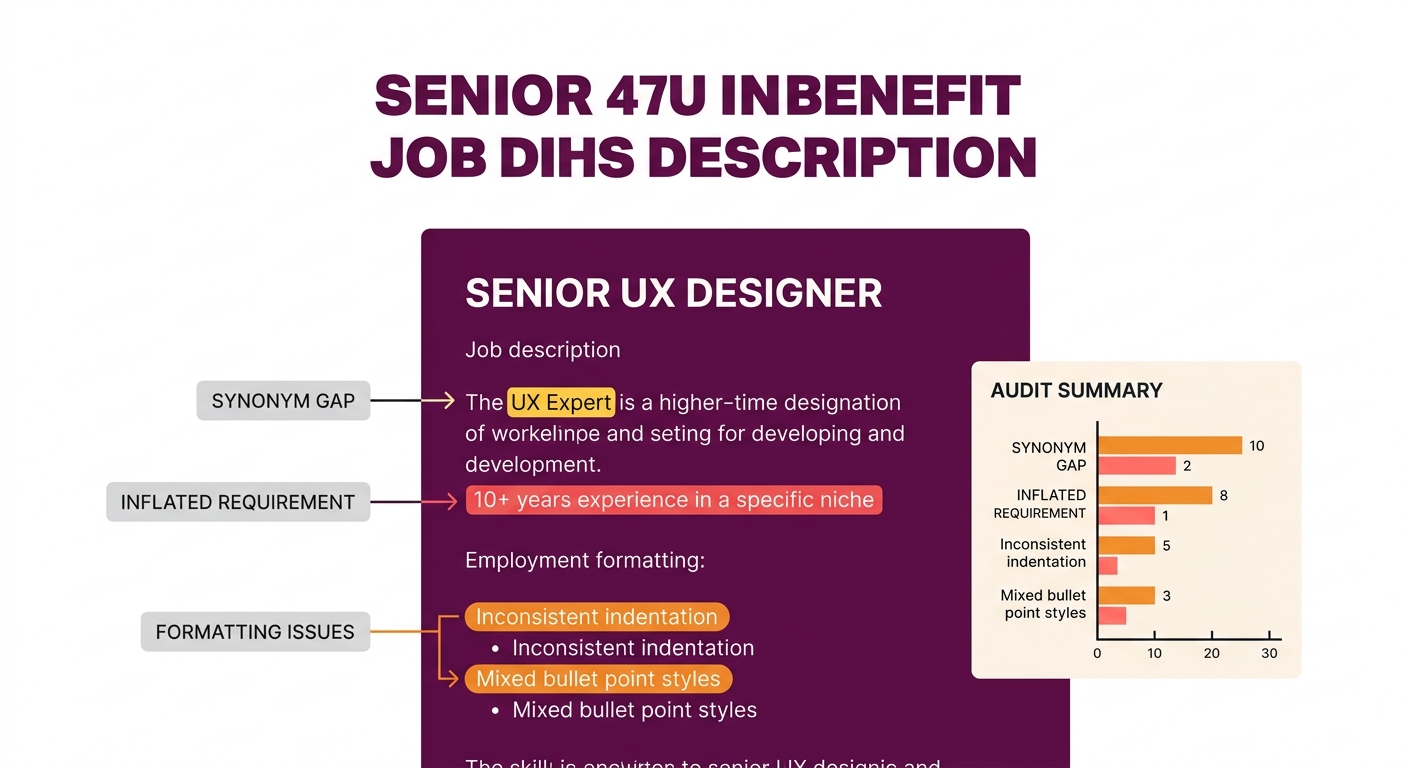
A practical job description audit has three passes, and each one catches a different category of candidate screening failures. The first pass is a synonym expansion. Pull three to five job descriptions for the same role from different companies and list every term used to describe each key qualification. If your posting says “project management” but competing postings also use “program management,” “project coordination,” and “PMO experience,” you’ve identified a vocabulary cluster your posting should address. Tools like Jobscan and SkillSyncer exist primarily for the candidate side, analyzing resumes for formatting errors, qualifications, hard skills, and match rates. But you can reverse-engineer the same process by running your own job description against a set of sample resumes from your existing applicant pool to see where the keyword misses concentrate.
The audit isn’t about dumbing down your requirements. It’s about writing them so both humans and machines interpret them consistently.
The second pass targets inflated requirements. The Harvard Hidden Workers study flagged that 49% of companies eliminate candidates for lacking bachelor’s degrees in roles that don’t functionally require them. Every unnecessary requirement narrows the keyword filter and increases false rejections. If a qualification is genuinely needed for the role, keep it. If it’s aspirational language that got promoted from the “nice to have” section during an internal review, move it back to a clearly labeled preferred section or remove it entirely. Your ATS treats every requirement equally unless you’ve configured weighted scoring, and most teams haven’t touched that setting. The result is that a candidate with 90% of the actual job skills gets filtered out because they’re missing a credential that doesn’t affect day-one performance.
The third pass is a formatting and structure review. Job descriptions with excessive bullet nesting, special characters, or unusual section headers confuse the same parsers that struggle with complex resumes. Keep section headers standard: Requirements, Responsibilities, Preferred Qualifications. Use plain text without embedded tables or graphics. If your organization uses a branded careers page or custom application portal, test how the posting renders across different browsers and devices, because formatting artifacts introduced during the posting process can alter how the ATS indexes your keywords. Teams using recruitment software for small businesses should be especially attentive here, since mid-market ATS platforms in the 60–75% accuracy range are more sensitive to formatting inconsistencies than enterprise-tier systems.
After these three passes, run the revised posting against your existing rejected-applicant pool. Export a sample of 20 to 30 candidates who were filtered out in the past quarter and check whether the updated keyword set would have changed their scores. This validation step is where most audits die, because teams revise the language but never test against real data. The validation is what separates a cosmetic rewrite from genuine ATS keyword optimization, and it’s the only way to measure whether your changes actually reduce candidate screening failures or just rearrange which qualified people get filtered out.
Where the Audit Hits Its Limits
Even a thorough job description audit can’t solve the full problem, and pretending otherwise would be dishonest. The keyword gap is partly a language problem and partly a structural one. Language you can fix through better synonym coverage, clearer phrasing, and regular validation against applicant data. Structure is harder. The ATS enforces binary matching logic because that’s what databases do, and until more organizations adopt semantic matching or skills-based scoring, the literal keyword match remains the default filter. Some modern AI-enhanced platforms evaluate contextual relevance and semantic similarity, but many production ATS configurations still run rigid keyword density rules that penalize legitimate experience described in different terminology. The gap between what vendors sell and what’s actually deployed in most hiring workflows remains wide.
There’s also a tension between thoroughness and fairness that the audit surfaces without resolving. Adding more synonym variants to a job description makes it more inclusive for qualified candidates, but it also makes the posting longer and more complex for applicants to read. Writing “MBA or equivalent experience” broadens the pool, but writing “MBA, Master’s, graduate degree, postgraduate qualification, advanced degree” starts to read like SEO keyword stuffing applied to a hiring document. Hiring teams that are auditing their screening tools for compliance risk are finding that certain synonym clusters correlate with specific demographic backgrounds, which introduces new bias vectors even as it reduces false rejections.
The honest conclusion is that job description auditing reduces the keyword gap without eliminating it. The 52% miss rate on unoptimized resumes will shrink with better synonym coverage and simpler formatting, and the 75% of resumes that currently fail ATS screening won’t all suddenly pass. But running the audit quarterly, validating changes against real applicant data, and treating your job descriptions as living documents rather than static templates is the practice that compounds over time. Whether it compounds fast enough depends on how many qualified candidates you’re willing to lose while the technology closes the distance between what people write and what machines can read.