
Recruitment software vendor 100hires published a comprehensive technology stack guide on July 5 mapping 14 tools across six hiring layers, prioritizing integration capability over feature lists as the primary selection criterion, according to the company’s blog. The guide evaluated applicant tracking systems, sourcing platforms, interview schedulers, and AI screening tools based on public API availability, webhook support, and verified cross-platform connections rather than standalone functionality.
TL;DR: 100hires published a recruitment tech stack guide on July 5, 2026, evaluating 14 tools across six layers with integration surface as the key differentiator, based on analysis of 460 Reddit comments, YouTube reviews, and vendor documentation audits.
The 460-comment Reddit analysis, sixteen discussion threads, twelve YouTube practitioner videos, and five podcast episodes formed the research base, the guide states. Every price listed came from vendor pages or review platforms fetched in July 2026, with tools cut from consideration if they targeted organizations above 500 employees or lacked verified pricing.
Integration Surface Emerges as Primary Evaluation Criterion
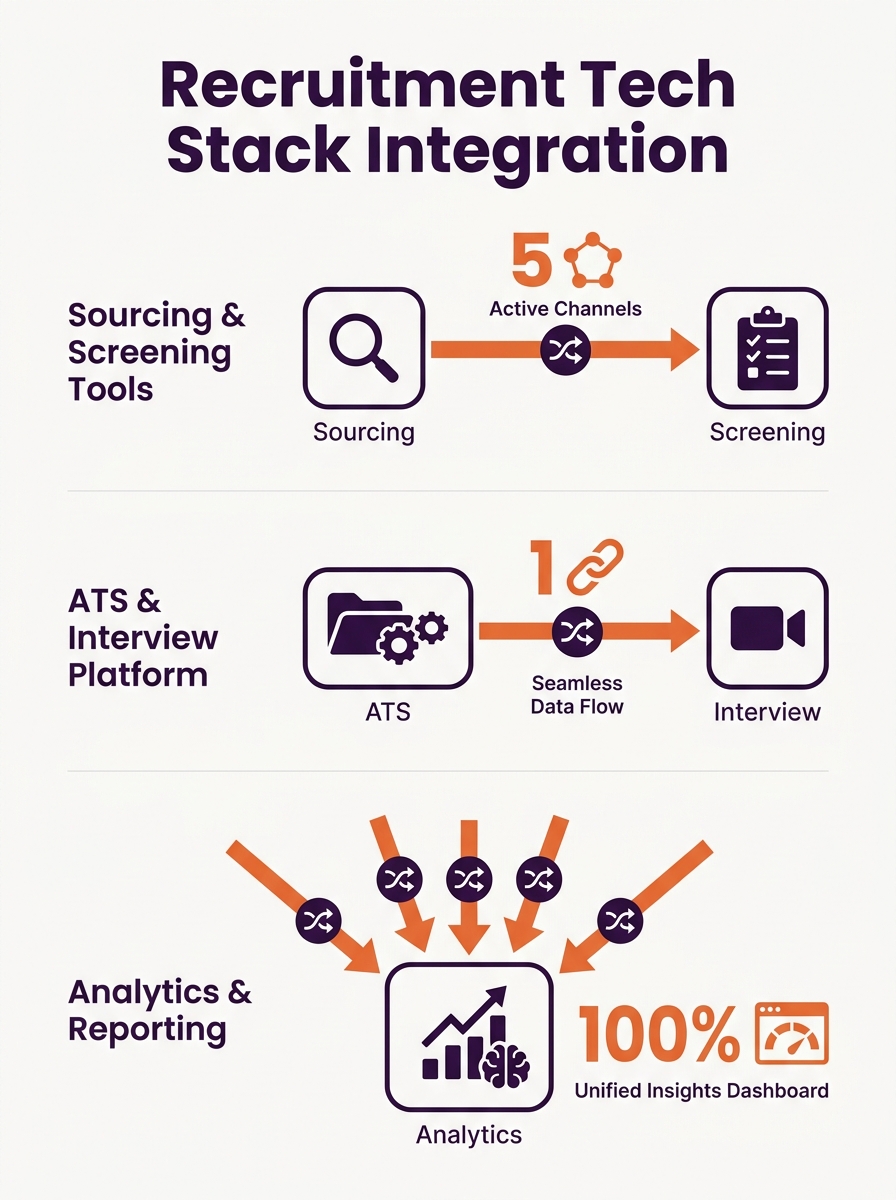
The guide structures recruitment technology around three selection filters before evaluating features: whether a tool exposes a public API, whether it connects to the applicant tracking system through webhooks or native integrations, and whether consolidating multiple point solutions into one platform delivers cost savings.
100hires positioned integration capability in the rightmost column of its comparison table, noting that tools like Apollo offer public APIs and Zapier connections starting at $49 monthly, while platforms such as GoodTime operate without Zapier support but build directly into ATS calendar data. “A brilliant sourcing tool that traps candidates in its own database” fails the integration test regardless of screening accuracy, the guide states.
The analysis documented which vendors publish no starting prices at all—GoodTime displays “custom quote” on its pricing page—and which tools ration API access by subscription tier. Zoho Recruit, priced at $25 per recruiter monthly when billed annually, limits API calls based on plan level, while Workable at $299 monthly offers unrestricted public API and webhook access, according to the vendor documentation audit.
Six-Layer Framework Anchors Stack Around System of Record
The guide organizes recruitment technology into the system-of-record ATS layer at the center, then adds five surrounding capability layers: job distribution and career sites for candidate attraction, sourcing tools for passive candidates, screening and assessment platforms, interview scheduling software and note-taking tools, and analytics dashboards.
Starting prices span from Calendly’s $10 per seat monthly for basic interview scheduler features to hireEZ’s $494 monthly solo tier for AI-powered sourcing. TestGorilla offers skills assessment at $142 monthly when billed annually with a free plan available, while Gem positions its startup-tier sourcing CRM at $135 monthly under annual commitment.
The career site evaluation shifted focus toward machine readability, stating that “your career site is now read by machines first” as AI aggregators and search engines parse job posting structured data before human candidates view the page. The guide recommends career page optimization for schema markup and API feeds ahead of visual design updates.
Research Methodology Documents Vendor Claims Against Third-Party Data
100hires conducted a July 2026 developer documentation audit across finalist tools, pulling API references, webhook configuration pages, Zapier integration listings, and Model Context Protocol announcements where available. Tools earned integration-surface ratings based on documented capabilities rather than vendor marketing claims.
The company disclosed its own product placement at the top of the comparison table, listing 100hires at $99 monthly or $49 monthly under annual billing with a 14-day trial, public API access, webhooks, Zapier connections, and a first-party ChatGPT Model Context Protocol app. “We list its weak spots right next to its strengths,” the guide states, though the published excerpt does not detail specific limitations.
G2 ratings ranged from 4.3 for Indeed’s job distribution platform to 4.8 for both 100hires and Metaview’s interview notes product. Juicebox, an AI sourcing tool priced at $139 per seat monthly, showed no G2 score in the table because its review sample size was too small to cite reliably, the guide notes.
The Takeaway
The July 5 guide signals a methodology shift in recruitment software evaluation—prioritizing API connectivity and data portability over isolated feature depth. For HR teams building or replacing their hiring stack, the framework suggests auditing integration surface before comparing screening algorithms or candidate database size.
The research base combining practitioner commentary from Reddit, YouTube walkthroughs, and podcast discussions with July 2026 vendor documentation creates a snapshot of tools actively discussed by working recruiters rather than those dominating paid search rankings. Teams under 500 employees gain a filtered view excluding enterprise platforms whose minimum seats or custom-quote pricing models place them outside SMB budgets.
The guide’s emphasis on “the tool that traps candidates in its own database” as an automatic disqualification reflects 2026’s tighter focus on preventing data silos—a direct response to the ATS data migration failures and field mapping disasters that blocked hiring teams from switching platforms in prior years.