
Huntr’s analysis of over 1.7 million job applications confirmed that no ATS auto-rejects resumes — the system tracks and organizes, but people make the cut. The real screening failure sits upstream: parsers that mangle candidate data before a recruiter ever sees the record, turning qualified applicants into garbled profiles no human reviewer would advance. An ATS resume parsing audit exposes those blind spots before they cost you hires.
TL;DR: Most ATS “rejections” happen because the parser extracted bad data, not because the candidate was unqualified. These six rules give you a repeatable audit framework for catching recruitment automation blind spots — from section-header misreads to hidden rejection rules buried in your configuration.
Run test resumes through your own parser before blaming candidates
The first rule of any AI candidate matching validation: feed your system known-good resumes and see what comes out the other side. A technical analysis on DEV Community documented that ATS systems rely on pattern matching to identify resume sections, and non-standard headers like “Professional Journey” instead of “Experience” are often missed entirely. “Core Competencies” gets skipped where “Skills” would be recognized. “Get In Touch” vanishes where “Contact Information” would parse correctly.
Build a test deck of 10–15 resumes that represent your actual applicant pool. Include at least three with creative section headers, two with multi-column layouts, one scanned PDF, and one that uses tables for formatting. Upload each through your ATS the way a candidate would. Then pull the parsed record and compare it field by field against the original document.
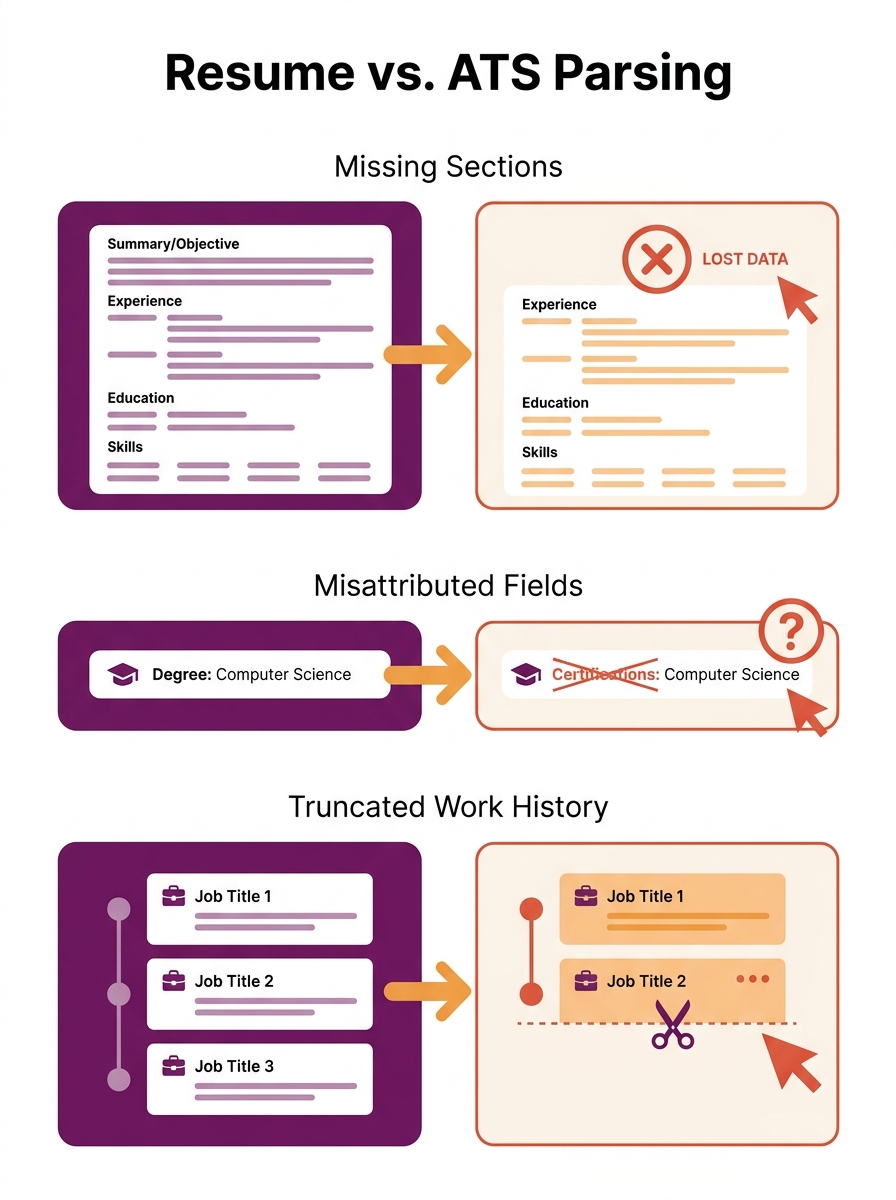
You’re looking for three specific failure types: missing fields (the parser dropped an entire section), misattributed data (a job title landed in the company-name field), and truncated entries (only the first two positions appeared when the candidate listed five). Document the failure rate per resume format. If more than 20% of your test deck has at least one critical parsing error, your system is generating unreliable candidate profiles at scale.
Audit section headers and layout patterns, not keywords alone
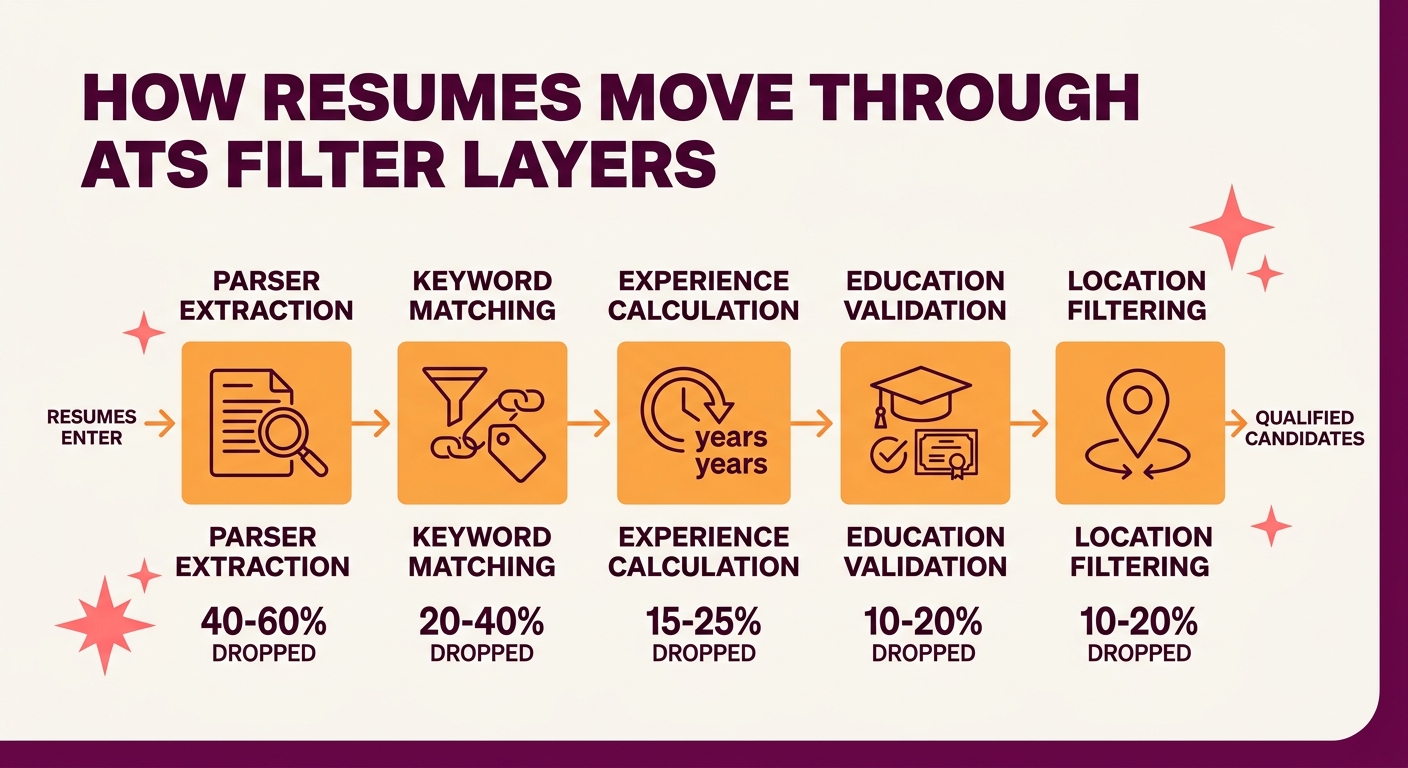
Why do keyword audits miss the bigger problem? Because keyword matching happens after parsing. If the parser can’t identify the “Skills” section in the first place, it doesn’t matter whether the right keywords appear there. The section-recognition layer is where most recruitment automation blind spots originate.
Standard headers that consistently parse correctly include “Experience,” “Education,” “Skills,” and “Contact Information.” But candidates increasingly use variations: “Where I’ve Worked,” “Technical Toolkit,” “Academic Background,” “What I Bring.” Each of these labels represents a potential extraction failure. And when an entire section fails to parse, every data point inside it — certifications, skills, years of experience — disappears from the candidate’s searchable profile.
| Standard Header (Recognized) | Non-Standard Variant (Often Missed) | Data at Risk |
|---|---|---|
| Experience | Professional Journey, Where I’ve Worked | Job titles, employers, tenure |
| Education | Academic Background, Learning Path | Degrees, institutions, graduation dates |
| Skills | Core Competencies, Technical Toolkit | Keywords, proficiency levels |
| Contact Information | Get In Touch, Reach Me | Email, phone, LinkedIn URL |
If you’ve already built a hybrid screening workflow that catches top talent, this audit fits right into your human-review gate. Flag any resume where the parsed record contains fewer sections than the source document. That gap is a direct signal that the parser missed content.
Check date-format handling across every field
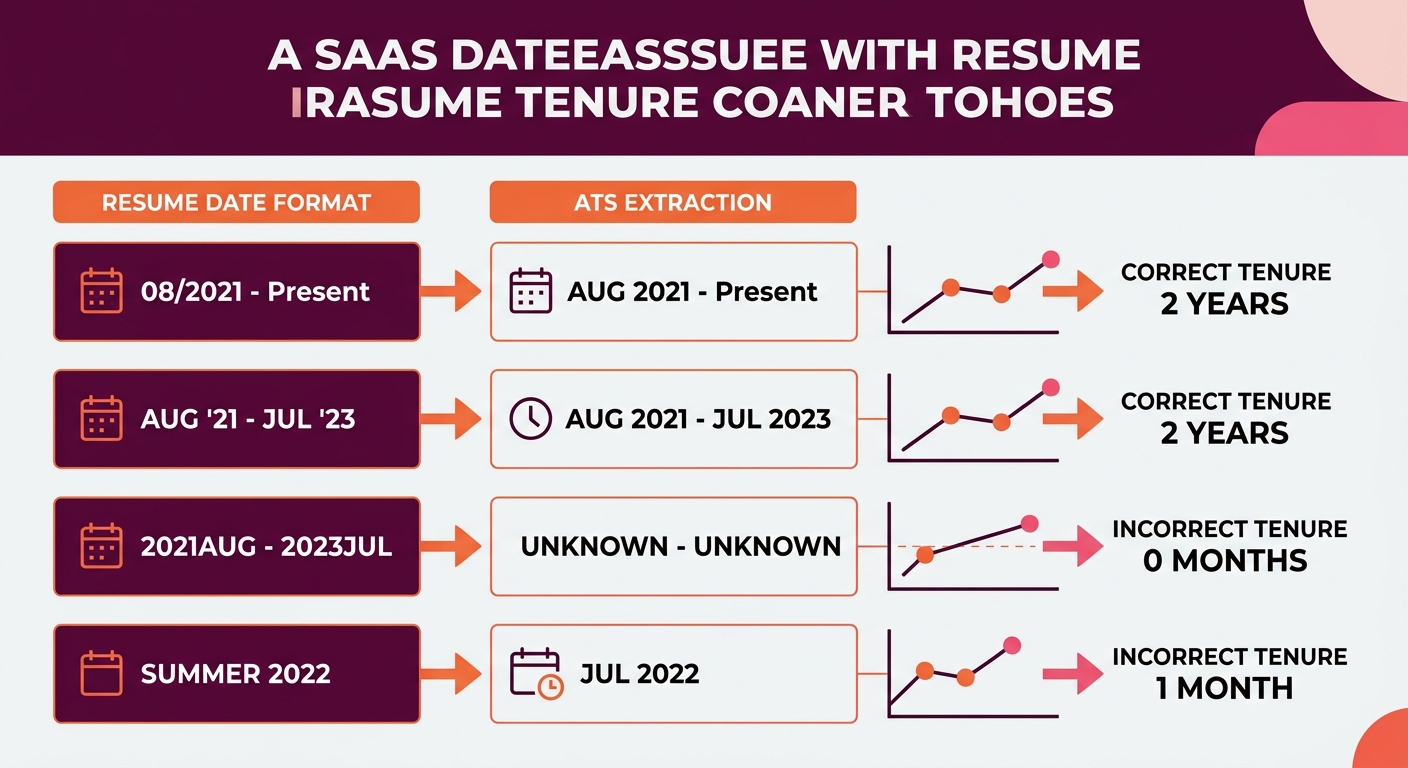
Date parsing failures are subtle and devastating. When a candidate writes “March 2021 – Present” and the parser expects “03/2021 – Current,” the system might calculate zero months of tenure. Or worse, it assigns a null value to the end date, making the candidate’s most recent role invisible to duration-based filters.
The DEV Community analysis specifically flagged date format inconsistencies as a consistent ATS failure point. International candidates compound the issue: “01/03/2024” reads as January 3rd in the U.S. and March 1st in most of Europe. If your ATS applies experience-length filters (e.g., “minimum 5 years in role”), a single date-parsing error can disqualify a candidate who actually exceeds the requirement.
Your test deck should include resumes with at least four date formats: “Month Year,” “MM/YYYY,” “YYYY-MM,” and written-out ranges like “Spring 2019 to Fall 2022.” Run each through the parser and verify that total experience calculations match the source. Document which formats break.
Warning: If your ATS applies automatic minimum-experience filters, a date-parsing error can silently reject a 10-year veteran by calculating their tenure as zero months. Audit your experience filters alongside your date parsing — they’re interconnected failure points.
Sample your rejection pool every month
False-negative auditing — checking whether rejected candidates were actually unqualified — is the single most direct way to measure your AI candidate matching validation accuracy. Eximius AI’s research on recruitment bias blind spots recommends sampling rejected candidates to estimate missed talent and running quantitative tests (like the four-fifths rule) to surface disparate impact.
Here’s a concrete protocol: pull 50 randomly selected rejected or unranked applications per month. Have a recruiter review each original resume (not the parsed version) against the job requirements. Track how many of those 50 would have advanced to screening if a human had read the actual document. If more than 10% of your sample contains candidates who meet the stated qualifications, your hidden rejection rules are filtering out talent you intended to keep.
If more than 10% of your randomly sampled rejections would have advanced under human review, your parser or filter configuration is actively losing you candidates.
This is the audit step most teams skip because it feels like unnecessary rework. The reality is the opposite. The ATS intake filtering paradox shows how tightening rules without measurement leads to spiraling rejection rates among qualified candidates. Monthly sampling gives you a baseline and a trend line. Without it, you’re optimizing blind.
Require per-field confidence scores from your vendor
When a system returns a parsed candidate record, you should be able to see whether the parser was 95% confident about the candidate’s job title and 40% confident about their skills list. That gap tells you exactly where to route human review. But not every ATS vendor exposes parsing confidence at the field level, and that opacity makes informed routing decisions impossible.
Workday, for example, commissioned an independent third-party bias audit conducted by Secretariat using its own applicant data to verify that its scoring doesn’t produce disparate outcomes across demographic groups. But the underlying text parser, as Jobscan’s analysis notes, remains rigid. The bias audit addresses scoring fairness. It doesn’t address parsing accuracy — and these are two different failure modes that require two different fixes.
When you evaluate your ATS vendor (or negotiate a renewal), ask specifically for: per-field extraction confidence scores, OCR confidence metrics for scanned inputs, and documentation of which resume layouts have been validated. If your vendor can’t provide field-level confidence data, you have no technical basis for deciding which candidates need human review and which can flow through automated screening. That gap should factor directly into your recruitment process design.
Map your hidden rejection rules before adding new ones
Every ATS accumulates configuration choices over time: minimum keyword match thresholds, required certifications, years-of-experience cutoffs, degree requirements. These settings interact with each other and with parser accuracy in ways that are rarely documented. An ATS resume parsing audit has to cover the filter stack, not the parser in isolation.
A hidden rejection rule is any filter that eliminates candidates without a recruiter explicitly reviewing the decision for that specific applicant. Common examples include: Boolean “must-have” keyword requirements that don’t account for synonyms (requiring “project management” but not matching “program management”), education filters that reject candidates with equivalent international credentials, and location-radius filters applied to remote roles by default.
The ATS keyword mismatch audit process covers the keyword side in detail. But keyword gaps are only one category of hidden rejection rules. Pull a complete list of every active filter rule across your open requisitions. For each rule, document: who created it, when, the business justification, and the estimated rejection rate. If nobody on your team can explain why a filter exists, that filter is a liability — both for candidate quality and for compliance exposure around AI screening.
Mapping these rules also directly improves the candidate journey. Every hidden rule that silently rejects a qualified person degrades the experience for candidates who never learn why they were eliminated, and eats into your employer brand in ways that are hard to measure but easy to prevent.
Tip: A quick diagnostic you can share with candidates: copy all resume text and paste it into a plain text editor. If content appears out of order, duplicated, or missing, the ATS parser will have the same problem. This works as a self-service check before submission.
When These Rules Conflict
The six rules above assume stable conditions: a consistent applicant volume, a vendor that communicates updates, and a team with enough bandwidth to review rejection samples monthly. Real hiring environments break those assumptions constantly.
During high-volume surges — seasonal hiring, post-acquisition integration, viral job postings — monthly rejection sampling might need to become weekly, while test-deck runs get pushed to quarterly. When you’re migrating between ATS platforms, all of these rules need to run in parallel against both systems for at least one full hiring cycle. And if your vendor refuses to provide field-level confidence scores, rules 1 through 4 become your only defense against silent parsing failures.
ATS vendors also push parser updates on their own schedule, and most customers never learn the extraction logic changed. A parser update can fix one category of failures (say, multi-column layouts) while introducing new ones (say, breaking date extraction from table-formatted resumes). Re-run your test deck after every vendor update notification. If field accuracy shifts by more than 5 percentage points in any direction, investigate before assuming the change was an improvement. This discipline matters especially for teams running structured interview processes that depend on parsed profile data for pre-screening questions — a parser regression can send interviewers into conversations with bad information about what the candidate actually brings.
The underlying principle holds even when the cadence shifts: treat your ATS parser as production software that needs monitoring. Parser accuracy degrades as resume formats evolve, as vendors push updates, and as your own requisition configurations accumulate complexity. The audit framework here gives you a structured way to catch those problems before they compound into months of quietly lost candidates.