
Poor hiring decisions linked to fraudulent applications are costing Australian small and medium businesses $7.3 billion per year, according to research from Seek, as workforce screening specialists warn that AI-generated documents and remote interview manipulation are outpacing traditional verification methods, according to reporting published July 2 by Human Resources Director.
TL;DR: AI-enabled identity fraud—including doctored credentials, synthetic profiles, and candidate impersonation across interviews, assessments, and first-day arrivals—is accelerating faster than recruitment checks can detect it, with legal and screening experts warning Australian employers face criminal liability for hiring unverified workers.
The $7.3 billion figure covers the broader cost of wrong hires, but Tania Evans, CEO of workforce screening company WorkPro, said candidate fraud has become a significant contributor to that total. “AI, for all its wonderful things, has also created an opportunity for those to impersonate others or create synthetic profiles of themselves,” Evans said in the report. WorkPro has observed a shift in the sophistication of documents used to support false applications, she said, with a particular increase in AI-created identity documents.
A Gartner forecast cited in prior industry reporting predicts one in four job candidates globally could be fake by 2028. The fraud spans a range of tactics: doctored resumes, AI-altered video interviews, and cases where the person interviewed, the person who completes an assessment, and the person who starts the job are three different individuals, Evans said.
Remote Hiring Boosts Identity Verification Gaps
The risk escalates in remote recruitment settings where employers may never meet a candidate face-to-face, according to Evans. “One person might turn up for the interview, another completes the assessment, and then another person starts the job,” she said. The phenomenon has prompted warnings about multiple submissions from the same device or IP address—a red flag that an effective recruitment process should be designed to catch.
Local research shows Australian jobseekers are among the most likely in the Asia-Pacific region to embellish CVs, often by shifting job titles or adjusting employment dates to cover gaps. Globally, only three in five employers conduct identity checks as part of pre-employment screening, according to workforce data referenced in the report.
Criminal Liability for Hiring Unverified Workers
Evans said the consequences for employers who fail to verify a candidate’s identity extend beyond financial loss. “It’s a criminal offence to hire someone who hasn’t gone through the proper hiring process,” she said. If an unverified worker is injured on the job, the employer can face a workers’ compensation claim “for someone that you didn’t even hire.”
In extreme cases, company directors who repeatedly fail to apply appropriate risk frameworks to hiring “can be liable for that on behalf of their company, which can mean jail time,” Evans said.
Alana Rafter, senior associate at Australian Business Lawyers and Advisors and speaker at the upcoming Employment Law Masterclass, said the simplest way to reduce legal exposure is to complete every check before an offer is made. “You don’t make an offer of employment subject to them providing a licence, passing a work-related test, or a reference check—you make all those inquiries prior to making that offer. It’s so simple,” Rafter said.
She noted that embedding a contract term requiring candidates to confirm they hold claimed qualifications or licenses adds a protection layer, though it should never replace upfront verification. This principle aligns with findings from HireRight’s 2026 benchmark report showing most employers found candidate discrepancies during background checks.
Building Layered Verification Into Recruitment Workflows
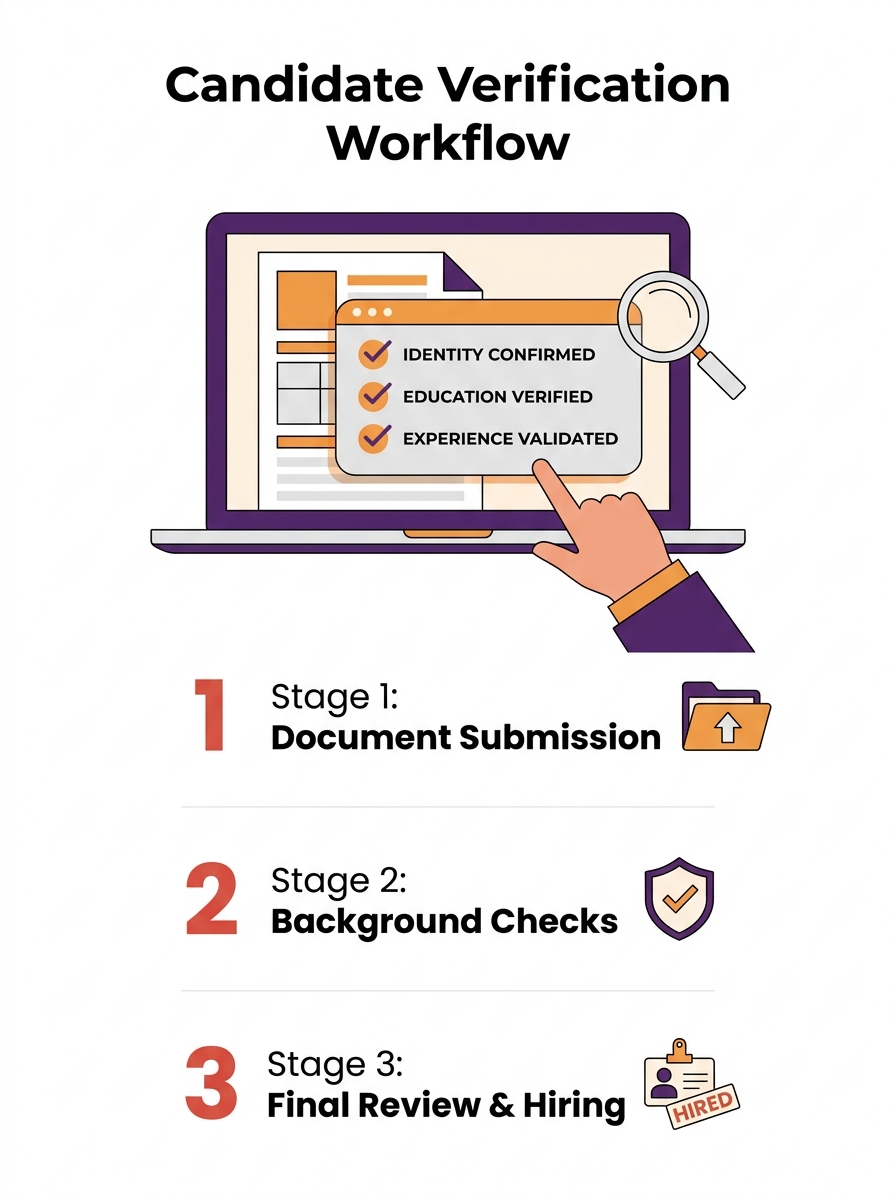
Rather than relying on a single checkpoint, both Evans and Rafter pointed to a layered approach spanning job advertisement, application, and interview stages. The model treats verification as a continuous process rather than a one-time gate, an approach that integrates naturally into ATS compliance workflows for organizations tracking audit trails across candidate touchpoints.
Evans emphasized that the goal is not to treat every applicant with suspicion. Most candidates have nothing to hide, she said—layered verification is designed to catch the minority attempting to exploit process gaps.
Probation Periods Remain Strongest Post-Hire Safety Net
Rafter said that even with strong pre-hire checks, the probation period remains employers’ most important tool. “The most important step—and this is the one I will die on this hill for employers—is that they’ve got to absolutely take charge of the probation period,” she said.
She recommends structured check-ins at the two-week, three-month, and pre-six-month marks of a standard probation period, rather than allowing it to lapse unmanaged. “There’s no rule that says they have to see out the entire probation period,” Rafter said.
Once probation ends, she warned, options narrow considerably. “It’s very difficult to terminate an employment contract… because of all the risk that can be there, even if there is a problem,” she said.
Four in Ten HR Professionals Unsure How to Respond to Fraud
A LinkedIn poll conducted by Human Resources Director asked followers, “Would you know what to do if exposed to candidate fraud in the hiring process?” Sixty percent of respondents said yes, while 40 percent said no.
The split suggests awareness of AI-generated resumes, doctored credentials, and deepfake interviews has grown among HR professionals. But four in ten answering “no” represents a sizeable gap, particularly for an audience of HR practitioners who would reasonably be expected to have some form of response plan in place. The result points to a divide between organizations that have updated verification protocols to account for AI-enabled fraud and those still relying on legacy screening methods.
Why This Matters Now
Candidate fraud isn’t a future threat—it’s a present-day liability risk that carries criminal penalties for employers who skip verification steps. The $7.3 billion cost figure from Seek quantifies what happens when wrong hires slip through, and as Evans and Rafter both note, AI has accelerated the sophistication of fraudulent applications faster than most recruitment teams have updated their checks.
For talent acquisition leads running high-volume pipelines or managing remote-first hiring, the layered verification model—pre-hire checks, contract terms confirming credentials, and structured probation management—offers a practical framework that balances speed with due diligence. The 40 percent of HR professionals who said they wouldn’t know how to respond to candidate fraud represent the segment most at risk. Organizations in that group should treat verification protocol updates as a compliance priority, not an optional enhancement.
The probation period remains the final lever. Rafter’s guidance to conduct structured check-ins at two weeks, three months, and before the six-month mark turns probation into an active risk management tool rather than a passive waiting period. Once that window closes, termination options narrow sharply—making early detection the most practical path to containing fraud exposure.