
Keyword filters inside applicant tracking systems reject resumes in under six seconds. That speed is the selling point of every ATS. It’s also the mechanism behind a documented candidate experience crisis: 88% of employers acknowledge their own screening tools filter out qualified applicants before a recruiter reviews a name.
The Six-Second Gate Nobody Audits
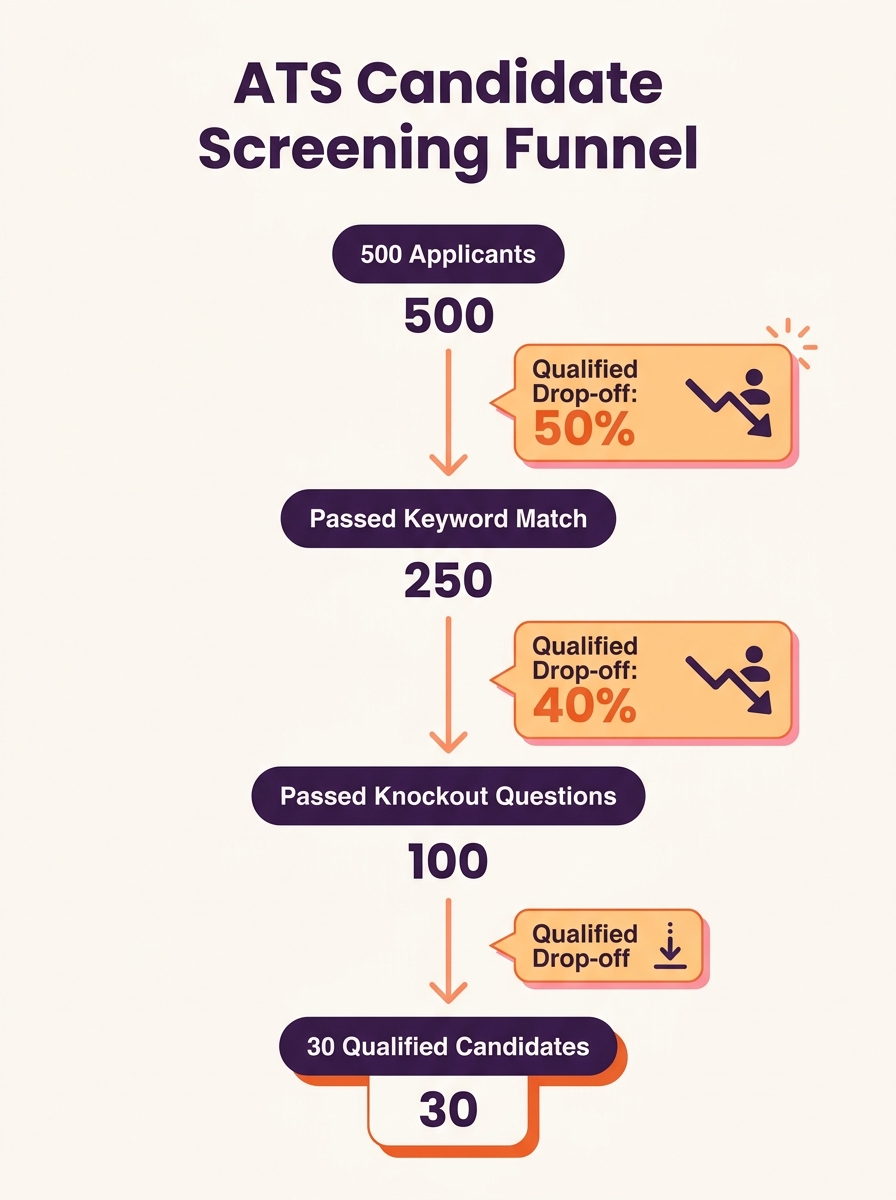
Top candidates are off the market within 10 days, according to ClearCompany’s hiring data. That number has made speed the dominant metric in ATS purchasing decisions. Every demo emphasizes throughput: how many resumes parsed per hour, how quickly knockout questions filter a 500-applicant pool down to 30.
But the tools built to capture fast-moving talent are simultaneously repelling it. Auto-rejection emails fire within minutes of submission. Keyword filters screen for exact-match phrases, penalizing candidates who describe the same skills in different language. Knockout questions with rigid yes/no logic eliminate applicants who’d explain nuance in a 30-second phone call.
The scale of the problem is staggering. Harvard Business School research found that ATS systems filter out millions of qualified workers before any human reviews their application. These aren’t fringe candidates. The study specifically documented workers with relevant experience and applicable skills who were rejected because their resumes didn’t conform to the exact formatting or keyword patterns the system expected.
And the speed keeps accelerating. A June 2026 roundup from Classet evaluated 15 screening platforms, and the competitive differentiator across nearly every tool was processing velocity. Faster parsing. Faster scoring. Faster rejection. The assumption baked into the entire product category is that screening speed and screening quality move in the same direction. The data from actual hiring outcomes says otherwise.
The Reputation Damage Candidates Inflict on Their Way Out
What happens to the hundreds of applicants who get auto-rejected? They don’t disappear. Seventy-two percent of candidates share negative hiring experiences on social media, and 80% of job seekers abandon applications they find overly complicated or impersonal. Those abandoned and rejected applicants become an active drag on your employer brand.
The financial math is punishing. Poor candidate experience increases cost-per-hire by 2.5x. That multiplier comes from two directions: you spend more on sourcing because your reputation narrows the top of the funnel, and you lose candidates mid-process who would have accepted offers if the experience felt respectful.
Candidates who have a bad application experience are less likely to buy your products, according to research from Impress.ai. They tell their friends. They leave bad reviews on Glassdoor. When your ATS processes 10,000 applicants a year and rejects 9,400 of them with a templated one-line email (or worse, silence), you’re creating 9,400 potential brand detractors annually.
This is where the AI screening speed tradeoff becomes concrete. The ATS saved your recruiters 200 hours of manual screening. The resulting employer brand damage cost you 3x that in extended time-to-fill on senior roles where reputation matters most. We’ve written extensively about how your employer brand can look polished on LinkedIn while tanking candidate experience during the actual hiring process, and screening speed is almost always the root cause.
When your ATS rejects 9,400 applicants a year with a templated email or total silence, you’re manufacturing 9,400 brand detractors annually.
The Paradox Inside Every Recruiting Team
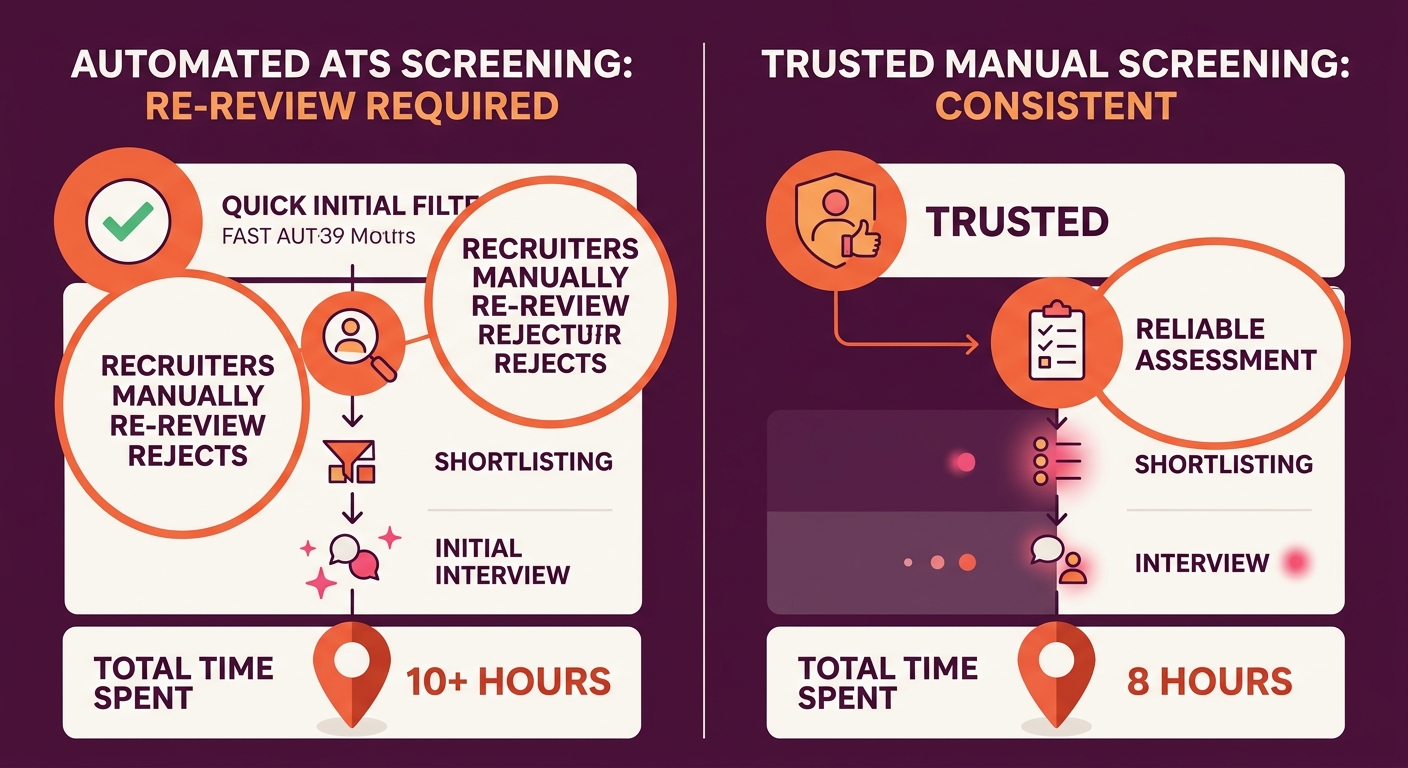
Here’s the part that should alarm anyone running an HR function: 40% of HR time still gets burned on manual resume review because automated screening produces results nobody trusts. The system is fast, but recruiters don’t believe it’s right.
This creates a bizarre workflow. The ATS runs its keyword filters and knockout questions, producing a ranked shortlist. Then the recruiting team manually re-reviews a significant portion of the rejected pile because they’ve learned from experience that the system misses strong candidates. The automation designed to save time becomes an additional layer of work instead of a replacement for existing work.
Gallup research found that 85% of Americans are concerned about AI in hiring decisions. That skepticism exists inside recruiting teams too. When your own recruiters don’t trust the output, you haven’t automated screening. You’ve added a step.
The hiring process automation ethics question here isn’t abstract. NYC’s Local Law 144 already requires periodic bias audits of AI hiring tools. Understanding employer legal liability for AI hiring tools regardless of vendor is a growing concern. But even setting aside compliance, the practical problem is clear: a screening system that’s fast but unreliable costs more total time than a slower system that’s accurate.
One damaging side effect of this trust gap is candidate ghosting. When recruiters are overwhelmed by double-processing applications, communication drops. Applicants wait weeks for responses that never come. We’ve covered why the real problem behind candidate ghosting is broken follow-up automation, and the root cause traces directly back to screening workflows that generate more work than they eliminate.
The Recruiter Touchpoint Strategy That Actually Rebalances
The fix requires rethinking which parts of screening should be fast and which parts need deliberate friction. Speed belongs in logistics: parsing resumes, scheduling interviews, routing applications to the right hiring manager. Friction belongs in communication: acknowledgment emails, status updates, rejection messages, and interview preparation.
The best-performing recruiting teams in 2026 are building what amounts to a communication layer on top of their ATS. That layer includes conditional logic for automated status updates at each stage transition, personalized rejection messages that reference the specific role and include a timeline, and 24-to-48-hour follow-up windows after every interview. Mapping the candidate journey across all seven stages of your hiring process reveals exactly where these touchpoints need to live.
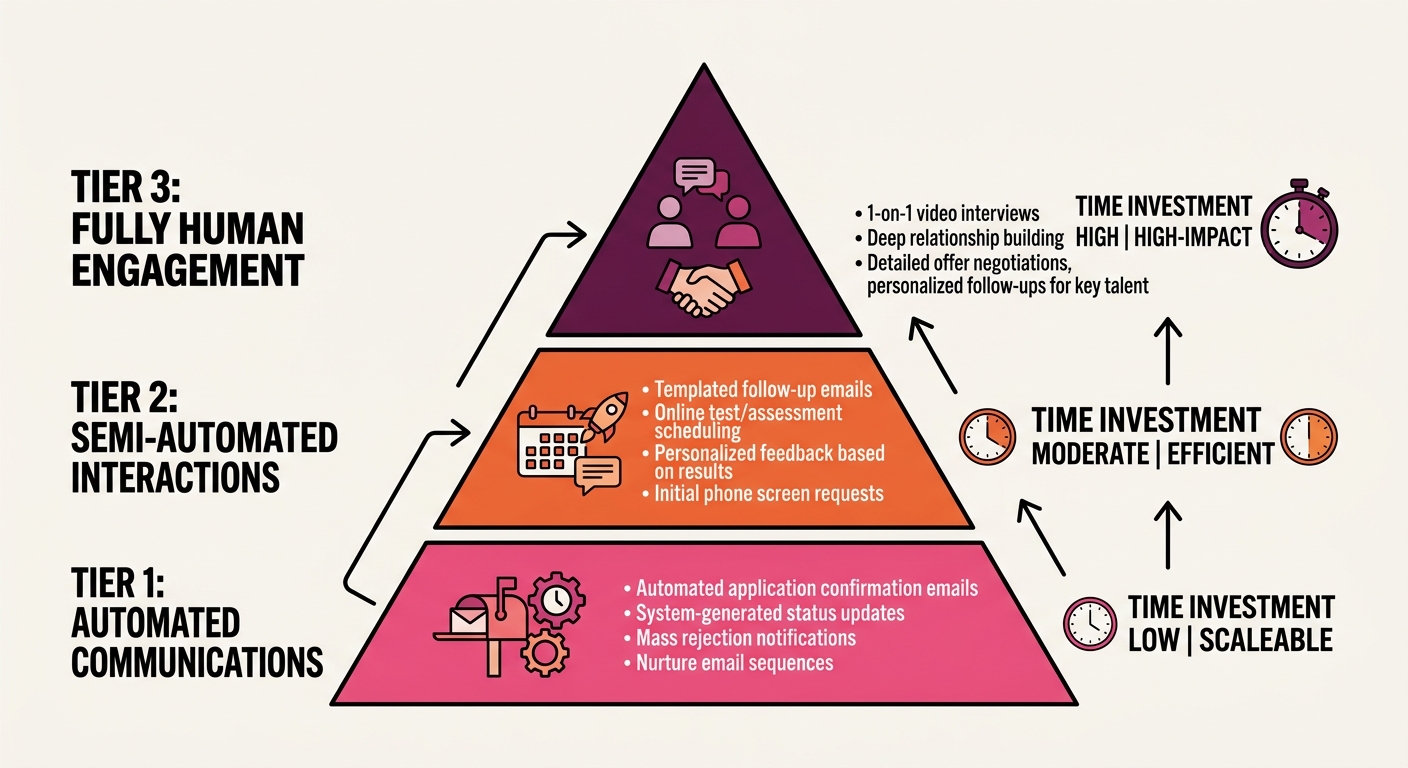
A practical recruiter touchpoint strategy breaks down into three tiers:
Tier 1 — Automated but personal. Application received confirmations, stage-change notifications, and timeline-setting emails. These should fire immediately and include the specific role title, expected timeline, and a named recruiter contact. Every ATS on the market supports this. Most teams don’t configure it beyond the default template.
Tier 2 — Semi-automated with recruiter review. Rejection messages for candidates who reached screening or phone-screen stages. These need a 50-word personalized section that references something specific about the candidate’s background. A recruiter spends 90 seconds on each one. That’s the investment that prevents a Glassdoor review.
Tier 3 — Fully human. Post-interview feedback, offer negotiations, and any communication with candidates who’ve invested more than 30 minutes of their time in your process. Knowing how to interview candidates effectively extends beyond the interview itself into how you communicate before and after it.
Tip: Track stage conversion rates, time-to-hire, and candidate feedback scores at each touchpoint. When one stage shows a drop-off rate above 30%, that’s your communication gap.
For organizations processing thousands of applications monthly, enterprise recruitment software with built-in communication workflows makes the tiered approach feasible at scale. The key is configuring those workflows intentionally instead of accepting vendor defaults.
Screening at the Speed of Trust
This week’s convergence of data from Bristow Holland, Classet’s June 2026 screening tool analysis, and our own deep-dive into the ATS candidate experience paradox all point to the same conclusion: the industry’s obsession with screening velocity has overcorrected. The ATS category spent a decade optimizing for the wrong variable.
The rebalancing point is specific and measurable. Your ATS should screen resumes within 24 hours of submission (not six seconds). Your first human touchpoint should happen within 48 hours of any stage change. Your rejection communications should include role-specific language and arrive within 72 hours of the decision. And your screening accuracy, measured by the percentage of auto-screened candidates that recruiters would also have advanced, should sit above 80% before you trust the system to operate without manual review.
The organizations that figure this out won’t just fill roles faster. They’ll stop bleeding the employer brand equity they spent years building, one auto-rejected applicant at a time.