
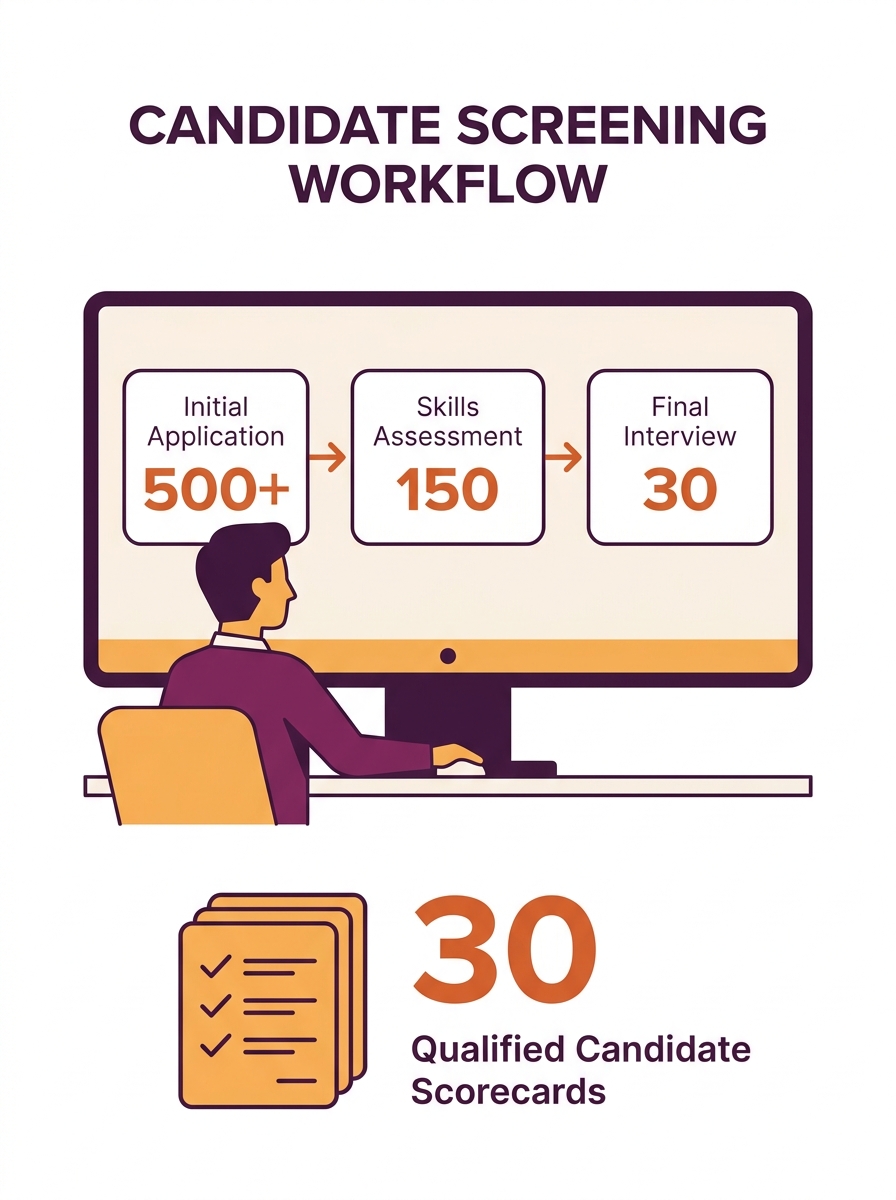
Four progressive evaluation checkpoints separate inbound job applications from final interview panels in a candidate screening framework published July 21 by recruitment advisory Pete Gabi, aimed at preventing qualified candidates from dropping out during slow manual reviews.
TL;DR: Pete Gabi released a four-stage candidate screening guide on July 21 outlining how recruitment teams can move from application intake to hiring manager shortlist using structured evaluation gates and modern screening tools.
The framework addresses a persistent bottleneck in talent acquisition: hiring teams struggle to assess high application volumes quickly enough to prevent top candidates from accepting competing offers while managers spend hours reading unvetted resumes, according to the guidance published on petegabi.com. The structured approach applies identical qualification criteria across every applicant to reduce interviewer bias while protecting manager bandwidth.
“Without a structured screening framework, hiring processes degrade,” the guidance states. “Managers spend hours reading generic PDF resumes, phone screens turn into unstructured casual chats, and qualified applicants drop out due to slow communication.”
The Four-Stage Screening Model
Pete Gabi’s framework segments candidate evaluation into four distinct gates, each designed to filter fit before qualified applicants reach live interview panels.
Stage one focuses on resume and application form review, where recruiters verify work authorization status, education requirements, relevant experience, and necessary credentials against essential job requirements. The second stage introduces an initial qualification screen—a 15- to 20-minute asynchronous or telephonic checkpoint that confirms compensation band alignment, notice period length, location logistics, and basic communication skills.
Technical and practical skills evaluation forms the third stage for specialized roles. Teams deploy role-specific assessment tools including short coding tasks, work sample tests, or domain-specific scenario evaluations to verify hard skills. The ATS resume parsing vs. human review balance becomes critical at this stage, particularly for technical positions where automated keyword matching may miss qualified candidates with non-standard experience paths.
The final stage delivers a pre-qualified shortlist to hiring managers, complete with candidate evaluation scorecards, assessment results, and screening summaries. Managers review vetted profiles and approve candidates for panel interviews rather than sorting through raw application piles.
Screening Tool Categories and Deployment Context
The guidance maps five distinct tool categories across the evaluation stages, each serving specific hiring contexts.
Resume and ATS parsing tools automatically extract skills, job titles, and experience history from PDF submissions, eliminating manual data entry while organizing candidate records. Technical screening software administers automated coding challenges and logic tests for engineering, software development, and data science roles, filtering out resume exaggerations before live interviews. Asynchronous video screening tools capture pre-recorded responses to standardized prompts on candidate schedules, particularly effective for high-volume hiring in customer support, retail, and graduate programs.
Automated voice and conversational screening conducts interactive two-way evaluations in real time, delivering immediate structured scorecards without phone scheduling delays. For teams managing hundreds of applications weekly, interview scheduling software integrated with these screening layers can reduce coordinator workload by eliminating back-and-forth email chains once candidates pass initial gates.
Organizations implementing these tools face the same calibration challenges documented in recent audit frameworks—automated keyword filters can reject up to 90% of qualified candidates when rules aren’t aligned with actual job requirements.
Operational Impact on Hiring Pipeline Movement
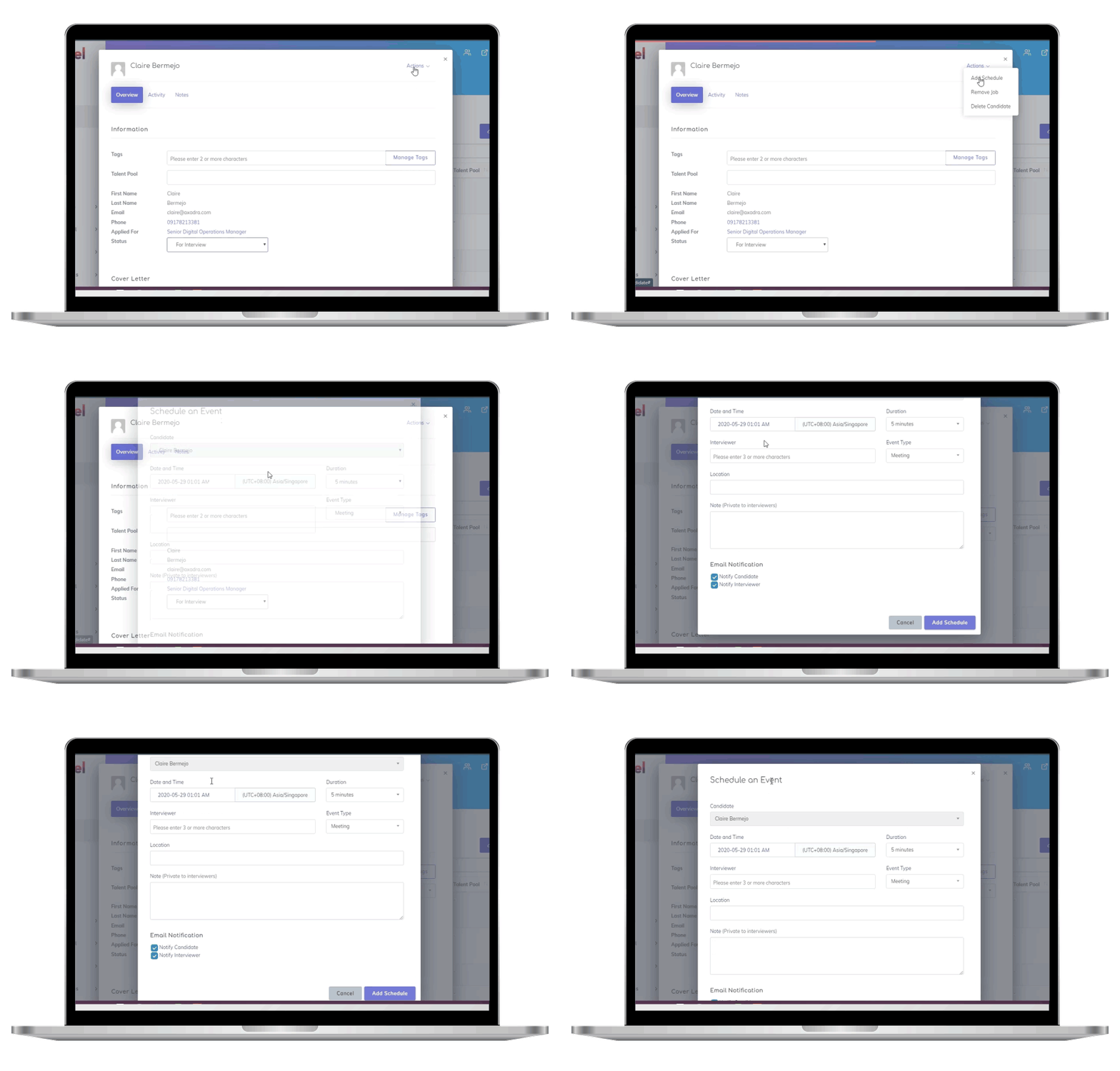
The framework’s operational benefits center on four measurable outcomes: filtering out compensation mismatches and authorization issues before live interviews, protecting manager bandwidth by delivering only vetted candidates, standardizing evaluation to reduce personal bias, and maintaining candidate speed to prevent drop-off during delays.
Organizations deploying structured screening see immediate reductions in manager time spent reviewing applications, but Pete Gabi’s guidance cautions that governance and data quality problems often block screening tool effectiveness more than technical capability gaps. Poorly maintained job requirement databases or inconsistent candidate data fields can undermine even sophisticated automated assessments.
The guidance recommends implementing human review gates at critical AI screening stages to catch false negatives—qualified candidates rejected by automated rules—before they exit the pipeline entirely. This hybrid approach balances automation speed with human judgment on edge cases.
The Takeaway
Pete Gabi’s four-stage framework arrives as talent teams recalibrate screening rules in response to 2026’s AI discrimination liability environment. The structured gate approach gives recruitment leaders a defensible audit trail showing consistent evaluation criteria applied across all applicants—a critical requirement when ATS compliance liability for AI discrimination forces recruiters to document every filtering decision.
For small businesses and growing teams without dedicated TA operations, the guidance provides a roadmap for building repeatable evaluation without enterprise-scale tools. Recruitment software for small businesses increasingly bundles these four screening layers into single platforms, eliminating the need to stitch together separate resume parsers, assessment tools, and scheduling systems.
The timing matters: as corporate recruiters report communication and problem-solving skills now outrank AI fluency in hiring priorities, structured early-stage screening prevents technical filter over-reliance that can miss candidates with strong soft skills but non-traditional backgrounds. Organizations that treat screening as a strategic bottleneck—rather than an administrative checkbox—gain measurable advantage in time-to-hire and candidate quality metrics.