
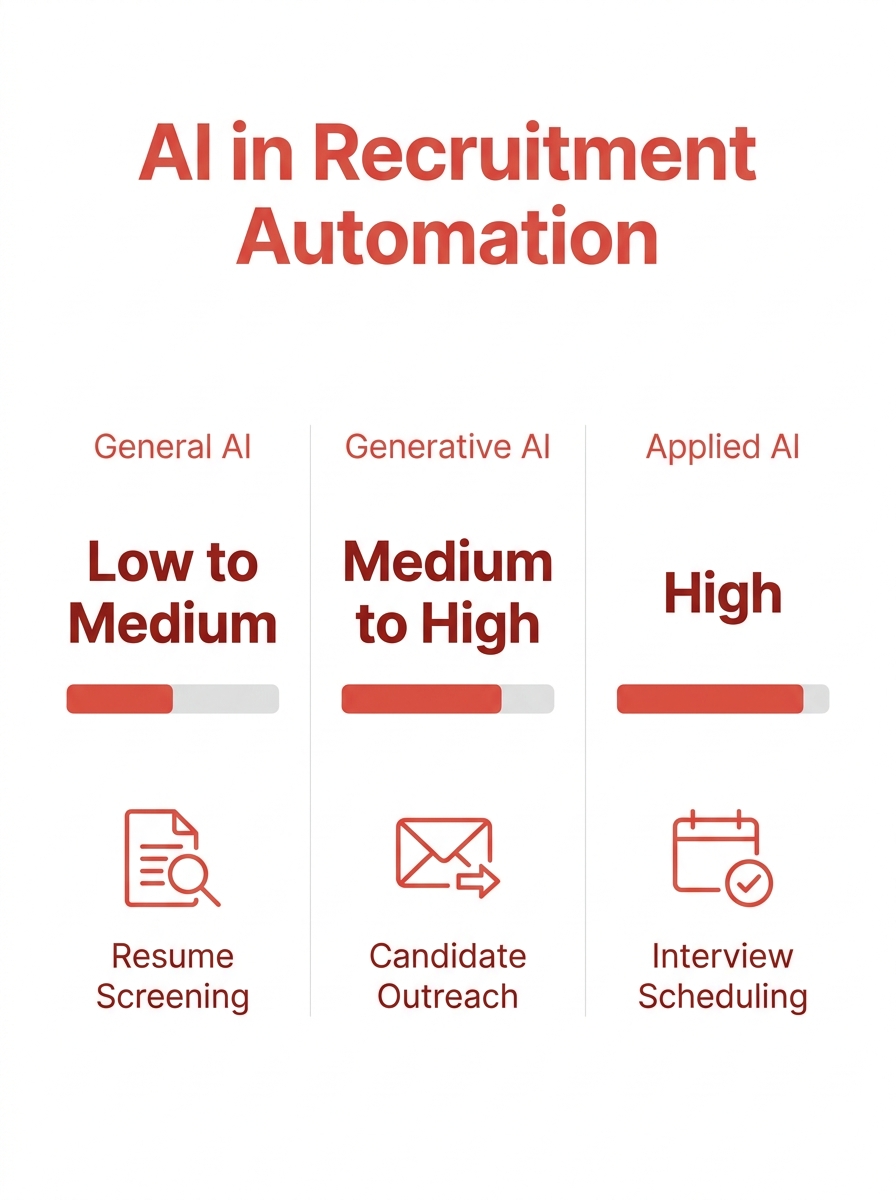
A task-by-task analysis of AI recruitment tools published September 3 classifies automation into three price tiers—general AI for fixed-rule tasks, generative AI for content creation, and applied AI for autonomous workflow orchestration—after finding that mismatched tool selection drives budget waste in hiring automation, according to GeekExtreme.
TL;DR: GeekExtreme’s September 3 guide sorts recruitment AI into three cost tiers and warns that applying agent-level pricing to scheduling tasks—problems “a vending machine could solve”—represents the primary failure mode in automation buying decisions.
The analysis arrives as talent acquisition teams handle 40 percent more requisitions than in 2021 while applications per role have climbed 2.7-fold over the past decade, according to the guide. High-volume roles now routinely pull 500 to 1,500 applicants, with sourcing alone consuming 30 hours per week of recruiter time in some organizations.
Three-Tier AI Classification Separates Fixed-Rule Tools From Autonomous Agents
GeekExtreme’s framework divides recruitment AI into general AI (fixed-rule screening and chatbots triggered by user action), generative AI (LLM-based content creation requiring direction), and applied AI (context-aware autonomous agents that coordinate workflows without prompting). The guide positions general AI as “the vending machine of AI—it does one thing when you press the button” and applied AI as the tier that “watches your pipeline while you sleep.”
The classification distinction matters because vendor pricing scales sharply across tiers while many recruitment tasks—particularly interview scheduling—function effectively at the general-AI level without requiring agent-tier infrastructure, the analysis notes. “Misclassify your task and you’ll pay agent-tier prices for a scheduling problem a vending machine could solve,” the guide states.
Organizations evaluating enterprise recruitment software face a “wide bucket” of tools all labeled AI-powered despite fundamental differences in capability and cost structure, according to the report.
Vendor-Reported Data Shows 44 Percent Internal-Database Hires at Phenom
Phenom reported that 44 percent of its 2024 hires came from rediscovered candidates already sitting in internal databases, according to the analysis. The finding positions database mining—”people you paid to acquire and then forgot about”—as a zero-marginal-cost first step before purchasing external sourcing tools.
Adopters report 30 to 50 percent reductions in time-to-hire after implementing AI screening and workflow automation, the guide notes, citing vendor-supplied figures. GeekExtreme includes an attribution caveat: “most of these figures are vendor-reported, meaning the companies who made the spreadsheet are the ones quoting it.”
Greenhouse, an applicant tracking platform, stated that “AI is most useful when it supports a hiring process that’s already structured, visible and accountable,” according to the vendor’s platform comparison documentation cited in the analysis. The framing positions infrastructure discipline as a prerequisite to automation ROI rather than a parallel concern.
Recent reports of AI flooding hiring pipelines with over 1,000 résumés per role underscore the volume pressure driving automation adoption, though the guide warns that poorly configured screening creates bias risk rather than eliminating it.
Scheduling Identified as Highest-Use Automation Point
Interview scheduling automation delivers 40 to 50 percent reductions in time-to-interview and two-to-three-fold increases in interviews booked, according to vendor-reported results compiled in the guide. The analysis classifies scheduling as a task “that genuinely doesn’t need agent-tier AI” despite its measurable impact on pipeline velocity.
The framing echoes findings that AI eliminates screening tasks rather than recruiter roles, with one recruitment tech CEO reporting 400-hour savings per hire when automation handles repetitive coordination work.
GeekExtreme’s analysis positions scheduling friction—candidates waiting on human availability coordination—as a structural bottleneck that general-AI tools resolve without requiring natural-language reasoning or contextual judgment.
Bias Control Requires Clean Data and Audit Infrastructure
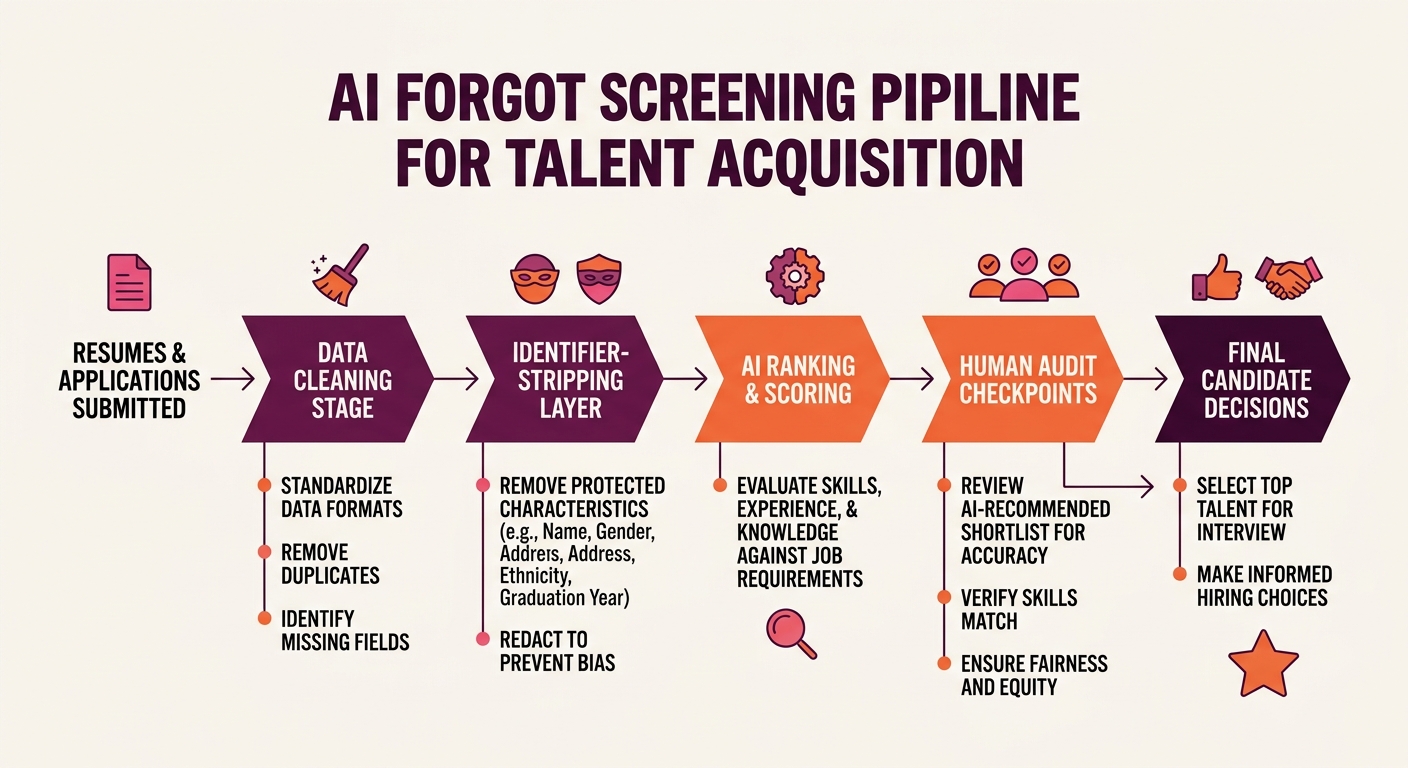
AI screening “can cut bias, but only with clean data, stripped identifiers, and real audits,” the guide states, citing Mobley v. Workday litigation in which plaintiffs allege candidates were rejected within minutes by automated systems. A University of Washington study found that humans “tend to rubber-stamp biased AI decisions rather than fix them,” according to the analysis.
Investigations into AI recruitment bias have documented automated rejection patterns affecting mid-life women and other demographic groups, raising compliance questions as organizations scale screening automation.
The guide positions bias mitigation as a design requirement rather than an inherent automation benefit: algorithms grade on skills and experience “if you design it” that way, with anonymized data inputs and regular audit protocols serving as table stakes rather than optional enhancements.
Why This Matters Now
Recruitment teams face compounding volume pressure—2.7-fold application growth, 40 percent more requisitions, 30-hour weekly sourcing burdens—that makes some form of automation inevitable rather than optional. The decision space has shifted from “whether to use AI” to “which AI tier matches which task,” and the cost of misclassification is immediate: paying for autonomous-agent infrastructure to solve scheduling problems burns budget without delivering proportional value.
The three-tier framework provides procurement teams a sorting mechanism for vendor pitches. A fixed-rule screening bot and a context-aware orchestration agent both wear “AI-powered” labels, but one costs subscription fees in the low hundreds monthly while the other indexes into five-figure enterprise platform contracts. The gap between general-AI pricing and applied-AI pricing can reach 10-to-20-fold, making accurate task classification a budget-protection exercise as much as a capability question.
The vendor-reported caveat embedded throughout the analysis—efficiency claims sourced from the companies selling the tools—positions independent validation as an ongoing requirement. Forty-four percent internal-database rediscovery at Phenom and 30-to-50 percent time-to-hire cuts industry-wide are encouraging signals, but they require case-specific confirmation before committing infrastructure budget. The sorting exercise matters more than the sticker shock: knowing which drawer the tool belongs in prevents overpaying for automation that delivers vending-machine value at consultant prices.