
Organizations that trimmed job requirement lists to only skills directly predicting role success saw applicant pools expand immediately, according to Patricia Burlaud of P. Burlaud Consulting, one of ten executive coaches who contributed recruitment strategies to a Forbes Coaches Council compilation published August 26. The framework addresses how employers can reach wider candidate ranges by removing unnecessary barriers rather than reducing qualification standards.
TL;DR: Forbes Coaches Council published ten executive coach recommendations August 26 documenting changes organizations made to broaden applicant pools, including trimming requirement lists, hiring for potential over experience, and replacing degree requirements with skills-based criteria.
The compilation responds to persistent talent-shortage complaints among hiring teams that maintain rigid credential requirements, lengthy qualification checklists, and narrow candidate profiles, according to the publication. The ten coaches documented strategies they observed organizations implement, ranging from rewriting job descriptions to restructuring internal promotion pathways.
Requirement-List Reduction and Skills-Based Criteria
Burlaud reported that effective teams reduced “must-have” lists by requiring hiring managers to justify each retained requirement, eliminating qualifications that did not predict success. “Most postings pile up a dozen requirements, so strong people who miss two or three never apply,” Burlaud said in the compilation.
Dr. Ari McGrew of Tactful Disruption documented frontline role clarity as an expansion method. Organizations that rewrote frontline positions with transparent workloads and competency-based criteria instead of credential lists attracted stronger and more diverse applicant pools, McGrew reported.
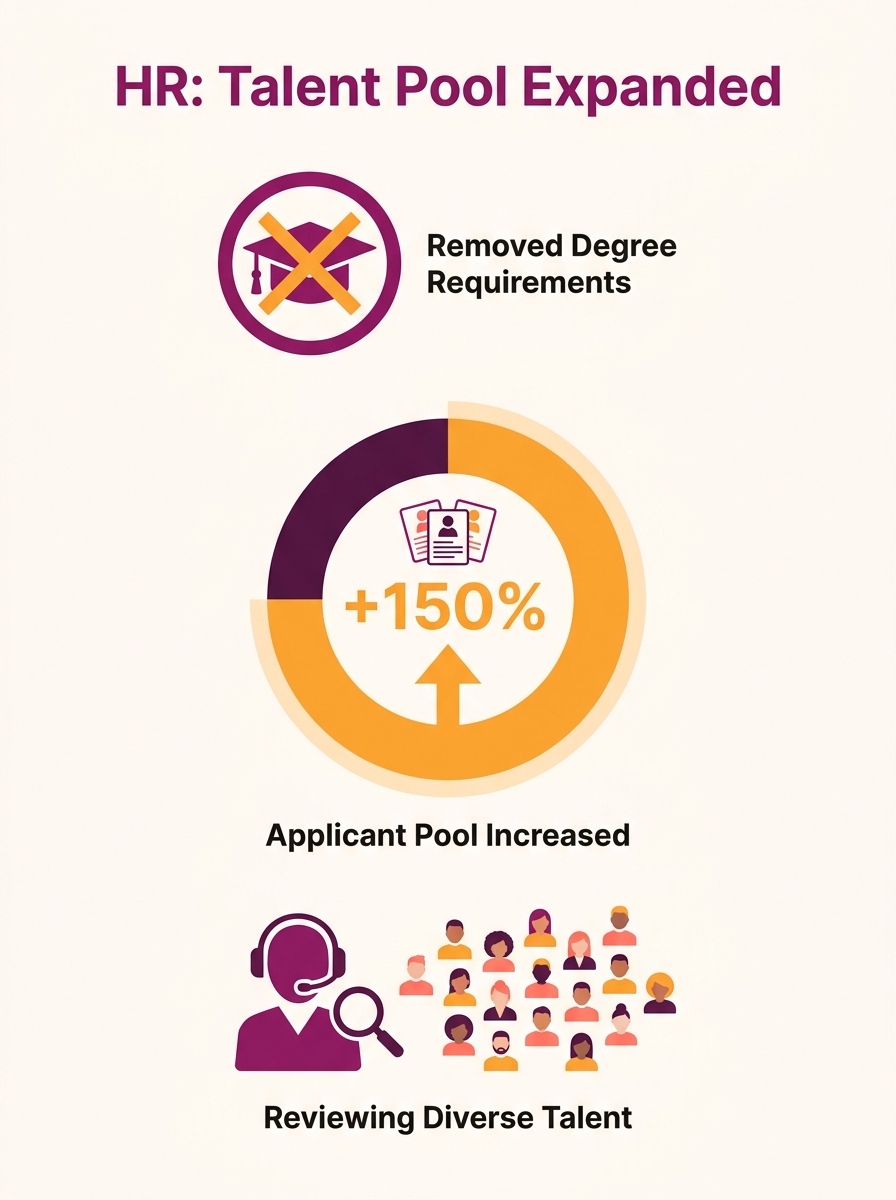
Kathryn Lancioni noted organizations replacing rigid degree requirements with skills-based hiring, using inclusive job descriptions and recruiting beyond usual networks. “The process focused on what the role required—not assumptions about who should fill it,” Lancioni said, adding that diverse interview panels reinforced the commitment.
Hiring-Manager Accountability and Outcome-Focused Descriptions
Alla Adam of Adam Impact Institute described organizations requiring hiring managers to list the three skills they were genuinely willing to teach rather than seeking “perfect candidates.” The strategy expanded talent pools by acknowledging on-the-job training capacity, Adam reported. “Overnight, the talent pool became deeper, more diverse and far more interesting,” Adam said in the publication.
Desiree’ Stapleton, a fractional COO and Harvard-certified business strategist, recommended job descriptions emphasizing expected outcomes instead of qualification lists. Organizations that hired for demonstrated capability rather than résumé credentials expanded opportunity without lowering standards, Stapleton reported.
Teams implementing skills-based hiring criteria often discover candidates with transferable capabilities who lack traditional credentials but possess the adaptability to succeed in role-specific contexts.
Culture and Leadership-Pathway Changes
Nick Leighton recommended replacing “culture fit” assessments with “culture add” evaluations, hiring for curiosity, adaptability, and learning speed. “‘Culture fit’ is often just corporate code for ‘people who look and think like us,'” Leighton said in the framework.
Veronica Angela of CONQUER EDGE advocated leading with organizational purpose and core values in recruitment rather than focusing solely on job requirements. Candidates seek alignment with employer values, not just job specifications, Angela reported.
Dr. Nore Salman of The Heart Centered Leadership Institute identified succession velocity as a structural constraint on candidate pools. When senior leaders do not transition and middle leadership positions freeze, promotion pathways close and decision-making stalls, Salman reported. “Broaden the candidate range by actually moving people into leadership,” Salman said, describing the structural shift as more impactful than traditional recruitment adjustments.
Stephan Lendi of Newbury Media & Communications documented employee-ambassador strategies, where organizations enabling employees to share authentic workplace experiences reached broader candidate networks through trusted referrals. Strong organizational culture functions as a recruitment asset when current employees become credible advocates, Lendi reported.
What This Means for In-House Recruiters
The Forbes framework offers in-house recruiters permission to challenge hiring-manager requirement lists that constrict applicant pools without improving candidate quality. Recruiting teams managing ATS workflows can use the three-skill teaching-capacity question—what skills is the manager genuinely willing to train?—to separate predictive requirements from wish-list credentials that eliminate viable candidates.
The outcome-focused job description recommendation directly addresses a persistent recruiter pain point: translating vague manager requests for “rockstars” or “culture fit” into measurable hiring criteria. Recruiters who anchor job postings in role outcomes rather than credential inventories can defend inclusive candidate slates against manager objections rooted in pattern-matching bias.
The succession-velocity observation matters for talent acquisition leads facing perpetual “not enough pipeline” complaints while internal promotion pathways remain blocked. Recruiters cannot solve applicant-pool problems that originate in organizational unwillingness to advance current employees—a structural constraint that no sourcing tactic or employee referral program overcomes.