
Forty-five percent of companies that publicly committed to skills-based hiring never changed a single hiring practice, according to research tracked by the Burning Glass Institute and Harvard Business School. Another 18% made early progress, then backslid — ending up hiring fewer workers without degrees than before they announced anything.
The Three Buckets Burning Glass Uncovered
The Burning Glass Institute didn’t just survey companies about their intentions. Researchers tracked what actually happened to hiring patterns after organizations made public skills-first commitments. The results split neatly into three groups, and two of them are damning.
The first bucket: leaders. Thirty-seven percent of companies followed through, increasing the share of workers without degrees by nearly 20%. These organizations rewrote job descriptions, restructured screening workflows, and backed their announcements with operational changes. They’re the minority.
The second bucket: in-name-only adopters. This 45% slice made announcements, issued press releases, sometimes even updated job postings — but their actual hiring data didn’t move. The same credential filters stayed in place. The same screening criteria got applied. Recruiters in these organizations received the memo about skills-first recruiting but never received new tools, new rubrics, or new evaluation processes to replace what they’d been told to abandon.
The third bucket: backsliders. Eighteen percent of companies initially gained ground, then reversed course. Their share of non-degreed hires actually shrank below the pre-announcement baseline. As HRMorning reported, these companies made short-term gains when they dropped degree requirements but didn’t sustain the change. The pattern suggests that without structural reinforcement, old habits reassert themselves within months.
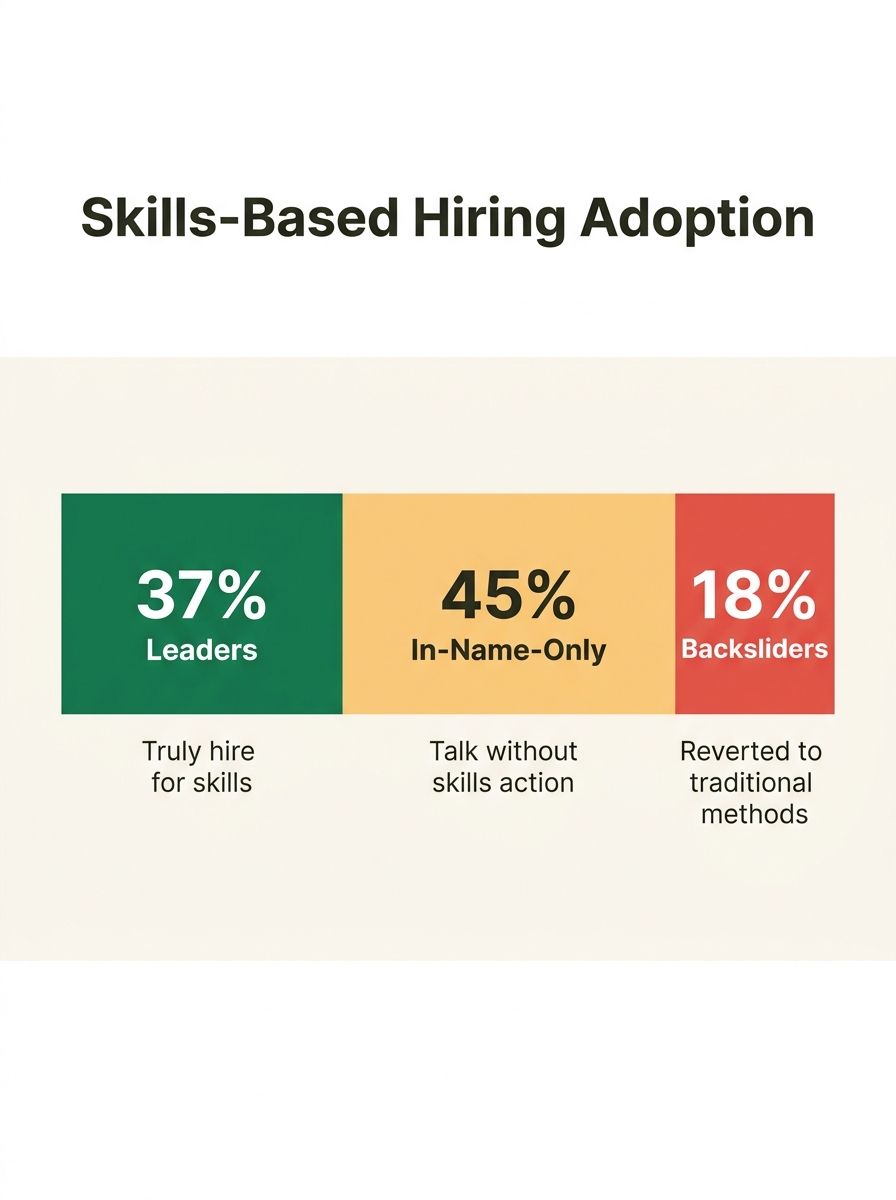
So here’s the uncomfortable arithmetic: 63% of companies that said they’d adopt skills-based hiring either did nothing or made things worse. The recruiters at those companies absorbed the messaging, adjusted their language, maybe even started asking competency-based screening questions in interviews — while the infrastructure around them stayed frozen in place.
The Assessment Gap Nobody Wants to Fund
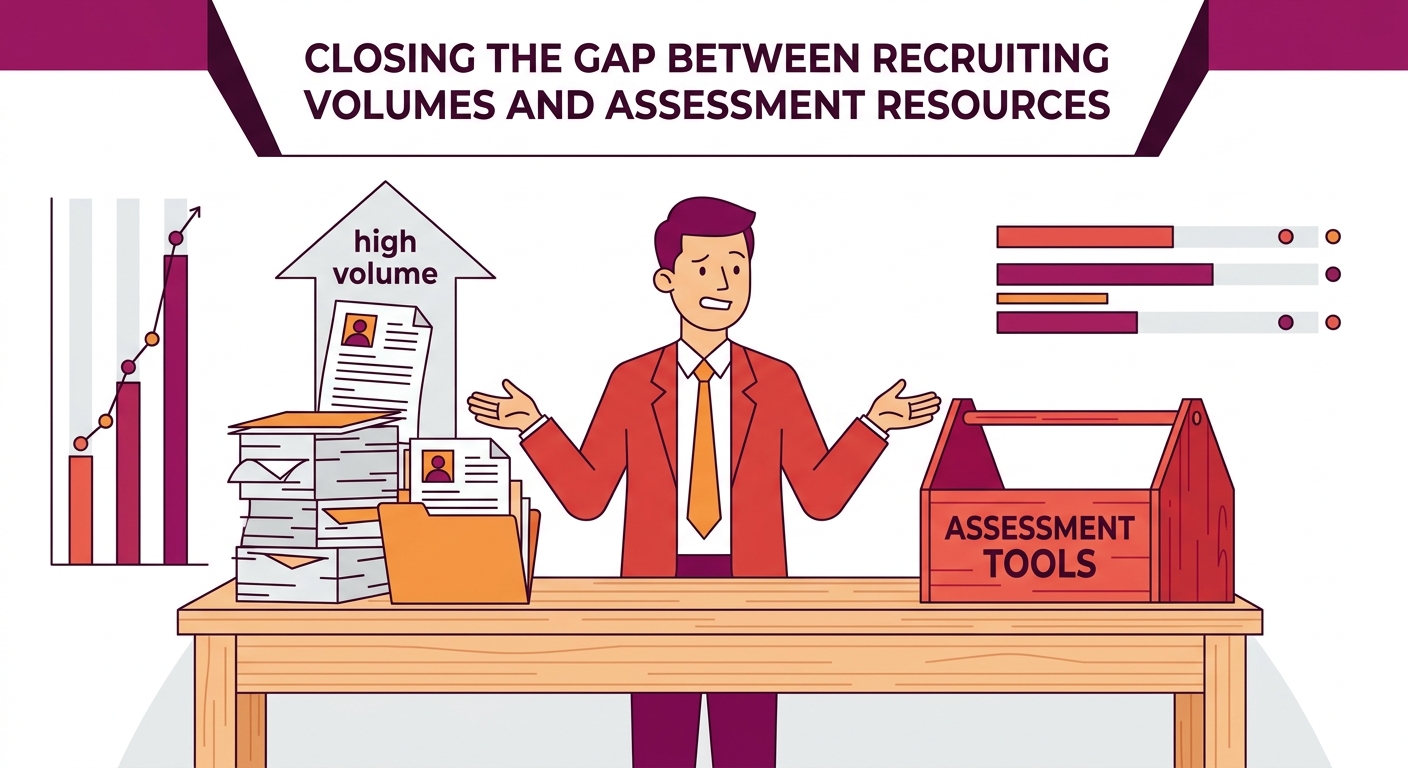
Why did the in-name-only companies stall? The hiring framework debate often gets framed as a philosophical question: Should we value credentials or skills? But the real blocker is mechanical. Forty percent of hiring managers say they find it difficult to assess skills directly, and 30% report that skill requirements in their own job descriptions remain unclear.
That’s a staggering admission. Three in ten hiring managers at companies ostensibly practicing skills-first recruiting can’t clearly define what skills they’re looking for. And four in ten don’t know how to evaluate those skills when a candidate demonstrates them.
The reasons are practical, not ideological. Validated skill assessments cost money. Work-sample tests require development time. Structured scoring rubrics need to be built, calibrated, and maintained for every role family. SocialTalent’s research on skills-first hiring resistance put it plainly: the approach “requires more effort, more rigor, and more time.” Leaders at many organizations are eager to notice that skills-based hiring requires signing up for a testing service — a new line item — but hesitate to apply that same scrutiny to their current hiring practices and the hidden costs buried in slow time-to-hire and bad-fit attrition.
Sixty-three percent of companies that committed to skills-based hiring either changed nothing or made their credential bias worse. The recruiters absorbed the messaging. The infrastructure didn’t move.
And the infrastructure problem compounds when you consider what recruiters are already dealing with. SHRM research found that 77% of HR professionals struggle to find candidates due to talent scarcity and skills gaps. A Robert Half survey found 58% of business leaders say finding skilled talent is harder than it was the previous year. Recruiters are being told to widen the funnel by dropping degree requirements while simultaneously being handed no new way to sort through the larger applicant pool that results.
Where the Recruiter Ends Up Holding the Bag
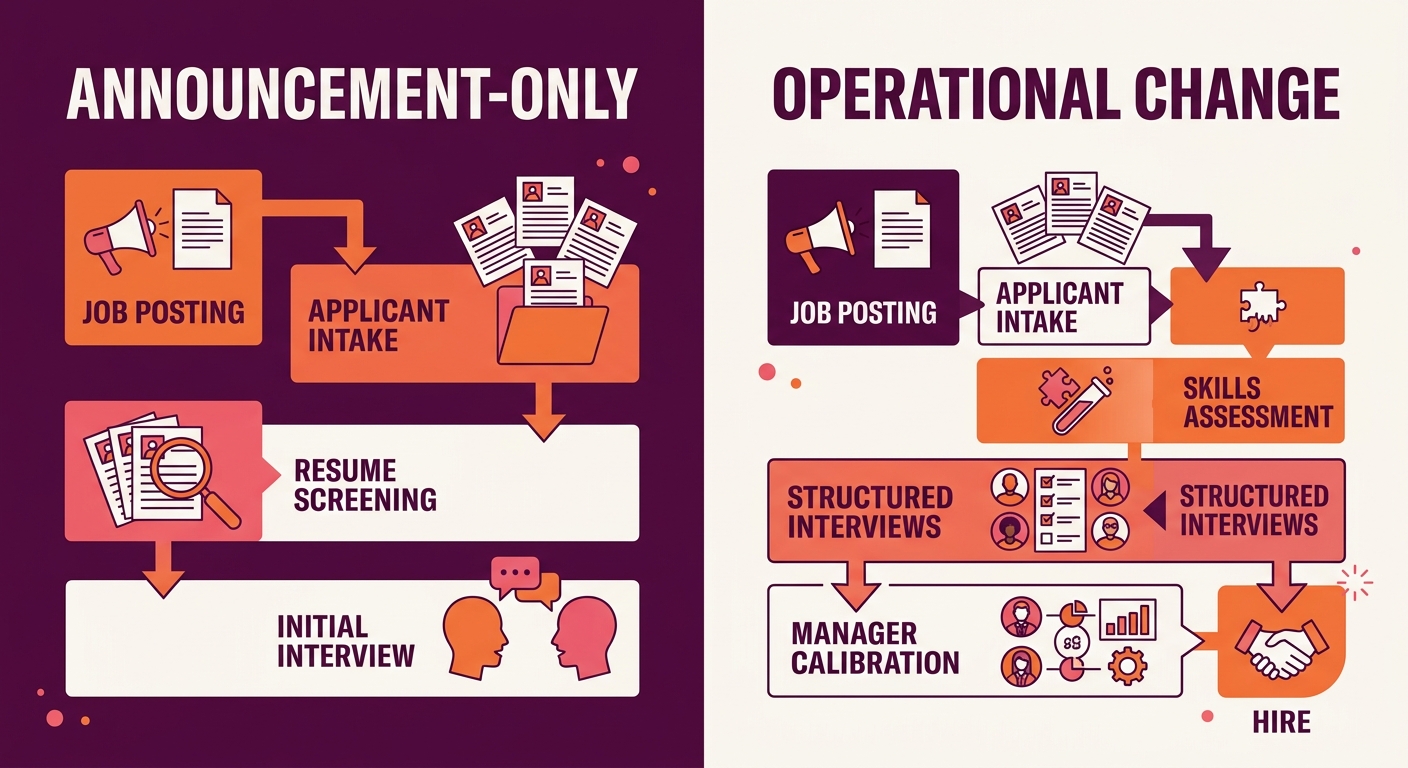
This is where job requirements reform rhetoric collides with recruiter reality. The sequence goes like this: Leadership announces a skills-first initiative. Marketing writes a blog post. The CHRO presents the new philosophy at an all-hands. Degree requirements get removed from 52% of job postings. And then the recruiter opens their ATS the next morning and faces the same candidate ranking system, the same knockout question logic, and the same hiring manager who still asks “Where did they go to school?” in the debrief.
The recruiter becomes the translation layer between an aspiration and a system that wasn’t rebuilt to support it. They’re supposed to evaluate competencies without validated assessments, explain non-traditional candidates to skeptical hiring managers without data to back the pitch, and maintain time-to-fill metrics that were already under pressure. If your team is working within an effective recruitment process, you’ve already felt the tension between structured evaluation and speed. Skills-based hiring, done honestly, makes that tension worse before it gets better.
As HBR noted in its analysis of skills-based hiring failures, the logic is “unimpeachable” — talent is scarce, and progress in boosting workforce diversity remains sluggish. Casting a wider net makes sense on paper. But widening the top of the funnel without upgrading the filters inside it creates more work per hire, not less. And that work lands squarely on recruiters.
The numbers from the UK tell a similar story: 67% of employers reported it was harder to find top talent than the prior year, while 72% of jobseekers said landing a job had become more difficult. Both sides are struggling more, even as organizations publicly embrace skills-first philosophies. The system is producing friction for everyone.
Meanwhile, recruiter call time has already doubled to 286 minutes per week as AI tool usage rises. The administrative load is climbing. Adding unstructured competency evaluation on top of that workload without providing scoring tools or structured rubrics is a recipe for burnout, inconsistency, or quiet reversion to credential shortcuts — which is exactly what the backslider data shows.
Warning: If your organization has dropped degree requirements from job postings but hasn’t changed its ATS screening logic, knockout questions, or interview scorecards, you’re likely in the 45% in-name-only bucket. The announcement alone changes nothing about how candidates get evaluated.
What the 37% Actually Did Differently
The leaders in the Burning Glass data didn’t just remove degree requirements from job postings. They rebuilt operational workflows. The distinction matters because it reveals where the hiring framework debate gets stuck: the conversation centers on what to remove (degrees, credential filters, years-of-experience minimums) instead of what to build in their place.
Companies that increased non-degreed hiring by nearly 20% invested in three specific areas. First, they developed competency-focused job descriptions that defined required hard and soft skills for each role — 75% of employers in the leader category had created these descriptions, though enforcement during screening remained inconsistent even among them.
Second, they implemented pre-employment assessments: work samples, job simulations, structured problem-solving exercises. These aren’t free, and they aren’t fast. But they gave recruiters something to evaluate beyond resume keywords and alma maters. If you’ve ever seen how ATS candidate ranking mechanics actually work, you know the default system rewards keyword density, not demonstrated ability. Skills-based hiring requires an entirely different scoring layer.
Third, they trained hiring managers on how to read assessment results. This is the piece that most organizations skip entirely. A recruiter can surface a non-traditional candidate with strong assessment scores, but if the hiring manager defaults to “I don’t see a CS degree” in the debrief, the effort collapses. Building structured interview scorecards is one concrete step, but it only works if hiring managers are held accountable to the scores rather than their gut.
The retention data provides the strongest argument for doing this work. Employees hired based on demonstrated skills stay 9% longer than those hired through traditional credential-based methods. Workers without four-year degrees who were hired through skills-validated processes stay 34% longer than degree-holders in comparable roles. The return on investment exists, but it accrues over 12 to 18 months — a timeline that requires organizational patience most companies don’t exercise.
The Gap Between the Press Release and the ATS
The skills-based hiring criticism that matters isn’t whether the approach works. The data from the 37% who followed through shows it does. The criticism that matters is that 63% of organizations treated it as a communications strategy instead of an operational overhaul, and their recruiters absorbed the consequences.
Recruiters at in-name-only companies got a mandate without a method. They were told to evaluate competencies without assessment tools, to champion non-traditional candidates without hiring-manager buy-in, and to widen pipelines without any change to the screening infrastructure that sorts those pipelines. The gap between the press release and the ATS configuration is where the entire initiative lives or dies. And for the majority of companies, that gap stayed wide open, filled by recruiters improvising with the same tools they had before the announcement was made.