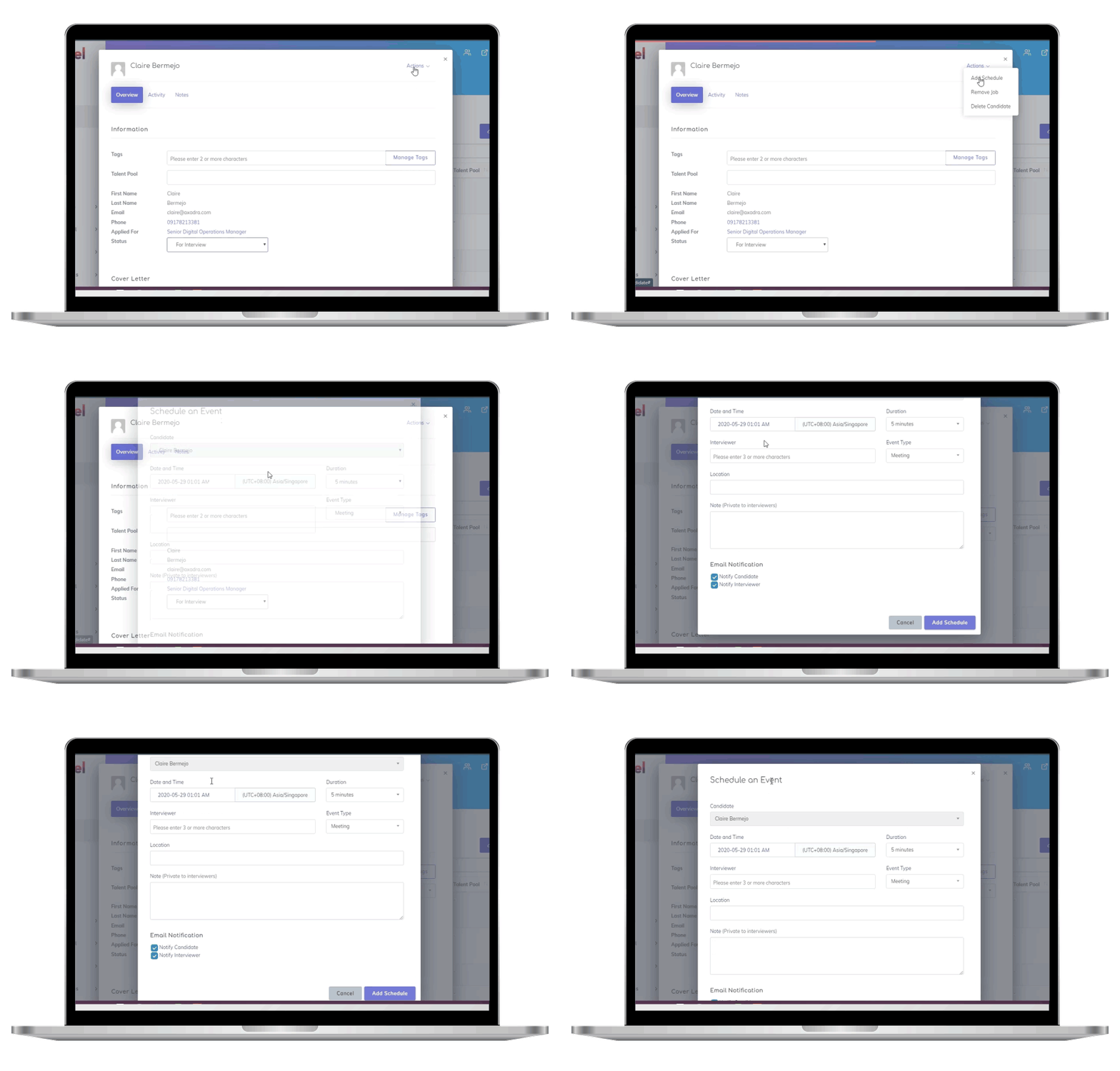

Hiring 300 seasonal retail workers is a sourcing problem for about 72 hours. The remaining 11 days of a typical two-week sprint get consumed by offer letters, tax forms, and compliance documents that never needed a human hand in the first place.
TL;DR: The real bottleneck in seasonal retail hiring is post-offer paperwork, not candidate sourcing. Automated digital offer letters, bulk document workflows, and mobile-first form completion cut a 300-person onboarding cycle from weeks of chaos to a repeatable two-week process — and reduce early turnover at the same time.
TimeForge proved this when it implemented automated onboarding for a major retail chain handling 300 seasonal hires in two weeks. The system paired digital document signing with automated training modules and structured checklists, getting workers productive on day one while managers skipped the paperwork shuffle entirely. That result sounds impressive in a case study. It becomes more interesting when you break down the three specific bottlenecks it eliminated, because each one exists in virtually every multi-location retail operation running a seasonal hiring workflow today.
The Paperwork Wall Between “Yes” and Day One
Every seasonal retail hire generates between 8 and 15 individual documents: the offer letter, a W-4, an I-9, state tax withholding forms, direct deposit authorization, employee handbook acknowledgment, safety training sign-offs, and location-specific policy agreements. Multiply that by 300 hires across 20+ store locations, and a single HR coordinator faces somewhere between 2,400 and 4,500 individual document touchpoints.
Manual processing of that volume breaks in predictable ways. Offer letters go out in batches of 10–15 because someone has to personalize each one. Candidates wait 3-5 days for their packet. Forms come back incomplete with wrong Social Security formats, missing signatures, and blank fields. Each correction adds another round-trip of email or, worse, a phone call. By the time a candidate’s paperwork clears, a competitor has already gotten them through orientation.
This is why candidate ghosting in the offer-to-start gap hits retail so hard. The dropout doesn’t happen because the candidate changed their mind about the job. It happens because a faster employer got them working while your HR team was still chasing wet signatures.
According to staffing agency best-practice research from NextCrew, the onboarding experience for high-volume hires “must be simple, mobile-friendly, and fast enough to finish between shifts.” That’s a direct acknowledgment from practitioners that the form-filling stage is where seasonal hiring workflows die. When a cashier candidate has to drive to a store location to sign paper forms during business hours, you lose 15-20% of accepted offers to friction alone.
And the problem compounds across locations. Store #47 uses a different onboarding checklist than Store #12. Regional managers have their own form preferences. State-specific tax withholding requirements vary. Without standardization, “onboarding 300 people” is actually “onboarding 15 people at each of 20 locations using 20 slightly different processes.” That fragmentation is what makes the timeline balloon.
Bulk Digital Offer Letters Change the Arithmetic
The single highest-impact automation in a seasonal hiring workflow is bulk generation of digital offer letters. The mechanics are straightforward: HR uploads a master template, imports candidate details from a spreadsheet or HRIS export, and dispatches personalized documents to the entire cohort simultaneously. Systems like eDocGen can use XML, Excel, or JSON data to populate templates and generate hundreds of offer letters in seconds, with role-based authorization controlling who triggers each send.
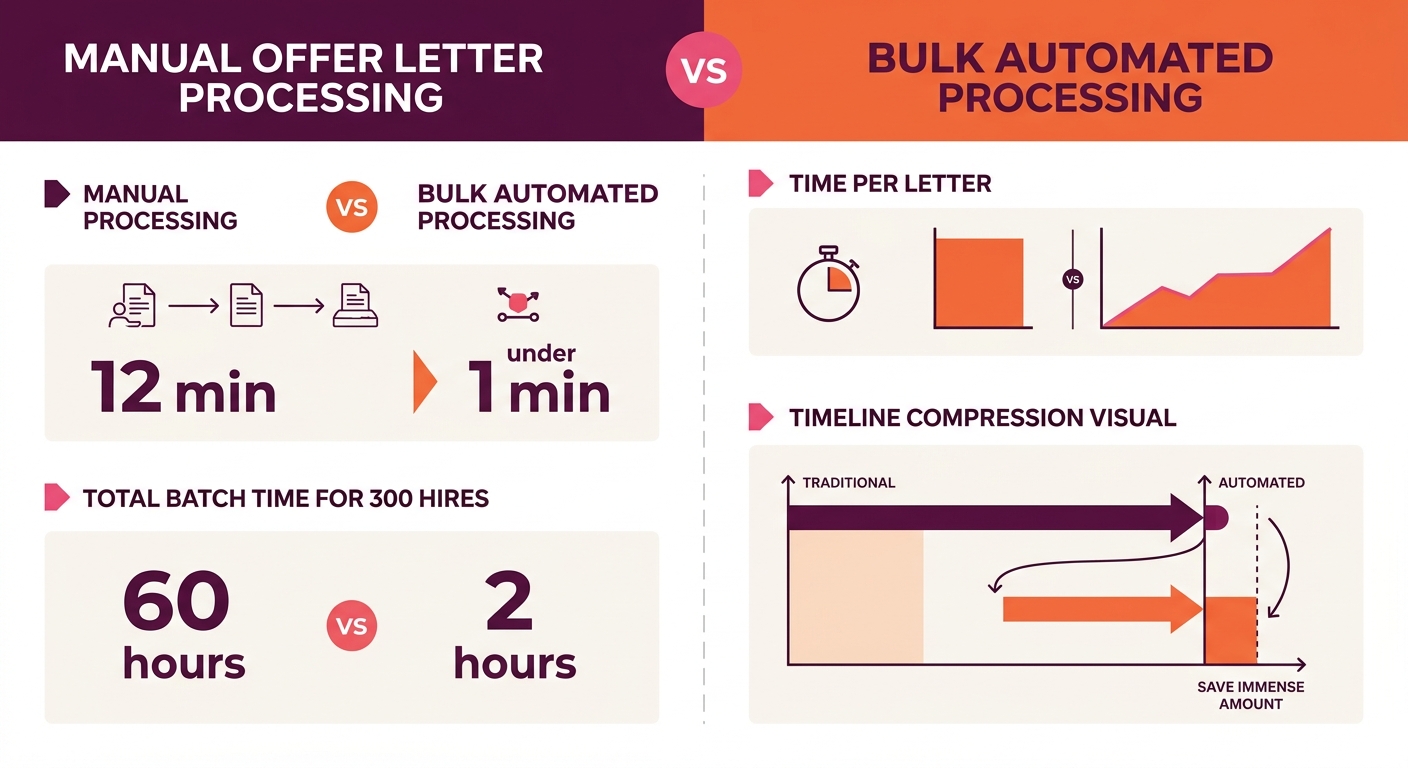
That speed difference reshapes the entire onboarding timeline. Instead of personalizing and sending 300 offer letters over 5-7 days, the whole batch goes out in one afternoon. Candidates receive their offer, review terms, and e-sign on their phone within hours. The downstream effect is significant: compliance document collection starts days earlier because you’re no longer waiting for the offer stage to clear before triggering the next form packet.
For multi-location retail chains, the platform choice matters. Fountain, Paradox, SmartRecruiters, and iCIMS all support the kind of automation and multi-location coordination that high-volume onboarding automation requires. Fountain’s bulk automation handles thousands of applicants during seasonal peaks. Workstream focuses on text-message engagement that keeps candidates responsive during document collection. Hireology standardizes the hiring process across locations, preventing the Store #47 vs. Store #12 divergence problem.
Tip: If you’re evaluating bulk onboarding software, test the template system with your actual document set before committing. Some platforms handle offer letters well but choke on state-specific tax forms or multi-page policy acknowledgments that require initials on every page.
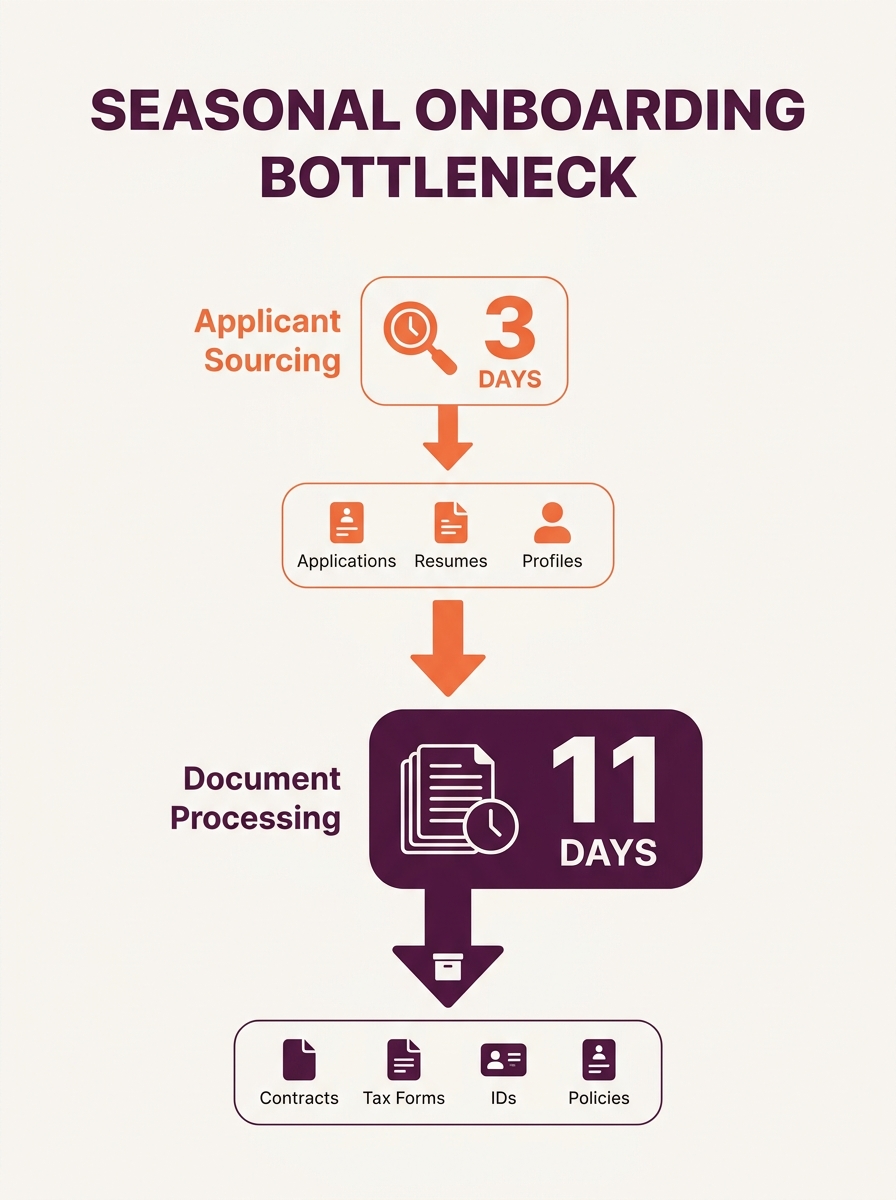
The math on retail HR automation tells the whole story: if a manual offer letter takes 12 minutes to personalize, review, and send, 300 letters cost 60 hours of HR time. That’s a full week and a half of one person’s work, dedicated exclusively to offer letters before a single compliance form gets touched. Automated bulk generation reduces that to under 2 hours of template setup plus a few minutes of review before the batch send. The 58-hour gap is where the two-week timeline becomes achievable.
Mobile Completion and the 120-Day Retention Connection
Getting documents sent fast is half the equation. Getting them back is the other half, and this is where mobile-first form design separates functional high-volume onboarding automation from systems that look impressive in a demo but fail in the field.
Seasonal retail workers skew young, hourly, and phone-dependent. Asking them to open a PDF on a laptop, print it, sign it, scan it, and email it back is asking them to complete a process that roughly 40% of them can’t do because they don’t own a printer. Blueink’s Bulk Send feature and similar tools deliver forms as mobile-responsive documents that candidates complete with thumb taps and finger signatures. Completion happens on a bus, during a lunch break, or at 11 PM, whenever the candidate has 10 minutes free.
The retention payoff from getting onboarding right is where the TimeForge case becomes interesting beyond the speed metric. Research on hourly workforces shows that 50% of hourly workers leave within 120 days. Structured onboarding that includes 30-60-90 day plans, clear role expectations, and completed training before the start date directly attacks that attrition number. When a seasonal worker shows up on day one and their badge works, their training module is already assigned, and their manager knows their name, the signal is unmistakable: this employer is organized, and working here will be less chaotic than the alternative.
When a seasonal worker shows up on day one and their badge works, their training module is already assigned, and their manager knows their name, the signal is unmistakable: this employer is organized.
Some organizations push even further. As we’ve covered, forward-thinking companies are getting new hires into customer-facing work by day three instead of burying them in week-long orientations. That’s only possible when every form, signature, and training acknowledgment cleared before the start date, which is only possible with an automated document pipeline.
Automation also handles the back end that nobody thinks about until January. After the holiday rush, automated systems process end-of-season paperwork in bulk while simultaneously tagging high-performing seasonal staff for pre-approved rehire the following year. That rehire pipeline means next year’s seasonal ramp starts with 50-80 workers who already have completed I-9s and training records on file, shrinking the next cycle before it begins. Companies that have rebuilt their ATS workflows stage by stage will recognize the compounding benefit: each cycle gets faster because the system retains institutional data from the previous one.
The Claim, Revisited
The standard playbook for seasonal hiring focuses almost entirely on the top of the funnel: post more jobs, run more ads, staff up recruiting. Sourcing does matter. But the 300-in-two-weeks case reveals something the funnel obsession misses: most retail chains already attract enough applicants during seasonal peaks. The breakdown happens in the administrative dead zone between a verbal yes and a completed employee file.
Rebuilding that middle layer with automated offer and document workflows is a less exciting project than deploying an AI chatbot or redesigning your career site. There’s no flashy demo to show leadership. The work involves mapping every document required per state per role, building templates with conditional logic for location-specific forms, testing mobile rendering across different screen sizes, and establishing escalation rules for incomplete packets. It’s the kind of operational cleanup that organizations tackling common onboarding automation mistakes eventually arrive at when they stop patching symptoms and start fixing plumbing.
The thesis holds up under scrutiny: seasonal retail onboarding bottlenecks are document problems dressed up as hiring problems. The 300-worker sprint worked because someone decided to treat the offer letter, the W-4, the I-9, and the handbook acknowledgment as a single automated pipeline instead of 300 individual administrative tasks. Any retail HR team with a bulk onboarding software platform, a library of mobile-friendly templates, and the discipline to standardize start dates across locations can reproduce the result. The hard part was never the technology. The hard part is admitting that the post-offer process has fixable inefficiencies embedded in it that nobody has prioritized because recruiting always gets the budget first.