Referral programs are reshaping hiring by focusing on quality, speed, cost, and retention. Here’s why they work:
- Better Hires: Referred candidates are 3–4 times more likely to be hired and 30% more likely to be top performers.
- Faster Hiring: Referrals cut time-to-hire by 55%, with some hires completed in as little as 18 days.
- Lower Costs: Companies save up to $1,634 per hire, reducing recruiter fees and advertising expenses.
- Higher Retention: Referred employees stay 4.5 years on average – double that of non-referred hires.
Despite their efficiency, managing these programs can be tricky. Tools like Skillfuel simplify the process by automating tracking, payouts, and analytics, ensuring no referral is overlooked while boosting program ROI.
Employee Referral Program Metrics to Track
sbb-itb-e5b9d13
Impact of Referral Programs on Hiring Metrics
Referral programs bring measurable benefits to hiring processes, improving metrics like quality, speed, cost, and retention. The numbers speak for themselves: referred candidates are 3 to 4 times more likely to be hired compared to those from other sources. While job boards have a hiring rate of just 2-5%, referrals boast a 34% success rate. This advantage stems from employees essentially pre-screening candidates for compatibility, ensuring they align with the company’s expectations and values.
Quality of Hire Improvements
Referred employees consistently outperform those hired through other methods. Thanks to their connection with current employees, they often have a better understanding of the company’s culture and expectations before they even start. This translates to smoother onboarding and quicker adaptation. In fact, referred hires are 30% more likely to earn higher performance ratings and are 2.6 times as likely to be top performers after a year.
This creates a ripple effect: high-performing employees tend to refer others who are similarly skilled, reinforcing a cycle of strong hires. A majority – 88% – of workers agree that referrals are the best way to discover top talent. The impact on the bottom line is clear, too: referred hires can increase company profits by 25%. In healthcare, the savings are particularly striking. For example, replacing a travel nurse with a referred registered nurse (RN) can save a hospital around $157,000 annually.
Faster Time-to-Hire
Referral programs also speed up the hiring process. Recruiters can skip initial screening steps, diving directly into advanced evaluations. On average, referral hires are brought onboard 55% faster than those from other sources. For instance, Cisco’s referral hires complete the process in just 29 days, compared to 55 days for traditional candidates. Similarly, healthcare referrals are hired 25 days faster than those sourced through agencies. In some tech companies, offers are made in as little as 18 days.
Even onboarding moves more quickly. Referral hires typically take 23 days to fully onboard, compared to 44 days for other candidates.
Lower Cost-per-Hire
Referral programs are also a cost-effective solution. They reduce the average cost-per-hire by 50%, saving companies significant resources. These savings come from cutting recruiter commissions, lowering advertising expenses, and streamlining onboarding. On average, referral programs save $1,634 per hire.
| Metric | Referral Hires | Job Board Hires |
|---|---|---|
| Average Time-to-Hire | 15-30 days | 45-55 days |
| Cost-per-Hire (Retail) | $1,500 | $4,000 |
| Apply-to-Hire Conversion | 28.2% | 2-5% |
| Performance Rating (1 year) | 30% higher | Baseline |
Higher Retention Rates
Retention is another area where referrals shine. Referred employees tend to stay longer, thanks to a stronger alignment with the company’s values and work environment. On average, referred hires remain at their jobs twice as long as those from other channels – 4.5 years compared to 2.3 years. After three years, 46% of referred employees are still with the company, compared to just 33% of non-referred hires.
Several organizations have seen dramatic results from ramping up their referral efforts. Fairview Health Services, for example, increased referrals from 6% to 41% of total hires over 17 months, leading to 589 nursing hires with an impressive 92% retention rate. Similarly, Compassus boosted its referral rate from 22% to 35% in 16 months, cutting time-to-fill by 17 days and reducing turnover by 50%. Ebenezer saw referrals jump from 5.5% to 36% over a 16-month period, slashing employee turnover by 58%.
This retention advantage is driven by several factors. Employees tend to recommend candidates who they believe will thrive in the company’s environment, and the act of referring someone adds a layer of accountability for both parties. In the tech sector, 70% of referred employees stay beyond three years, and they are nearly three times less likely to leave early in their tenure.
Research Findings on Referral Program Performance
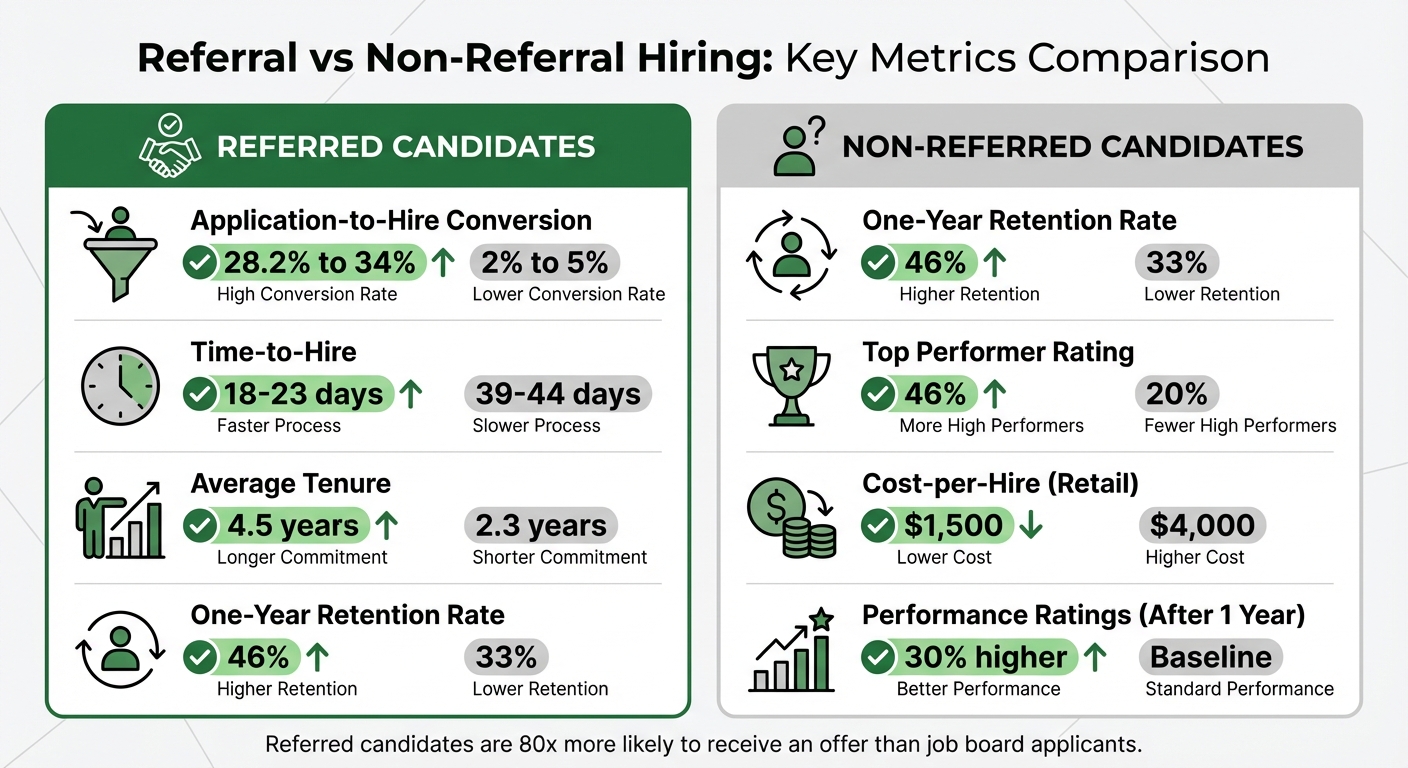
Referral vs Non-Referral Hiring Metrics Comparison
The research highlights how referral programs consistently deliver better hiring outcomes compared to traditional recruitment methods. Studies show that referral programs outperform other channels across industries, company sizes, and regions.
Here’s a striking statistic: while referrals make up just 1% to 7% of total applications, they account for an impressive 45% of all hires. This efficiency stems from the trust and validation that employee endorsements provide. As Joel Westmark from Ashby explains:
"Referred and internal candidates are often seen as lower risk".
This sets up a clear comparison between referred and non-referred candidates, especially when it comes to conversion rates. For example, referred candidates boast a 16% offer rate, compared to 8% for agency candidates and just 0.2% for inbound applicants. In simpler terms, a referred candidate is 80 times more likely to receive an offer than someone applying through a job board.
Top-performing recruitment teams have taken note of this advantage, with the best attributing 30% to 35% of their external hires to employee referrals. The following table highlights how referred candidates consistently outperform their non-referred counterparts across several key metrics.
Referral vs. Non-Referral Metrics Comparison
| Metric | Referred Candidates | Non-Referred Candidates |
|---|---|---|
| Application-to-Hire Conversion | 28.2% to 34% | 2% to 5% |
| Time-to-Hire | 18–23 days | 39–44 days |
| Average Tenure | 4.5 years | 2.3 years |
| One-Year Retention Rate | 46% | 33% |
| Top Performer Rating | 46% | 20% |
| Cost-per-Hire (Retail) | $1,500 | $4,000 |
| Performance Ratings (After 1 Year) | 30% higher | Baseline |
The numbers speak for themselves. Referral programs not only improve hiring efficiency but also slash costs. On average, they reduce the cost-per-hire by 50%, saving companies around $1,634 per hire. In specialized industries like healthcare, the impact is even more dramatic. For instance, replacing a travel nurse with a referred registered nurse can save hospitals approximately $157,000 annually.
How Skillfuel Supports Referral Program Management
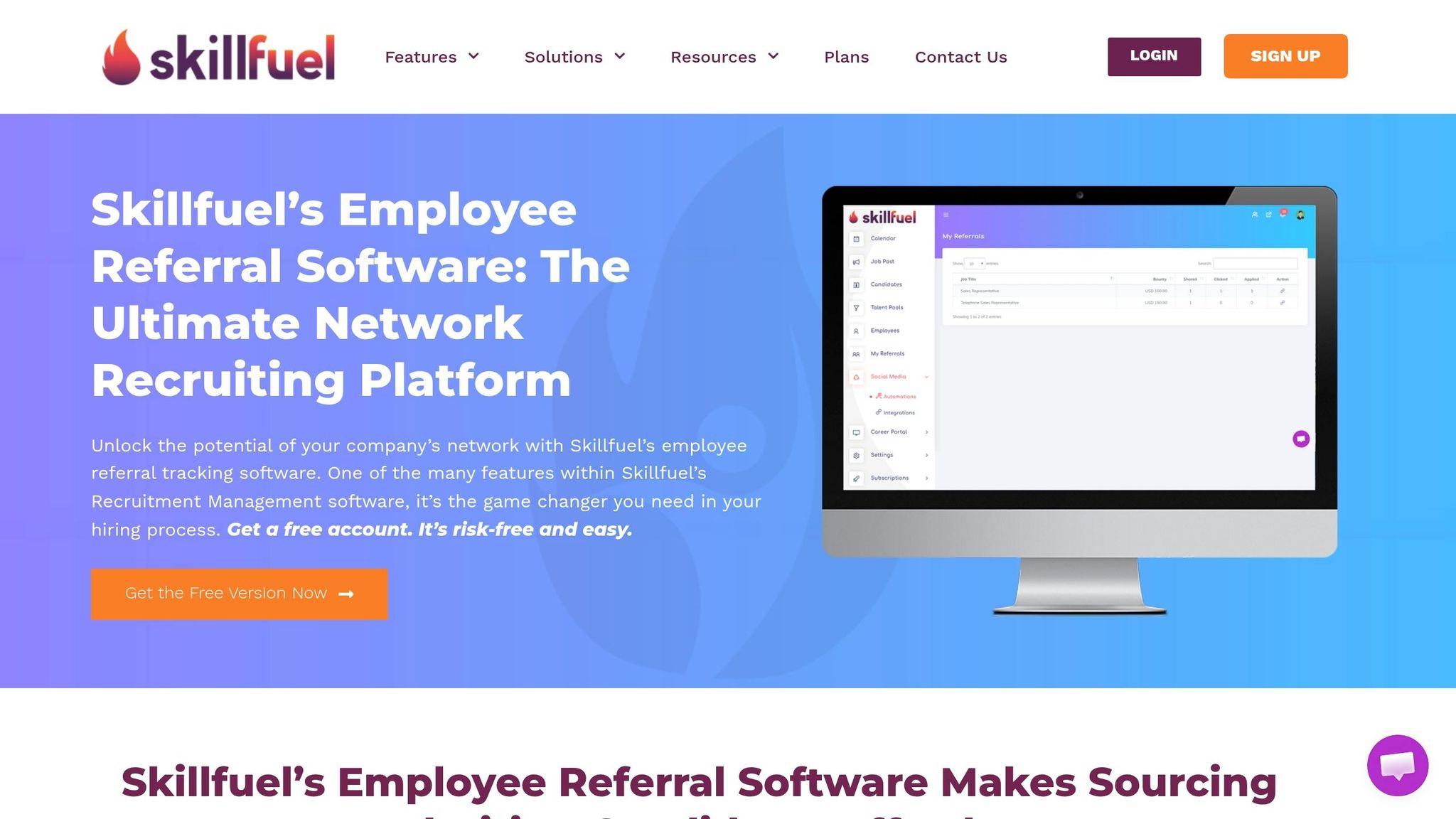
Managing referral programs on a large scale can be tough, even with their proven advantages. Skillfuel tackles these challenges with features that simplify tracking, automate processes, and refine every aspect of employee referral programs. The result? Better hires, quicker hiring processes, and reduced costs. Let’s dive into how Skillfuel achieves this through its analytics and automation tools.
Referral Tracking and Analytics Tools
Skillfuel’s centralized dashboard keeps tabs on every referral – tracking who made the referral, when it happened, and for which role. This level of visibility ensures no candidate slips through the cracks, a problem that often discourages employees from participating in referral programs.
But Skillfuel doesn’t stop at basic tracking. Its analytics tools provide conversion charts and progress reports to monitor candidate journeys. Configurable leaderboards highlight top referrers by department, enabling HR teams to reward high performers and identify which teams are most engaged. Additionally, revenue tracking features let organizations measure the ROI of referrals compared to other recruiting channels, making it easier to justify program spending to decision-makers.
Here’s a real-world success story: Between January and July 2021, isolved Talent Acquisition used automated tracking and public scoreboards as part of a "referral flywheel" strategy. The company grew from 140 to 210 employees in just seven months, hiring 78 people during that time. By rewarding actions (like submitting referrals) rather than just outcomes, they increased applicants per employee from 0.48 to 1.78 – a 300% jump. In one quarter, they hired 20 people through referrals, up from just 3 in the previous quarter.
Skillfuel’s automated workflows work hand-in-hand with these analytics to streamline the referral process even further.
Automated Workflows and Custom Reporting
Relying on spreadsheets and emails for referral tracking can lead to inefficiencies. Skillfuel eliminates these headaches by automating the entire process – from submitting candidates to issuing referral bonuses. The platform ensures referred candidates are routed to the correct hiring managers and sends timely notifications to both referrers and applicants.
A standout feature is probation tracking, which works seamlessly with payroll integration to ensure referral bonuses are paid on time. The system monitors when referred hires complete their probation periods and alerts payroll teams when payments are due. This avoids delays, builds employee trust, and encourages ongoing participation. Weekly automated reminders also nudge hiring teams to act on high-priority referrals, ensuring no candidate gets overlooked.
For HR teams, Skillfuel’s custom reporting tools are a game-changer. Tailored analytics reports can be created to highlight program performance for stakeholders. Data is exportable to spreadsheets for external sharing, and a visual Kanban-style workflow management system helps pinpoint and resolve bottlenecks in the referral process.
Conclusion
Employee referral programs can transform hiring outcomes, improving key metrics like conversion rates, time-to-hire, cost savings, and retention. For example, referred hires are completed about 10 days faster, save an average of $1,634 per hire, and tend to stay longer with the company. These benefits highlight how referrals can help build stronger, more stable teams.
However, the real challenge lies in execution. Without the right tools, manual processes like tracking referrals through spreadsheets often lead to delays, lost submissions, and a lack of trust from employees. This is where Skillfuel steps in. By automating workflows, it simplifies everything from candidate submissions to bonus payouts. A centralized dashboard ensures transparency, while analytics tools help measure ROI and identify top referrers. The platform also integrates probation tracking with payroll systems, ensuring bonuses are paid on time, and offers custom reporting tools to showcase program success to leadership. Additionally, its Kanban-style workflow management helps teams identify and resolve bottlenecks before they affect outcomes.
FAQs
Which hiring metrics should I use to prove referral ROI?
To show the return on investment (ROI) of employee referrals, keep an eye on metrics like quality of hire, time-to-hire, and retention rates. Referrals often result in better hires, speed up the recruitment process, and reduce turnover. These numbers clearly highlight how referrals enhance your hiring approach.
How do I prevent referral programs from hurting diversity?
To ensure referral programs support diversity, they need to be planned with inclusivity at the forefront. Start by using data-driven approaches to uncover and address any biases, establish clear diversity objectives, and regularly track referral trends. Encourage employees to refer candidates from underrepresented backgrounds by implementing targeted outreach initiatives and offering specific incentives. Bonuses for diverse referrals and training sessions on unconscious bias can also help create a fairer hiring process while expanding the range of potential talent.
What makes employees actually submit referrals consistently?
Employees are more likely to submit referrals when they see tangible rewards and feel genuinely involved in the process. Offering incentives such as bonuses, additional time off, or public recognition can significantly boost participation. A straightforward, well-organized referral system with clear objectives helps employees see the value of their contributions. Consistent updates, open communication, and fostering a workplace that appreciates employee input make referrals both satisfying and an essential part of successful hiring.