Candidate ghosting follows a predictable mechanical pattern: a recruiter goes silent for seven or more days, the candidate takes a competing offer, and the absence gets recorded as a “ghost” in the ATS. The generational framing (Gen Z is flaky, Millennials won’t commit) misidentifies the cause. The actual failure point is a breakdown in recruitment follow-up automation between pipeline stages.
TL;DR: Candidate ghosting is driven by recruiter communication gaps at specific pipeline stages, not by generational attitude. Time-to-hire has stretched to 41 days (up 24% since 2021), and 64% of candidates expect a response within one week of an interview. Automation that fills the silence between stages reduces mid-funnel candidate drop-off where most “ghosting” actually originates.
The Generational Blame Is a Misdiagnosis
Forty-one percent of Gen Z candidates admit to ghosting employers, versus 37% of Millennials. That 4-percentage-point gap carries the entire weight of the “Gen Z doesn’t respect the process” narrative. But the number that actually explains hiring pipeline abandonment sits on the employer side: 53% of job seekers report being ghosted by employers, and receiving another job offer is the top reason candidates disappear, according to an Indeed survey.
Candidates aren’t vanishing because they lack professionalism. They’re accepting offers from companies that responded faster. Patrice Williams-Lindo of Career Nomad put it directly: “The burden to fix the system should not fall on early-career candidates.” The generational frame gives recruiting teams a comfortable explanation that doesn’t require them to change their own communication workflows. The mechanism underneath is simpler and more fixable than a cultural shift.
How the Silence Window Creates Ghosts
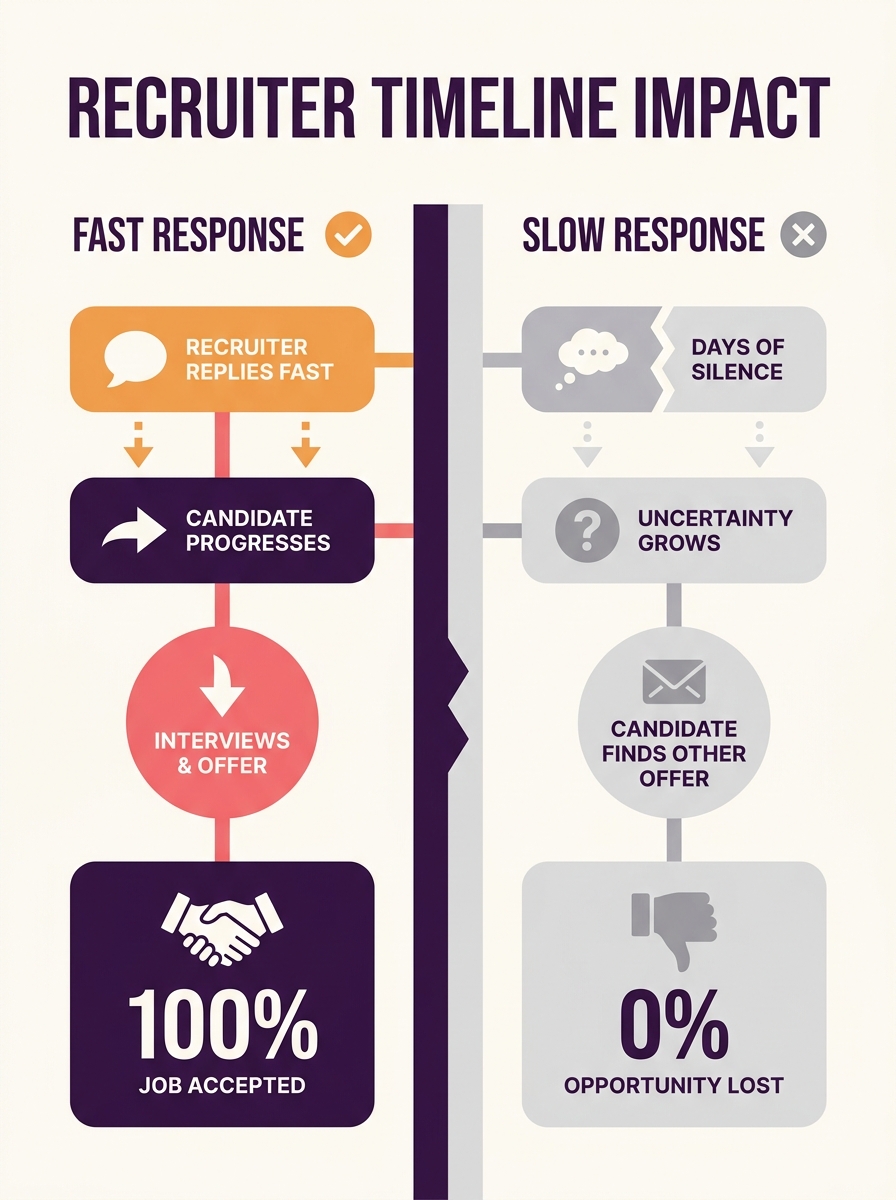
The one-week threshold is where most mid-funnel candidate drop-off concentrates. Hiring teams commonly interpret this as “candidates losing interest,” but the mechanism is more specific. Seventy-five percent of applicants expect a response within two weeks. Sixty-four percent expect one within a single week of interviewing. The median employer wait before responding sits at 6.7 days.
So the typical employer response time lands right at the edge of candidate tolerance. Any delay beyond that, and you’re competing against every other recruiter who already made contact. Time-to-hire across industries has stretched to 41 days, up 24% from 33 days in 2021. When a recruiter takes 14 days to deliver feedback, the candidate has already been hired elsewhere. That absence gets labeled as ghosting, but the mechanism was silence-driven attrition.
This is where the disconnect between top-of-funnel visibility and mid-funnel blindness matters. Most organizations track applications received and offers extended with decent accuracy. The stages between those endpoints, where recruiter communication gaps actually form, tend to be unmeasured. And the gap between “interview completed” and “feedback delivered” is where the largest share of candidates quietly exit.
They didn’t lose interest. They assumed you weren’t interested in them.
Three Stages Where Communication Decays
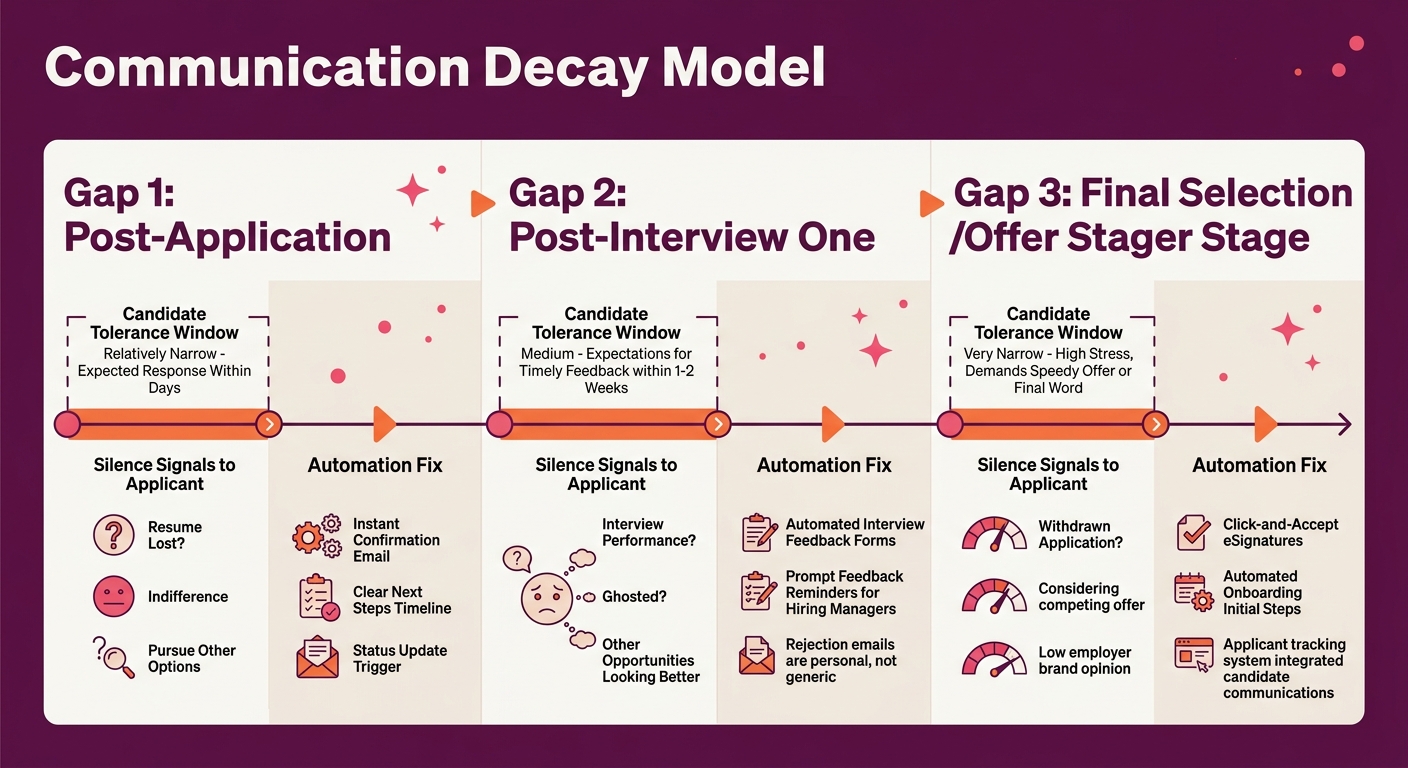
The pattern of hiring pipeline abandonment isn’t random. It clusters at three predictable gaps in the recruiting workflow, what we’d call the Communication Decay Model: post-application acknowledgment, post-interview status updates, and post-decision feedback. Each gap has a different tolerance window and a different automation fix.
| Pipeline Gap | Candidate Tolerance | What Silence Signals | Automation Fix |
|---|---|---|---|
| Post-application (0–48 hours) | 24–48 hours for acknowledgment | “They didn’t receive my application” | Auto-confirm receipt + expected timeline |
| Post-interview (3–7 days) | 5–7 days for status update | “I’m not a serious candidate” | Triggered status update at day 3 and day 5 |
| Post-decision (7–14 days) | 7–10 days for rejection or next steps | “They’ve moved on without telling me” | Automated disposition email on decision |
Each of these gaps is a point where a candidate re-enters the active job market. The post-interview gap causes the most damage because the candidate has already invested meaningful time and has the highest expectations for follow-through. Companies that disposition candidates within 3–5 days at this stage see Candidate Experience Net Promoter Scores improve by 52%, according to hiring experience benchmarks.
If your ATS doesn’t trigger messages at each of these stages, the pipeline has built-in communication decay that no amount of recruiter hustle can compensate for. And if you’re still relying on individual recruiters to manually send every update, the math doesn’t work. Recruiter call time has doubled to 286 minutes per week, leaving little room for manual status emails to every candidate in an active pipeline.
What Automated Sequences Actually Fix
Recruitment follow-up automation works through sequenced triggers tied to ATS stage changes. When a candidate moves from “applied” to “phone screen scheduled,” the system sends a confirmation. When 5 days pass after an interview without a stage update, the system sends a status hold message. When a rejection decision is logged, the system sends a dispositional email within hours.
Most outreach platforms support these sequences natively. The key best practice is to use “sequences” or “cadences” in an outreach tool where each step fires on a predetermined delay. Behavioral triggers add another layer: if a candidate clicks on a link to a specific job posting, a personalized email can highlight similar roles or additional company information automatically.
The distinction between useful automation and spam is specificity. A generic “thanks for applying!” email at day zero does very little. An email at day 4 post-interview that says “We’re still in the review process for the Senior Analyst role, and we expect to have an update by Thursday” holds the candidate’s attention because it acknowledges their specific situation and sets a concrete expectation. Jeri Doris of Justworks has noted that Gen Z candidates in particular thrive on real-time feedback, which contrasts sharply with the older “no news is good news” model that many hiring workflows still default to.
Building an effective recruitment process means designing these touchpoints into the pipeline from the start, not bolting them on after ghosting rates climb. The communication architecture should be part of the system, not an afterthought that depends on individual recruiter diligence.
Tip: Even a brief automated message like “We’re still reviewing — update coming Tuesday” reduces the perception of silence dramatically. The content matters less than the timing. Send it before the candidate’s tolerance window closes.
Why 30% of Postings Never Produce a Hire
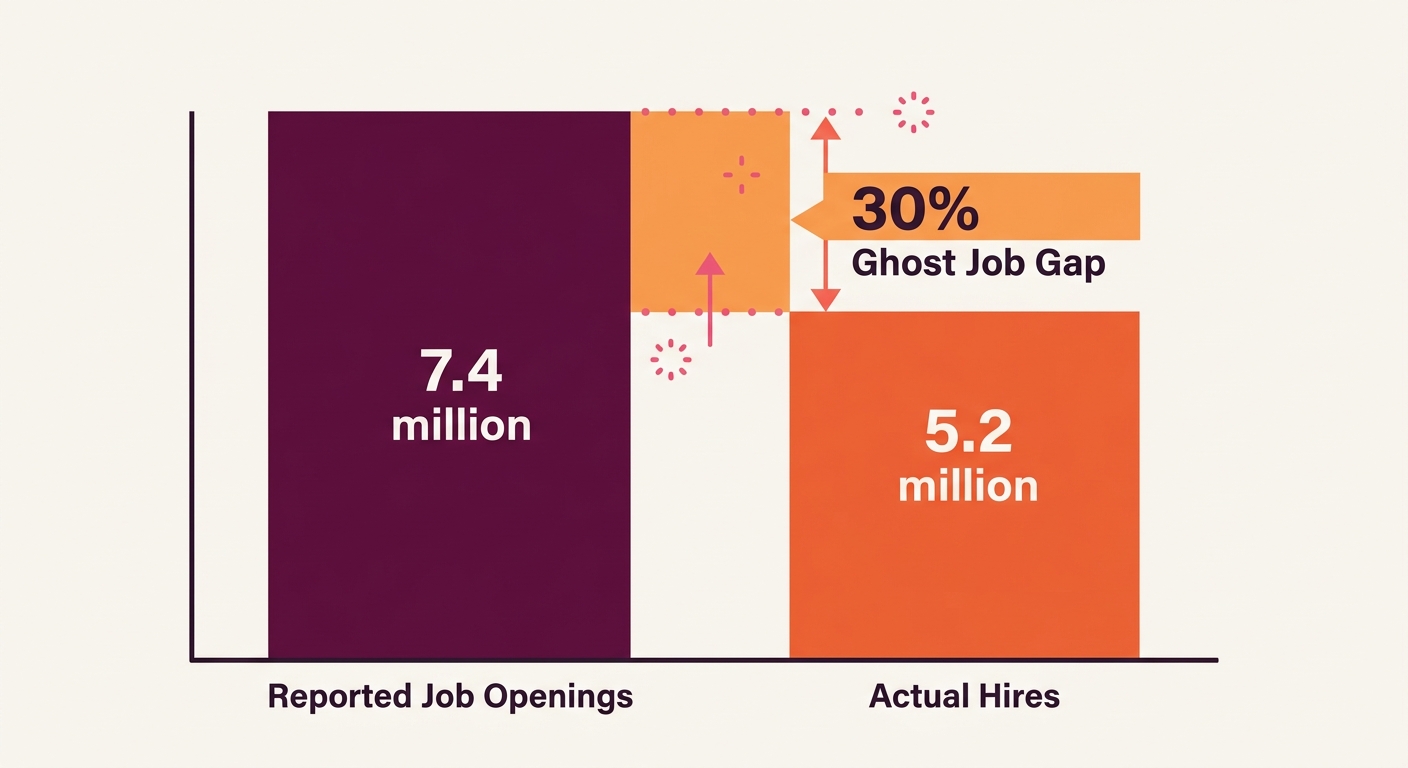
An analysis of June 2025 Bureau of Labor Statistics data found that employers reported 7.4 million job openings but made only 5.2 million hires, meaning 30% of postings never resulted in a hire. Nearly one in three job listings were effectively ghost jobs. And 72% of applicants report the job they applied for differed from the role actually offered.
This compounds the ghosting problem because candidates learn, through repeated experience, that silence from an employer is the norm. They stop waiting. They stop following up. They accept the next concrete offer, and the original employer never hears from them again. The rational response to an unreliable process is to hedge your bets across multiple pipelines, which looks like ghosting from the employer’s perspective but functions as self-protection from the candidate’s.
When your employer brand promises one experience but the hiring process delivers another, candidates notice the gap quickly. Automation alone can’t fix a broken role description, but it can prevent the silence that turns a cautiously interested candidate into one who assumes the role was never real.
Where the Communication Decay Model Breaks
Automation fills the measurable gaps in the pipeline. It handles acknowledgments, status holds, and rejections with consistency that manual workflows can’t match. Pairing free recruitment software with intentional sequence design gets most small and mid-size teams past the worst communication failures. But there are scenarios where the model doesn’t hold.
The first is when the hiring decision itself stalls. Automation can send “we’re still deciding” messages, but if a hiring manager takes 3 weeks to debrief after a final-round interview, no amount of sequenced emails will keep a top candidate warm. The communication decay model identifies the gap; it doesn’t fix the organizational dysfunction upstream of the recruiter.
The second is when personalization drops to zero. Automated messages that feel robotic erode trust as effectively as silence. Eighty-six percent of Gen Z candidates who had a positive experience with AI screening said they’d work with that recruiter again. But 65% of HR professionals believe AI contributes to disengagement when used impersonally. The line between helpful automation and cold automation is thin, and it shifts depending on how much the candidate has invested in the process.
And the third is feedback. Candidates who provide input on the recruitment process generate data that refines communication timing and content. Without that feedback loop, your automation sequences are flying blind, optimized for assumptions about candidate tolerance rather than measured reality. The model works when it’s calibrated against actual candidate behavior in your specific pipeline. Without calibration, it’s guesswork wearing an automation costume.