
Creating a behavioral competency framework is about defining the behaviors, skills, and attitudes that align with effective job performance. Unlike traditional job descriptions, this approach focuses on how work is done, emphasizing observable actions and growth paths. Here’s the key takeaway:
- Purpose: Align employee behaviors with organizational goals.
- Structure: Includes core (universal), functional (role-specific), and leadership (management-focused) competencies.
- Key Elements:
- Clear definitions and measurable behavioral indicators.
- Grouping competencies into clusters for clarity.
- Proficiency levels (e.g., 3 or 5 levels) to track progression.
- Benefits: Companies using such frameworks see improved performance, reduced turnover (20% lower), and faster onboarding (e.g., Cisco cut onboarding time by 36%).
The process involves setting goals, gathering insights, organizing competencies, and testing before implementation. Regular updates ensure the framework stays relevant as business needs evolve. This tool isn’t just for HR – it supports hiring, evaluations, and employee development at every stage.
How To Develop A Competency Framework | A Beginners Guide
Core Elements of a Behavioral Competency Framework
A behavioral competency framework is built around four main components: competency definitions, behavioral indicators, competency clusters, and proficiency levels. Together, these elements create a shared language, measurable performance standards, role-specific clarity, and clear paths for growth. To keep these frameworks practical, aim for 8–12 core competencies. Let’s break down each element to understand its role in the framework.
Competency Definitions and Behavioral Indicators
A competency definition provides a clear explanation of what the competency entails. For example, "Communication: The ability to convey ideas clearly and listen actively" establishes a shared understanding. However, to make this measurable, you need observable behaviors.
This is where behavioral indicators come in. These indicators outline specific actions that demonstrate the competency. For instance, for communication, examples might include "delivers concise presentations tailored to the audience" or "asks clarifying questions to ensure understanding." By focusing on concrete behaviors, these indicators remove ambiguity and reduce the potential for manager bias during evaluations.
To create effective behavioral indicators, consider conducting targeted interviews with top-performing employees. Their insights can help pinpoint the actions that truly reflect excellence in a given competency.
Competency Clusters and Proficiency Levels
Competency clusters group related skills into categories, often divided into core, functional, and leadership competencies. This type of organization ensures clarity and relevance across different roles within an organization.
After grouping competencies, proficiency levels provide a way to track career progression. These levels illustrate how a competency develops over time. A common model is the 3-level system (Developing, Proficient, Advanced), which allows for quick assessments and minimizes fatigue during evaluations. Alternatively, a 5-level model (Novice to Expert) offers more detailed milestones, which can be particularly useful for technical roles where progression is tied to compensation. For example, someone at Level 1 might "participate in team meetings", while someone at Level 3 might "lead cross-functional workshops."
Here’s a quick comparison of the two models:
| Proficiency Model | Best Used When… | Strengths | Trade-offs |
|---|---|---|---|
| 3-Level | Quick, simple assessments are needed; managers have limited time. | Easy to use; reduces evaluation fatigue. | Less detailed; harder to track intermediate progress. |
| 5-Level | Detailed career paths or competency-based pay are priorities. | Precise milestones; helpful for technical roles. | Requires more training and calibration; can lead to over-analysis. |
Organizations that apply consistent competency models across hiring and performance management are five times more likely to achieve top-tier performance. However, the framework must remain practical. Clustering competencies prevents it from becoming overwhelming, while proficiency levels provide clear, actionable growth pathways.
How to Design a Behavioral Competency Framework
3-Step Process for Designing a Behavioral Competency Framework
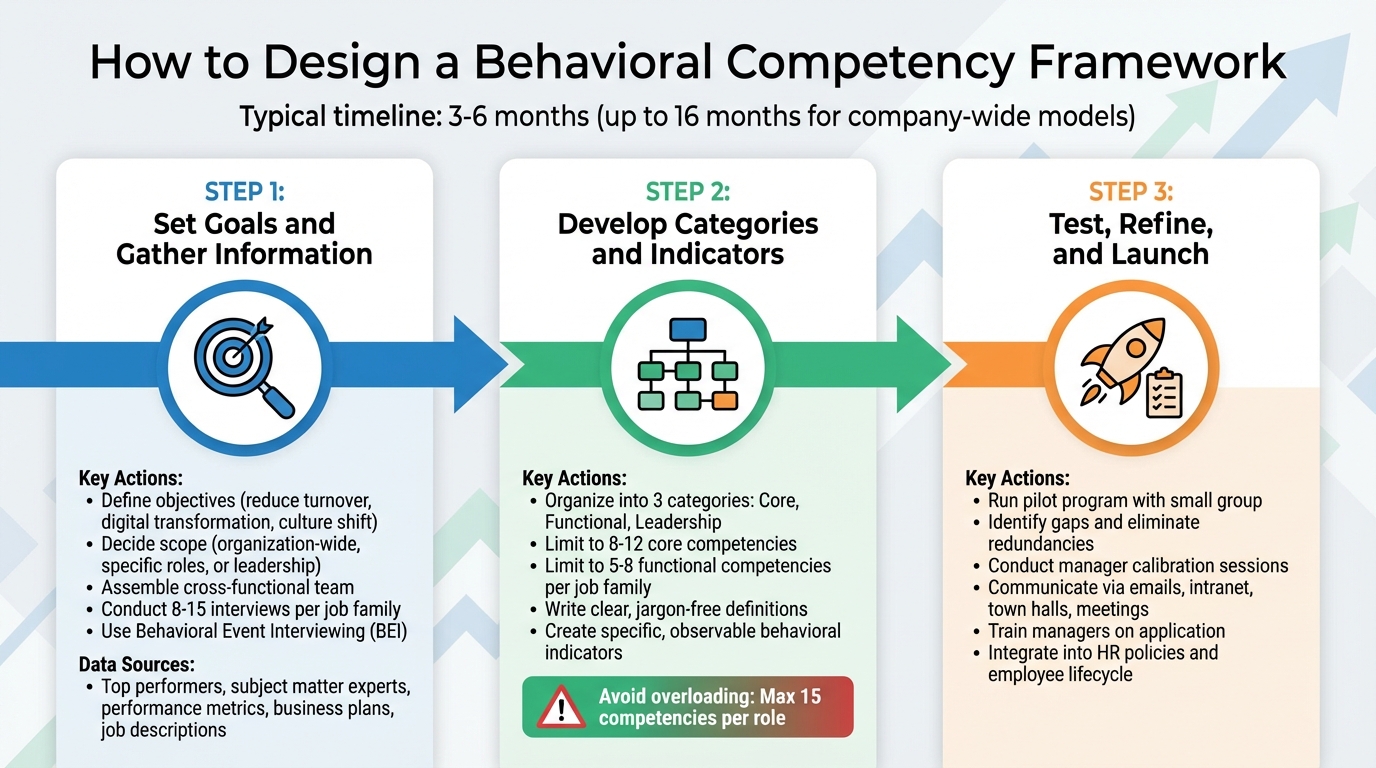
Creating a competency framework from the ground up typically takes 3 to 6 months, though larger, company-wide models can stretch to 16 months. The process unfolds in three key phases: setting clear objectives, organizing the insights into structured categories, and testing the framework before rolling it out. Here’s a closer look at each step.
Step 1: Set Goals and Gather Information
Start by defining what you aim to achieve – whether that’s reducing turnover, enabling digital transformation, or fostering a shift in workplace culture. Decide on the scope of your framework: will it cover the entire organization, focus on specific roles, or target leadership positions?
Next, assemble a cross-functional team and conduct 8 to 15 interviews per job family. These interviews should include top performers and subject matter experts. Supplement this with data from performance metrics, business plans, and job descriptions. To dig deeper, use Behavioral Event Interviewing (BEI) to identify the actions that distinguish exceptional performers from the rest.
This groundwork is essential for defining and categorizing competencies later on.
Step 2: Develop Competency Categories and Behavioral Indicators
Organize the collected behaviors into three main categories: Core, Functional, and Leadership. Keep the framework streamlined – limit it to 8 to 12 core competencies and 5 to 8 functional competencies for each job family. Overloading the framework with more than 15 competencies per role often makes it impractical for managers to use effectively.
Write definitions for each competency that are clear and free of jargon. For every competency, create specific and observable behavioral indicators that describe measurable actions rather than vague personality traits. This not only ensures clarity but also reduces bias and provides legal safeguards during evaluations.
Once you have these categories and indicators in place, the framework becomes easier to implement and refine.
Step 3: Test, Refine, and Launch the Framework
The next step is to test your framework. Start with a pilot program involving a small group before rolling it out organization-wide. Use this testing phase to identify gaps, eliminate redundancies, and fine-tune unclear definitions. Conduct manager calibration sessions to ensure consistent application of the framework.
When you’re ready to launch, communicate the framework’s purpose clearly through emails, intranet updates, town halls, and team meetings. Train managers on how to use it for performance reviews, career development, and hiring decisions. Finally, integrate the framework into your HR policies, embedding it into every stage of the employee lifecycle.
sbb-itb-e5b9d13
Aligning Competencies with Job Roles
Once your competency framework is established, the next step is making sure it works seamlessly across various positions, departments, and levels of seniority. A well-designed framework blends core competencies – the essential values and skills all employees should embody – with role-specific competencies tailored to the unique demands of specific job families. Research shows that organizations using consistent competency models in hiring and performance management are five times more likely to achieve top-tier performance. Let’s break down the distinction between universal values and job-specific skills.
Core Competencies vs. Role-Specific Competencies
Think of your framework as having three layers: core competencies that apply to everyone, functional competencies for specific departments or roles, and leadership competencies for management positions. Core competencies reflect the organization’s core values – like integrity, collaboration, or AI literacy – that every team member should uphold. Functional competencies, on the other hand, focus on the technical skills specific to a role or department, such as SEO expertise for marketing or coding standards for software engineers.
To avoid overwhelming managers and employees, aim for 8–12 core competencies and 5–8 functional competencies per job family. Too many competencies can complicate performance reviews and dilute focus. Grouping roles into job families helps keep the set of functional competencies both relevant and manageable. For each role, outline its key tasks and assess their connection to specific competencies on a scale of 1 to 3. This helps identify which skills are truly critical. Once these distinctions are clear, the next step is tailoring competencies to different levels of experience.
Adjusting Competencies by Job Level
After defining core and role-specific competencies, it’s important to adapt them to various levels of experience within the organization. Competencies evolve with seniority: junior employees might focus on following established processes, while senior staff take on tasks like driving innovation. To reflect this progression, create a proficiency scale – typically with 3 to 5 levels – and include behavioral anchors that describe what success looks like at each level.
For example, a 3-level model (Developing, Proficient, Advanced) simplifies assessments and reduces fatigue during reviews, while a 5-level model (Novice to Expert) provides the detail needed for technical roles where compensation often aligns with skill mastery.
As employees advance, their competencies should reflect greater complexity and responsibility. Senior roles often demand additional skills, such as strategic thinking, influencing without formal authority, or leading organizational change. To accelerate growth, map the required skills to proficiency levels and offer tailored coaching to bridge any gaps. To ensure these levels are accurate, interview high-performing employees across different seniority levels. This can help pinpoint the specific behaviors that set a seasoned professional apart from a junior employee.
Keeping the Framework Current
A competency framework isn’t something you create and forget about. Business goals shift, new technologies emerge, and job roles evolve. If your framework doesn’t keep up, it risks becoming irrelevant – especially during performance reviews. Think of it as a living document that grows and adapts with your business needs. Here’s how to stay on top of updates.
Adding New Competencies
Maintaining your framework is just as important as designing it. Updates should follow major changes, like shifts in business strategy, the introduction of new technologies (e.g., AI), or organizational restructuring. For example, skills such as AI literacy, prompt engineering, or ethical AI practices are now essential for many non-technical roles. Similarly, the rise of hybrid work has introduced competencies like "asynchronous coordination" and "ensuring psychological safety in distributed teams".
Deciding whether to add or replace competencies can be tricky. Persistent skill gaps or reports from 87% of executives about capability shortfalls signal it’s time to act. Start by consulting 4–6 top performers in roles that have changed. Share your current framework with track changes enabled, letting them highlight outdated or missing skills. Follow this up with a focused 1–2 hour workshop to finalize updates.
Setting Up Regular Review Schedules
Don’t wait for problems to arise – schedule regular reviews. A six-month review cycle is ideal, but an annual check is the bare minimum to avoid falling behind. Assign clear ownership to HR and business leaders, and set calendar reminders to ensure reviews happen on time. This keeps your framework aligned with both technical advancements and workplace culture.
In between these formal reviews, stay alert for red flags. Low manager adoption, feedback that competencies don’t match daily tasks, or an overly complicated framework (e.g., more than 50 competencies) are all signs of trouble. Simplify where necessary – 5 to 9 core competencies are usually enough. Remove anything that no longer helps distinguish top performers from average ones.
Finally, make your framework accessible. Store it in an HRIS or online tool instead of burying it in a static PDF. This ensures it’s always up-to-date and ready to support your broader HR strategy. Regular updates keep your framework relevant and aligned with your company’s evolving needs.
Conclusion
As outlined earlier, a well-designed behavioral competency framework goes far beyond being just another HR document – it’s a strategic tool that bridges your employees’ skills with your business goals. When implemented effectively, it establishes a shared language for talent-related decisions throughout the organization, covering everything from recruitment and onboarding to performance evaluations and succession planning. Companies that apply a unified competency model across their talent processes have reported a 20% drop in employee turnover and faster skill development for new hires.
To achieve these benefits, keep the framework practical and focused. Aim for 8–12 core competencies that managers can easily recall and apply. Define specific behavioral indicators to ensure feedback is precise and actionable, and include proficiency levels so employees can clearly see their growth opportunities. Above all, treat your framework as a dynamic resource that adapts to your organization’s evolving needs. Regular updates will ensure it remains relevant and continues to support your talent management efforts.
FAQs
How does a behavioral competency framework help reduce employee turnover?
A behavioral competency framework plays a key role in lowering employee turnover by helping organizations hire and nurture individuals whose skills and behaviors match both the job requirements and the company’s culture. By clearly outlining the traits and abilities necessary for success, it guides hiring decisions that lead to better job fit, satisfaction, and performance.
On top of that, these frameworks encourage employee development by setting clear expectations and offering pathways for growth. When employees understand how they can progress and feel connected to the organization’s goals, they’re more likely to stay engaged and loyal. This sense of direction and alignment creates a supportive work environment, minimizing turnover caused by mismatched expectations or limited growth opportunities.
How can I test and refine a behavioral competency framework before rolling it out?
To make sure your behavioral competency framework works well before rolling it out across the organization, start by getting input from key stakeholders. This step ensures the framework truly reflects the skills, behaviors, and attributes needed for specific roles. Bring managers, team leads, and employees into the conversation to gather their feedback and spot any gaps or areas that don’t align.
After that, put the framework to the test with practical methods like interviews, observations, or simulations. These tests help you see if the competencies match real job performance and whether they can predict success. Use the results to fine-tune the framework – this might mean tweaking proficiency levels, descriptions, or specific indicators.
Lastly, try out the framework with a small group or team as a pilot. This trial run can help you uncover usability issues. Gather feedback from participants and make adjustments to ensure the framework is both practical and relevant before rolling it out across the organization.
How do proficiency levels in a competency framework support career growth?
Proficiency levels in a competency framework act as a guide for employees, helping them pinpoint their current abilities and recognize areas where they can grow. By defining clear expectations at each stage – whether someone is just starting out or already a seasoned expert – these levels allow employees to concentrate on specific skills and identify opportunities to advance within their roles or even explore new paths within the organization.
For businesses, proficiency levels offer a consistent way to assess employee performance and make career growth decisions more transparent. As employees reach higher levels of proficiency, they may qualify for promotions, take on greater responsibilities, or step into specialized roles. This structure not only motivates employees to keep learning but also ties their development to the company’s objectives, fostering engagement and aiding in both retention and growth.