
The resume your ATS ranks first and the resume it ranks fifteenth often belong to candidates with nearly identical qualifications. The scoring gap between them is an artifact of formatting, keyword placement, and parse luck — not talent. The applicant scoring algorithm rewards compliance with its own rules, and those rules have little to do with job performance.
TL;DR: ATS match percentage reflects how well a resume conforms to the system’s parsing and keyword expectations, not how well a candidate will perform. Recruiters who treat the score as a talent signal end up interviewing the most system-savvy applicants, not the most qualified ones. Auditing what your scores actually measure is the fix.
What ATS Scores Actually Measure
An ATS score is a composite of four signals: keyword match (exact and semantic), parse fidelity, experience relevance, and structured data completion. According to a Resume Optimizer Pro analysis of over 1,200 resume/job-description pairs across Workday, Greenhouse, and Taleo, these four factors account for nearly the entire ranking output. The system scans a document, extracts information, matches it against posted requirements, and assigns a number. That number determines whether a recruiter ever sees the application.
The weighting is skewed toward surface-level compliance. A candidate whose current job title matches the target role can rank 12 positions higher than an equally qualified candidate with a different title. Keywords placed in the professional summary and first few bullet points carry heavier weight than identical keywords buried in later sections. And formatting matters enormously: single-column layouts parse cleanly on legacy systems like Taleo and iCIMS, while multi-column designs cause column-merging errors that can make strong candidates disappear from results entirely.
The best parsing technology achieves a 95% accuracy rate compared to human processing. That sounds high until you realize 5% error on 500 applications means 25 candidates get misread. And accuracy here means data extraction accuracy — did the parser correctly identify that a line was a job title versus a company name? — not whether the score reflects the candidate’s actual ability.
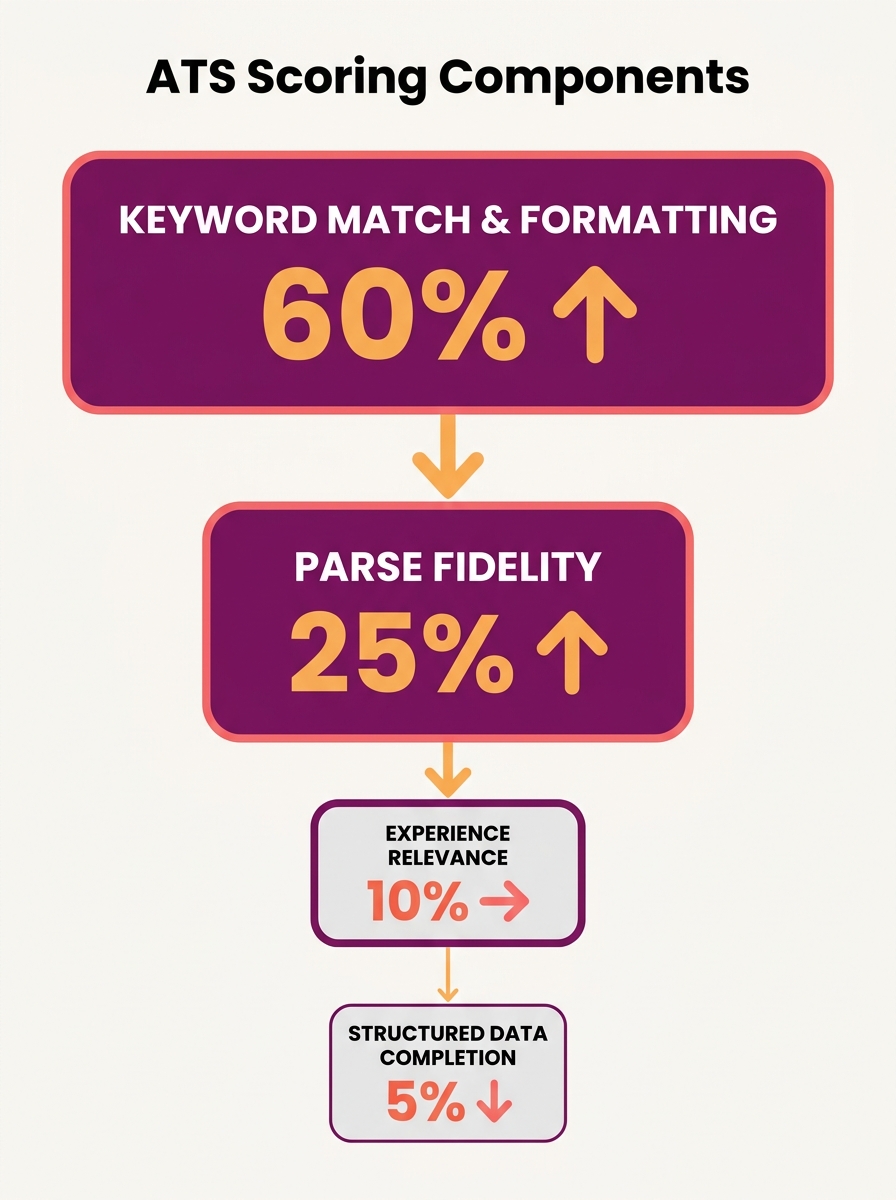
I call this the Compliance-Competence Gap: the measurable distance between what your ATS score rewards (format compliance, keyword density, section structure) and what you actually need to evaluate (skill depth, cultural alignment, growth potential). Every ATS has this gap. The question is how wide yours is, and whether your team is accounting for it.
In 2026, 93% of recruiters report using an ATS. That’s near-total adoption. And about 88% of applicants are unqualified for the roles they apply to, according to SelectSoftwareReviews’ updated statistics. So yes, you need automated filtering. The problem isn’t that ATS candidate ranking exists. The problem is that recruiters treat a keyword-matching score as a quality signal when it’s really a format-matching signal.
Historical Data Trains the Algorithm to Repeat Itself
Why does the algorithm define “good” the way it does? Because it learned from your past hires. According to findings published in the Harvard Business Review, biases in ATS often stem from algorithms trained on historical data. If an ATS is trained on a dataset reflecting a predominantly homogeneous workforce, it favors candidates who fit that profile. The system isn’t malicious. It’s a mirror of your hiring history, polished and automated.
A study by the MIT Media Lab confirmed that recruitment algorithms can inadvertently favor certain demographics, perpetuating existing inequalities. One well-known tech company’s algorithm ranked male candidates higher for technical roles because the training data — years of predominantly male hires — taught the system that male-associated resume patterns correlated with “success.” The resume ranking logic reproduced the bias at scale, faster and more consistently than any individual recruiter could.
University of Washington researchers demonstrated that AI tools show measurable biases in ranking job applicants’ names according to perceived race and gender. The applicant scoring algorithm doesn’t evaluate skills in a vacuum. It evaluates a document that contains signals — name, school name, location, phrasing conventions — that correlate with demographic categories. When the training data rewards a particular demographic pattern, the system rewards it too.
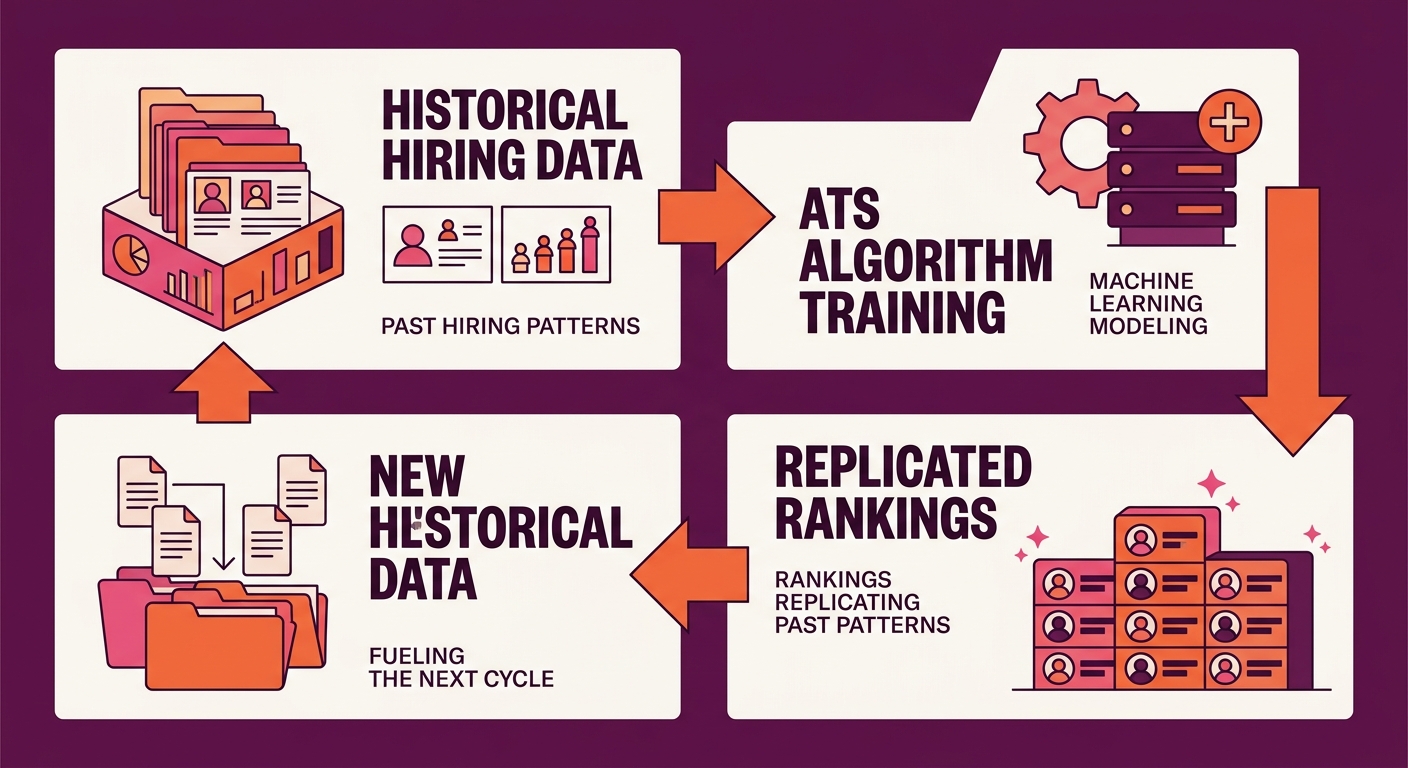
This feedback loop matters for a specific reason: the candidates your ATS scores highest are the candidates who most closely resemble your existing employees. If your team is already strong and diverse, that’s fine. If your team has blind spots — in skill mix, perspective, or demographic representation — the ATS match percentage will actively work against fixing them. We’ve written about how ATS systems can auto-reject candidates through hidden filters based on age, and the same structural logic applies to other demographic dimensions. The system reflects the past. Your hiring needs point toward the future. Those two things diverge more often than most recruiters realize.
Recruiters Trust the Number, and the Number Knows It
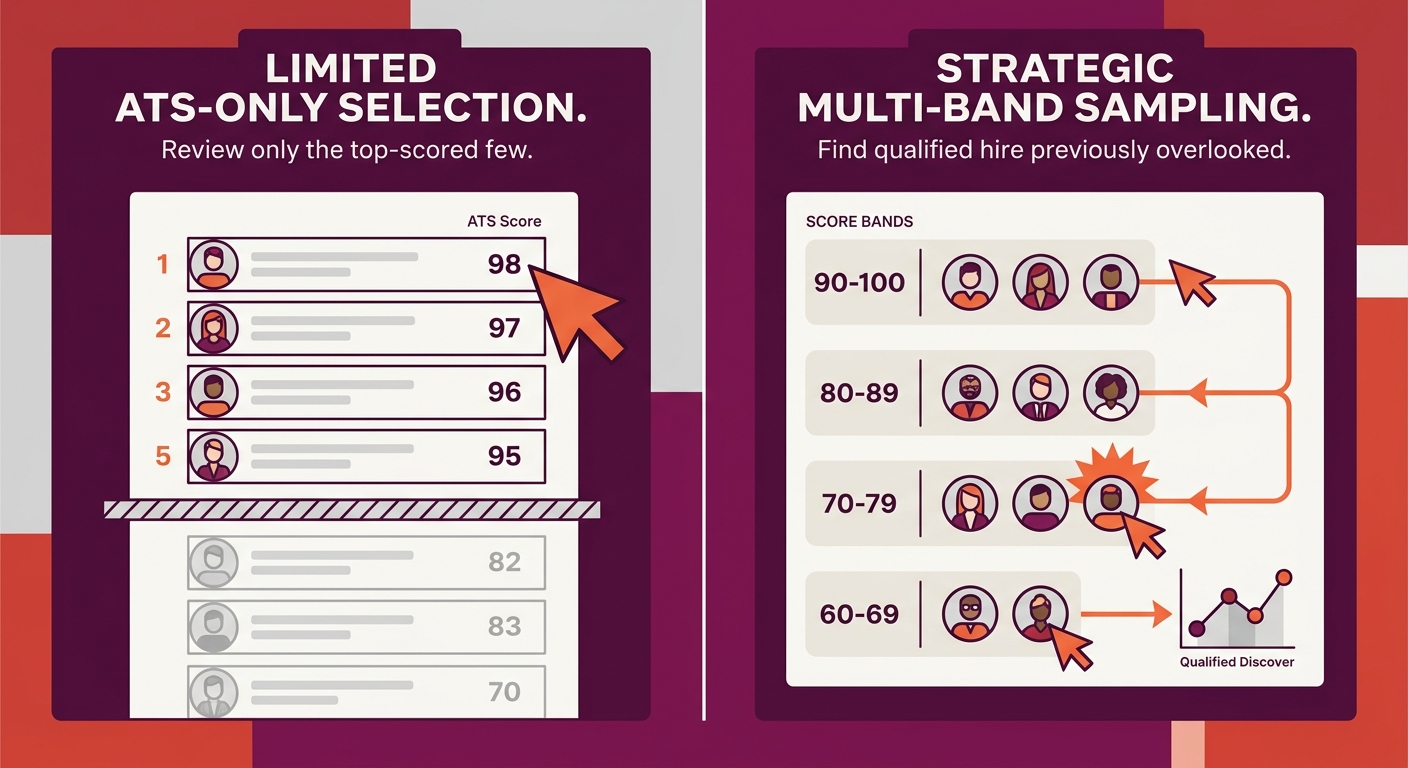
The third piece of evidence is behavioral, not technical. Automation bias — the tendency for humans to place excessive trust in automated systems — occurs when recruiters defer to algorithmic recommendations without adequate scrutiny or critical evaluation. The ATS gives you a ranked list. You start at the top. You interview candidates in descending score order. You fill the role before you reach candidate number 30. That candidate at position 30 might have been the best fit, but you’ll never know, because the system said they were 30th and you believed it.
The Compliance-Competence Gap is the measurable distance between what your ATS score rewards and what you actually need to evaluate. Every ATS has this gap.
This gets worse with volume. When 75% of resumes never reach a human recruiter — a widely cited figure across ATS industry data — the automated ranking becomes the de facto hiring decision for three-quarters of your applicant pool. The recruiter believes they’re making the decision. The algorithm already made it.
And the candidates who game the system know this. With AI-generated fake resumes now appearing in 72% of recruiters’ application pools, the top-scored applicants increasingly include people who’ve reverse-engineered the scoring logic. They match keywords exactly, use standard section headers (“Experience,” “Education,” “Skills”), submit in DOCX format, and hit an 80% role-match threshold with surgical precision. MokaHR’s benchmarks show their AI matching delivers 87% accuracy compared to manual reviews and 3× faster candidate screening, but accuracy measured against the algorithm’s own criteria doesn’t tell you whether those criteria predict job performance. A system that’s 87% accurate at identifying keyword matches is still 0% accurate at measuring judgment, collaboration, or adaptability.
The recruitment automation bias problem compounds when recruiters skip the step of validating ATS output against their own assessment. You can configure knockout questions to handle hard requirements like licensure or work authorization. But soft-skill evaluation, team-fit judgment, and potential assessment? Those can’t be scored by keyword frequency. Treating the ATS ranking as a rough filter rather than a final verdict is the difference between a hiring pipeline that works and one that looks efficient while missing talent.
The Claim, Revisited
The ATS candidate ranking in your system does something specific: it measures how well a document conforms to parsing expectations, keyword requirements, and formatting standards. That measurement correlates weakly with candidate quality. The correlation is strong enough to justify using ATS screening as a first pass. It is far too weak to justify using ATS scores as the primary signal for interview decisions.
Three structural forces drive the gap. The scoring weights favor surface compliance over depth of qualification. The training data reproduces your existing hiring patterns, including their blind spots. And automation bias causes recruiters to accept the ranked list without questioning what it actually represents.
Tip: Audit your Compliance-Competence Gap: pull the ATS scores for your last 20 hires, then compare those scores against 90-day performance reviews or hiring-manager satisfaction ratings. If the correlation is weak (and for most teams, it will be), you know the score is filtering for the wrong things — and you can recalibrate your process accordingly.
The fix isn’t abandoning automated ranking. You need it. Eighty-eight percent of applicants are unqualified, and no human team can process hundreds of resumes per opening without support. The fix is understanding what the score actually tells you — which is how well someone’s resume matches your system’s expectations — and supplementing it with evaluation methods that measure what the score can’t. Structured interviews with behavioral anchors, for instance, push predictive validity from .20 to .57, which is a stronger signal for hire quality than any ATS match percentage will ever produce. Your ATS is a screening tool, not an oracle. The organizations that treat it accordingly will hire better.