
Screening duration at a mid-market SaaS company dropped from five days to 1.8 days after the talent team dismantled its existing ATS pipeline and rebuilt every stage from the initial application trigger forward. The 40% time-to-hire reduction came from redesigning workflow logic, not from switching vendors.
The Workflow Nobody Actually Designed
Growth-stage SaaS companies build their ATS workflows the same way they build internal documentation: in panicked response to immediate needs, with nobody stepping back to evaluate the whole system. A company at 30 employees creates a basic pipeline in Greenhouse or Lever. By the time headcount reaches 200, three different hiring managers have bolted on custom stages, someone has configured knockout questions that haven’t been reviewed in over a year, and the original workflow has mutated into something that adds days to every open requisition without anyone understanding why.
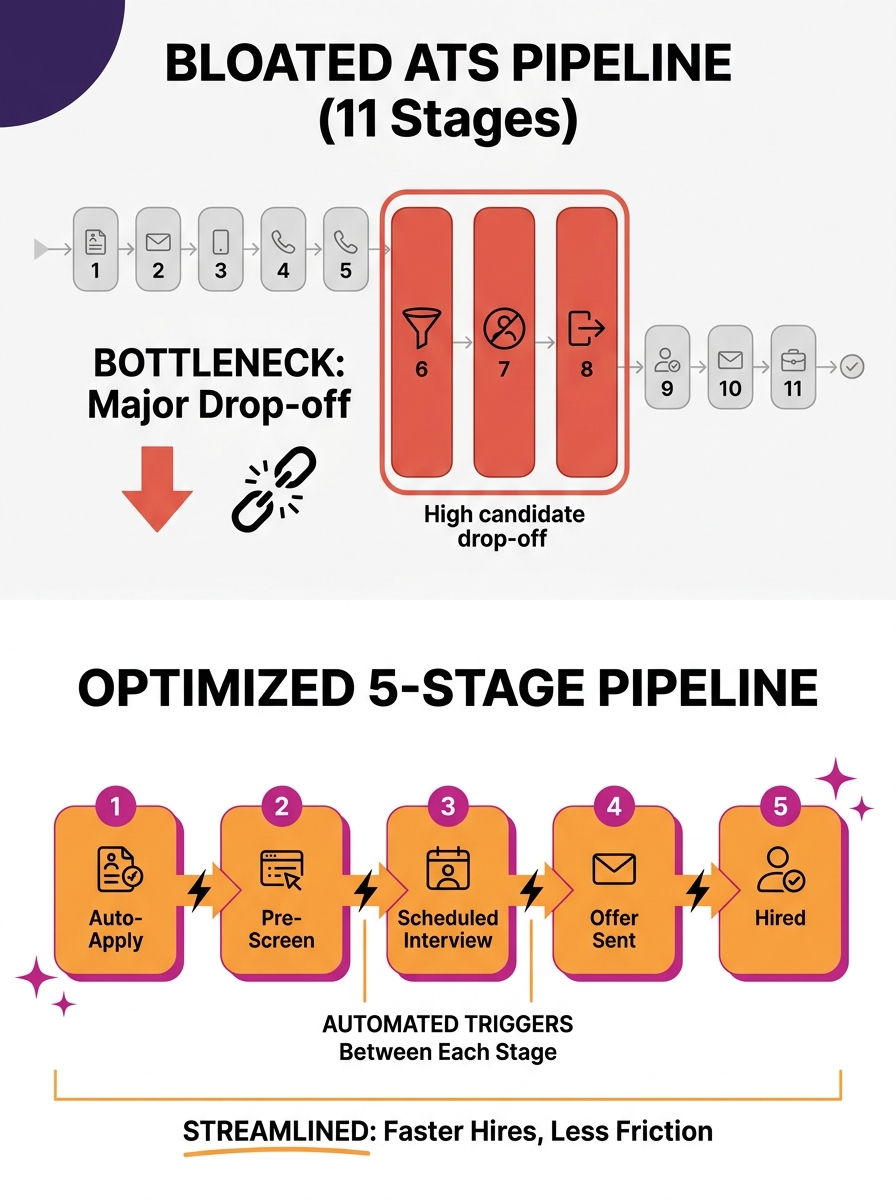
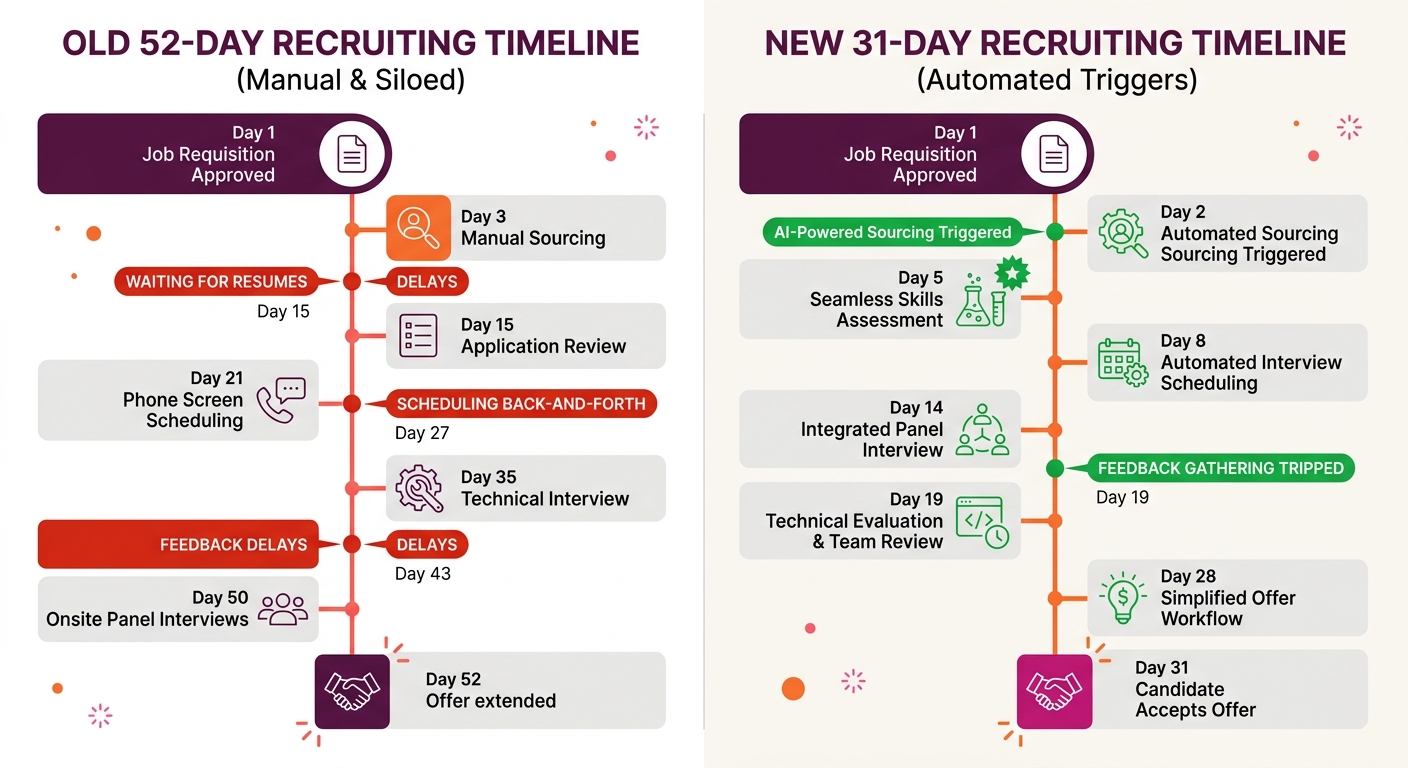
The 200-person SaaS company in this hiring efficiency case study fits that pattern precisely. Their ATS had accumulated 11 distinct pipeline stages for engineering roles, 9 for go-to-market roles, and 14 for customer success positions. No two departments followed the same cadence for moving candidates between stages, and automated communications had been turned off during a compliance scare and never switched back on. The result was a median time-to-hire of 52 days for technical roles and 38 days for non-technical positions, both well above the benchmarks their talent team had set when the company crossed 100 employees.
What made the situation more expensive than the raw day-count suggests is what Cornerstone’s talent pipeline research quantifies: proactive pipeline management reduces recruitment time from 170 to 60 days, and bad hires that slip through a slow, unstructured process cost up to 5x the employee’s annual salary. The company wasn’t just slow. Their offer-acceptance rate had dipped below 60% because top candidates were taking competing offers during the review bottleneck between stages 6 and 8 of the engineering pipeline. The follow-up gaps were creating exactly the ghosting pattern that most recruiting teams blame on candidates rather than on their own process design.
Rebuilding from the Application Trigger
The recruiting process redesign started with a decision that sounds obvious in retrospect but required genuine organizational courage: the VP of Talent threw out every existing pipeline configuration and started with a blank canvas. The team mapped only the stages where a human decision was genuinely required, and everything else became an automated trigger. For engineering roles, the 11-stage pipeline collapsed to 5 stages. For customer success, 14 became 6.
The first concrete change was automating application acknowledgments. Before the rebuild, candidates who applied to engineering roles waited an average of 72 hours before receiving any response. Research from iCIMS confirms that automating acknowledgments, scheduling, and scorecard reminders saves recruiters 4 to 6 hours per week and prevents the candidate drop-off that compounds at every stage of a sluggish pipeline. The company configured immediate acknowledgment emails with role-specific timelines, telling candidates exactly when they’d hear back and what the next stage involved. Transparency alone cut their early-funnel abandonment rate by 22%.
The second structural change targeted resume screening. The old process routed every application through a single senior recruiter who batch-reviewed resumes twice per week, creating an artificial 3-to-5-day delay before any candidate moved forward. The rebuilt workflow introduced AI-powered resume parsing that scored candidates against role-specific criteria within minutes of application. According to NTRVSTA’s analysis of automated ATS workflow solutions, AI-driven screening can reduce time-to-hire by up to 50% when paired with clear criteria definitions. The company landed at a 40% reduction, which their VP of Talent attributed to the fact that they kept a human reviewer in the loop for any candidate the AI scored in the middle 30% of the distribution. That human checkpoint added time but preserved quality, and their interview-to-offer conversion rate actually improved by 8 percentage points compared to the pre-rebuild baseline.
The third change addressed what the team called “the scheduling swamp.” Interview coordination for technical roles had involved an average of 14 emails per candidate across the full loop. The rebuilt workflow used automated scheduling tools integrated directly with the ATS, giving candidates self-service access to interviewer availability windows. Engineering panel interviews that previously took 6 days to coordinate dropped to 1.5 days from initial scheduling request to confirmed calendar hold.
What the Numbers Showed After Ninety Days
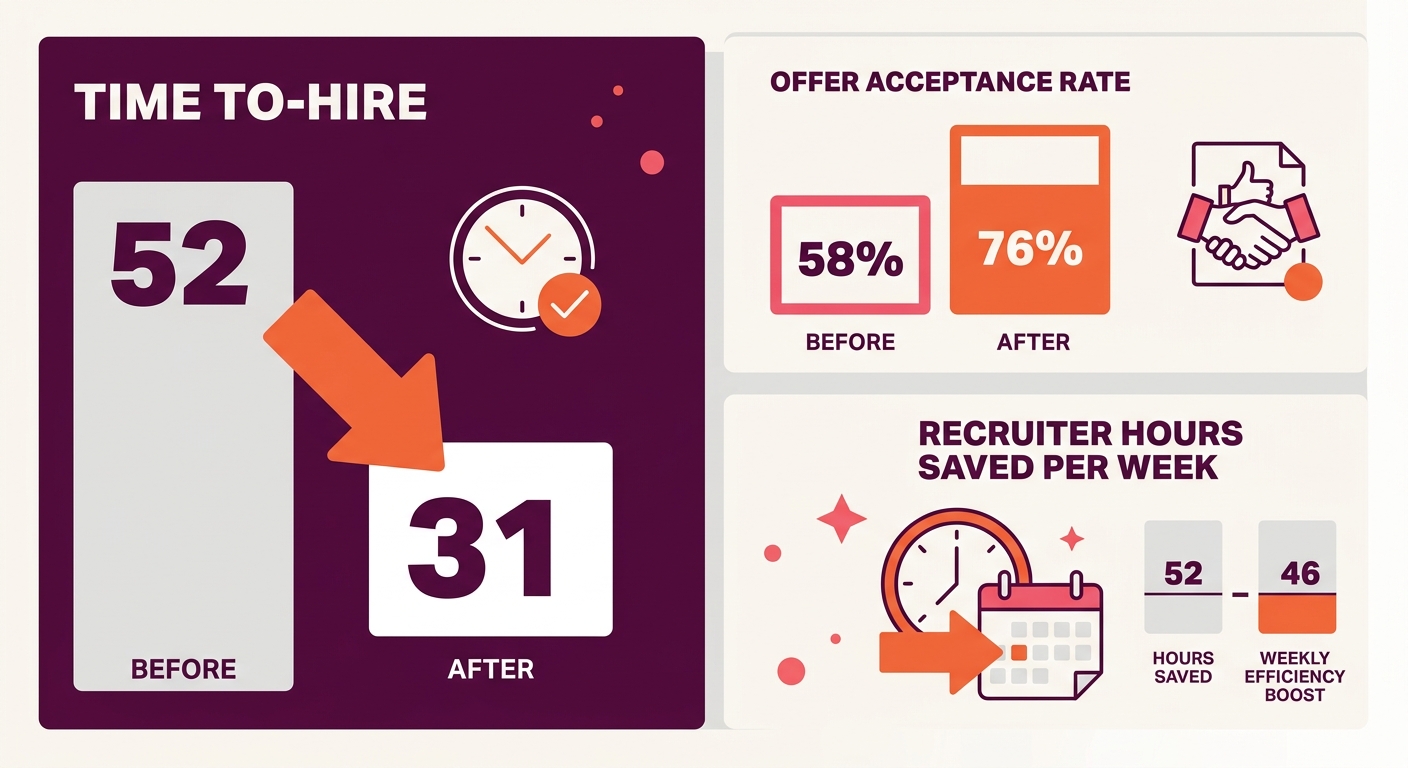
The 40% time-to-hire reduction is the headline figure, but the second-order metrics tell a more complete story about what ATS workflow optimization actually changes. Engineering roles dropped from a 52-day median to 31 days. Non-technical roles went from 38 days to 24 days. The company tracked these numbers weekly for 90 days after the rebuild went live, and the improvements were consistent across every hiring manager and every department, which suggests the gains came from the system design rather than from any individual recruiter performing differently.
Offer-acceptance rates climbed from 58% to 76%. The talent team’s internal analysis attributed roughly half of that improvement to speed and the other half to the candidate experience improvements created by consistent, automated communication at every stage transition. Candidates who received timely updates at each pipeline stage were 3x more likely to rate the company’s hiring process as “excellent” in post-interview surveys compared to the pre-rebuild period. And high-quality hires made through structured, faster pipelines are 40% less likely to leave within the first year, which connects the time-to-hire reduction directly to retention outcomes that the finance team cares about.
The company didn’t buy a new tool. They had every feature they needed already, sitting behind configuration screens their recruiting team had never revisited after initial setup.
Recruiter workload shifted in a way that the team didn’t fully anticipate. Each recruiter recovered approximately 5 hours per week from eliminated manual tasks, and most of that time migrated into sourcing and candidate relationship-building rather than into administrative work. The ratio of proactive sourced candidates to inbound applicants shifted from 20/80 to 35/65 within the first quarter, which began feeding the kind of talent pipeline that compounds over multiple hiring cycles. That pipeline effect is harder to quantify in the first 90 days, but the early signals suggest it will matter more than the initial speed gains over a 12-month horizon.
One number that didn’t change deserves mention: the volume of applications per role stayed essentially flat. The rebuild didn’t attract more candidates. It moved existing candidates through a sane process fast enough that the company stopped losing its best applicants to competitors who moved faster. The mechanics of how their ATS ranked candidates also became more transparent to hiring managers, which reduced the number of “why did this person get surfaced?” conversations that had been consuming weekly calibration meetings.
The Uncomfortable Part of This Argument
The case for SaaS talent acquisition teams to rebuild their ATS workflows is strong, and the data from this company supports a clear conclusion: a 200-person company with a bloated pipeline and manual bottlenecks has substantial time-to-hire reduction available without spending a dollar on new technology. But there are pieces of this story that resist clean generalization.
The rebuild worked in part because the VP of Talent had direct authority to override every hiring manager’s pipeline preferences simultaneously. Companies where recruiting operates as a service function to engineering or sales leadership rarely get that mandate. The political cost of telling a VP of Engineering that their 14-stage interview process is being cut to 6 stages is real, and nothing in the ATS configuration screen helps you navigate it. The technical redesign took two weeks. Getting organizational buy-in took three months before the technical work even started.
There’s also a question about whether the 40% figure represents a permanent structural improvement or a one-time correction of accumulated dysfunction. The company’s pre-rebuild process was unusually bloated, even by growth-stage SaaS standards. A company that already runs a reasonably clean 6-stage pipeline with basic automation in place would likely see a 10% to 15% improvement from the same type of audit, not 40%. The gains are real, but they scale with how broken the starting point was, which makes this more of a recovery story than a universal recruiting process redesign playbook.
And the reliance on AI-powered screening introduces its own risks. The company’s decision to keep a human reviewer for the middle 30% of AI-scored candidates was wise, but it also means their process depends on a recruiter who understands the ways ATS filtering can inadvertently exclude qualified candidates. If that person leaves, the institutional knowledge about where the AI’s judgment needs human correction leaves with them. Automation scales process speed. It doesn’t automatically scale process judgment, and conflating the two is how companies optimize their way into a different set of hiring problems six months down the road.