
Applicant tracking systems designed to simplify hiring are blocking millions of qualified workers from ever reaching human recruiters, according to joint research from Harvard Business School and Accenture that identified a population the study calls “Hidden Workers”, people ready to work but filtered out by automated screening criteria before their applications receive any human evaluation.
TL;DR: Harvard and Accenture research found that ATS platforms filter out millions of qualified candidates based on narrow keyword matching and rigid credential requirements, with 88% of employers acknowledging their systems reject suitable applicants who don’t match job descriptions exactly.
The Scale of Automated Rejection
The research documented a fundamental disconnect in today’s labor market: employers report difficulty filling open positions while millions of job-ready candidates submit hundreds of applications without ever receiving interview requests. The filtering happens through applicant tracking systems that process high application volumes by automatically eliminating candidates who fail to meet pre-programmed criteria.
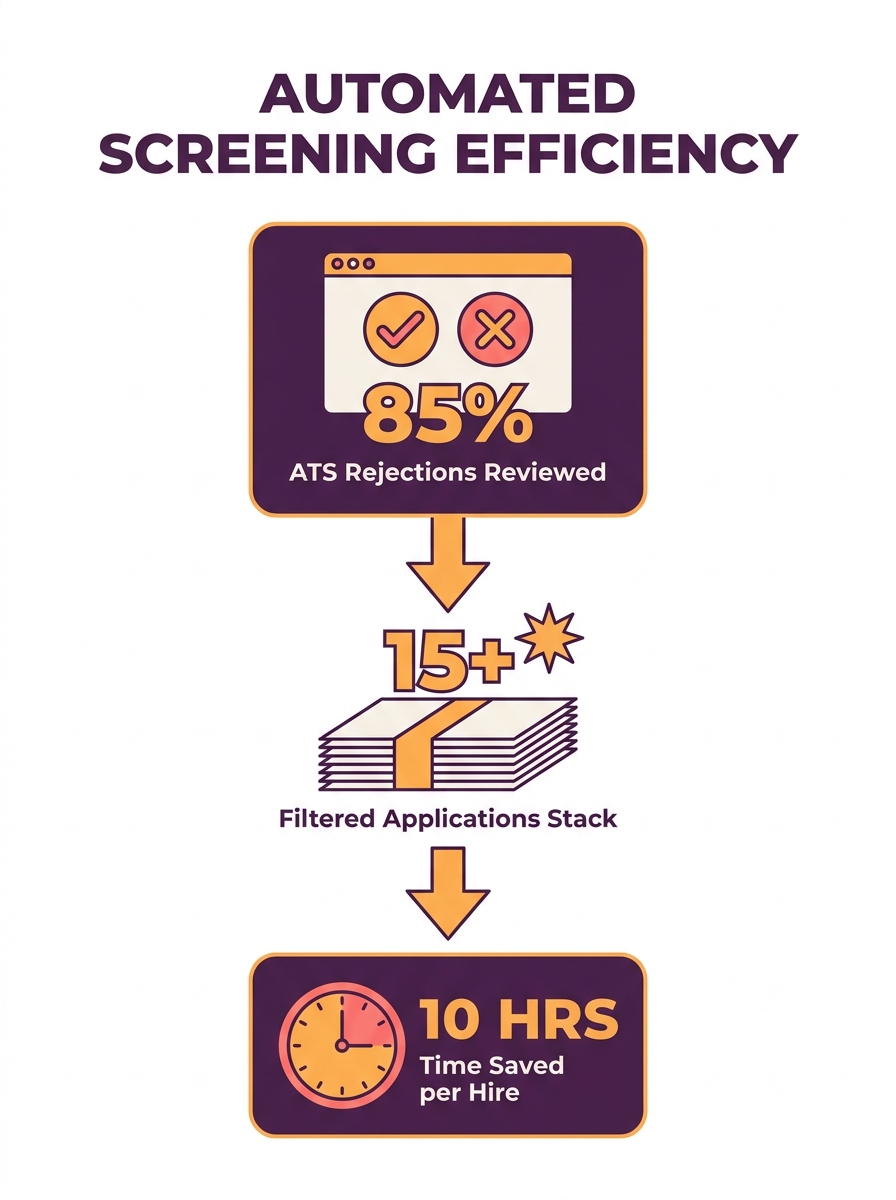
Eighty-eight percent of employers surveyed acknowledged that qualified candidates are filtered out of consideration solely because their applications do not precisely match the language used in job descriptions, according to the Harvard-Accenture study. The ATS platforms evaluate candidates on measurable data points, education credentials, years of experience in specific roles, and keyword density in resumes, rather than assessing actual ability to perform job duties.
Who Gets Filtered Out
Candidates with non-linear career paths face the highest rejection rates from automated screening. Workers who took time off to care for family members, professionals who changed industries mid-career, and job seekers re-entering the workforce after unemployment are disproportionately eliminated by systems programmed to identify exact credential matches, the research found.
The filtering extends to applicants with directly relevant experience who use different terminology to describe their skills. A candidate might possess the required technical abilities but describe them using industry terms that differ from the specific phrases the ATS was configured to detect, resulting in automatic rejection before any recruiter views the application.
Documented Cases of Algorithmic Bias
Amazon discontinued its AI-powered recruiting tool in 2018 after discovering the system assigned lower scores to female applicants, according to reporting on the company’s internal findings. The algorithm learned from Amazon’s historical hiring data, which reflected existing gender imbalances in technology roles, and replicated those patterns in its candidate evaluations.
In 2024, Workday, a major human resources software provider, faced a class-action lawsuit alleging its automated screening systems discriminate based on age, gender, race, and disability status. One plaintiff in the case reported being rejected more than 100 times by companies using Workday’s applicant tracking platform, according to court filings. The case remains in litigation.
The allegations against Workday reflect broader concerns about whether ATS candidate ranking mechanics encode biases that would violate employment law if applied by human recruiters. Legal experts note that automated systems can create discriminatory patterns even when developers do not intentionally program bias into the algorithms.
The System Design Problem
Applicant tracking platforms are engineered to reduce the number of candidates that reach human review, not to identify the best possible hires. When companies receive thousands of applications for a single opening, the ATS functions as an elimination tool designed to produce a manageable shortlist as quickly as possible.
This design priority creates a mismatch between system function and hiring goals. Resume parsing failures occur when ATS software cannot correctly extract information from document formats it was not trained to read, causing qualified candidates to appear unqualified in the database. Candidates who skip optional form fields may trigger automatic rejection through required field validation, even when the missing data is not material to job performance.
The Harvard-Accenture research noted that job descriptions themselves contribute to over-filtering when they list credentials beyond what the role actually requires. Systems configured to enforce every stated requirement eliminate candidates who could perform the work but lack specific educational degrees or certification acronyms.
What This Means for In-House Recruiters
Recruitment teams face a strategic choice about how much hiring authority to delegate to automated systems. The evidence shows that ATS platforms configured for aggressive filtering will eliminate qualified candidates in pursuit of exact-match credentials, potentially shrinking talent pools below sustainable levels in competitive hiring markets.
Recruiters can reduce over-filtering by auditing which ATS rules function as hard stops versus soft preferences, reviewing rejected candidate samples to identify patterns of inappropriate elimination, and manually reviewing borderline applications that fall just below automated cut scores. The 88% employer acknowledgment of qualified-candidate rejection suggests most hiring teams already recognize the problem exists in their own pipelines.
The legal exposure from algorithmic bias adds compliance risk to operational concerns. AI hiring screening tools face regulatory scrutiny in multiple jurisdictions, and relying on vendor-supplied algorithms does not insulate employers from discrimination claims if the systems produce disparate impact. Documentation showing human oversight of automated decisions strengthens legal defensibility when candidates challenge rejection patterns.