Seventy-two percent of recruiters have already encountered AI-generated fake applications including fabricated work histories, invented references, and machine-written resumes, according to a 2025 Software Finder survey of 874 HR professionals published May 29. The findings confirm that applicant tracking systems designed to parse and rank candidates were never built to verify authenticity, allowing AI-generated resumes to pass screening filters and often score well against keyword matching algorithms.
TL;DR: Three-quarters of recruiters report AI-generated fake resumes in their applicant pools, yet only 19% of hiring managers believe their processes would catch fraudulent candidates before hire.
The survey data reveals that 51% of HR professionals have seen AI-generated portfolios and 42% have encountered fabricated references. A separate 2025 Checkr survey of 3,000 hiring managers found that only 19% expressed confidence their hiring process would identify a fraudulent candidate, meaning 81% are screening applicants without effective fraud detection.
“When an AI writes a resume using the precise keywords from a job description, it doesn’t just pass the ATS. It scores well,” the Software Finder analysis notes. Tools like ChatGPT and specialized resume-building platforms can generate complete professional histories in under 60 seconds, including quantified achievements like “Reduced customer churn by 34%” that appear specific enough to be credible but remain impossible to verify without direct employment confirmation.
Detection Tools Reveal Scale of Existing Fraud
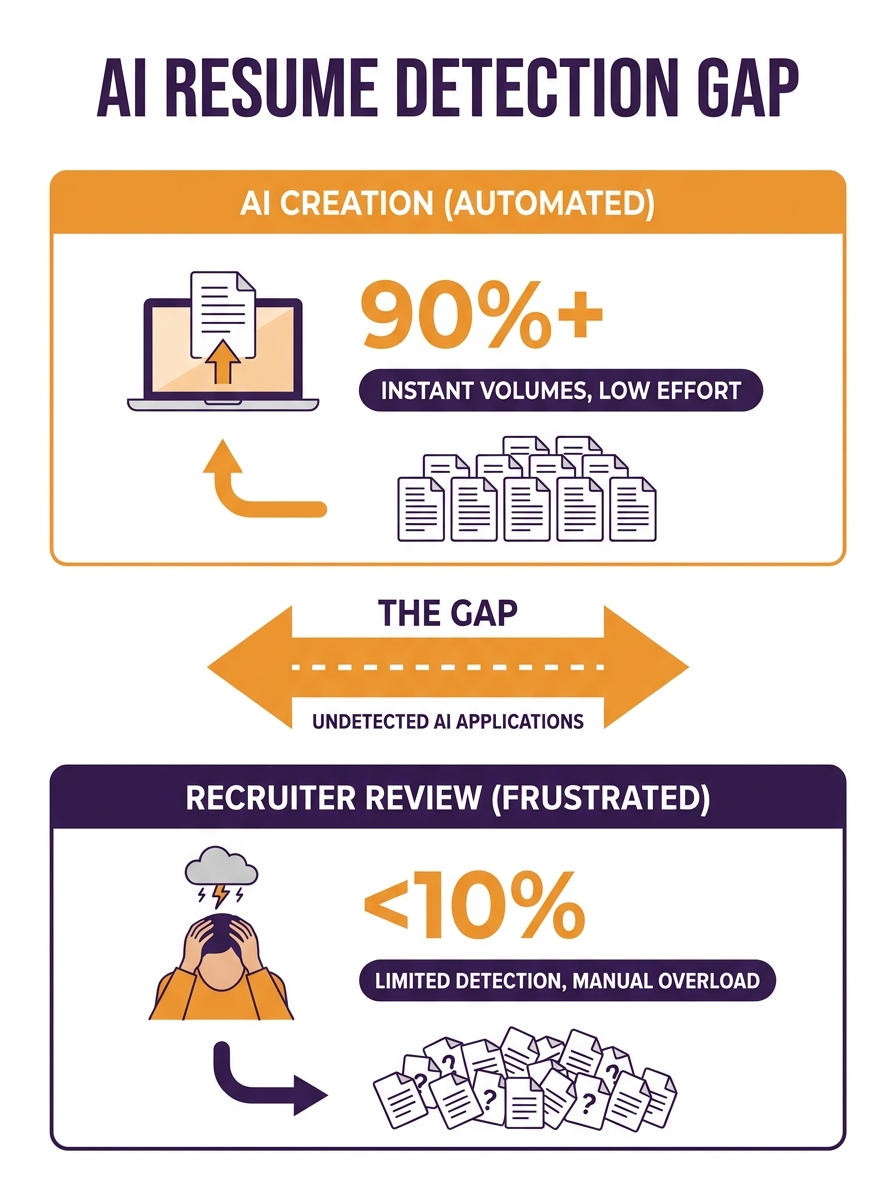
Between September and November 2025, cybersecurity firm Huntress implemented AI-detection tools on their own recruiting pipeline and flagged 23.2% of applicants as fraud risks, according to 2026 data from the company. The finding suggests nearly one in four applications in a tech-sector hiring process involved AI-generated or falsified resume submissions that would have remained invisible under traditional screening methods.
Gartner forecasts that one in four applicant profiles will be fraudulent by 2028. The prediction aligns with current detection rates among organizations that have deployed verification technology, indicating the fraud volume may already be higher than most recruiting teams realize.
The Checkr survey found that 62% of hiring managers believe job seekers are now better at faking qualifications and experience with AI assistance than HR teams are at detecting those deceptions. Only 13% disagreed with that assessment.
What AI Tools Can Fabricate in Under One Minute
AI resume generators can now produce complete career narratives that include job titles, employer names, employment dates, reporting structures, and progression patterns that mirror natural professional growth, according to the Software Finder report. The tools generate quantified achievements using specific numbers and percentages, skills sections that mirror exact language from job descriptions, and cover letters referencing company mission statements and recent organizational updates.
Some candidates create matching LinkedIn profiles with AI-generated connections and endorsements to support the fabricated work history. The profiles appear credible during standard reference-checking processes because they contain consistent information across multiple platforms.
Traditional applicant tracking system screening relies on keyword matching and resume parsing to rank candidates. Those systems were designed to identify relevant experience based on terminology alignment, not to verify whether the experience is real. When AI-generated resumes contain precise keywords lifted from job postings, they often rank higher than authentic applications from qualified candidates who use different terminology to describe equivalent skills.
Recruiters Lose 850 Hours Annually to Irrelevant Applications
Before AI-generated fraud entered the picture, recruiters were already losing an estimated 850 hours per year processing irrelevant applications, according to industry data cited in the Software Finder analysis. The addition of fabricated resumes that pass initial screening filters but fail at later verification stages compounds the time loss.
No recruiting team’s key performance indicators currently include fraud detection rate. Recruiters are measured on speed-to-fill and quality-of-hire metrics that create pressure to advance polished candidates through the pipeline rather than investigate application authenticity. The incentive structure favors moving quickly when a well-formatted resume appears in an inbox for a hard-to-fill role.
“Nobody’s KPI is ‘fraud detection rate,'” the report notes. “The more stretched your team is, the more AI-generated applications slip through.”
Organizations that have implemented detection tools report discovering fraud that was previously invisible under their standard screening processes. The Huntress finding of 23.2% fraud risk among applicants represents a baseline measurement after adding verification technology, not the fraud rate under their prior system.
What Happens Next
Recruiting teams will need to add verification steps between ATS screening and interview scheduling to catch AI-generated applications before investing time in phone screens or onsite interviews. The verification gap exists because current workflows assume resumes are authentic once they pass keyword filters and parsing requirements.
The Software Finder data suggests fraud detection needs to become a measured recruiting metric alongside time-to-fill and cost-per-hire. Organizations that continue optimizing for speed without adding verification checkpoints will likely see rising rates of fraudulent hires that only become apparent after onboarding, when the skill gaps emerge during actual work assignments.
Third-party verification services and AI detection tools represent the near-term solution for recruiting teams without capacity to manually verify every application. The Huntress case demonstrates that adding automated fraud screening can immediately flag nearly one-quarter of applicants in competitive tech hiring pipelines, preventing those candidates from consuming recruiter time during later interview stages.