
A technical implementation guide published May 28 identifies disruption to existing applicant tracking systems as the primary obstacle preventing recruiting teams from adopting AI-powered hiring tools, even when those teams acknowledge the performance gains AI can deliver, according to Pete & Gabi, an AI-powered call automation vendor serving recruitment and sales teams.
TL;DR: The guide documents four distinct integration patterns for connecting AI recruiting tools to existing ATS platforms without breaking live candidate pipelines or triggering data migration projects.
The 2,800-word technical resource was released as recruiting organizations increasingly face vendor pitches for AI screening, interview automation, and candidate matching tools while simultaneously managing years of candidate data, compliance records, and hiring manager access housed inside legacy ATS infrastructure. The friction point, according to the guide, is not whether AI tools improve hiring outcomes, IBM has documented measurable gains in time-to-hire and recruiter productivity across AI-assisted talent acquisition programs, the guide notes, but whether integrating new software will cause three-week pipeline outages or require six-month implementation cycles.
Four Integration Patterns Documented
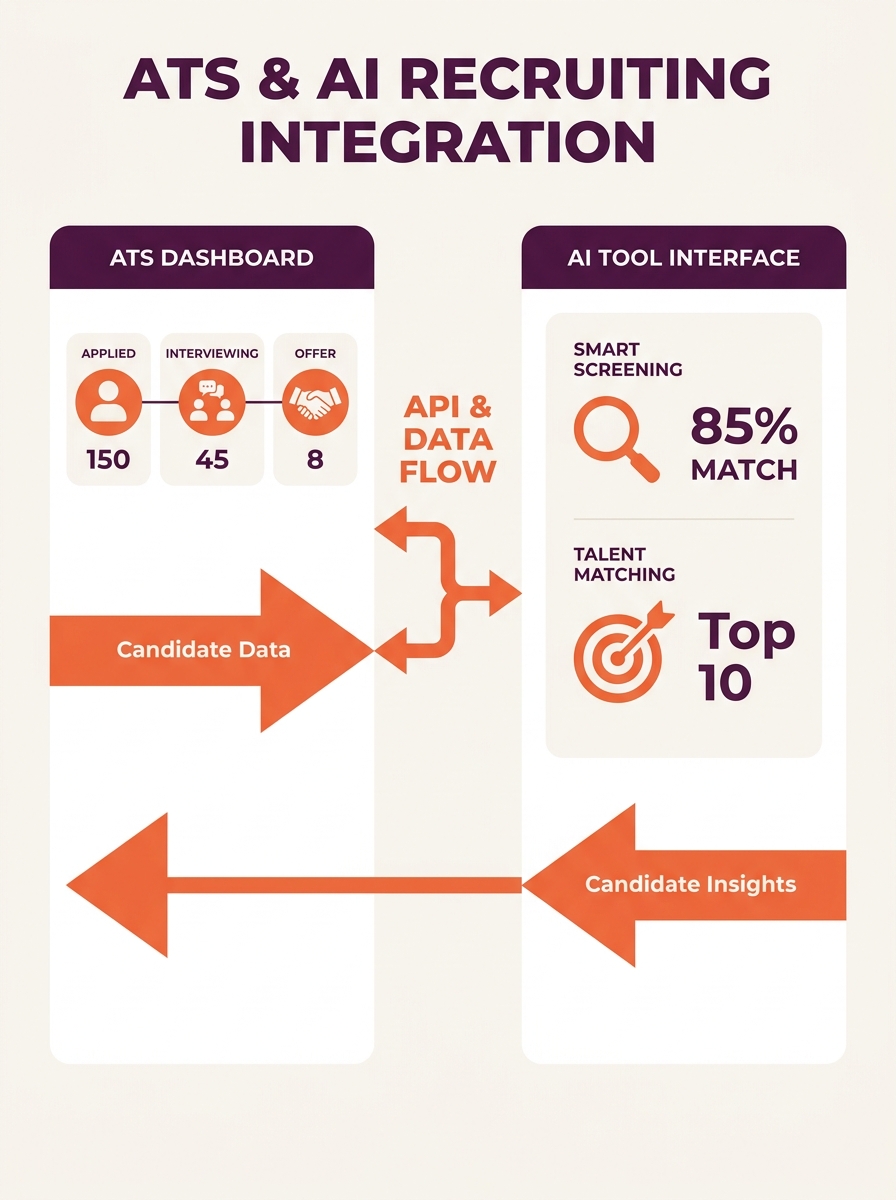
The guide categorizes ATS-to-AI tool connections into four technical approaches, each carrying different risk profiles and IT resource requirements.
Native marketplace integration, positioned as the lowest-friction option, involves granting OAuth permissions through an ATS vendor’s certified partner marketplace. Platforms including Greenhouse, Lever, iCIMS, and Workday maintain these marketplaces, the guide states. Setup typically requires no custom development and allows automatic data flow between systems.
Direct API or webhook connections serve as the second pattern for tools not listed in native marketplaces. The AI vendor sends interview scores, candidate summaries, and qualification flags to a webhook endpoint inside the ATS. Lever published guidance in 2024 recommending accurate data field mapping as the critical success factor for this integration method, according to the document.
Integration platform as a service (iPaaS) middleware, platforms like Zapier, Make, or Workato, represents the third approach. These tools translate data fields and automate synchronization without requiring dedicated engineering resources, though they introduce an additional monthly cost and a third system to maintain.
Browser extension overlays, the fourth pattern, operate as lightweight layers reading and writing through the ATS browser interface rather than backend APIs. The guide characterizes this approach as suitable for proof-of-concept deployments but warns that extension-based integrations “tend to break when ATS vendors update their UI” and rarely support reliable bidirectional data synchronization at the production level.
Pre-Integration Audit Requirements
The guide recommends recruiting teams conduct an internal ATS audit before evaluating vendors, identifying three required data points: whether existing data fields use structured formats or free text, whether the ATS platform supports open API access, and what the candidate flow looks like across each pipeline stage.
Structured fields integrate cleanly, the document states, while free-text recruiter notes, unformatted resume data, and inconsistent job titles “require transformation before an AI can use them reliably.” API depth varies across platforms, some allow full bidirectional data synchronization while others permit reading candidate records but restrict write-back functionality without additional configuration.
The audit process typically consumes one to two days for teams familiar with their ATS, according to the guide, but prevents “weeks” of delays later in implementation. Teams that skip this step “discover problems mid-implementation when the cost of fixing them is much higher,” the document states.
Sandbox testing emerges as a second critical pre-deployment requirement. The guide instructs teams to request sandbox or test environments from ATS vendors, noting that most enterprise platforms offer this capability but require specific requests. Running initial integrations in sandbox mode allows stress-testing of data field mappings without affecting live candidate records.
Pilot-First Deployment Model
The guide positions broad-scale activation across all open roles as “the most consistent mistake recruiting teams make when adopting AI tools.” When immediate system-wide deployment encounters problems, the document argues, isolating whether the issue stems from AI logic, data mapping, ATS configuration, or recruiter adoption becomes difficult.
The recommended alternative involves selecting a single role type where manual screening consumes the most recruiter hours, implementing the AI tool for that requisition exclusively, and measuring outcomes over a defined period before expanding deployment. This approach, which mirrors practices documented in real-time analytics for recruitment teams, allows teams to validate integration stability and performance gains in a controlled environment.
World Economic Forum reporting on AI-powered recruitment indicates that responsible deployment can strengthen both inclusion and process transparency, the guide notes, though it does not specify the publication date or methodology of that research.
Context and Outlook
The guide’s publication reflects a structural tension inside recruiting operations that has intensified as AI hiring tools proliferate. Talent teams increasingly encounter vendor demonstrations showcasing candidate matching algorithms, automated interview scheduling, and AI-powered screening, capabilities that promise measurable efficiency gains, while simultaneously managing ATS platforms containing years of hiring data, established integrations with HRIS systems, and workflows that hiring managers and recruiters depend on daily.
This integration complexity functions as a de facto barrier to AI adoption even among recruiting leaders who accept the performance case for automation. The four-pattern framework and sandbox-testing protocol documented in the guide address a gap in vendor sales processes, which the document characterizes as routinely glossing over infrastructure compatibility questions. For organizations evaluating recruitment automation tools, the pre-integration audit and pilot-deployment model offer a structured path that prioritizes risk mitigation over speed-to-launch.
The guide’s emphasis on native marketplace integrations and direct API connections over browser-extension approaches signals a maturing recruitment technology landscape where production-grade reliability and bidirectional data sync have become minimum requirements for enterprise recruitment software deployments. Teams considering AI recruiting tools now face a tactical decision about whether to prioritize tools that already maintain certified partnerships with their existing ATS vendor or to accept the implementation overhead of custom API work in exchange for broader vendor optionality.