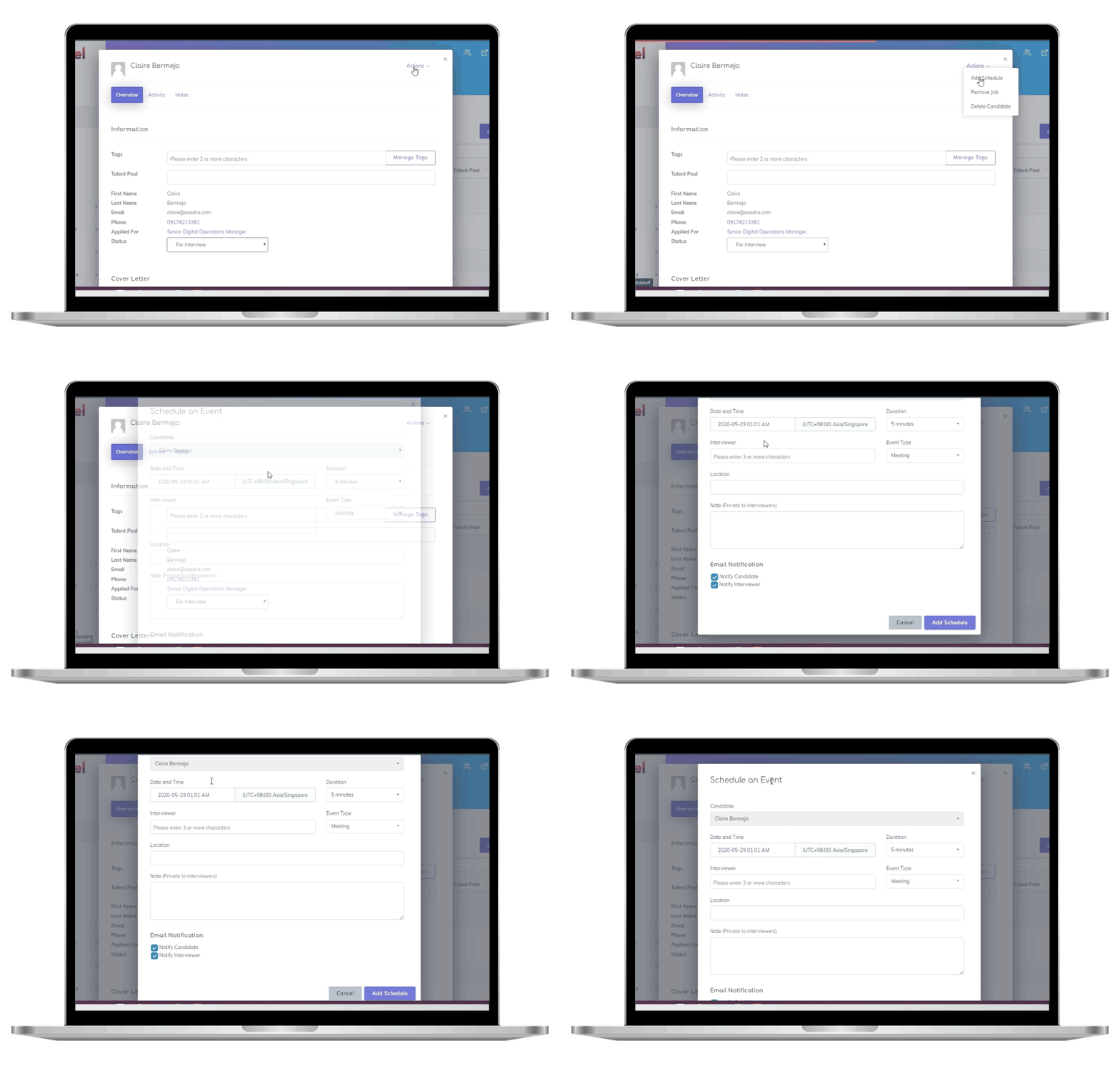
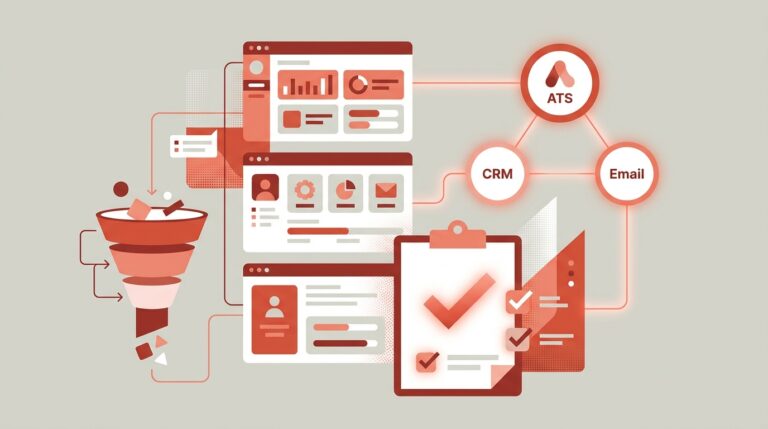
The global recruitment technology market is projected to reach $230.47 billion by 2028 at 7.68% annual growth, and over 75% of organizations already use some form of hiring tech. For in-house teams building a recruitment marketing tech stack in 2026, the real question is which layers matter, in what order they should be adopted, and how they connect.
When the ATS Was the Entire Stack
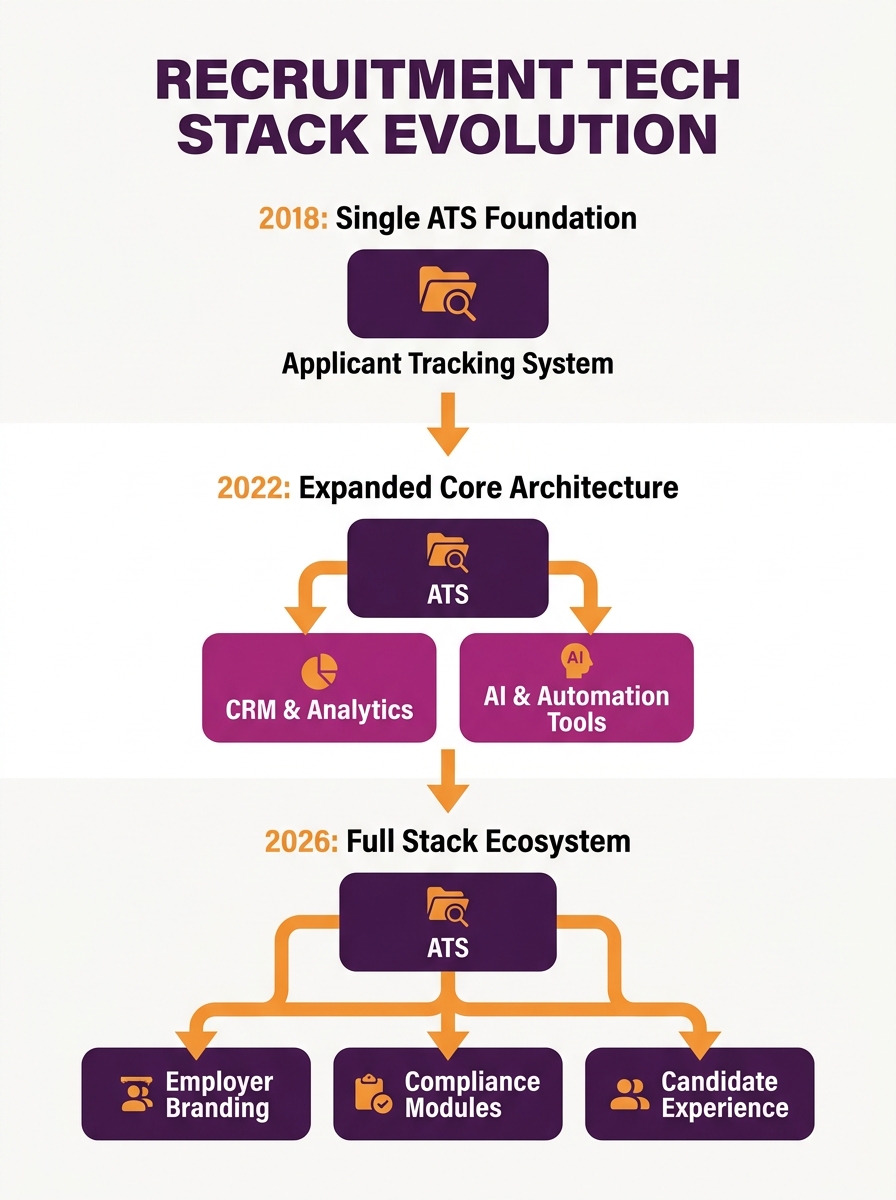
For most of the 2010s and into the early 2020s, the applicant tracking system was the recruitment marketing tech stack. Greenhouse, Lever, iCIMS, Workday: pick your flavor. These platforms handled job postings, application intake, interview scheduling, and offer management in a single interface. Employer branding tools were an afterthought, usually a careers page template bolted onto the ATS with limited customization.
The problem was structural. An ATS is built to process inbound applicants. It tracks people who’ve already raised their hand. But recruitment marketing requires a fundamentally different data model. You need to engage people who haven’t applied yet, track their interest over months, and serve them targeted content about your company long before a role opens.
In-house teams that relied solely on their ATS for candidate engagement were running a marketing function with a filing cabinet. The filing cabinet was excellent at what it did. Everything else suffered.
The CRM Breakout, 2022–2024
The separation of CRM for recruiting from the ATS started accelerating around 2022. Platforms like Beamery, Avature, and Gem built dedicated candidate relationship management tools that handled what an ATS couldn’t: outbound sourcing sequences, talent pool nurturing, event tracking, and engagement scoring.
As Leonar’s 2026 CRM analysis explains, “a CRM focuses on outbound recruiting: sourcing candidates, automating outreach sequences, nurturing talent pools, and tracking engagement over time.” That’s the opposite of what an ATS does. An ATS waits for applications. A CRM goes out and finds people.
By 2024, the split was clear enough that most mid-market and enterprise in-house teams ran both systems. Recruiting CRM platforms like Recruit CRM, Manatal, Bullhorn, and JobAdder offered multi-channel outreach through email, SMS, and even WhatsApp, with bulk messaging to 500+ profiles at once. The talent acquisition software checklist for any serious team now had two core entries instead of one.
But this created its own headache: data fragmentation. When your ATS and CRM don’t talk to each other cleanly, recruiters spend 11+ hours per week on manual data entry, copying candidate notes between systems and reconciling duplicate records. Teams that figured out why their employer brand fell apart during the actual hiring process often traced the breakdown to exactly this disconnect between marketing promises and operational reality.
AI Tools Flood the Market
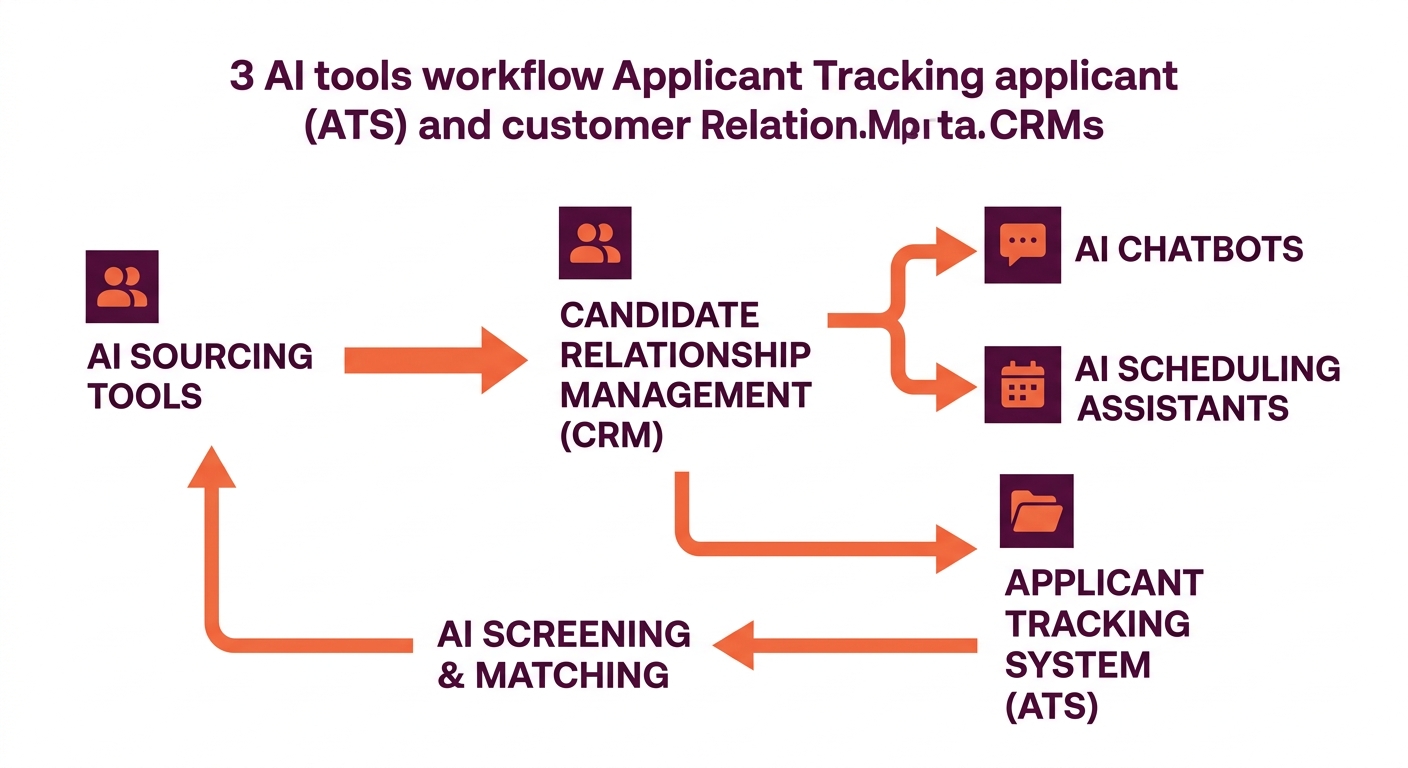
Between late 2024 and mid-2025, the AI layer of the recruitment marketing tech stack went from experimental to expected. Paradox’s Olivia chatbot handled fluid candidate scheduling and communication. Gem’s AI Outreach Assistant started generating personalized messages at scale. HireEZ and SeekOut brought AI-powered sourcing that could outperform traditional Boolean search on passive candidate discovery.
The numbers backed up the shift. Teams using AI scheduling and outreach tools reported 40–50% cuts in coordination time, according to industry analysis compiled by The Undercover Recruiter. That’s real hours back, hours that recruiters could redirect toward content marketing for recruiting efforts, candidate relationship building, or interview preparation.
Disconnected systems waste 11+ hours per week on manual data entry. Integration became the single most important selection criterion for HR marketing tools in 2026.
The Undercover Recruiter’s 2026 stack analysis captured the mood: the recruiter’s tech stack was being rebuilt from core candidate-engagement infrastructure to AI copilots making real-time recommendations. RecruitLab noted that leading teams had moved toward integrated platforms designed for speed, visibility, and control, with a unified CRM and ATS at the center.
The flood of point solutions did introduce vendor fatigue. A 2026 Recruiterflow analysis listed SmartDreamers, Firefish, Workable, Loxo, iCIMS, and TalentLyft among the top recruitment marketing tools, and that’s before counting the sourcing, scheduling, assessment, and analytics tools each team layered on top. Some in-house teams ended up managing 8–12 separate logins.
Compliance Forced the Stack to Mature
The regulatory landscape did something no vendor pitch could: it forced in-house teams to treat their tech stack as a system rather than a collection of tools. California’s Fair Employment and Housing Act (FEHA) and Illinois’s HB-3773 now legally require anti-bias testing and transparency when AI is used in hiring decisions. As we’ve covered, employers own legal liability for AI hiring tools regardless of vendor source.
This changed buying criteria overnight. Audit-ready transcripts, decision logs, and bias-testing documentation became essential features when evaluating any AI-powered tool. Employer branding tools that distributed job ads through programmatic channels needed to demonstrate they weren’t inadvertently excluding protected groups. Assessment platforms had to prove their algorithms weren’t creating hidden discrimination filters.
The compliance pressure also exposed a dirty secret about fragmented stacks: when candidate data lives across 8 different tools, producing a unified audit trail is nearly impossible. Teams running tight, integrated stacks could pull compliance reports in minutes. Teams with duct-taped stacks spent days assembling them manually.
The Stack Layer by Layer
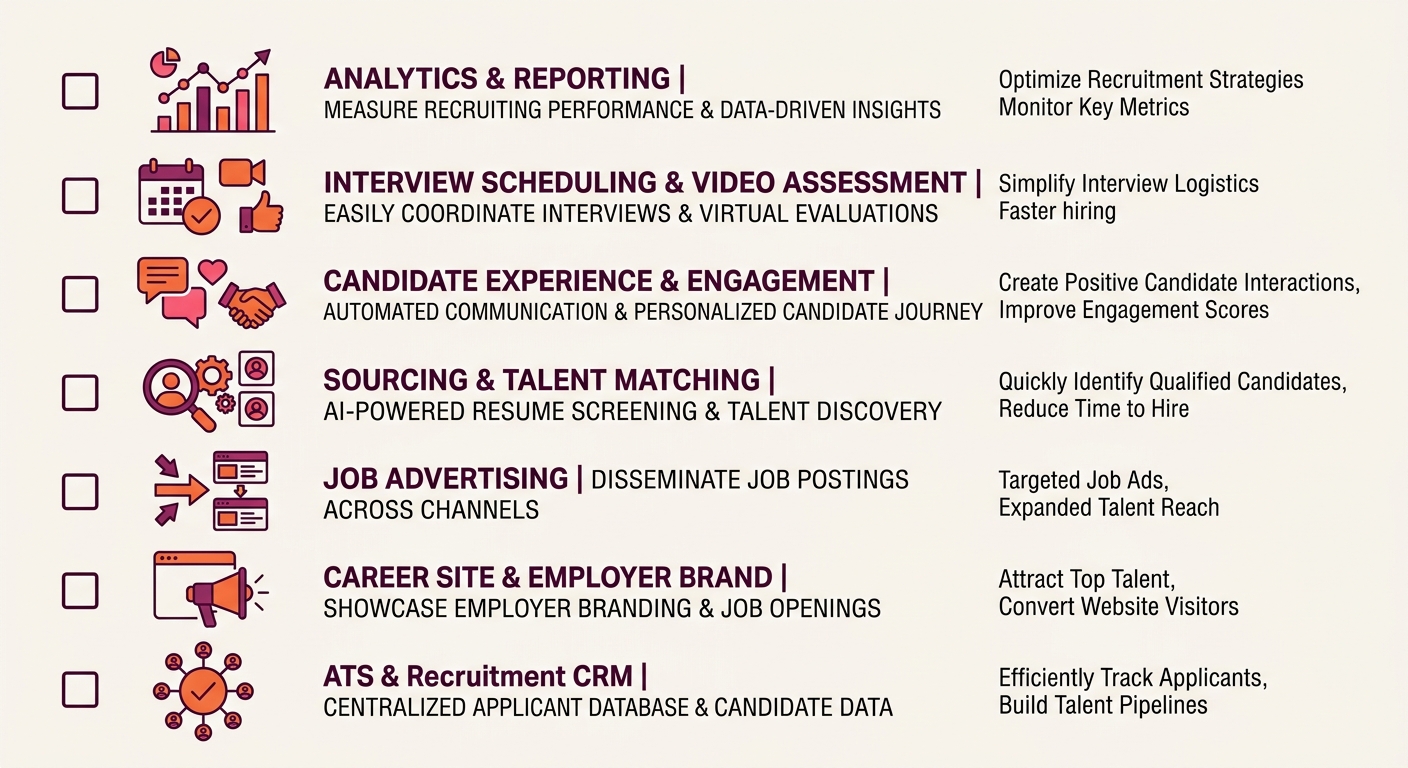
Here’s where the recruitment marketing tech stack has settled for well-run in-house teams. The organizing principle that’s emerged is what practitioners call “1 Core + 2 Enablers”: an ATS/CRM core paired with specialized tools for sourcing and scheduling.
| Stack Layer | What It Does | Example Tools (2026) | Integration Priority |
|---|---|---|---|
| ATS/CRM Core | Application tracking, candidate nurturing, pipeline management | Ashby, Greenhouse, iCIMS, Lever | Foundation: everything connects here |
| Sourcing & Outreach | AI-powered candidate discovery, outbound sequences | SeekOut, HireEZ, Gem, Loxo | Must sync bi-directionally with ATS/CRM |
| Recruitment Marketing Platform | Careers site, content distribution, event management | SmartDreamers, TalentLyft, Workable | Feeds candidates into CRM nurture tracks |
| Employer Branding Tools | Employee advocacy, social proof, review management | Dsmn8, Jobylon, Glassdoor tools | Connects to careers site and job distribution |
| Scheduling & Coordination | Interview scheduling, panel coordination, candidate comms | GoodTime, Paradox Olivia, Calendly | Calendar + ATS integration essential |
| Assessment & Verification | Skills testing, fraud detection, credential checks | Codility, HackerRank, Vervoe | Results must flow into ATS candidate profiles |
| Analytics & Reporting | Pipeline velocity, source attribution, DEI compliance | Built-in ATS reporting, Visier, Datapeople | Pulls from all layers |
A few things stand out. First, the CRM for recruiting function has increasingly merged back into the ATS for in-house teams, even as it remains separate for staffing agencies. Platforms like Ashby and the newer versions of Greenhouse now ship with native CRM capabilities that handle talent pooling and nurture sequences without requiring a separate tool.
Second, employee referral programs remain the highest-ROI source channel and deserve their own tooling consideration, whether that’s a native ATS module or a dedicated platform like Jobvite’s referral engine.
Third, fraud detection is now a required stack layer. With 30–50% candidate misrepresentation rates in tech hiring and AI-generated fake resumes appearing in 72% of recruiter application pools, skills-based assessment tools have moved from nice-to-have to mandatory.
Warning: If your stack can’t produce a unified audit trail across all AI-assisted hiring decisions, you have a compliance gap. California and Illinois regulations require documentation at every automated decision point.
Where This Lands Now
The recruitment marketing tech stack for in-house teams has gone through roughly four phases in six years: the ATS-only era, the CRM breakout, the AI tool explosion, and the compliance-driven consolidation that defines 2026. Connected stacks now deliver approximately twice the ROI of siloed systems by improving conversion rates at every pipeline stage, according to industry benchmarking data.
The pattern that’s emerged favors fewer tools with deeper integrations over more tools with shallow connections. Teams that got programmatic job advertising right, for example, did so by connecting their ad platforms directly to ATS source-attribution data, so they could see which channels produced hires rather than which channels produced clicks.
If you’re building or rebuilding your talent acquisition software checklist for the second half of 2026, the honest advice is to start with your ATS/CRM core and get the integration architecture right before adding anything else. Every tool you add to a broken foundation multiplies the mess. Every tool you add to a solid one multiplies the value. The teams doing this well aren’t the ones with the most HR marketing tools in 2026. They’re the ones where data moves between tools without a human copying and pasting it.