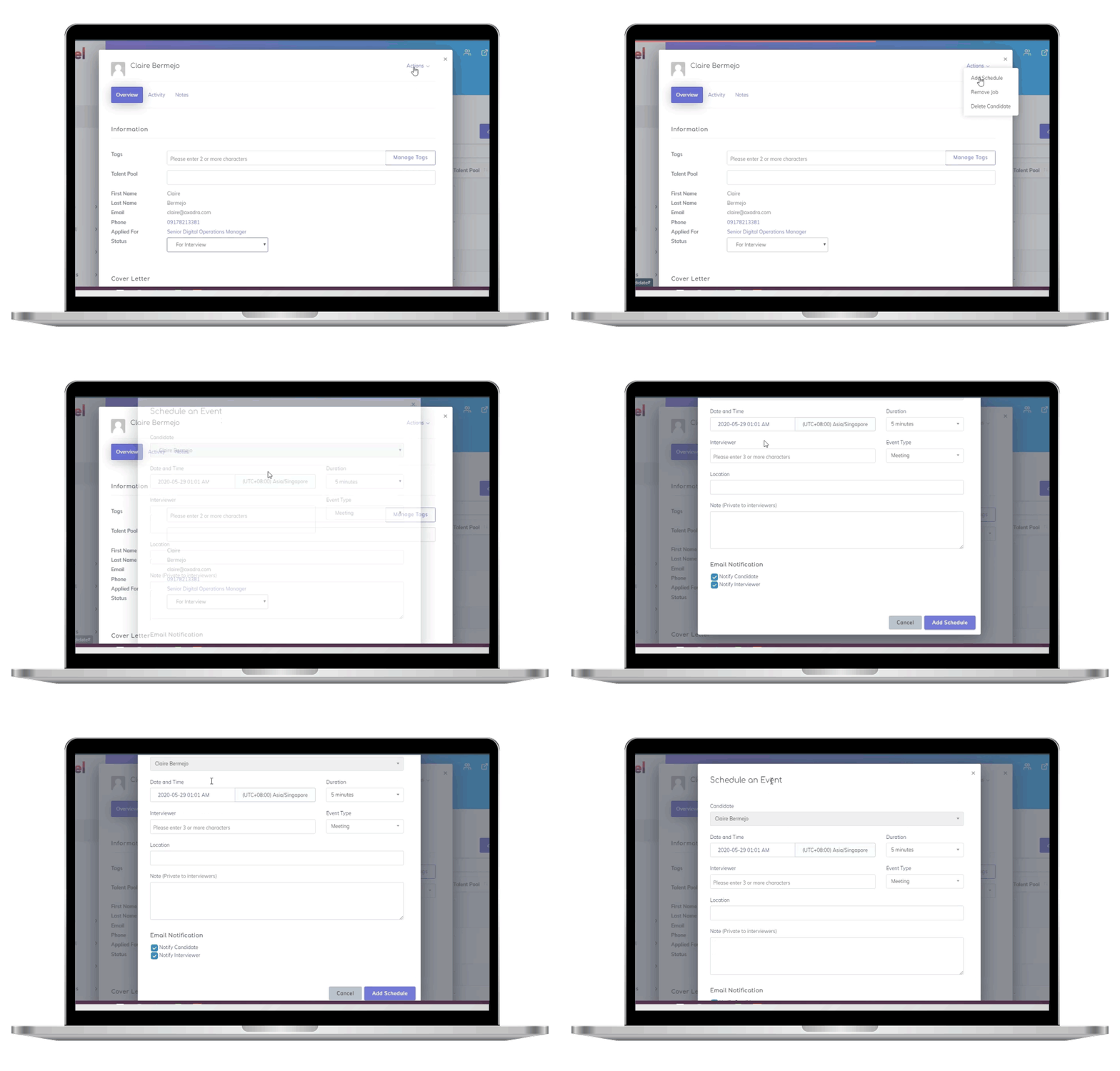

Recruiters spend 42% of their week scheduling interviews. That’s nearly half their time lost to emails and calendar coordination. Tools like Skillfuel automate this process, cutting scheduling time to under 24 hours and reducing time-to-hire by up to 50%. Here’s how automation simplifies recruitment:
- Scheduling Automation: Real-time calendar syncing eliminates back-and-forth emails, even for panel interviews.
- Candidate Communication: Automated updates and reminders keep candidates informed, reducing no-show rates.
- Streamlined Screening: AI ranks applicants based on skills and experience, saving days on manual reviews.
- Centralized Dashboards: All feedback and data in one place speeds up decision-making.
Companies like Southwest Airlines saved 3,000+ hours by automating interviews, proving how automation transforms hiring into a faster, more efficient process.
Which Interview Scheduling Software Optimizes Recruitment?
How Automated Scheduling Saves Time
Manual scheduling is a major time drain. Recruiters often spend 30 to 60 minutes per candidate just arranging schedules, and around 35% of their total time is consumed by interview coordination alone. By automating this process, you can eliminate the back-and-forth emails and cut scheduling time down to almost nothing.
Coordinating panel interviews is even more demanding. Aligning calendars for multiple interviewers can take up to 5 hours per hire. In 2023, Beacon Health System adopted automated scheduling, which completely removed the need for recruiter involvement in managing logistics. As the HireVue Team observed:
"Having [automated scheduling] has drastically cut back on our recruiter’s scheduling time–giving them time to focus on candidates, not calendar logistics."
– HireVue Team
Similarly, a global tech company that implemented automated scheduling in 2024 saw their time-to-hire drop by 37% and saved recruiters an average of 4 hours per week that was previously spent juggling calendars. Speed matters – 48% of candidates abandon hiring processes due to slow scheduling or delayed responses. Automation addresses this by reducing scheduling delays from days or weeks to under 24 hours, ensuring candidates stay engaged.
Real-Time Calendar Integration
Automation tools like Skillfuel take time savings to the next level with real-time calendar syncing. It integrates seamlessly with Google Calendar, Outlook, and Office 365 to show only truly available slots. This two-way sync prevents double-bookings and ensures up-to-date availability. Once a candidate picks a time, the system instantly sends calendar invites and meeting links to all participants.
Skillfuel doesn’t stop at simple scheduling. It overlays multiple internal calendars to set up panel interviews in seconds, adjusts for candidate time zones, and even tracks room availability for in-person or virtual meetings. For global hiring, the time-zone adjustment is a game-changer, displaying options in the candidate’s local time to avoid confusion or missed appointments. Smart buffers of 15 to 30 minutes can also be set before and after interviews, giving interviewers time to recharge and recap. These features directly address delays and candidate drop-offs caused by inefficient scheduling.
Automatic Scheduling Updates
Last-minute changes? Automated systems handle them effortlessly. Candidates receive personalized links to reschedule themselves, and the system updates all calendars and notifies the team automatically. This self-service feature eliminates the need for endless follow-up emails.
Skillfuel also supports alternate interviewer assignments. If the primary interviewer becomes unavailable, the system suggests backups based on skills and availability. Automated reminders, sent via email and SMS 24 hours and 1 hour before interviews, significantly reduce no-show rates. In fact, 70% of job seekers now expect online scheduling options like this as the norm. This level of automation ensures a smoother, faster process for everyone involved.
Automating Candidate Communication and Screening
Keeping candidates informed shouldn’t eat up hours of your day. Recruiters often find themselves bogged down by sending updates, answering questions, and sorting through endless applications. Automation steps in as a dependable virtual assistant, taking care of communication and screening tasks without requiring constant attention. Here’s how automated updates and pre-screening tools can simplify these processes.
Automated Candidate Status Updates
Skillfuel ensures candidates stay informed throughout the hiring process by sending automated emails at key milestones – whether it’s acknowledging an application, notifying them of screening results, scheduling interviews, or informing them that a position has been filled. This transparency matters: 83% of candidates report a better experience when employers provide a clear hiring timeline.
The platform also integrates real-time calendar syncing and ATS updates, giving you full visibility into interview schedules and progress. Plus, its centralized dashboard consolidates all feedback and ratings in one place. With a Kanban-style interface, you can easily organize candidates and spot any delays in the pipeline.
Pre-Screening with Automated Tools
Automation doesn’t stop at updates – it also helps narrow down the applicant pool to save time. With an average of 250 applications per job opening, manual screening can quickly become overwhelming. Skillfuel’s AI streamlines this process by ranking candidates based on factors like skills, experience, and location. This ensures you focus your attention on the most qualified applicants, making the hiring process faster and more efficient.
Improving Team Collaboration and Decision-Making
Say goodbye to endless email chains and meeting marathons when making hiring decisions. When interview feedback is scattered across inboxes or buried in separate documents, teams waste precious time hunting for details instead of focusing on candidates. Centralized tools solve this by bringing all interview data into one easily accessible location, making decisions faster and more efficient. Let’s dive into how centralized dashboards and streamlined review tools can transform collaboration.
Centralized Dashboards for Interview Data
Skillfuel’s centralized dashboard organizes interview notes, feedback, and evaluations into one Kanban-style platform, giving hiring teams a clear view of each candidate’s progress. No more digging through email threads or chasing updates from colleagues – managers can instantly spot bottlenecks and address them.
This approach saves time in a big way. For instance, 59% of recruiters using automated scheduling report saving between 2 to 10 hours every week. That’s extra time that can be spent on strategic candidate evaluations rather than administrative tasks. With features like real-time calendar syncing and ATS integration, everyone on the team stays on the same page, avoiding the confusion caused by outdated information.
Faster Post-Interview Reviews
Centralizing data is just the start. Speeding up post-interview evaluations is another game-changer. Skillfuel’s shared scorecards and collaborative notes allow teams to capture standardized ratings and comments immediately after interviews, cutting out the need for separate review meetings. By recording feedback while impressions are still fresh, and with automated reminders ensuring timely assessments, the process becomes much smoother.
The results speak for themselves. AI-driven interview automation can slash time-to-hire by up to 50%, while delivering a return on investment of up to 300%. When team members can review scorecards simultaneously, reaching a consensus becomes quicker, enabling qualified candidates to move through the pipeline without unnecessary delays.
sbb-itb-e5b9d13
Reducing Time-to-Hire with Integrated Workflows
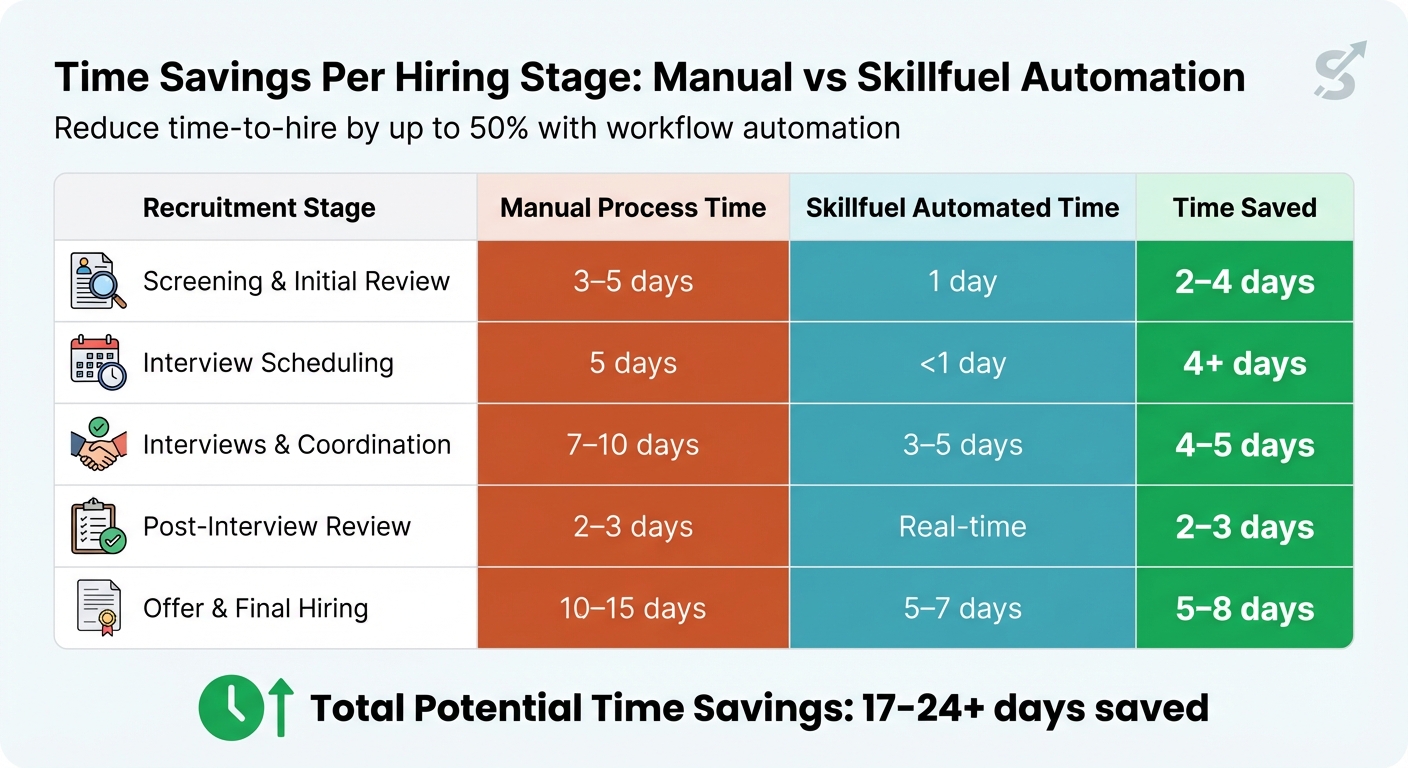
Time Savings Comparison: Manual vs Automated Recruitment Process
Streamlined workflows across hiring stages can save a significant amount of time. Skillfuel’s integrated approach ties together screening, scheduling, interviews, and decision-making, cutting out delays caused by juggling disconnected tools. Each step flows smoothly into the next, keeping the process moving without unnecessary pauses.
Time Savings Per Hiring Stage
Let’s break down how much time can be saved at each stage of the hiring process. Traditional manual screening often takes 3–5 days as recruiters sift through resumes individually. With Skillfuel’s automated filtering and visual Kanban boards, this step is shortened to just 1 day. Similarly, scheduling interviews manually can take up to 5 days due to back-and-forth emails. Skillfuel’s real-time calendar integration allows candidates to book interview slots almost instantly, reducing this step to less than a day.
| Recruitment Stage | Manual Process Time | Skillfuel Automated Time | Time Saved |
|---|---|---|---|
| Screening & Initial Review | 3–5 days | 1 day | 2–4 days |
| Interview Scheduling | 5 days | <1 day | 4+ days |
| Interviews & Coordination | 7–10 days | 3–5 days | 4–5 days |
| Post-Interview Review | 2–3 days | Real-time | 2–3 days |
| Offer & Final Hiring | 10–15 days | 5–7 days | 5–8 days |
These time reductions at each stage work together to create a faster, more efficient hiring process.
End-to-End Workflow Integration
When these savings are combined, they transform the entire hiring process. Skillfuel ensures that every stage is connected through automated alerts, real-time status updates, and a centralized dashboard. For example, once a candidate completes the screening stage, the system automatically triggers the next step – scheduling – without requiring manual input. This eliminates bottlenecks, keeps candidates engaged, and ensures hiring managers receive timely updates and feedback.
A great example of this in action comes from The Saxton Group. By integrating AI-driven screening with automated scheduling, they cut application times from 15 minutes to just 3 minutes and saved over $1 million in hiring costs. Removing manual steps between stages not only speeds up the process but also keeps candidates involved and allows hiring teams to make quicker, well-informed decisions based on real-time data.
How to Implement Interview Workflow Automation with Skillfuel
You don’t need to overhaul your current process to start using Skillfuel. The platform is designed to integrate quickly, allowing you to automate key tasks right away. The trick is setting it up correctly, training your team on the most impactful features, and keeping an eye on the results to demonstrate its value. Here’s a guide to getting Skillfuel up and running for your recruitment process.
Setting Up Skillfuel for Automation
Skillfuel can streamline critical recruitment tasks, saving your team time and effort. Start by syncing the platform with your Gmail or Outlook calendars to avoid double-bookings and show only available time slots. Next, configure interview calendars by setting up alternate interviewer rules and ensuring room availability is accounted for. Skillfuel’s AI-powered matching feature can automatically assign interviewers based on their skill sets and other attributes.
Take advantage of automated templates for interview invites, confirmations, and reminders. You can personalize these messages with tokens like {candidate_first_name} to keep communication professional yet personal. To help your team stay on track, add 15-30 minute buffers before and after interviews for debriefing and note-taking. Finally, make sure Skillfuel is set to sync seamlessly with your Applicant Tracking System (ATS) once a candidate selects a time. This step centralizes your data and eliminates manual data entry.
Training Recruitment Teams
Once the system is configured, the next step is to train your team. While Skillfuel is user-friendly, it’s essential to show your team how to fully leverage its features. Teach them to use the centralized dashboard for logging candidate ratings and comments – this eliminates the need for long email threads and speeds up decision-making. Walk them through the AI-powered interviewer selection process and how to tailor automated communication templates to align with your company’s tone.
For panel interviews, demonstrate how to use collective scheduling rules to find mutual availability across multiple calendars. Before starting training, identify your current bottlenecks – like delays in hiring manager availability or coordinating complex interview panels – so your team can see exactly how automation addresses these issues. Also, implement automated debrief triggers to capture immediate feedback after interviews.
Emily Giltner, Senior Vice President at Staffmark Group, highlights the benefits of automation:
"With automation, we are able to adjust to their preferred timings very easily. Candidates who engage with a bot schedule within 28 minutes." – Emily Giltner, Senior Vice President at Staffmark Group
Measuring ROI from Time Savings
The efficiency gains from Skillfuel’s automation are measurable and impactful. Track the time saved per applicant – automation can save up to 50 minutes per candidate. Multiply this by your monthly hiring volume to calculate the total hours freed up for more strategic tasks. Aim to reduce the time it takes to schedule an interview to under 24 hours from initial candidate interest and work toward lowering no-show rates to below 5%.
Cost reductions are another key metric. Automation can cut cost-per-hire by 20–40% and reduce time-to-hire by over 30%. Survey candidates about their scheduling experience to ensure it’s seamless and clear, aiming for a satisfaction rate above 90%. For example, one tech company reported a 15% increase in its candidate Net Promoter Score (NPS) within six months of automating its scheduling process. Use Skillfuel’s centralized dashboard to monitor how quickly your team makes hiring decisions compared to your previous manual system. These insights will help you fine-tune your process and maximize the platform’s benefits.
Conclusion
Automating interview workflows is reshaping how recruitment teams operate. Tools like Skillfuel handle tasks like scheduling, communication, and feedback collection, freeing up 2–10 hours per week for recruiters. That extra time can be directed toward more impactful activities, such as evaluating candidates and building stronger relationships.
The benefits go beyond just time savings. AI-powered automation can cut time-to-hire by as much as 50% and deliver a return on investment (ROI) of up to 300%. One company even managed to save over $1 million by reducing ad spend and streamlining manager involvement. These kinds of results allow HR teams to focus on what truly matters – strategic decision-making and improving the candidate experience.
Automation also meets the demands of today’s HR professionals by offering scalability without compromising on quality. Centralized dashboards help eliminate the clutter of endless email threads, while real-time calendar integrations ensure seamless scheduling without conflicts. Case studies from top organizations highlight how automation significantly reduces scheduling hours while increasing interview capacity, making it a powerful tool for modern recruitment.
FAQs
How does automating interview workflows enhance the candidate experience?
Automating interview workflows streamlines the hiring process, making it quicker and more accommodating for candidates. With self-scheduling options, candidates can pick interview slots that fit their availability, cutting out the endless back-and-forth of coordinating times. This not only saves time for everyone involved but also demonstrates respect for the candidates’ schedules, leaving them with a strong impression of your company.
Automation also minimizes common issues like double bookings or missed communications. Features such as automated reminders and notifications ensure candidates stay informed and engaged throughout the process. The result? Fewer no-shows, faster hiring timelines, and a more polished and organized experience overall. By simplifying the journey for candidates, automation enhances satisfaction and strengthens your employer brand.
How does Skillfuel help speed up the hiring process?
Skillfuel takes the hassle out of hiring by automating tasks that often eat up recruiters’ time. Take its automated interview scheduling feature, for instance. It syncs calendars, sets up interviewer availability, and allows candidates to self-schedule their interviews. This eliminates the endless back-and-forth emails and avoids scheduling mishaps, freeing up recruiters to focus on more critical tasks.
On top of that, Skillfuel simplifies candidate communication. With tools like pre-built email templates, automated reminders, and SMS updates triggered by changes in an applicant’s status, staying in touch is effortless. These features ensure candidates are always informed and engaged without requiring constant manual input.
By cutting down on repetitive tasks and boosting efficiency, Skillfuel allows recruiters to spend their time where it truly counts – connecting with top talent and filling roles faster.
How can businesses calculate the ROI of using Skillfuel for recruitment?
Businesses can determine the ROI of using Skillfuel by tracking metrics like time saved, cost savings, and better candidate experiences. For example, automating tasks such as interview scheduling can cut down the time-to-hire, allowing recruiters to spend more energy on strategic priorities.
Cost savings come from areas like reduced administrative expenses, fewer no-shows due to automated reminders, and less reliance on manual workflows. On top of that, faster communication and smoother processes often lead to happier candidates, which can be a powerful qualitative indicator of success.
Skillfuel’s centralized dashboards simplify the process of monitoring these metrics over time, giving organizations a clear view of their efficiency improvements, hiring results, and overall ROI.